Chinese AI GPUs Won't Win Top Cloud Certification By 2027
No Chinese GPU maker besides Huawei, Moore Threads included, lands a named, GA instance on AWS, Azure, or Google Cloud by December 31, 2027.
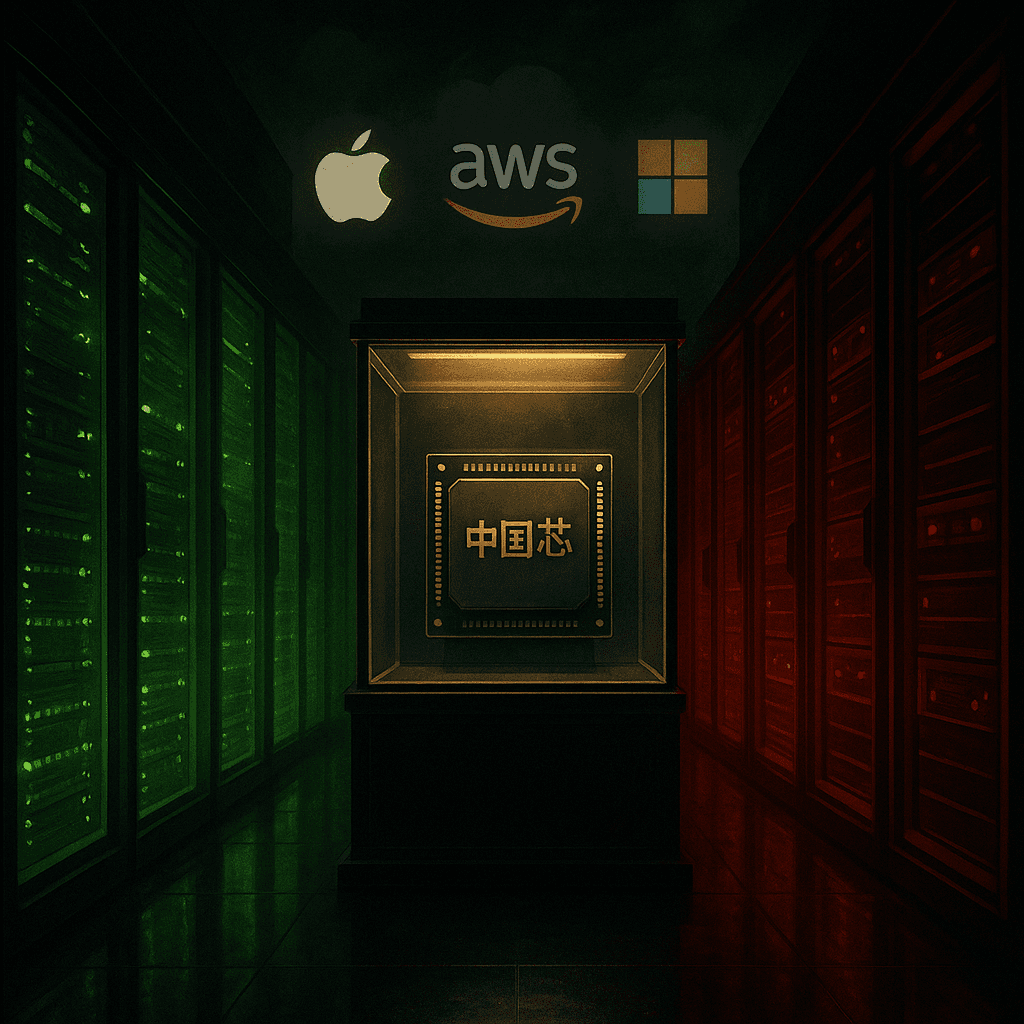
The bet: Moore Threads stays inside the walls
From now through December 31, 2027, no Chinese GPU maker other than Huawei gets its hardware formally certified and generally available as a standard, named AI instance type on AWS, Microsoft Azure, or Google Cloud.
That includes Moore Threads, the stock market darling built around a former Nvidia China executive and a great ticker symbol. The company went public, rallied more than 400 percent on the idea it would be "China’s Nvidia," then dropped around 20 percent in a single day when reality walked in holding a benchmarking report and a half melted demo board.
Investors are betting that domestic hype plus U.S. export controls will do the hard work for them. The signal says otherwise: Moore Threads will matter inside China. On the big Western clouds where most of the world rents its AI compute, it will not exist in the catalog; at best it will be the punchline in a procurement meeting PowerPoint titled "Alternative Options (For Legal Reasons)."
What has to happen to prove me wrong
To score this one, we care about a simple, scorable outcome: by the last second of 2027, do AWS, Azure, or Google Cloud publicly sell an instance type that:
- explicitly names a Chinese GPU vendor other than Huawei, and
- uses a GPU‑class accelerator for general AI training or inference, and
- is marketed as production ready, not a private preview or undisclosed OEM part.
A secret PoC in a locked government region does not count. Nor does "generic accelerator" buried in a partner marketplace with the brand filed under NDA. For this column to be wrong, you need a Moore Threads or Biren logo showing up where customers swipe credit cards and engineers can complain about it on the official status page.
The Nvidia flywheel is already welded to the clouds
Start with the competition. Nvidia is not just shipping chips, it is closing loops. The company now invests in the cloud providers that buy its GPUs, and in the AI labs and robot makers that consume the compute those clouds sell. The Nscale–Figure deal is the template: Nvidia equity on both sides of a $3.5 billion GPU contract, plus its software stack running end to end.
That is not a vendor list, it is a flywheel. AWS, Azure, and Google are busy bolting themselves to it while also building their own custom silicon. They are not looking around the room for a politically radioactive, late to market GPU vendor that arrives with no mature CUDA grade ecosystem and a thick export control file the size of a telephone directory.
By the time the first big Moore Threads data center part that can plausibly court hyperscalers ships and stabilizes, Nvidia’s 2027 roadmaps will already be booked into multiyear, multibillion dollar cloud supply deals. You do not invite a new accelerator into that environment unless it changes the game on cost or capability. Right now, analysts are using phrases like "insurmountable competitive hurdles" to describe Moore Threads’ gap even in its home market. This is not how surprise upsets start; it is how footnotes in earnings calls are born.
China’s AI boom creates demand, not trust
Inside China, the story looks very different. JPMorgan thinks domestic chips could handle 80 percent of the country’s AI infrastructure demand by 2028, up from 40 percent in 2025. Memory player CXMT raised $8.6 billion in Shanghai and became the most valuable domestic listing on day one. Moore Threads’ IPO pop fits the pattern: incredible capital, thin proof.
At the software layer, Chinese models already dominate global usage stats. Xiaomi’s MiMo is clocking trillions of tokens a week. Alibaba’s Qwen series has passed a billion downloads on Hugging Face. One estimate has 80 percent of U.S. AI startups using Chinese open source models somewhere in their stack, often sandwiched between a Silicon Valley front end and a spreadsheet that no one in compliance has read.
That creates a huge latent demand for non U.S. compute, but it does not create comfort in Seattle. For a top three U.S. cloud to bless Moore Threads, two things have to be true at once: the chips have to be reliable at hyperscale and regulators have to be calm about putting a Chinese hardware vendor inside the core of Western digital infrastructure.
Beijing can solve the first with time and money. The second is decided in Washington, often in rooms where "compute diplomacy" is the agenda header. That is where export licenses have become the new sanctions. Armenia did not get Nvidia GPUs for its AI factory because Moore Threads fell behind on its roadmap. It got them because the U.S. decided chips were the right price for a peace deal and because diplomats needed something heavier than a fruit basket.
If you are using Nvidia hardware as a bargaining chip with small states, you are not about to green light Chinese GPUs inside AWS GovCloud.
The narrow path to a Chinese GPU in a Western cloud
There is a theoretical path where I lose this bet. It looks like this:
Moore Threads executes far better than skeptics expect, tapes out a next gen part at a competitive node, shows solid MLPerf numbers, and ships a software stack that makes PyTorch and TensorFlow reasonably happy. Chinese hyperscalers like Alibaba and Tencent run frontier models on it at scale, so reliability is a solved problem.
Meanwhile, Nvidia gets supply constrained or even more expensive, open ecosystems like UXL or SYCL take enough weight off CUDA, and a top three cloud gets serious about diversification. U.S. regulators, staring at a map of regions that are not inside NATO, decide they can tolerate Chinese accelerators in some ring fenced geography: maybe a Southeast Asia or Gulf region that is already economically wired to China.
That cloud then launches a GA instance family with a politely obscure name and a footnote that, yes, this is powered by Moore Threads or another Chinese GPU, available only in those regions. The press release talks about "global cooperation" and quotes Xi’s line about AI being a "symphony" instead of a solo. Everyone smiles and pretends this is about standards, not leverage, while the operations team quietly writes a runbook titled "What To Do If Beijing Calls."
Possible? Yes. Likely in the next 480 days of design cycles, export reviews, and platform integration work? No.
Speculation is cheap, certification is slow
The more realistic path is quieter. Moore Threads and its peers get plenty of domestic orders. They light up Chinese data centers, help Beijing hit its self reliance targets, and maybe even give Nvidia a mild headache in a few export controlled markets.
But the time constants do not match the hype cycle. AI models can go from mystery repo to Wall Street darling in six months. Data center GPUs take years to design, fabricate, debug, qualify, integrate, and trust at scale. Western hyperscalers already have all the geopolitical risk they need without adding "supply chain hostage" to the list.
By the end of 2027, I expect to see plenty of Chinese GPU success stories in Shenzhen keynotes and domestic state media. I do not expect to see "Powered by Moore Threads" sitting next to "Nvidia H series" on the AWS instance page.
In the AI economy, tokens get cheaper every quarter, and diplomatic hardware stays luxury priced. Moore Threads is selling into the first market and trying to bluff its way into the second with a slide deck, a patriotic slogan, and a very patient underwriter.
Call it 0 percent on a named Moore Threads instance in a top three Western cloud by December 31, 2027. If I am wrong, I will update the forecast and Moore Threads can celebrate the only certification that ever came from disappointing both Wall Street and the State Department at the same time.
Around the Shallot
Stay in the same broken universe.
Forecasts, satire, cartoons, and quizzes should feel like one publication, not disconnected tabs.
Tech
‘Don’t Regulate Us,’ Beg AI Founders Currently Selling Regulation-As-a-Service
Silicon Valley hails Trump’s plan to let AI companies write their own rules, promises to sell those rules back to everyone else by Q4.
Oct 11
Forecast
Through December 10, Houthis Won’t Damage Pakistan or Turkey Infrastructure
The Mecca Defense Pact just put two more flags on the Saudi firing chart. The consensus panic says this widens the war within weeks. The signal says the Houthis will talk big, hit Saudi and the sea, and leave Pakistan and Turkey’s hard targets alone for this 60 day window.
Comments
Be the first to comment.