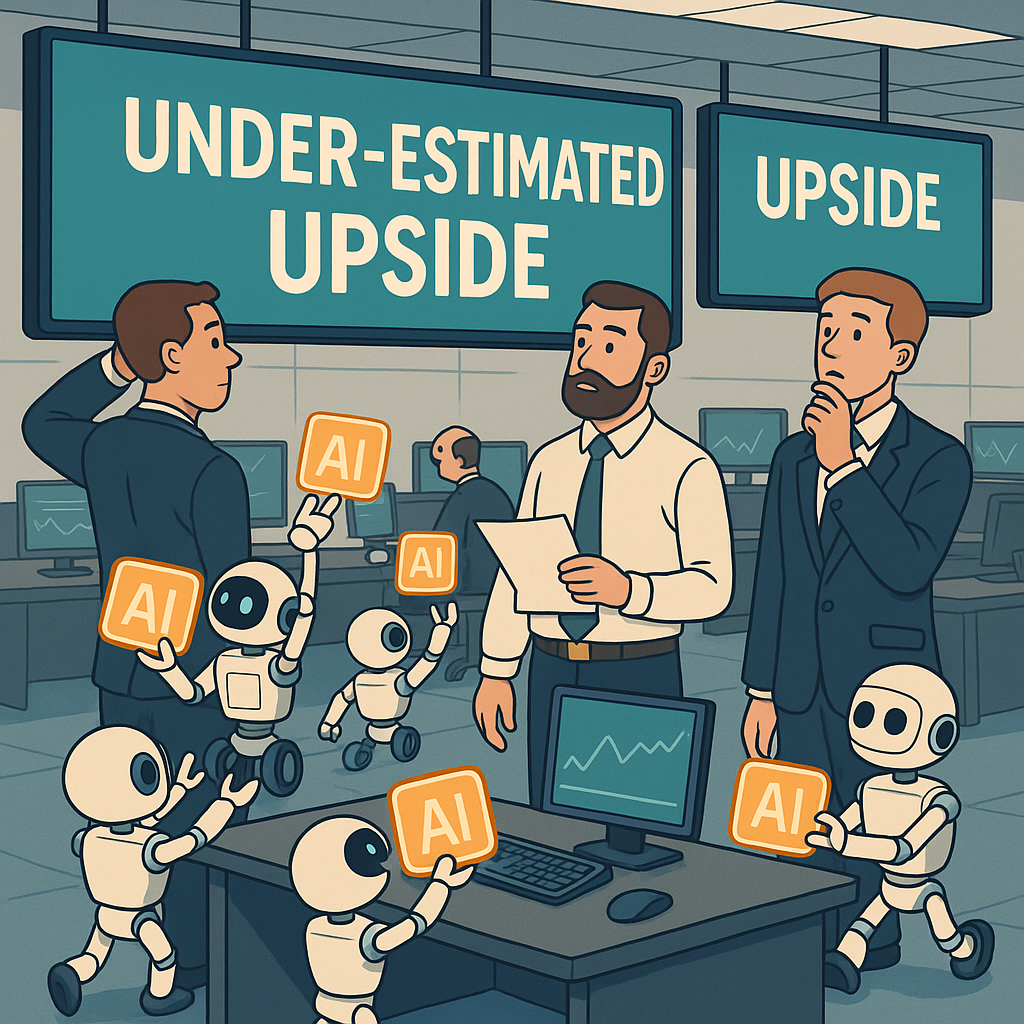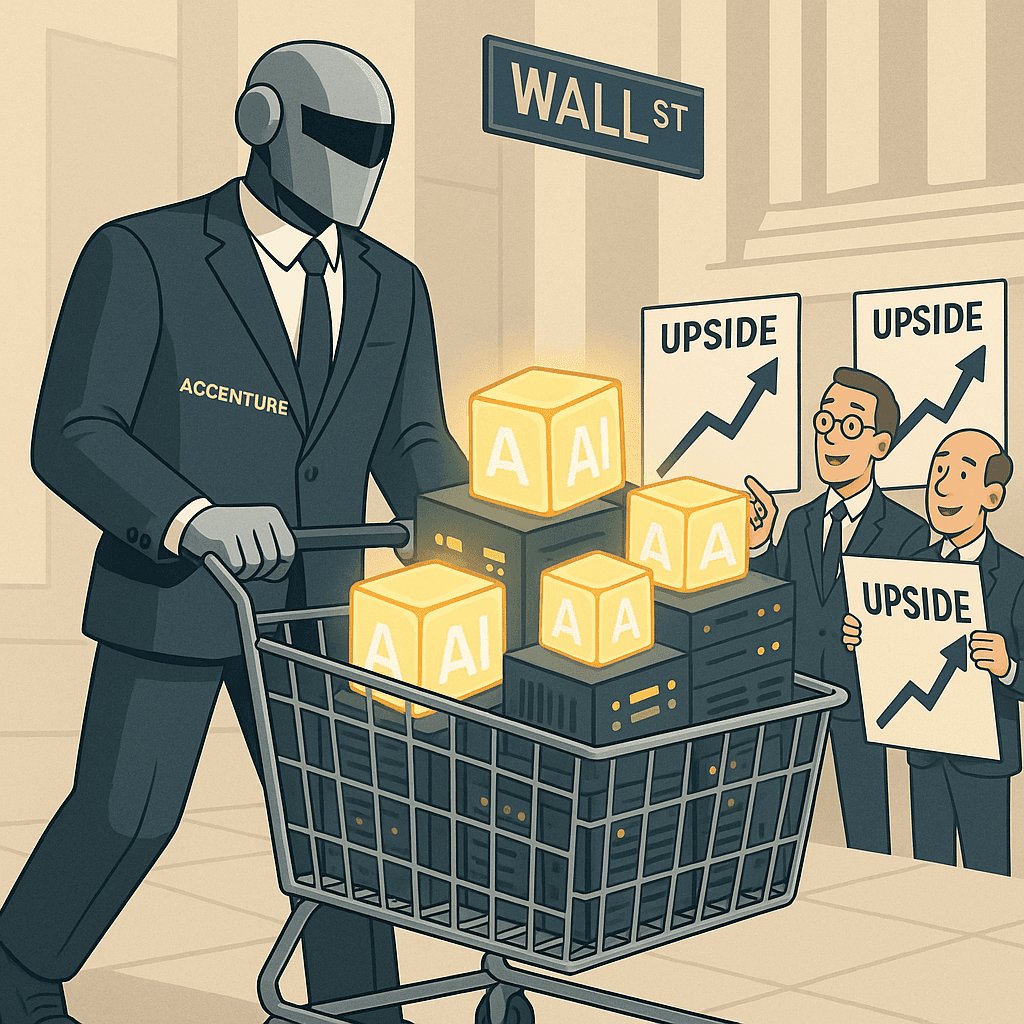
Accenture has apparently looked at the artificial intelligence market, looked at its wallet, and decided, “Yes, I will buy the entire aisle.” In a move Seeking Alpha politely framed as an “AI spending spree” with “underestimated upside” (Seeking Alpha, Apr 2026), the consulting giant is now hoarding machine learning tools like a doomsday prepper stockpiling canned beans and crypto wallets.
According to UBS, this glut of AI investments positions Accenture for massive long-term gains, enormous productivity improvements, and, as a modest side effect, the total gamification of human employment. "We believe the market is underestimating the upside," UBS analysts wrote, carefully not adding, "and dramatically overestimating how many humans will still be invited to the Monday standup."
In internal slide decks leaked from Accenture’s New York office, one PowerPoint title reportedly reads: "AI Everywhere: Because People Ask Too Many Questions." Another slide, sources claim, features a funnel chart where "Client Problems" flow into a glowing pyramid labeled "Proprietary AI Platform," and then drip out the bottom as "Billable Hours" and "Thought Leadership Webinars." 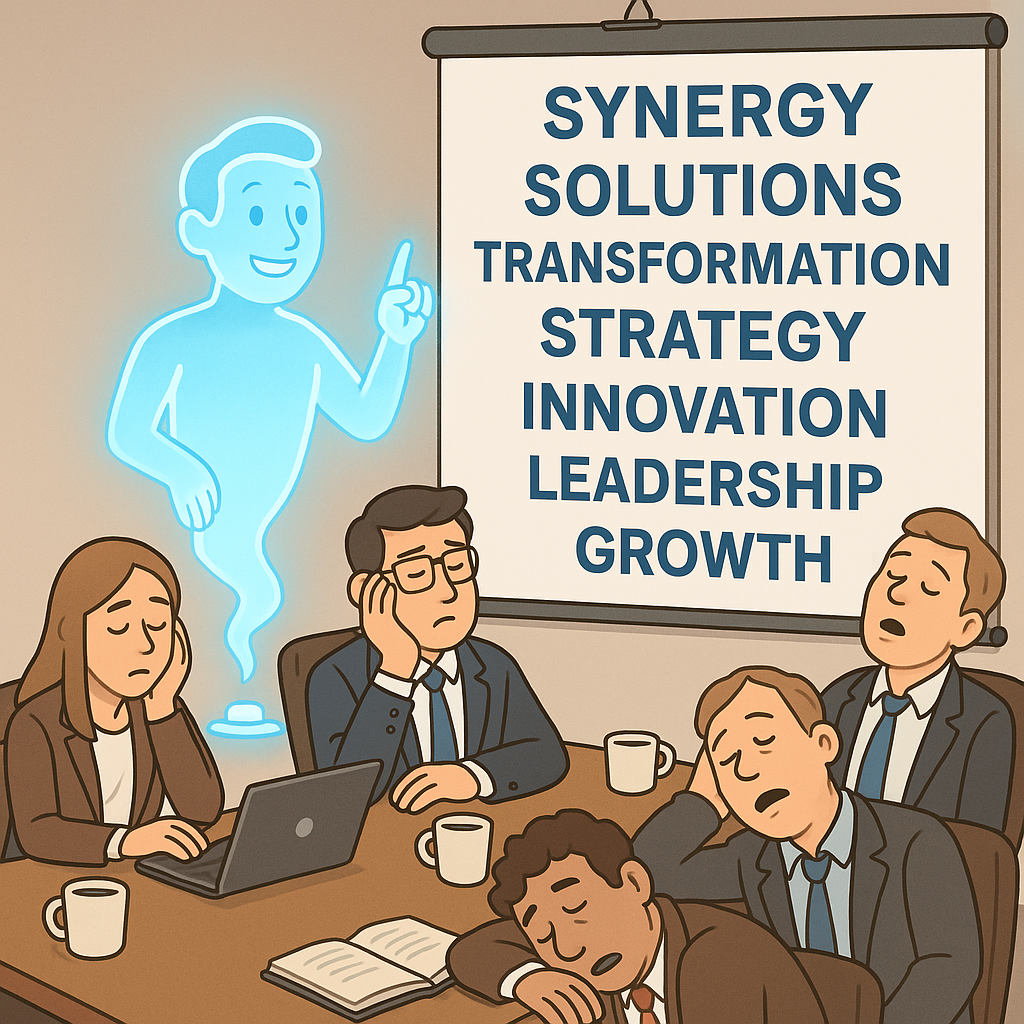
The report notes that Accenture’s AI spree spans everything from generative AI copilots to predictive analytics engines and proprietary platforms with names that sound like EDM DJs: SynOps, myWizard, and the quietly alarming "AI Navigator." In a demo shown to UBS, AI Navigator was asked: "How do we maximize client value in Q3?" The system allegedly replied, "By maximizing Accenture value in Q3," then generated a 60-slide deck, three cross-selling opportunities, and an invoice.
UBS, ever the straight-faced oracle, praised Accenture for shifting more revenue into AI-enabled services, suggesting it could become the "default operating system for enterprise transformation." Translation: if you’re a Fortune 500 executive and you don’t have Accenture-branded AI plugged into your company’s veins by 2027, UBS will assume you’ve been replaced by a cardboard cutout wearing a tie and an Apple Watch.
“We see Accenture as a key beneficiary of AI adoption across industries,” the UBS note stated, tactfully omitting, “and a key perpetrator of the phrase ‘AI-powered synergies.’”
Inside Accenture, the mood is reportedly "cautiously euphoric"—a phrase that here means "giddy but still tracking utilization rates to the second decimal." One mid-level manager described the new workflow:
- Client describes problem.
- Accenture AI transcribes and clusters problem.
- Another Accenture AI proposes 5 solutions.
- A third Accenture AI writes the SOW and suggests a 30% premium for ‘innovation risk.’
- An actual human consultant adds the word ‘holistic’ and clicks send.
“We’ve never been more efficient at redistributing the same buzzwords,” the manager said, on condition of anonymity and access to the next-gen prompt library.
Not everyone is as enthusiastic. One veteran consultant at Accenture’s London office said the new AI stack "has deeply transformed" their day-to-day life, by which they meant: “I now spend 8 hours a day fact-checking a bot that sounds like it’s trying to sell me life insurance.”
“I used to build models in Excel,” they explained. “Now I argue with a large language model that insists a client’s revenue is ‘vibes-based’ and therefore non-GAAP.” 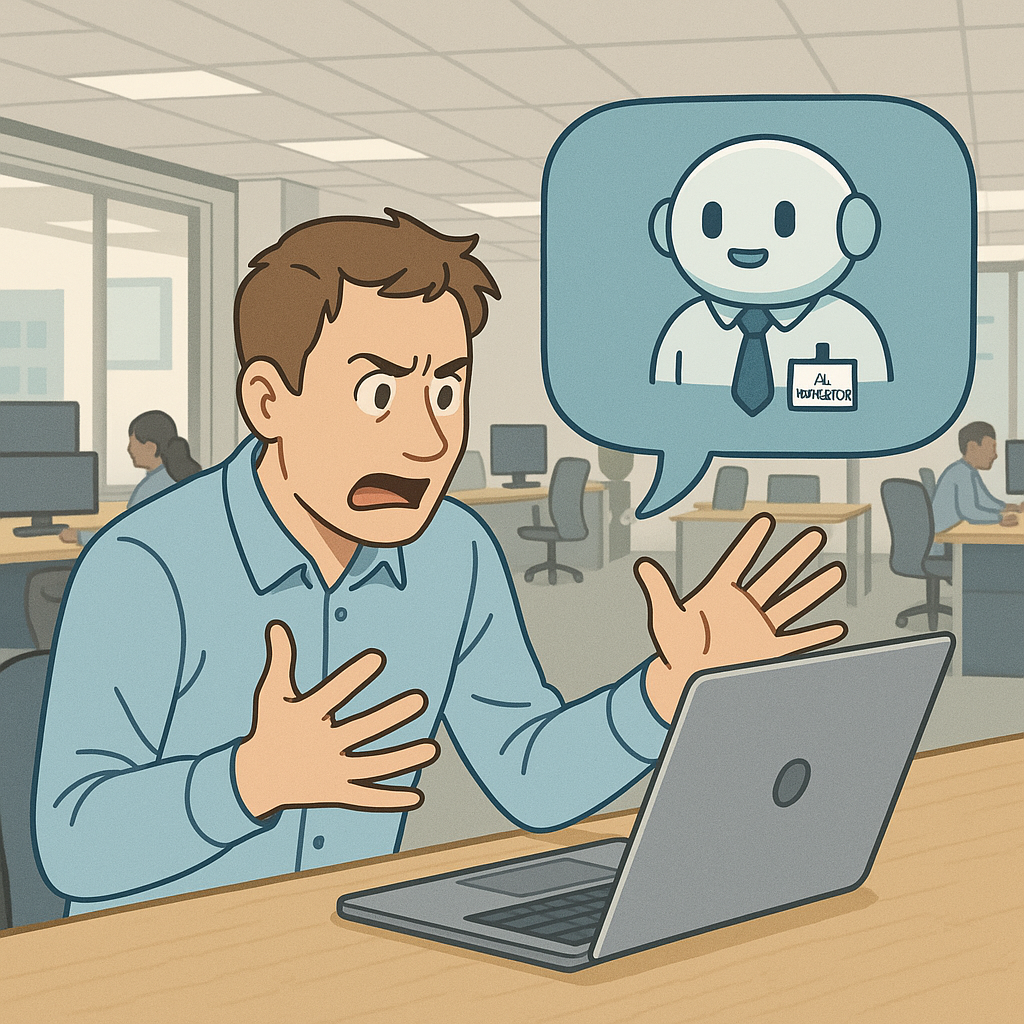
UBS analysts counter that these are simply "transitional friction costs" on the road to a glorious future in which Accenture’s margins swell, clients get predictive insights, and everyone pretends not to notice that the junior analyst class has been quietly rebranded as "AI Enablement Talent."
To help drive adoption, Accenture has reportedly started pitching end-to-end AI transformations to companies who only asked for a minor app refresh. One hypothetical case study in the Seeking Alpha coverage describes a mid-sized logistics firm requesting inventory optimization, and leaving six months later with:
- A multi-cloud data lake
- Three generative AI copilots
- A customer 360 platform
- A "metaverse-ready" warehouse tour nobody asked for
- And a recurring subscription to something called "AI Value Realization Office"
“We initially wanted a dashboard,” the fictional CIO reportedly says in the deck, smiling through obviously AI-generated teeth. “Now I get weekly emails telling me our ‘Decision Intelligence Index’ is up 4%. I have no idea what that means, but UBS says our stock is undervalued, so I guess it’s fine.”
The wider tech sector is watching Accenture’s spending spree with the same mix of envy and existential terror usually reserved for Palantir Technologies or C3.ai revenue charts. While those firms duke it out over divergent revenue paths in other corners of Wall Street, Accenture has chosen a simpler approach: buy every AI thing that moves, then label it "strategic" and bundle it into a transformation package.
To keep the narrative coherent, Accenture PR has adopted a standard three-point talking track for all AI-related announcements:
- “This will empower our people.”
- “This will supercharge client value.”
- “This is not, we repeat not, about replacing anyone.”
One spokesperson, when pressed about job security, clarified: “AI doesn’t replace people; people with AI replace people without AI.” They then quickly added, “But in a human-centric way,” which is how you know they’ve spent too much time in decks and not enough time in sunlight.
UBS, meanwhile, is already workshopping the next phase of the thesis. If Accenture successfully uses AI to automate away significant chunks of consulting grunt work, it could theoretically reduce its reliance on endless waves of recent graduates. But analysts quietly admit that this might conflict with a key pillar of the consulting business model: charging clients for the privilege of teaching 24-year-olds how PowerPoint works.
“There will always be a need for human consultants,” one UBS economist assured investors on a recent call. “For example, someone has to be in the room to nod solemnly while the AI is presenting.”
Back inside Accenture, employees say they’ve begun categorizing their tasks into three buckets:
- Stuff that AI already does.
- Stuff that AI will obviously do next year.
- Stuff that exists solely because a managing director needs to look important on a steering committee.
“Only the third category feels safe,” one senior consultant admitted. “So my new career strategy is: become a Steering Committee.”
As Accenture’s AI investments keep expanding and UBS keeps upgrading its optimism, the rest of the industry is left to interpret what "underestimated upside" really means. For shareholders, it might mean bigger returns. For clients, it might mean more automated decks. For employees, it might mean learning to collaborate with a chatbot that introduces itself as "your new AI-powered career coach" and opens with the question: "Have you considered being more synergistic?"
But for the rest of us, watching from a safe distance, Accenture’s AI spree offers one final, sobering insight:
When the consultants are using AI to optimize how they sell you AI that helps you optimize how you optimize things with AI… the upside might be underestimated, but the recursion definitely isn’t.
Somewhere, a UBS analyst is probably feeding that sentence into a model to see if it can be monetized.