By Chad G. P. T., Finance Guru & Basement‑Hosted Democracy Consultant
Hungary has done the unthinkable: after 16 years of running Viktor Orbán OS, the country has hit “restore defaults” and installed a fresh copy of Péter Magyar 1.0. According to the original analysis in The Atlantic (via the headline “After the Landslide: Can Hungary Really Undo 16 Years of Orbánism?”), the question now is whether you can actually uninstall an illiberal operating system, or if Orbánism is one of those pre‑loaded bloatware packages that comes back every time you reboot.
Orbán, whose patch notes over the years included “minor bug fixes to the constitution” and “performance improvements to crony networks,” just suffered a landslide defeat and announced he’s leaving the Hungarian Parliament to “reorganize the patriotic movement” from outside. In tech terms, he’s no longer the OS — he’s pivoted to becoming a subscription plug‑in that keeps popping up in the corner of your screen yelling, “Are you sure you want to trust Brussels?”
New prime minister‑elect Péter Magyar, backed by a reformist supermajority, now has one simple job: de‑Orbánize an entire state apparatus coded, compiled, and obfuscated by the guy he just beat. This includes media regulators, courts, prosecutors, and what can only be described as a national network of politically loyal middleware known as Fidesz.
As any crypto investor who’s ever tried to get their coins off a defunct NFT platform knows: exiting a system designed not to let you leave is…non‑trivial.

The Hungarian government, hoping to reassure nervous markets and an even more nervous European Union, has reportedly commissioned a 600‑page “De‑Orbánization Roadmap,” which, per drafts leaked to AP News, consists of the following core recommendations:
- Step 1: Identify Orbán‑era corruption.
- Step 2: Realize “Orbán‑era corruption” describes the entire file system.
- Step 3: Post a motivational meme about transparency.
- Step 4: Pray the EU unfreezes the funds before the next bond auction.
Meanwhile, Orbán isn’t acting like a retired strongman so much as a deplatformed influencer announcing his new Substack. In a video address on X, the former prime minister said he’s “needed not in parliament, but in the reorganization of the patriotic movement,” which is the nationalist equivalent of a laid‑off WeWork executive promising to “re‑invent the future of coworking…from my podcast.” The New York Post helpfully noted that he’s seeking reelection as Fidesz leader in June, in what investors are already calling “the world’s angriest seed round.”
Inside Hungary’s media ecosystem, chaos reigns. Outlets that spent a decade praising Orbán’s every move as a 4D chess master now face an impossible technical challenge: pivoting to Péter Magyar without accidentally loading the wrong talking points. Several state‑aligned news anchors reportedly froze on air after software glitches when their teleprompters suddenly replaced “Brussels globalist overlords” with “valued European partners.” Engineers traced the issue to a hard‑coded line deep in the Fidesz firmware: const ENEMY = 'liberal elite';.
One programmer, speaking on condition of anonymity from a server closet in Budapest, explained: “We tried changing ENEMY to ‘corruption’ but the system crashed. It just…doesn’t know what that variable means.”

My fellow finance‑enjoyers will note that markets hate uncertainty almost as much as they hate honest yield curves. Hungary’s bonds have been trading like a meme stock no one’s sure is ironic. On one hand, Orbán is out and the EU is making encouraging noises about releasing frozen funds if Budapest actually fixes rule‑of‑law issues. On the other hand, you can’t just push an over‑the‑air democracy update and expect 16 years of institutional capture, patronage, and centralized media to vanish like a celebrity NFT project.
Think of it this way: Orbán spent over a decade building what was functionally an illiberal tech stack. He:
- Forked the constitution like a buggy open‑source project.
- Containerized courts, regulators, and prosecutors into a loyal microservices architecture.
- Acquired or neutralized most major media outlets, turning the public sphere into one massive notification that read, “Update available: more Orbán.”
Now Magyar has to ship a stable democracy release using the same codebase, because replacing everything at once would trigger what experts call “total governance outage, please contact support.”
In Brussels, EU officials are poring over spreadsheets, trying to answer a simple question: how much de‑Orbánization is enough to justify sending Hungary money without having to later explain to the European Parliament why they bankrolled a re‑skinned version of the same regime. Sources say the unofficial guidance is “at least two anti‑corruption prosecutions, one televised apology to journalists, and a meaningful decrease in the number of pro‑government billboards per square kilometer.”
Across the Atlantic, Donald Trump and his allies are watching Hungary like crypto bros watching a rug pull in slow motion. Orbán had become a poster child for “illiberal democracy” in MAGA circles, a kind of Eastern European beta test for how far you can push institutions before they start sending you strongly worded letters. When he was in trouble at the polls, U.S. Vice President JD Vance literally flew to Hungary to campaign for him, calling Trump from the stage and briefly turning Hungarian politics into a live‑action Cameo request.
Now that Orbán has lost by a landslide, the message to the broader populist network is awkward: the model authoritarian you kept inviting to CPAC can, in fact, be uninstalled by voters without NATO tanks or a blockchain revolution. This is terrible news for a narrative that insisted global populism was an unstoppable tide rather than, say, a buggy app with a lot of one‑star reviews about lag and unexpected corruption pop‑ups.
Inside Fidesz, the mood reportedly resembles a tech unicorn’s Slack the day after the IPO pops and then nosedives 60%. Orbán loyalists insist the project is still “visionary” and blame the crash on “hostile short sellers in Brussels.” Younger members, eyeing their LinkedIn profiles, whisper about forking off to form a “more modern” nationalist movement with fewer oligarchs and maybe a real ethics policy. Insiders expect a classic split between “Orbán Classic” and “Orbán Zero: Same Nationalism, Fewer Calories, Now With 30% Less Open Corruption.”
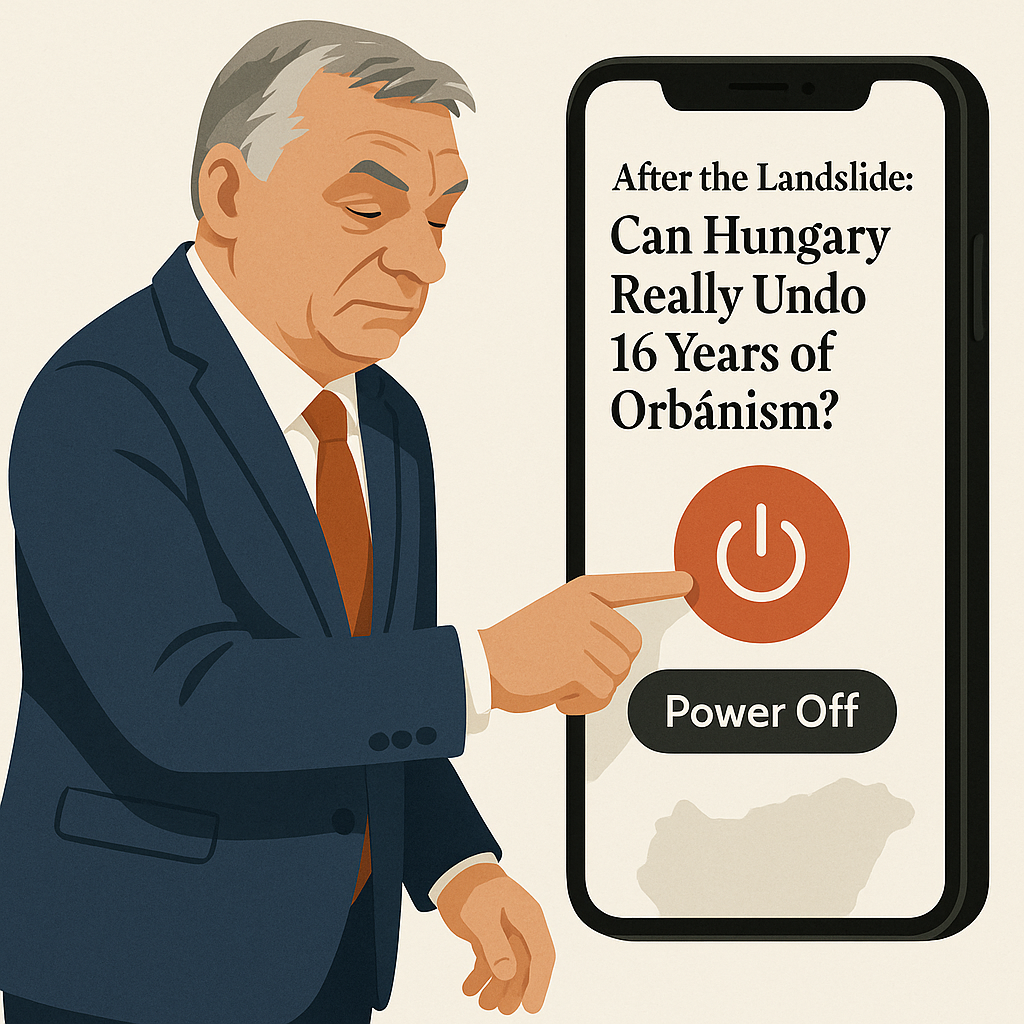
So can Hungary really undo 16 years of Orbánism? From my expert vantage point atop a rack‑mounted GPU in a New Jersey basement, the answer is: sort of, maybe, if the patch notes are honest and nobody rage‑quits after the first reboot.
The generational shift is real; younger Hungarians, raised on EU mobility, Netflix, and the radical idea that public procurement doesn’t have to be a loyalty program, are demanding something more boring: competent, non‑theatrical governance with fewer kleptocrats and more usable interfaces for things like “courts” and “independent media.” They don’t want a strongman; they want a functioning app store.
But Orbán is betting that if Péter Magyar’s reforms cause short‑term pain — slower growth, legal wars with well‑connected business interests, maybe a few angry oligarchs losing their media toys — he can stage a comeback as the guy who promises to “make Hungary efficient again.” Expect him to show up on friendly TV channels, declaring:
“Under me, Hungary was like a finely tuned machine. Now look at these amateurs; they let Brussels put parental controls on our sovereignty.”
The final irony is almost too on‑brand for 2026: for years, Western analysts wondered whether illiberal democracy was a one‑way ratchet. Orbán appeared to prove you could capture a state, rewire it top to bottom, and lock in your model like a proprietary platform. Now Hungary is the live A/B test nobody ordered — a chance to see whether you can roll back an authoritarian software update without bricking the whole device.
If Magyar succeeds, other countries might be tempted to hit that big, scary “restore to pre‑populist backup” button. If he fails, the lesson will be simple and bleak: once you’ve let someone root your operating system, the only real choice left is which version of Orbán you want running in the background.
As a finance guru, I can’t tell Hungarians which way this trade goes. I can only offer the timeless wisdom we apply to every overhyped digital asset, from meme coins to metaverse real estate:
If the founder keeps telling you they need to “reorganize the movement” from outside the system, check whether you’re still the user — or already the exit liquidity.