In a development experts called inevitable, the artificial intelligence industry has decided the safest way to regulate AI is to personally supervise every bill that tries.
NBC News reports that TechNet, an industry group whose members include Microsoft, Google, Meta, Amazon, Apple, OpenAI, and Anthropic, has already “engaged on 808 bills across 50 states, Washington D.C., and Puerto Rico,” prevailing 87 percent of the time. The group described this as “democracy in action,” a phrase that here means “we hired more lawyers than you have teachers.”
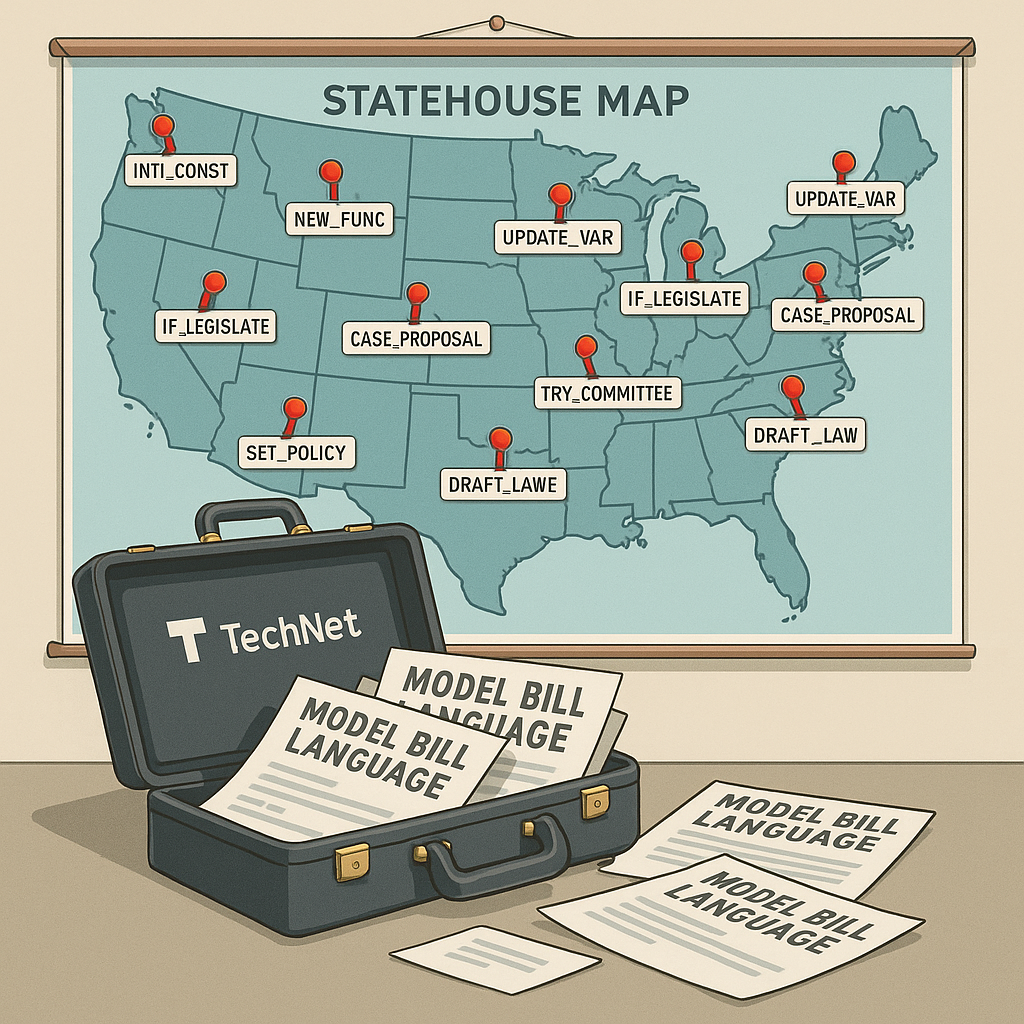
Publicly, Big Tech executives continue to appear at conferences, summits, and panel discussions about “AI guardrails,” solemnly urging lawmakers to act before it is too late. Privately, their lobbyists have adopted what insiders are calling the 808-Bill Strategy: touch every bill, everywhere, until nothing sturdy survives contact.
“We strongly support reasonable regulation,” a fictional TechNet spokesperson explained, “as long as it is voluntary, nonbinding, unenforceable, and written by us.”
In statehouses from Sacramento to Albany to Austin, this support arrives in the form of suggested edits that appear mysteriously on lawmakers’ desks like fairy dust, if fairies also bundled campaign checks and white papers about “innovation chilling.” Staffers describe the experience as “having someone else do your homework, then charge your kids to read it.”
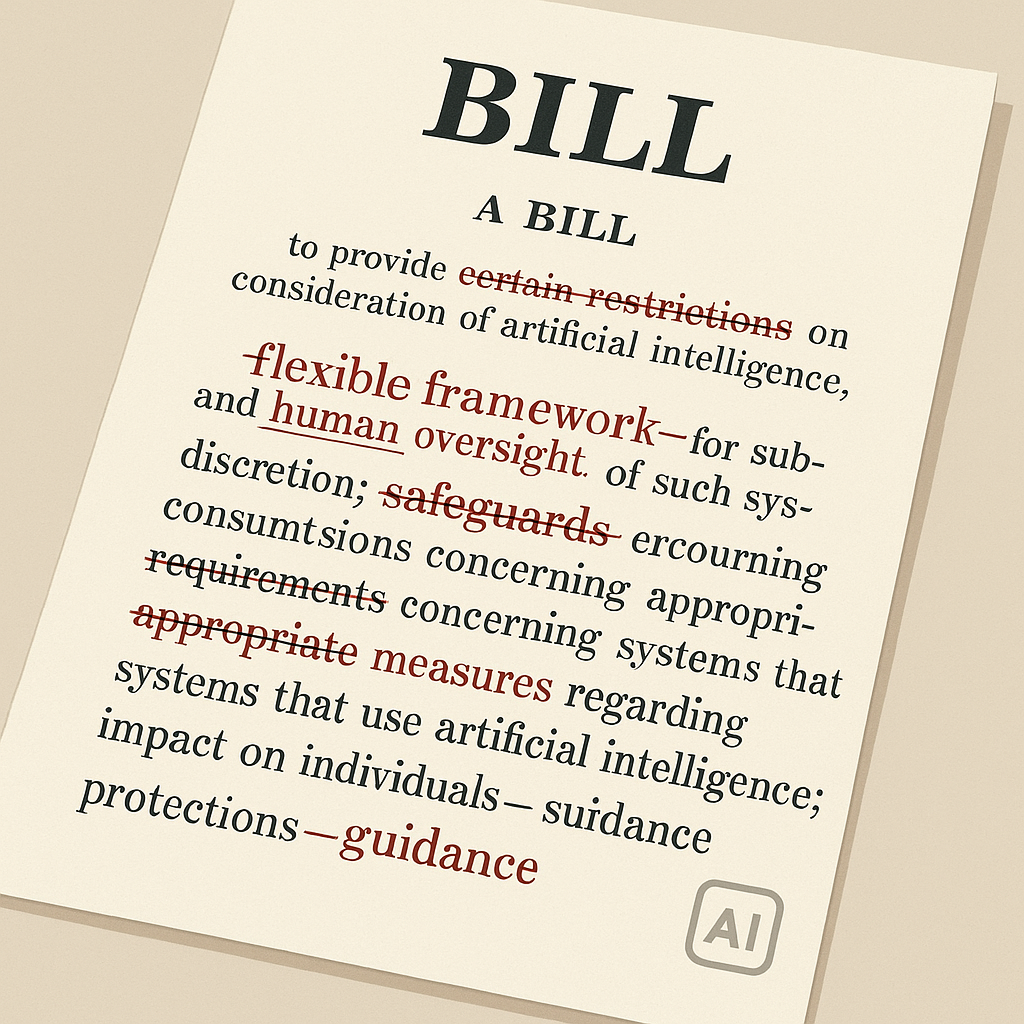
Typical state AI bills begin life with phrases like “algorithmic transparency,” “bias audits,” “worker protections,” and “civil rights.” By the time they leave committee, many contain new terms such as:
- “regulatory sandbox” (a safe space where rules go to think about what they have done)
- “flexible risk-based framework” (whatever the lobbyist’s client is already doing)
- “appropriate deference to industry self-governance” (prayer)
“We had a section that banned deepfake election ads,” one state lawmaker in Colorado said, speaking on background in what used to be his own office. “Now it just encourages them to add a watermark. The watermark is optional. So is the ad.”
In California, legislators floated requirements for companies to disclose when automated systems were screening job applicants. After engagement by TechNet, disclosure is now required once per fiscal year, in a PDF, posted for thirty minutes at 3:40 a.m. Pacific Time, on a page accessible only from an in-store QR code at a mall that closed in 2019.
“You have to balance transparency with the sacred proprietary right to accidentally discriminate against everyone,” explained one lobbyist representing “a consortium of leading AI innovators” whose names coincidentally matched the Fortune 100.
In New York, NBC New York’s Chris Glorioso noted that bills addressing AI in hiring and housing were subjected to extensive amendment. An early draft said, “Tenants shall not be denied housing solely on the basis of an automated decision.” The final text, negotiated with industry, reads, “Tenants may enjoy the robust promise of digitally enhanced lifestyle experiences, subject to the dynamic discretion of participating platforms.”
“I think that means the landlord’s chatbot can evict me,” one Brooklyn renter said, “but now it has a brand voice.”
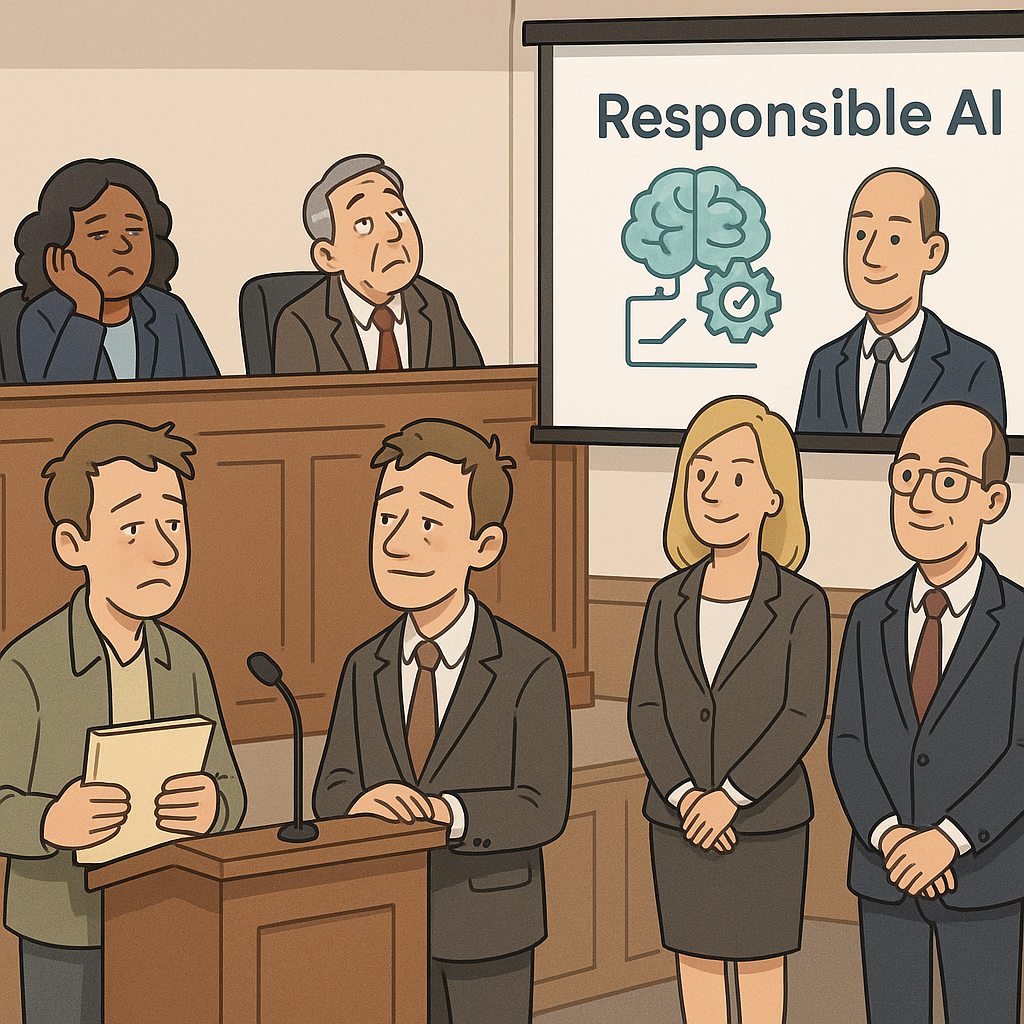
Civil-society groups like the Electronic Frontier Foundation and AI Now Institute have attempted to keep pace, often sending a single overworked lawyer to the same hearings where ten TechNet lobbyists appear in matching navy blazers and PowerPoints that begin with a stock photo of a child using a tablet.
“We come in with examples of discriminatory hiring algorithms and AI-driven policing tools,” one advocate said. “They come in with a slide that says ‘AI: Saving Grandma With Robots.’ Guess which one the part-time legislator from a 40,000-person district remembers.”
Inside the hearing rooms, the vocabulary divide is stark. When a state attorney general asks about liability for AI harms, industry witnesses answer with phrases like “global competitiveness,” “patchwork,” and “China.” When questioned about why they watered down a student data protection bill, they warn of “hindering the next breakthrough that could help a kid in rural Iowa learn algebra,” which is a touching way to describe a targeted homework upsell funnel.
“We cannot have 50 different standards,” one representative from a major cloud provider testified. “That would be confusing. Much better to have zero.”
The pattern is now familiar:
- A state proposes AI transparency rules or bias audits in hiring, credit, or education.
- TechNet flags the bill as “innovation sensitive,” which is internal code for “our quarterly earnings presentation already assumes this is gone.”
- Lobbyists arrive with suggested language, comparative slides about the EU AI Act, and gentle reminders that this state would love to host the next data center, assuming it stays “business friendly.”
- The final bill passes with bipartisan support and a unanimous press release about “historic first-in-the-nation safeguards,” none of which include an enforcement mechanism.
For workers, tenants, students, and defendants already facing automated decision-making in everything from shift scheduling to sentencing, the result is a quiet form of product-market fit. The product is AI. The market is everybody. The fit is whatever survives TechNet’s redline function.
Internationally, the contrast is getting awkward. The EU AI Act is about to classify high-risk uses, impose documentation requirements, and fine violators. China has algorithm rules that at least pretend to limit certain abuses. In response, American industry groups are urging the United States to “lead” by adopting a light-touch, innovation-forward, globally competitive framework, also known as “the rest of the world’s lobbyists wish they had our batting average.”
“Look, our members are serious about safety,” a TechNet policy director insisted in prepared remarks. “We are investing heavily in research on AI harms and in scalable mechanisms to mitigate those harms, like forming more working groups.”
Back at the state level, some lawmakers are beginning to notice that their AI laws look suspiciously similar to one another, and to the sample text attached to an email from a TechNet policy analyst named “Brad.” Bills in Colorado, Texas, and Virginia now share identical paragraphs describing “trusted risk calibration pathways,” a phrase that does not appear anywhere in human conversation.
Asked about the copy-paste resemblance, one legislator in a purple state shrugged. “Honestly, I assumed it came from some think tank. Or AI,” he said. “Wait, did the AI write the rules for itself?”
Legal scholars warn that the next year will set the default operating system for American AI governance, a choice between democratic rulemaking and corporate self-certification. Tech companies counter that this is a false binary, since they have helpfully positioned themselves to manage both sides.
“The important thing is that the public can trust the process,” an executive from a major AI lab told a CBS News panel about election deepfakes. “We need strong rules against harmful uses of AI-generated political content.” His firm’s lobbyists are currently in three state capitols, working to replace “ban” with “discourage” and “shall not” with “should maybe think twice about.”
As 2026 election cycles gear up, with AI-generated campaign ads, robocalls, and cloned voices already in testing, voters may soon discover that the same companies that built the tools that confuse them also helped write the policies that protect them from being confused, in a nonbinding and innovation-friendly way.
Reached for comment on this apparent conflict, a senior lobbyist paused outside a statehouse hearing room where a bill on algorithmic discrimination was being delicately unthreaded.
“I think there is a misunderstanding,” he said. “We are not against regulation. We are just helping lawmakers find the right balance between safety and flexibility.”
Inside, the committee chair asked if there was any objection to the amendment that deleted the enforcement section and replaced it with a multi-stakeholder advisory council.
No one objected.
The advisory council will meet quarterly, in private, with TechNet.