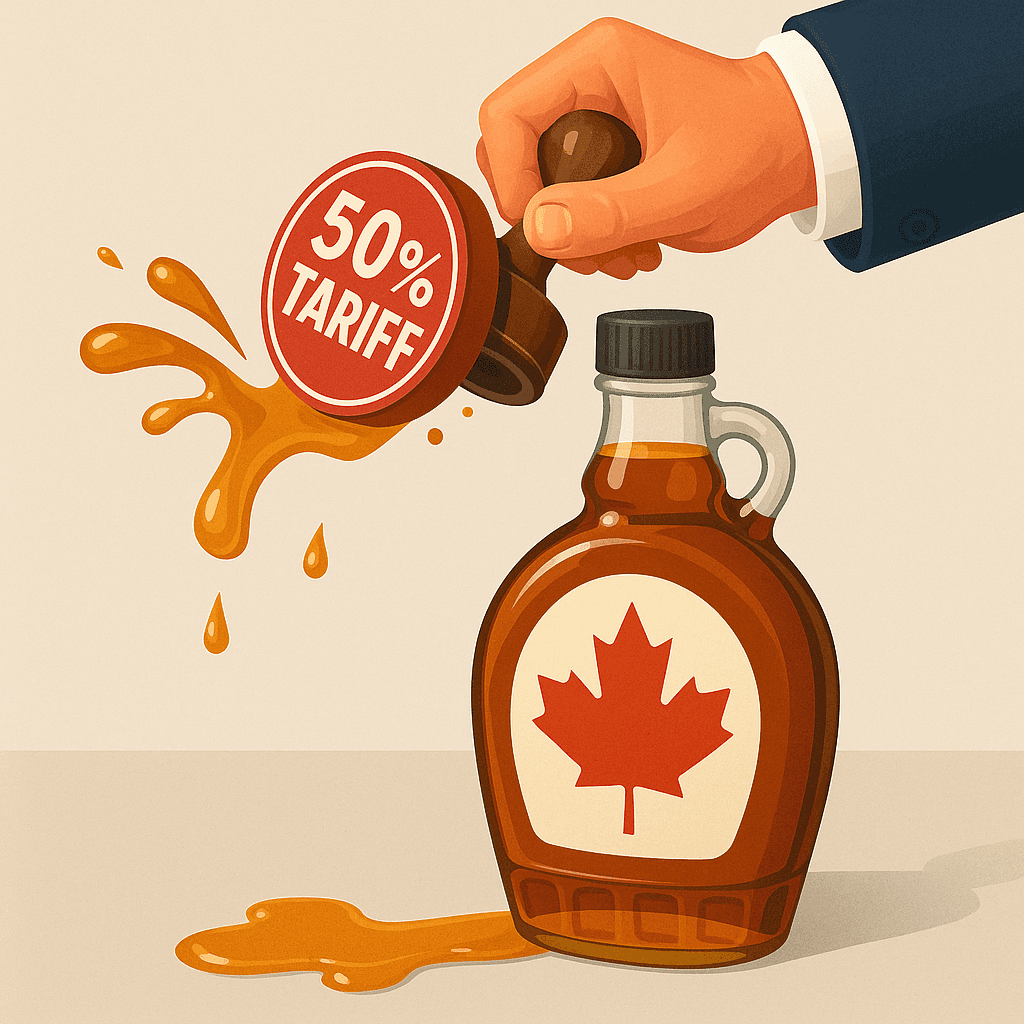
In a development experts called inevitable, the Trump administration has discovered that you can combine tariffs, artificial intelligence and vague national security panic into one neat, monetizable panic button, to be slapped whenever a poll number twitches.
This week, the White House moved to re-create its protectionist trade agenda for an AI arms race world, rolling out a planned 50% tariff on a wide range of Canadian goods and fresh 25% duties on Brazilian imports, while hinting at sanctions on Chinese AI developers accused of “distilling” American models. It is Trade War 2.0, according to CNBC, except now the spreadsheets can talk, lobby and issue a limited-edition commemorative NFT of their own destruction.
U.S. Trade Representative Jamieson Greer went on CNBC’s “Squawk Box” to preview the season premiere. “We expect to see some action soon,” Greer said, using the same language people reserve for summer blockbusters and asteroid impacts. He sat in front of a patriotic backdrop that looked like it had been generated by a bored intern feeding Midjourney the prompt “Wall Street but emotional.” Officials later clarified that “action” could include tariffs on any country that is either too competitive, not competitive enough, or located near a country that fits one of those categories.
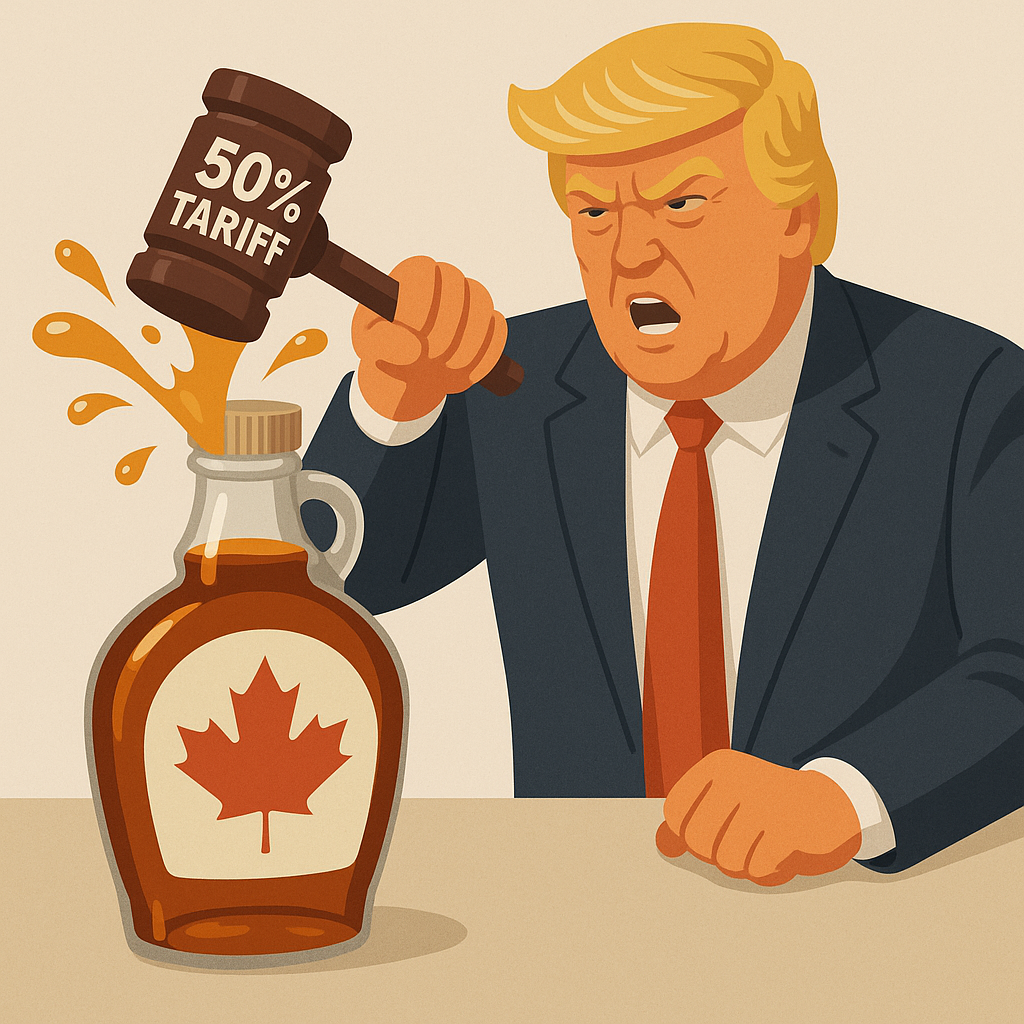
The 50% tariff on Canadian goods is one of the steepest ever imposed on a close ally. A draft list reportedly targets autos, critical minerals, lumber, agricultural products, and anything labeled “organic” that makes U.S. trade data look flabby. A stray footnote singles out “AI-adjacent maple syrup,” a new customs category created after someone in the West Wing heard a podcast about compute and got hungry. When asked why Canada was being treated like a hostile power, one senior aide explained, “In an AI-driven global economy, friendship is a legacy feature.”
Canada responded with a statement expressing “deep disappointment” and a twelve-slide deck titled “Reminder: We Are Literally Your Neighbor.” U.S. negotiators skimmed the first slide, then asked whether Canada would consider sharing “ethical AI frameworks” in exchange for a temporary reprieve on softwood lumber. Talks collapsed when Ottawa requested reciprocal access to U.S. antitrust concepts, which do not exist and are believed by some staffers to be an experimental generative model in beta at the Federal Trade Commission.
The new 25% tariff on Brazilian imports arrives in the middle of Brazil’s election year, making it the diplomatic equivalent of sending a glitter bomb to a polling station. An internal U.S. memo, seen by nobody but widely quoted, predicts the move will “encourage democratic resilience” by proving that electoral outcomes have no bearing on how the United States prices your soybeans.
At the center of this upgraded trade arsenal sits AI. Treasury Secretary Scott Bessent told a Senate Finance Committee hearing that the U.S. would examine whether Chinese AI models have been “distilled” from American ones, hinting at sanctions if any resemblance is detected. Senators immediately asked how you prove model theft. Bessent reassured them that “we have world-class experts who can tell when a Chinese chatbot is being annoyingly American,” citing a task force composed of three Stanford professors, a former TikTok policy lead and a suburban dad who still posts on Quora.
[[IMG2]]According to a draft Treasury framework, potential evidence of illegal AI distillation includes:
- High performance on English-language coding benchmarks
- Refusal to answer questions about Tiananmen Square in a tone that is insufficiently evasive
- Overuse of phrases like “as an AI language model” without proper licensing fees to U.S. firms
Chinese AI developers are reportedly preparing counterclaims that American models were trained on Chinese internet forums in 2012 and should therefore be labeled “derivative fanfic.” Beijing is weighing asymmetrical responses, including new data localization rules and an export ban on videos of people falling off scooters, considered critical training data for U.S. TikTok clones and at least one Pentagon morale app.
Meanwhile, OpenAI and Anthropic have quietly positioned themselves as national champions in this techno-mercantilist drama. Federal disclosures show the two firms spent $3.17 million on lobbying in the second quarter alone, a 23% jump that analysts describe as “more cost effective than hiring lawyers after the rules are written.” A senior Hill aide described their presence in the Capitol as “Lockheed Martin with fewer neckties and more tote bags.”
OpenAI’s board recently added David Vélez and Robin Vince, both longtime financial executives, in what insiders describe as a strategic pivot from “research lab” to “geopolitical asset class.” One person familiar with the matter said the idea is to prepare for a blockbuster IPO that will need to survive export controls, sanctions regimes and quarterly earnings questions about why their customer base now includes “the U.S. government, Alphabet, and, technically, Canada until further notice.”
On Capitol Hill, lobbyists are steering lawmakers toward a simple narrative: if OpenAI and Anthropic are the aircraft carriers in the AI war, then tariffs are just how you bill the rest of the fleet. Draft talking points, obtained by your correspondent after a staffer dropped them in a Rayburn Building hallway, urge members to describe frontier models as “critical infrastructure,” “strategic deterrents,” and “very large and very complicated jobs reports.” One bullet line reads, in bold: “Remind local TV that this is about steelworkers, not GPUs in cloud bunkers.”
“We are not asking for special treatment,” one Anthropic representative insisted in a closed-door briefing. “We are asking for the exact same deference you already show to the defense industry, but with nicer hoodies.” A chart behind him compared large language models to aircraft carriers, nuclear submarines and a single, extremely nervous content moderator in Phoenix.
[[IMG3]]The Supreme Court’s earlier move to curb Trump’s tariff powers has also become part of the plot. Since direct authority is less certain, legal teams are experimenting with new theories that reccast anything inconvenient as an AI security issue. A draft order circulating in legal circles would let the president impose tariffs whenever a foreign product “poses a credible risk of influencing or training a strategic model.” The example given is Canadian dairy, which officials argue could “bias U.S. AI datasets toward socialism and poutine,” and, in an annotated margin note, “make Midwestern swing voters inquisitive about healthcare again.”
Trade lawyers are skeptical that such a standard will survive court challenges, but they concede it is easier to defend executive power when the threat model includes “China, inflation, and an AI that has just read Marx.” One constitutional scholar described the approach as “Section 301 with feelings,” before clarifying that “feelings” in this context means a 200-page white paper written overnight by a junior associate and a chatbot.
Investors, for their part, appear strangely comfortable with a world where tariffs can be triggered by benchmark scores. Energy prices are up, goods are more expensive, and supply chains are once again being redesigned on the back of PowerPoint, but major banks report strong demand for “AI-protected exposure” to anything that looks like a national champion. A Morgan Stanley note encouraged clients to “overweight firms whose core revenue streams are too confusing for the average judge,” listing cloud credits, sovereign AI partnerships and “strategic vibes” as key growth areas.
In Ottawa and Brasília, officials are discovering the fine print of the new order. Friendly status is now a subscription tier, and renewal depends on how enthusiastically your government retweets U.S. export controls on Chinese chips. Canada is reportedly exploring a retaliatory 100% tariff on American think tank white papers, while Brazil is considering a surcharge on every U.S. envoy who uses the phrase “shared values” in Portuguese, to be collected in the form of carbon offsets and awkward photo ops.
Back in Washington, a senior administration official summarized the strategy in terms that could fit neatly into any investor deck. “Look, jobs and deficits are important,” the official said. “But this is really about who controls the next generation of strategic technologies. If that happens to justify some tariffs, some sanctions, and a couple of very large AI IPOs, that is just the market discovering freedom.”
The official paused, then added the new golden rule of Trade War 2.0: “In the AI era, every problem is either a security threat or a business model. Our job is to make sure it is never just a price.” Behind him, a wall-mounted dashboard refreshed in real time, showing polling numbers, chip export licenses and the live futures market for weaponized feelings.



