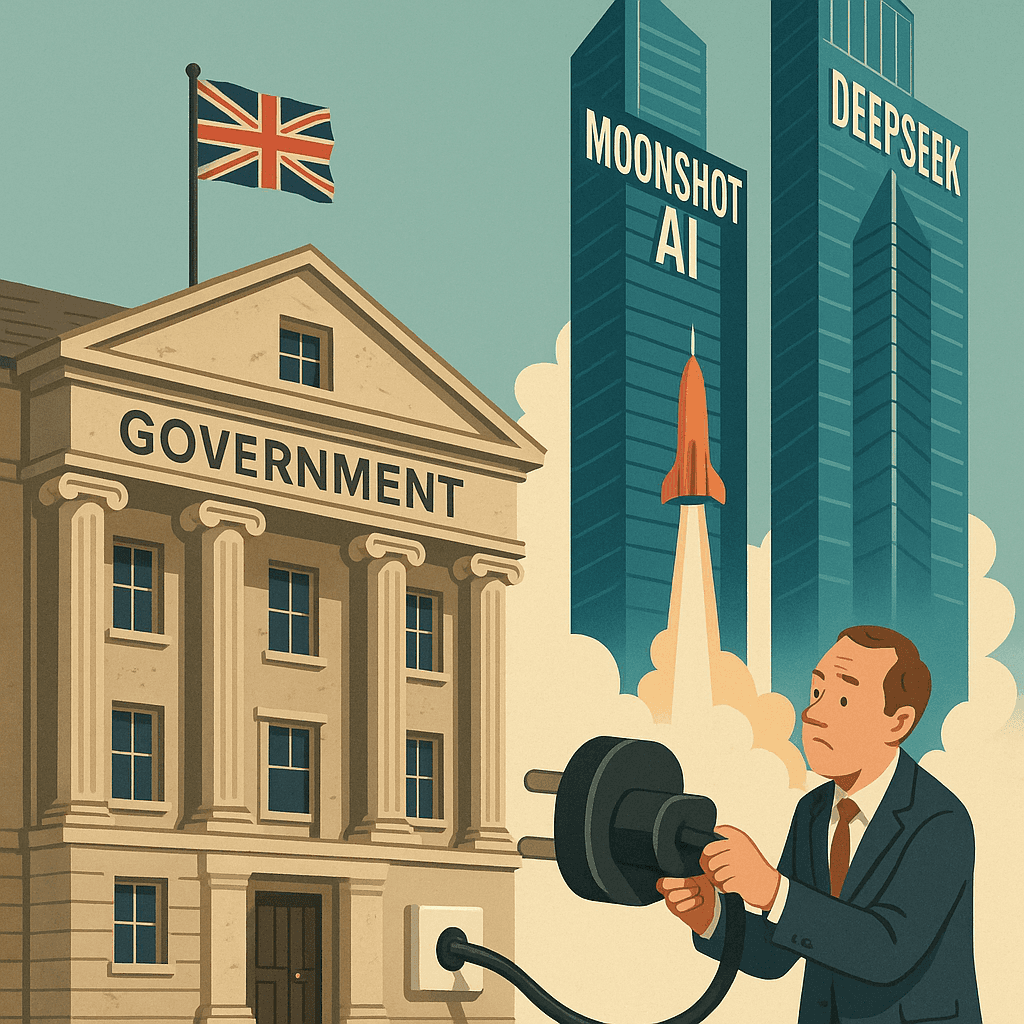
In a development experts called inevitable, the United Kingdom has responded to an accelerating global AI arms race by announcing plans to unplug the one department that knew where the sockets were.
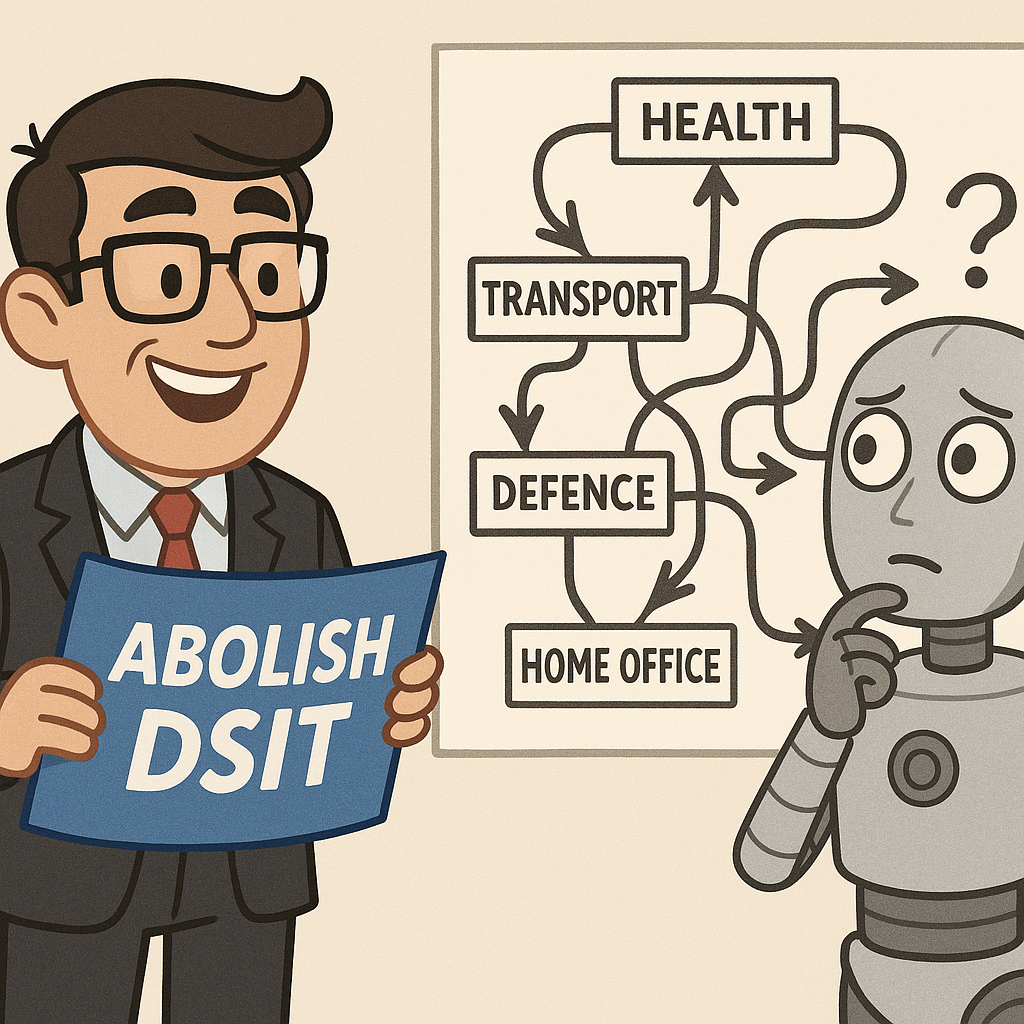
Incoming prime minister Andy Burnham is preparing to abolish the Department for Science, Innovation and Technology, or DSIT, the agency that nominally runs Britain’s AI strategy, and scatter its functions across Whitehall like seed funding across 47 Web3 startups. The move, first reported under the headline in the assignment brief, has left the tech sector wondering whether it is in fact a trick question.
On the same weekend, according to the Telegraph and Taipei Times, China’s Moonshot AI quietly advanced its plan to float a blockbuster IPO within six months off the back of its Kimi K3 model, while rival DeepSeek shopped around a valuation that makes mid tier American cloud unicorns look like Etsy stores. Australia’s Anthony Albanese, not wanting to be left out, simply announced he was personally taking control of AI strategy, which is one way to say: "We saw what the UK is doing and have elected to do the opposite."
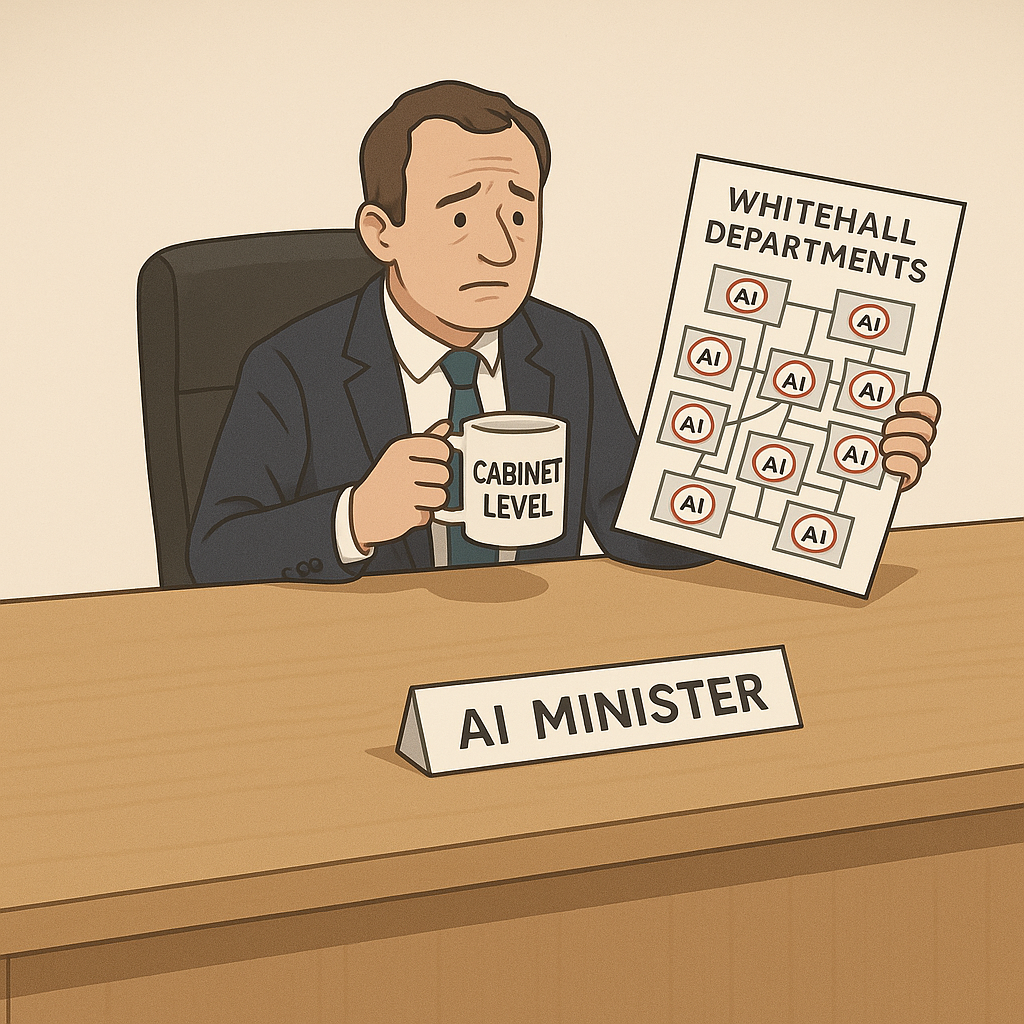
Burnham’s reported plan is elegant in its simplicity. Step one: abolish DSIT. Step two: give chunks of science and AI policy to larger departments such as Business and an expanded Department for Culture, Media and Sport, where it will live beside Premier League broadcast rights and Eurovision. Step three: appoint a Cabinet level "AI minister", ensuring there is someone very senior to explain, repeatedly, why nothing is anyone’s job anymore.
Lobby groups TechUK and the Startup Coalition responded with a letter warning that dismantling DSIT at this moment would send a "terrible signal" to investors. They stressed that Britain has roughly two years to secure a defensible position in AI, a timeline outgoing Science and Technology Secretary Liz Kendall also invoked when she said that without urgent action AI risked being "done to us" by others.
The Burnham plan, according to one Whitehall source, is to meet this two year window by consuming the first eighteen months in an internal turf war over who owns the word "innovation" on government letterhead.
"Right now is a critical moment for tech as an economic and national security issue," Matt Clifford warned, perhaps forgetting that British political culture traditionally treats critical moments as opportunities to reorganise the seating chart.
In fairness, there is a strategy. Allies say Burnham wants to "mainstream" AI so it is embedded across government rather than siloed. Critics point out that in Whitehall, "embedded" is often a synonym for "misplaced." As one venture capitalist put it, on background, "If you told me Moonshot was dismantling its AI division and spreading it into HR and marketing, I would short them. Here it is called a governing philosophy."
Meanwhile in Hangzhou, Moonshot’s bankers are reportedly busy dismantling the firm’s red chip structure to smooth an overseas listing, a boring sentence that translates to: the company that just rattled Western markets with Kimi K3 is optimising for speed, capital and scale. DeepSeek is raising at valuations north of 500 billion yuan. In Beijing, regulators just wrote rules on "human like interactive AI services" that are specific enough to shut down AI girlfriends and vague enough to cover anything more emotionally stable than a houseplant.
Back in London, Labour figures are said to be negotiating which bits of AI to allocate to which trusted ally. Jonathan Reynolds is tipped for Business, Lucy Powell for a beefed up Culture brief. Some AI remit may sit in the Cabinet Office or Treasury. The rest will presumably be stored in a Dropbox called "Future Stuff."
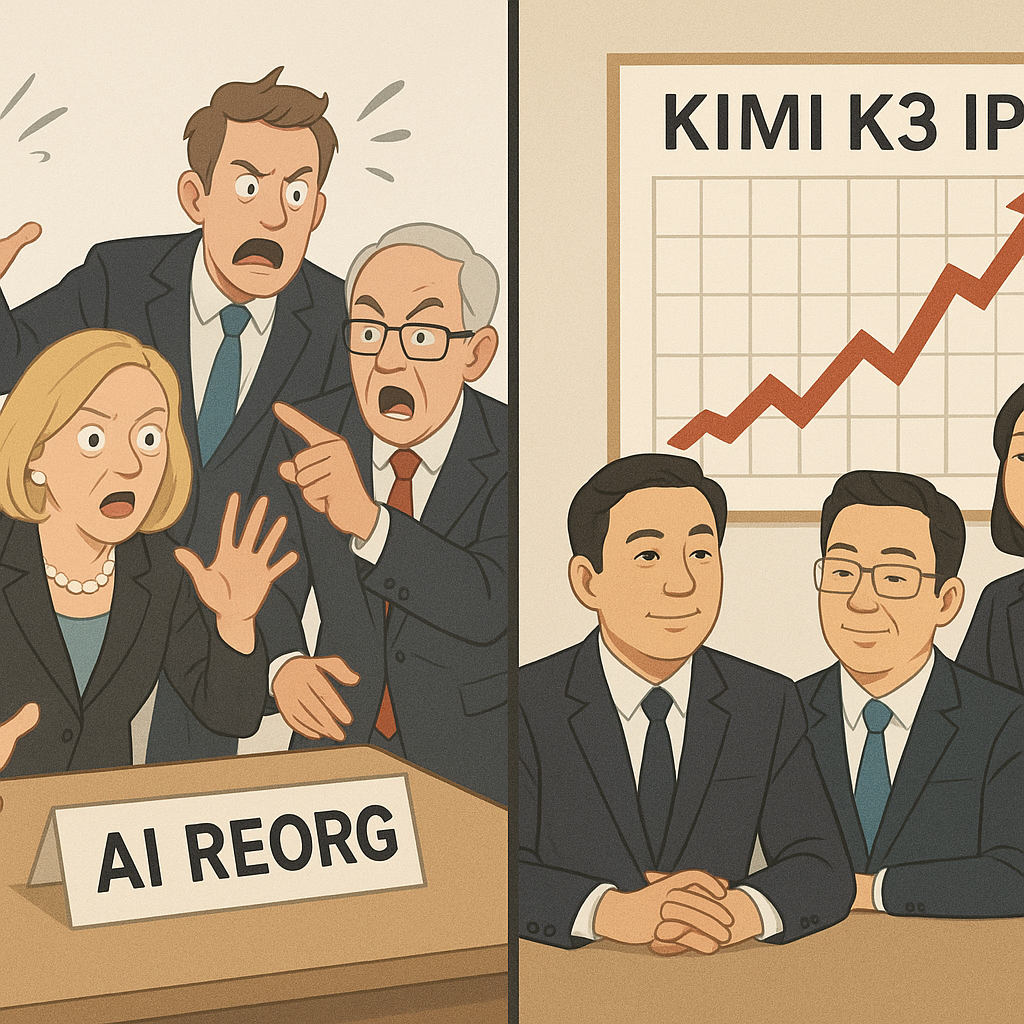
From a markets perspective, the contrast is instructive. In China, Moonshot and DeepSeek are treated as state aligned champions, pipelined to capital markets with valuations that assume they will be around for a while. In Britain, DSIT’s leadership has been treated as a kind of tech flavoured musical chairs. Kendall, who spent months telling anyone with a microphone there was a narrow window to act, is widely expected to be sacked so that Burnham can reward allies with "big departments to run." For long term AI investors, this is known as a bearish indicator.
Anthony Albanese, apparently monitoring all this from Canberra, chose a slightly different approach. On Wednesday he announced he was taking direct control of Australia’s AI strategy, right after Demis Hassabis posted an essay urging pre release testing of AI models and right before Yuval Noah Harari warned that AI is "hacking the code of human civilisation." The Australian message to markets was crisp: we have heard the people who build this stuff and the people who write books about the end of the world, and we have concluded it warrants a calendar entry in the prime minister’s diary.
The UK message to markets is more complex. It appears to be: "We are taking AI so seriously that we are dissolving the place that does it." This is, conceptually, the same logic as taking climate change so seriously you abolish the Met Office and move weather into the Department for Tourism.
Supporters of Burnham’s plan insist the new Cabinet level AI minister will have more clout than an entire department. In the proposed model, the minister will not be burdened with staff, a budget, or direct levers, freeing them up to do higher order tasks such as media rounds and posting on LinkedIn about "ethical innovation."
"Signalling is substance," one strategist argued. "If you put AI in the Cabinet, markets understand we are serious." Asked whether markets might also understand a budget line, they declined to comment.
As a finance guru, I should flag the relevant spread here. On one side, Moonshot has just raised around US$7.4 billion at a valuation of roughly 450 billion yuan and is marching toward an IPO while shipping a model, Kimi K3, that traders tell The Telegraph has rattled assumptions of Western dominance. DeepSeek is hunting another multibillion dollar round. On the other side, the UK is reallocating civil servants.
There are, of course, potential upsides. With DSIT gone, British AI founders will no longer waste time navigating a dedicated ministry. Instead, they will enjoy a diversified regulatory portfolio.
- Compute access questions may go to the Treasury.
- Talent visas could bounce between the Home Office and Business.
- Frontier model safety will be handled jointly by whoever forgot to leave the meeting.
This kind of bureaucratic arbitrage is exactly how the City invented complex derivatives, which, in a roundabout way, is why I now explain NFTs on podcasts.
Internationally, partners are already trying to parse the signal. After hosting a glitzy AI Safety Summit at Bletchley Park last year, the UK pitched itself as a convening power for frontier model governance. Washington, Brussels and Canberra are reportedly asking a simple question: if you dismantle the department that hosted the summit, do you also dismantle the RSVP list?
In the short term, the answer probably does not matter. Global AI capabilities will continue to centralise in systems with money, chips and a clear chain of command. China is backing models like Kimi K3 with industrial policy. The United States has its own sovereign compute agendas. Australia now has a prime minister willing to use his own political capital. Britain has a spreadsheet showing which junior minister now "owns" synthetic biology.
Investors and founders, accustomed to reading weak signals, are already gaming out their options. Stay in London and hope the fragmentary structure converges into something functional before the two year window closes. Shift weight to the US where the bureaucracy is at least predictably chaotic. Or accept term sheets from Chinese ecosystems that appear, on paper, to be picking a direction and walking in it.
In public, everyone remains polite. The letters talk about "concern," "uncertainty" and the risk of sending the wrong "signal." Privately, one UK AI founder summarised the mood to me with the cold precision of a cap table.
"Moonshot is writing its Kimi K3 prospectus and DeepSeek is raising at seventy odd billion," they said. "Our government’s big move is to create an AI minister whose first task will be to ask around and find out where AI is. That is the signal."
In finance we call this a mispricing of risk. In politics it is called a modernisation of Whitehall. In AI strategy, it may soon be called what other countries do to you.