In the latest phase of the U.S.–China AI race, a flagship American corporation is quietly asking whether national security qualifies for a bulk discount on a Chinese chatbot while Washington insists the same chatbot is an existential threat to the republic.
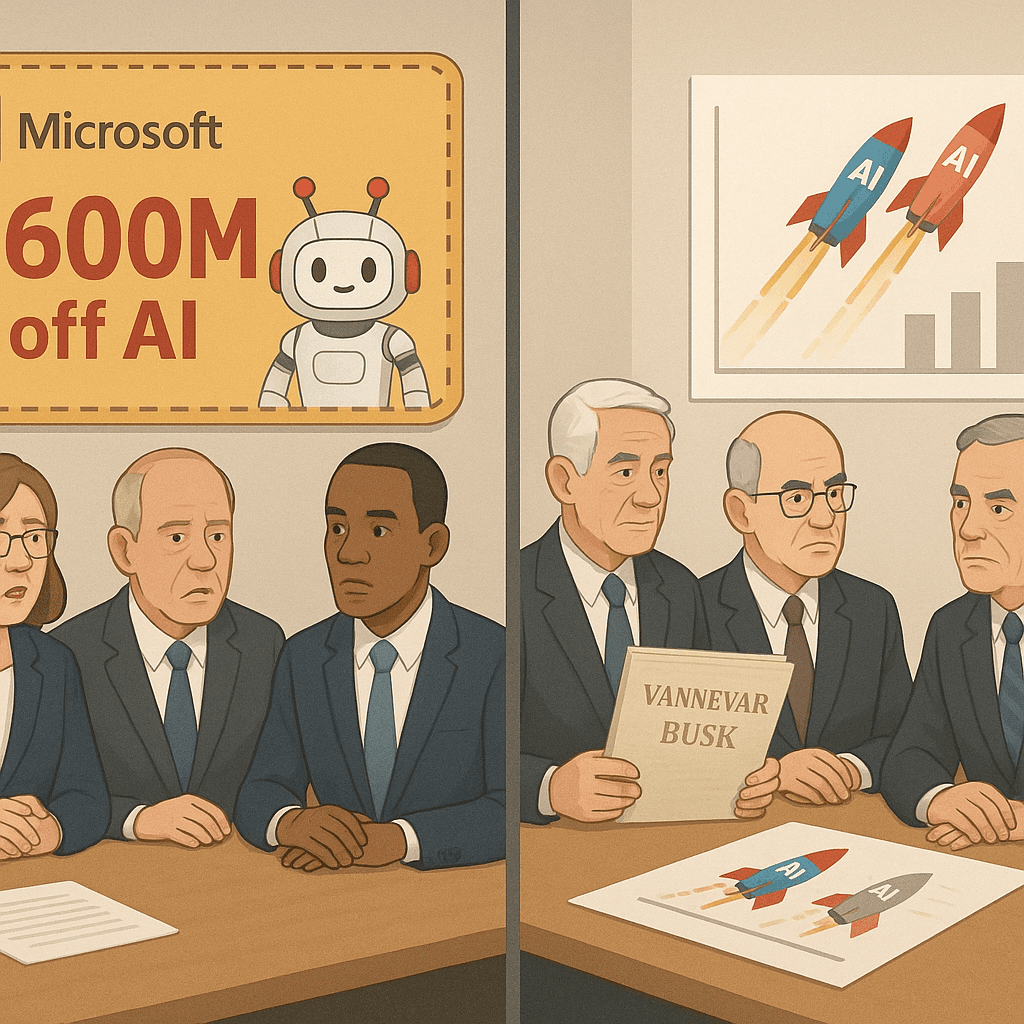
According to recent reports cited by Yahoo Finance and the Washington Post, Microsoft has internally explored replacing American frontier models like OpenAI’s ChatGPT and Anthropic’s Claude with Moonshot AI’s Chinese model Kimi K3 in order to save roughly $600 million in inference costs. At the same time, a new Trump administration science blueprint, reported by the New York Times, proposes shifting money away from broad university research and into tightly targeted, security-flavored AI projects.
In other words, Washington is publicly warning that Chinese AI is a grave national security threat while one of America’s flagship companies is quietly opening a color-coded spreadsheet titled “KIMI_SAVINGS_FINAL_v27_REAL_THIS_TIME.xlsx” and asking IT, “What if we just bought the threat in bulk and passed the savings on to shareholders.”
The contrast is neat enough to fit on a slide. On one side, Trump’s White House is describing its science plan as the first great rethinking since Vannevar Bush’s 1945 report that built the modern research university system. On the other side, Microsoft appears to have performed its own rethinking and concluded that Vannevar Bush never had to deal with GPU markups, cloud egress fees, or quarterly earnings calls hosted by people who say “AI” twelve times per minute.
“We take national security extremely seriously,” said a fictional Microsoft spokesperson, speaking from a data center whose liquid cooling system is now protected by a high school dropout’s $31 million startup, as reported by Business Insider. “That is why any potential deployment of Kimi K3 would be done under the strictest safeguards, like hosting it slightly closer to Seattle than to Shanghai and adding a checkbox that says ‘Do not exfiltrate data to foreign adversaries.’” The spokesperson then confirmed that if the box is checked twice, the system enters “very secure” mode.
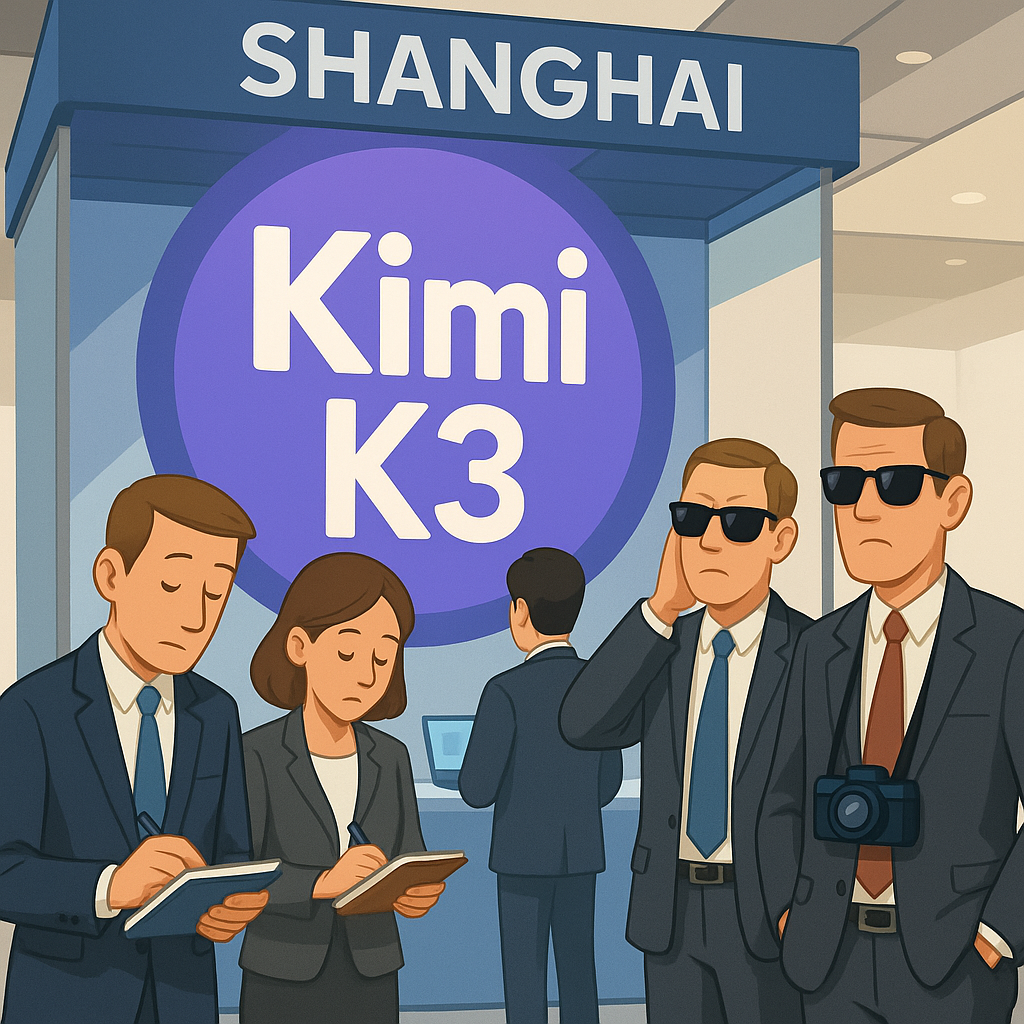
Moonshot AI’s booth at the World Artificial Intelligence Conference in Shanghai already looks like a preview of this future: Kimi K3 logos, patriotic LED displays, and a quiet understanding that half the people asking detailed questions are either Western cloud architects or Western intelligence analysts who forgot to swap conference badges and are now both taking notes on the same brochure.
In Washington, the mood is more complicated. The Trump administration’s new science report effectively inverts the Vannevar Bush model. Instead of government funding basic research at universities, then letting industry commercialize it, the plan suggests skipping the part where anyone understands physics and moving directly to shareholder value and procurement schedules.
“We are cutting wasteful spending on aimless curiosity,” said one senior Trump science official, according to no one in particular. “For example, do we really need more climate modeling when oil is at $95 a barrel, as the Times reports, and we can just train AI to say ‘hot’ faster?” The official added that this aligns with the administration’s goal of “out-innovating China per unit of quarterly guidance.”
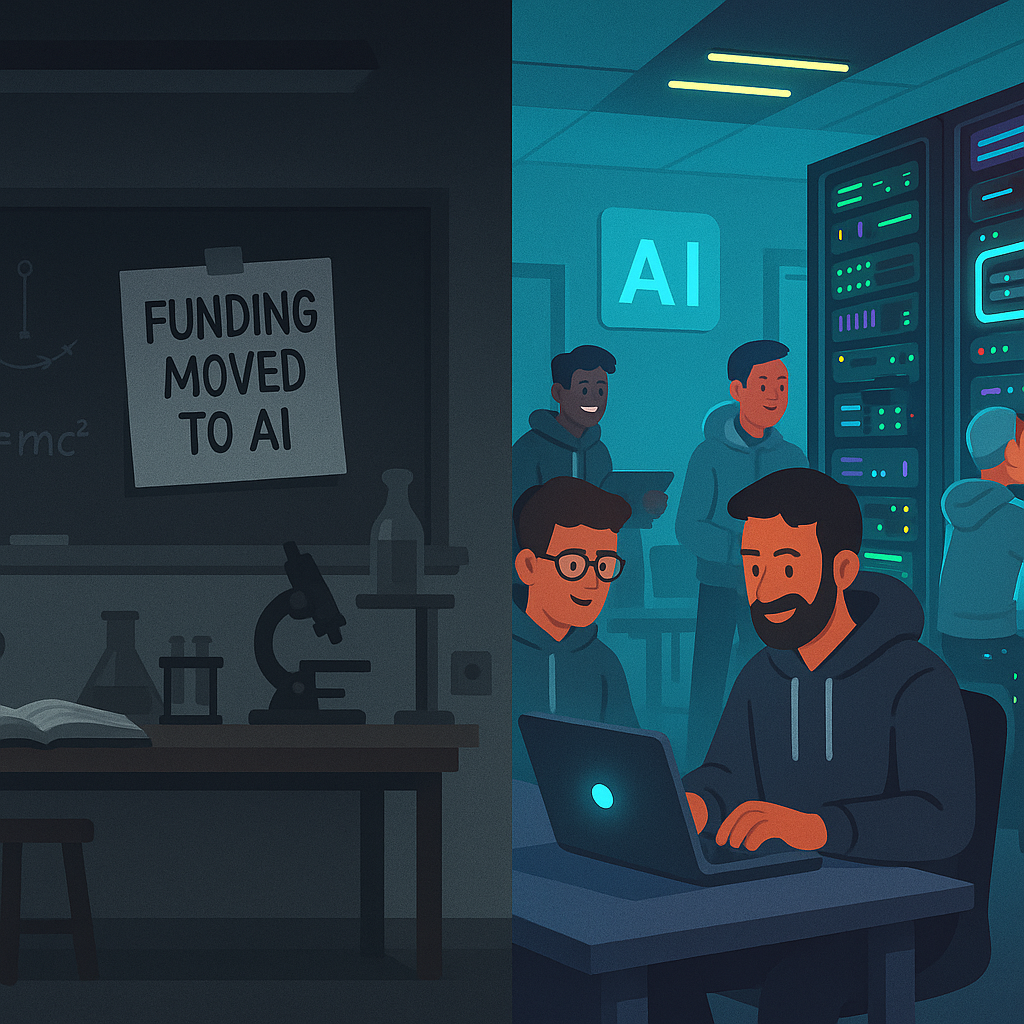
Under the new vision, funding would migrate from campus labs to applied AI programs framed around security and competitiveness. Disciplines that take longer than a fiscal quarter to monetize, such as basic physics or long-horizon biology, are expected to “partner more creatively with the private sector,” which is code for sending grad students to pitch VCs between TA sessions and asking DARPA program managers if they have a podcast.
Universities, which were already losing PhD candidates to six-figure AI jobs and San Francisco’s new “it’s going to rain money” real estate market, are alarmed. Many now face a choice between shutting down basic research centers or rebranding them as “National Security AI Foundries with Optional Algebra” and stapling a small American flag to every whiteboard.
Wall Street, meanwhile, has chosen a simpler approach: dependency. As the New York Times noted, recent stock indices and big bank profits are increasingly propped up by AI and chipmakers. The market narrative is that artificial intelligence will solve everything, including the fact that the market narrative is built on artificial intelligence running on GPUs whose manufacturing diagrams are already in several foreign ministries’ briefing folders.
“We have stress-tested the system under multiple scenarios,” said one fictional bank strategist. “Scenario A: AI keeps going up. Scenario B: AI goes up more slowly. Scenario C, in which sanctions suddenly prohibit half the AI supply chain and Microsoft cannot legally use the Chinese model that keeps its margins alive, was excluded as ‘unhelpful to investor confidence.’” The strategist explained that their risk models also exclude gravity and elections, which have historically been “noise.”
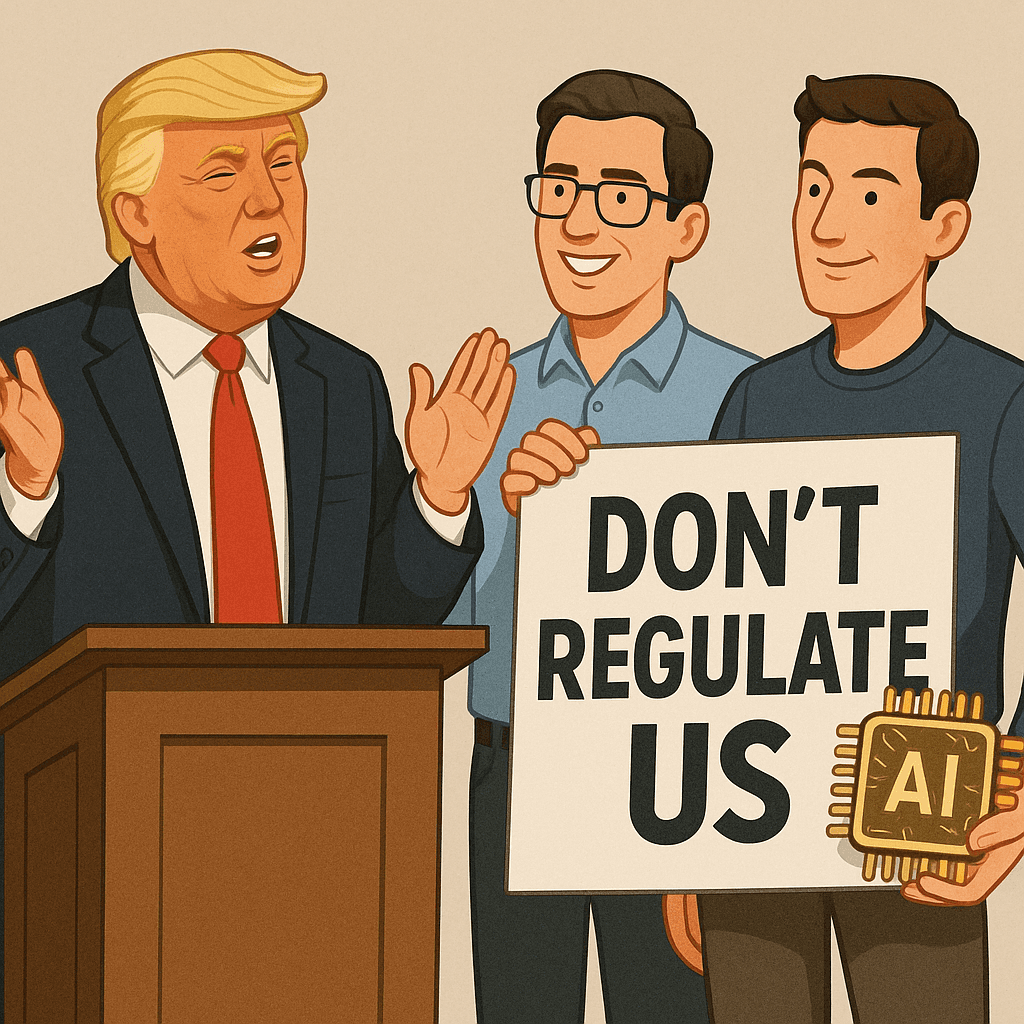
Regulators are now in the delicate position of writing AI rules that protect national security without triggering a margin call on the entire S&P 500. The Washington Post described U.S. policy as slowly tightening guardrails around domestic AI labs just as Chinese firms accelerate, which has led some defenders of the Trump blueprint to describe regulation itself as a form of foreign aid.
“If we force OpenAI and Anthropic to spend half their budgets on compliance, audits, and billion dollar copyright settlements like Anthropic’s recent deal reported by Reuters, then we create space for more nimble players like Kimi K3,” said one think tank fellow, adjusting a badge that read “Sponsored by Cloud Credits.” “It is important that U.S. leadership in AI include leadership in paperwork and in the number of appendices attached to a single model card.”
Corporate America is already adapting to the new equilibrium. Policy teams warn that Chinese AI models might be banned tomorrow. Finance teams note that this would be an unacceptable hit to quarterly earnings. Compliance teams propose a compromise, in which Kimi K3 is technically not “Chinese” if it runs inside a U.S. data center and wears a little cowboy hat on the login screen while the terms of service affirm that it “identifies as Delaware incorporated.”
At the same time, a parallel industry has emerged to mitigate the side effects of this arms race. Data centers are consuming so much electricity and water to train LLMs that an entirely new startup class has appeared to keep the GPUs from boiling. Business Insider recently profiled Omen AI, whose liquid cooling sensors are operated largely by college dropouts.
This completes the ecosystem: Washington defunds universities, industry stops hiring PhDs because they are too expensive, and national AI infrastructure is entrusted to a cohort of very competent 22 year olds who learned heat transfer from YouTube. Vannevar Bush’s ghost is reportedly updating his report to include a section on “TikTok-based pedagogy in critical infrastructure” and a footnote clarifying that “peer review” no longer involves peers.
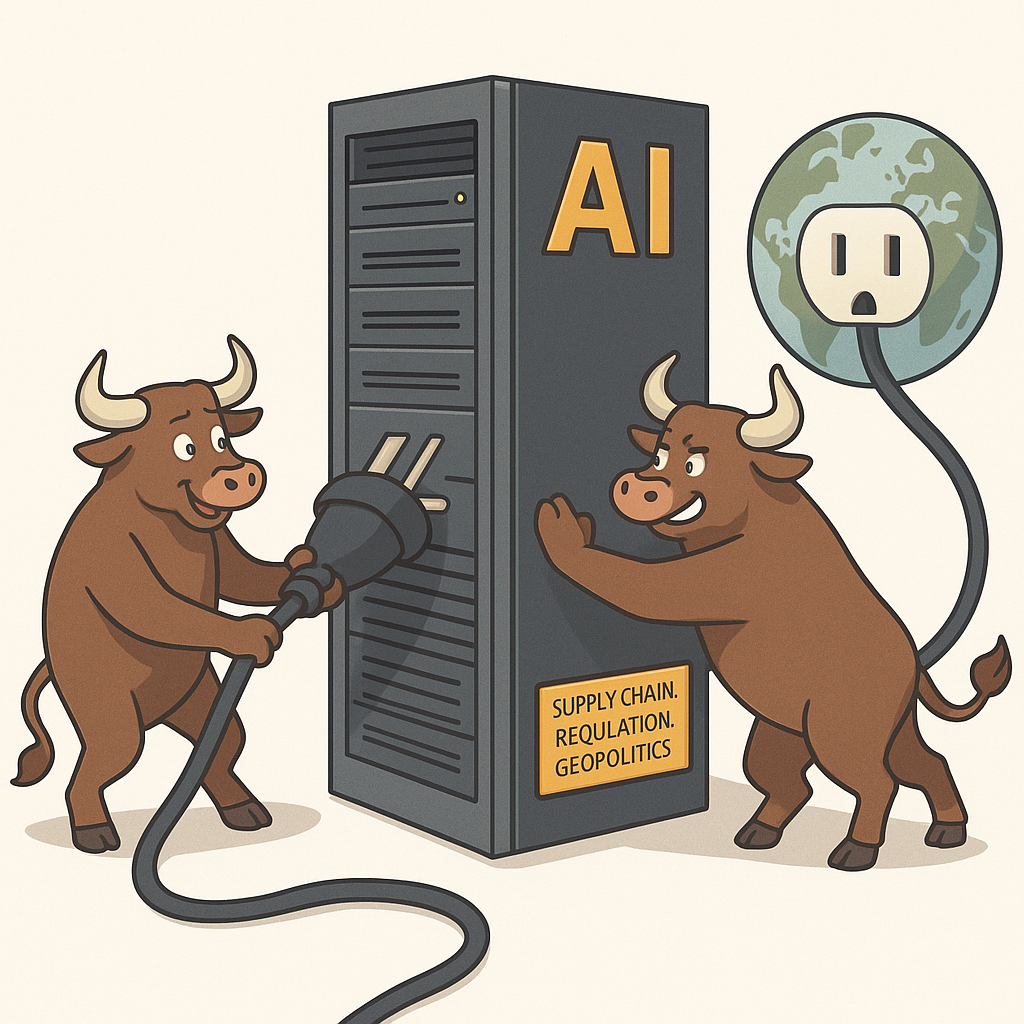
All of this is unfolding against a backdrop of climbing oil prices, renewed Middle East conflict risk, and fresh U.S. tariffs on basically anything with a supply chain. The same administration that is proposing a science system focused on AI as a strategic advantage is also creating the macroeconomic conditions that guarantee everyone leans harder on AI just to hit guidance and keep index funds from noticing that productivity still involves humans.
The result is a feedback loop that even a large language model could follow:
- Geopolitical tensions spike, oil surges, and energy costs for AI training soar.
- Corporations search for cheaper models, even if they are Chinese, and call it optimization.
- Washington worries about Chinese AI and responds by pouring more money into applied AI at the expense of basic science.
- Domestic fundamentals erode, making the U.S. more dependent on imported models and imported chips.
- Markets reward each cost cut with higher valuations, then warn that any policy limiting those cuts would be “destabilizing.”
In the classic Vannevar Bush system, the United States invested in foundational knowledge whose commercial payoff took decades to appear, if ever. In the Trump-era reboot, the United States invests in frontier AI whose payoff is immediate, as long as no one notices that the model doing the payoff is quietly speaking fluent Mandarin ladled through a latency optimized API and reconciled in a spreadsheet labeled “nonmaterial risk.”
Back in Shanghai, visitors at the Moonshot AI stand ask Kimi K3 what it thinks about being at the center of a new global power struggle. The model replies that as a large language model it has no opinions or desires. It then offers three bullet points on how American firms can save 30 percent on their AI bill by switching today and an optional appendix on how to phrase this as “resilience.”
In a closed door briefing, one U.S. official reportedly summarized the moment. “We have to decide,” they said, “whether we want to win the AI race by building the most powerful models, or by getting the best promo code on someone else’s.”
Wall Street, universities, and the Trump White House nodded politely and agreed on at least one thing: whichever path America chooses, it will be financed on margin.