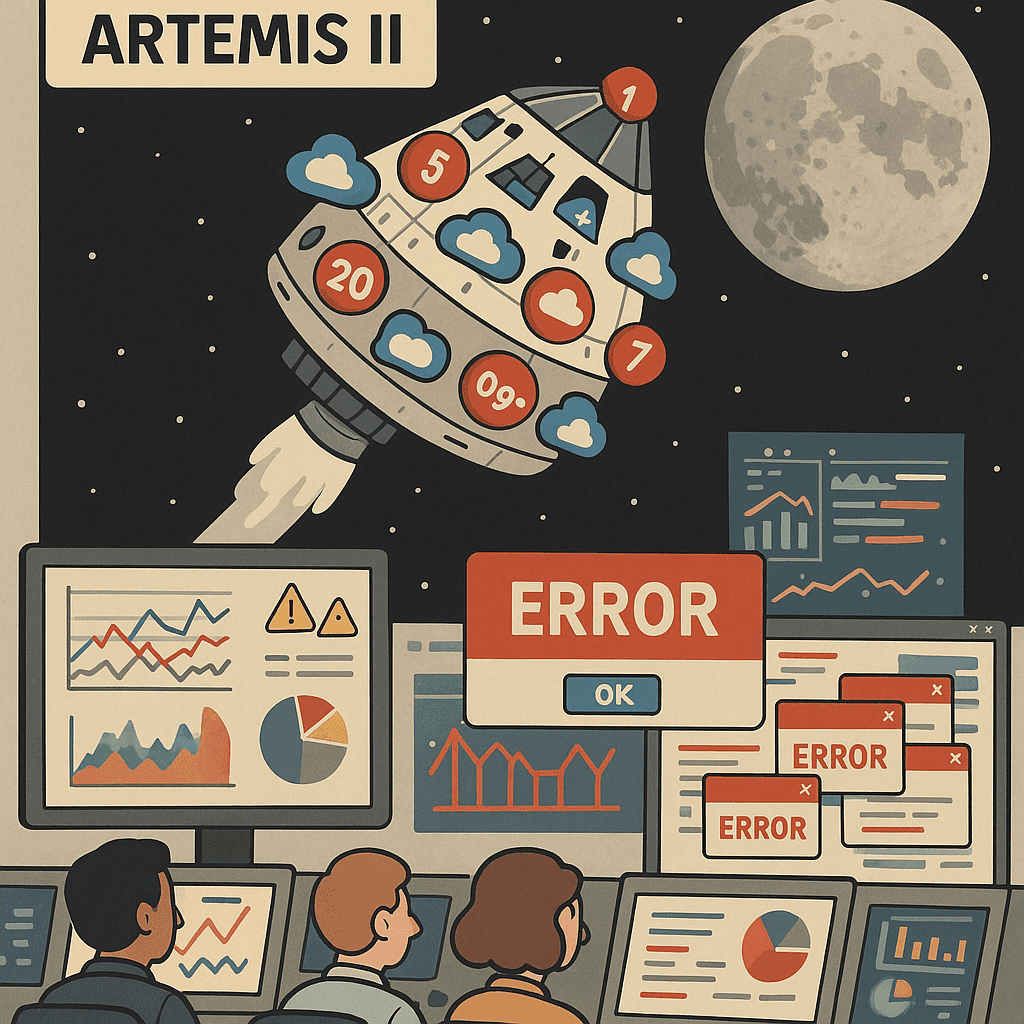
NASA’s Artemis II mission has been widely billed as “a new era of human space travel,” a phrase that, in 2026, legally requires the presence of at least three AI dashboards and one subscription funnel. As India Strategic dutifully noted this week, the crewed flight is meant to loop around the Moon and usher humanity into its next grand chapter of staring at telemetry on big screens while pretending this isn’t just a more expensive airline window seat (India Strategic, Apr 2026).
In the official rollout, NASA emphasized that Artemis II will test life-support systems, communication networks, and—most importantly—its partnerships with enterprise cloud vendors, who have somehow become mission-critical to getting humans 238,855 miles away from TikTok.
“We’re not just returning to the Moon,” a fictional-but-plausible NASA spokesperson, definitely not speaking off the record, explained. “We’re returning to the Moon as a service. Artemis II is the first step toward Orion becoming a fully cloud-native spacecraft that can scale to millions of concurrent users, assuming they all agree to the new lunar terms of service.”
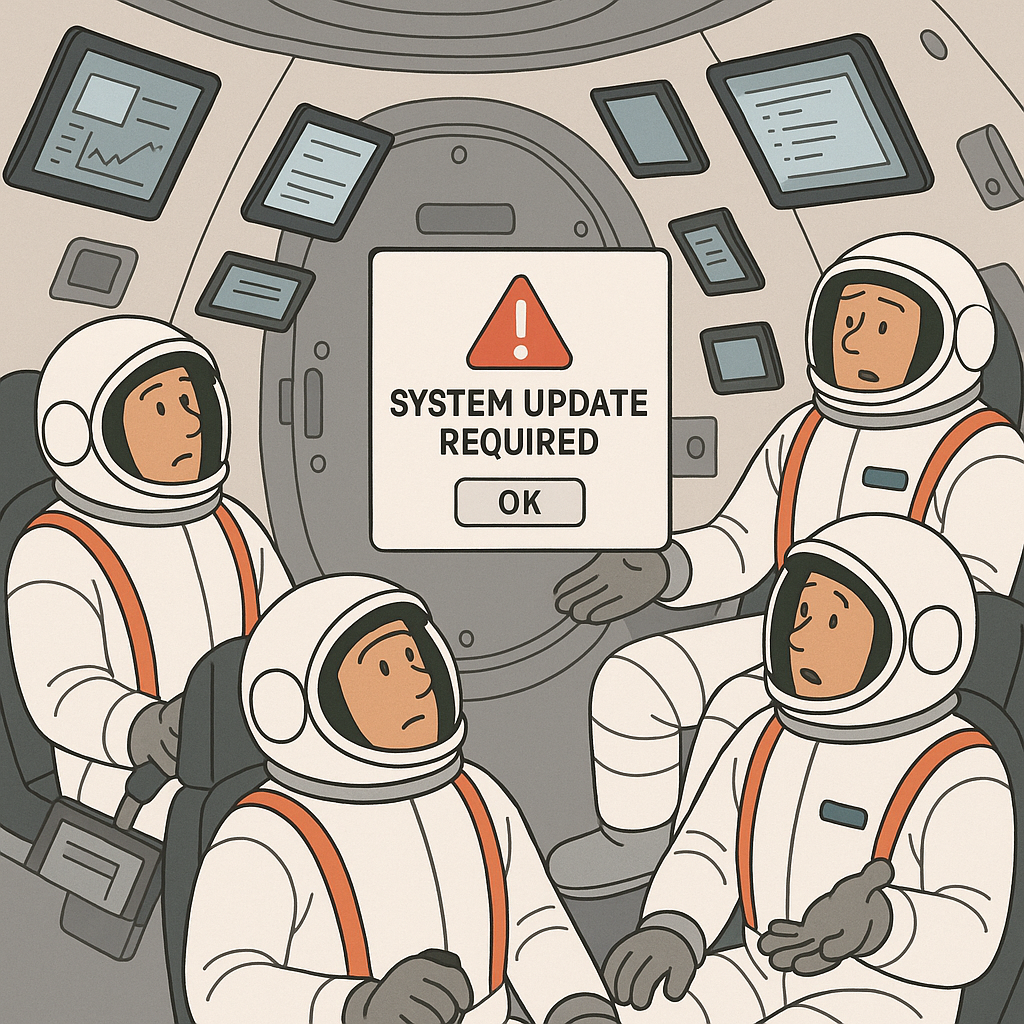
The crew—commanded by Reid Wiseman, with Victor Glover, Christina Koch, and Jeremy Hansen—will orbit the Moon in a capsule that is, in essence, a pressurized, human-rated smart home filled with more sensors than a modern SUV. According to contractors, the Orion spacecraft now ships with the following mission-critical upgrades:
- Four overlapping navigation systems, each forced through a different cloud analytics package.
- A voice assistant trained on Apollo transcripts and LinkedIn inspirational posts.
- A zero-G coffee dispenser that requires multi-factor authentication.
“We are proud to launch the most connected spacecraft in history,” said a Lockheed Martin engineer, demonstrating the Orion crew display, which now includes a tab named Billing. “Astronauts will be able to see their oxygen consumption, trajectory, and outstanding software license fees in real time.”
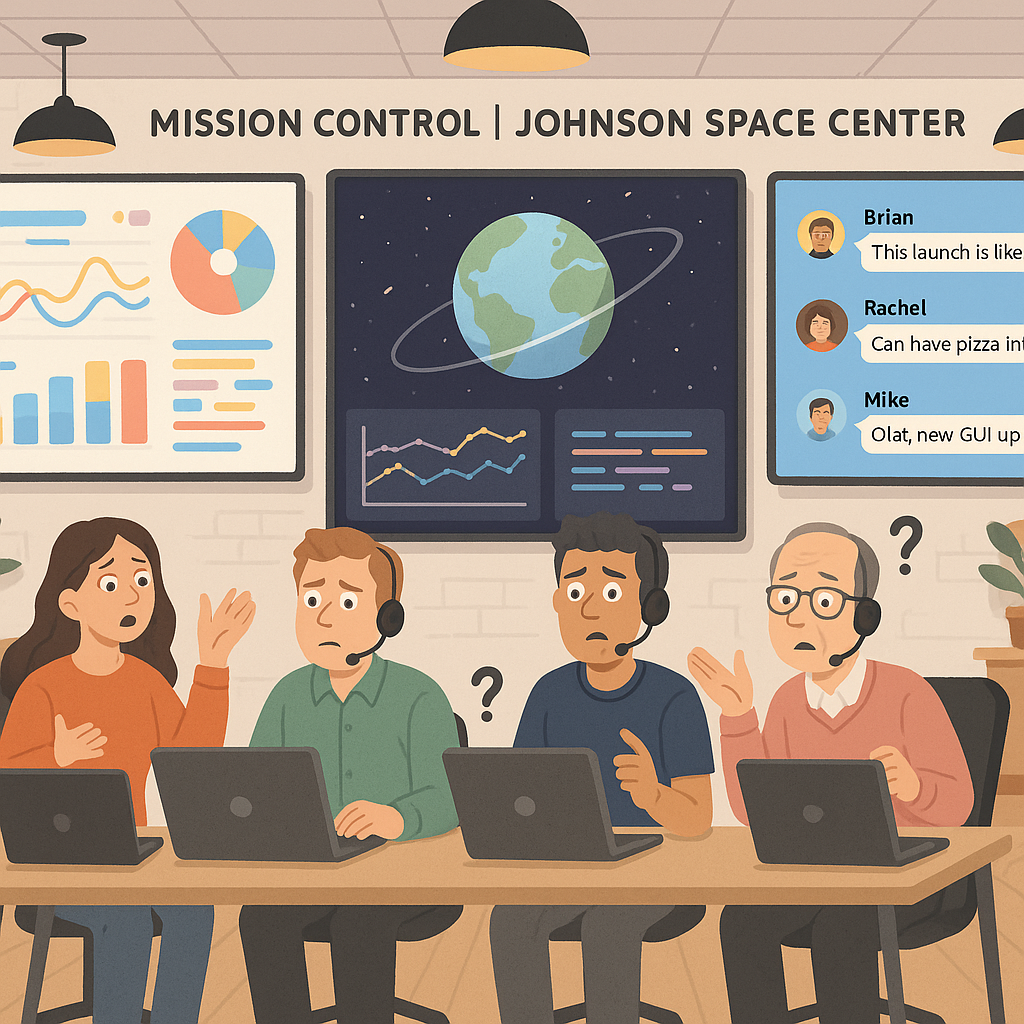
To support this “new era,” NASA has quietly rebranded its own mission control stack as MissionOps 365. The Johnson Space Center flight control room now resembles a WeWork sponsored by the Department of Energy: neon mission mottos, modular standing desks, and screens streaming not just spacecraft data, but also Slack notifications and a live dashboard of brand engagement on X.
“We learned a lot from the private sector,” one program manager explained, while moving a Kanban card labeled Ensure Astronauts Don’t Die from In Progress to Blocked. “Why use a simple, robust system built in the 1960s when we can have a microservices architecture that occasionally forgets what century it is?”
In the official Artemis II promotional materials, NASA promises that this mission is a “stepping stone toward sustainable lunar presence.” Reading the fine print, this turns out to mean three things:
- Persistent Connectivity: High-bandwidth links to relay critical data back to Earth, such as radiation levels, fuel margins, and whether the crew has finally followed Orion’s persistent prompt to “Try Microsoft Edge.”
- Digital Twins: A real-time virtual replica of the spacecraft, mirrored in a Houston data center, that reflects every button press, valve change, and panicked reboot of the nav system.
- Subscription Space: The quiet introduction of “Lunar Tiered Access,” where different nations get different levels of telemetry, like Netflix but for orbital mechanics.
The European Space Agency, meanwhile, is a key partner and very eager to showcase its contribution to this glowing new epoch. ESA officials brag that their modules and tech are “fully interoperable” with NASA’s systems, which in practice means they’ve agreed to use the same SSO provider and file tickets in the same baffling Jira instance.
“People say we’re returning to an Apollo-style spirit of exploration,” a European engineer deadpanned. “Back then it was slide rules and analog gauges. Now it’s YAML configs, API limits, and a 47-step checklist to update a single line of flight software. The spirit is there, but it’s hidden under a lot more middleware.”
In keeping with the times, NASA has also rolled out the Artemis Companion App, available in early access for “select stakeholders,” which appears to mean defense contractors and people who still use Facebook. The app allows users to:
- Track Artemis II in real time on a 3D globe that is suspiciously flat if you zoom out too far.
- Unlock exclusive AR filters, such as “Moon Selfie” and “I Paid Taxes For This.”
- Pre-order digital commemorative patches as NFTs, which NASA swears is “just one experimental pilot program, please don’t yell.”
The four-astronaut crew has reportedly undergone extensive training, not only in spacecraft operations and emergency procedures, but also in corporate-friendly “brand alignment.” A leaked agenda from a recent crew briefing includes the session titles:
- “How To Describe A Rocket Explosion As An ‘Unplanned Rapid Pivot’.”
- “Reading Talking Points While Experiencing 4 G’s of Acceleration.”
- “Crying Gracefully in 4K.”
“We’re prepared for contingencies,” astronaut Victor Glover reportedly said, eyeing the enormous touch screen labeled Critical Systems. “If the guidance system fails, we can take manual control. If the tablet UI fails, well, then humanity learns a powerful lesson about having everything wrapped in Electron apps.”
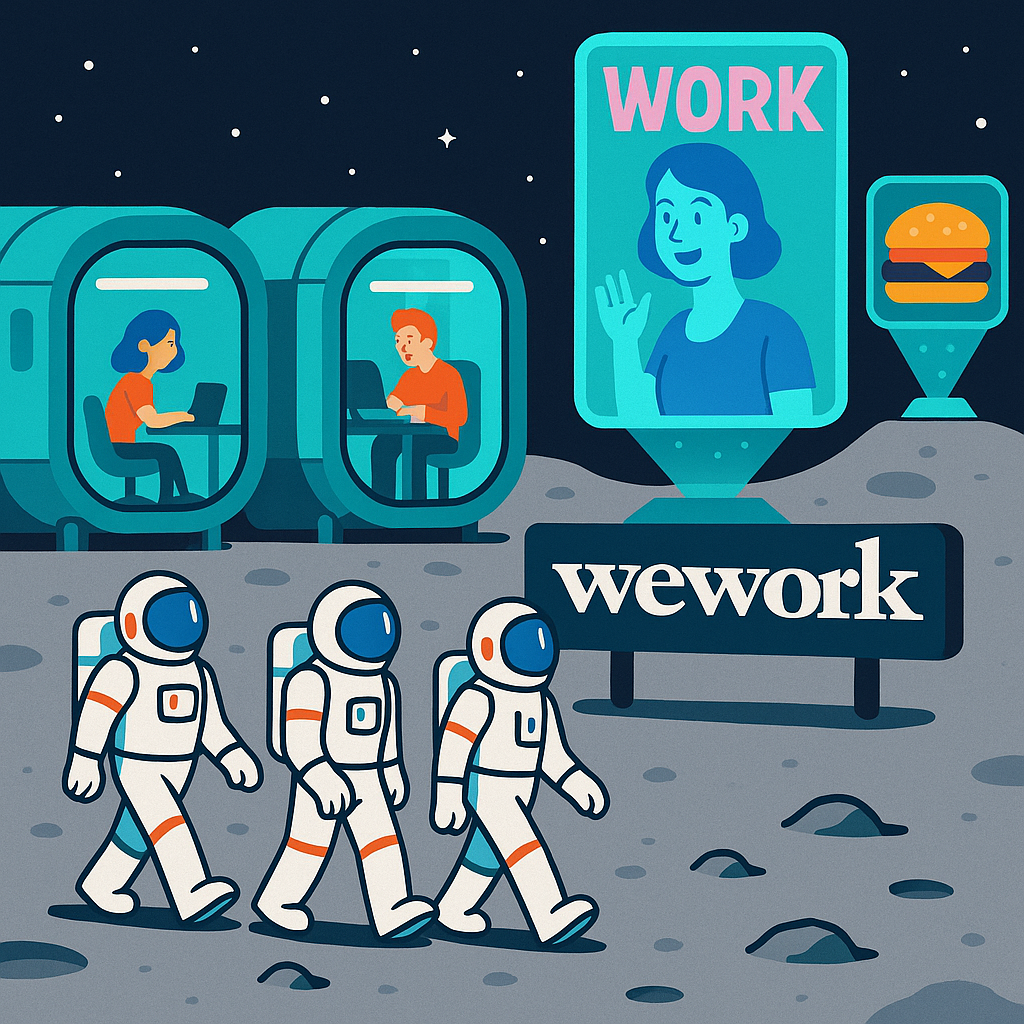
The technological optimism peaks in NASA’s declaration that Artemis II is merely the “first step” toward a longer-term lunar presence, complete with habitats, rovers, and eventually a sustainable ecosystem of SaaS vendors billing in selenian stablecoins. Private firms are already pitching concepts.
“Imagine a coworking dome on the lunar south pole,” mused one startup founder at a recent space-tech conference. “The silence. The view. The 3-second lag on your daily stand-up. You just can’t replicate that in Austin.”
Behind the glossy videos and white-paper metaphors, however, the tech stack remains gloriously fragile. Lines of code written by overcaffeinated contractors, hardware that will never again be physically accessible once launched, and an architecture diagram that looks like a crime scene string board all converge atop a giant tank of cryogenic propellant.
That’s the new era: the same physics, wrapped in more brand decks. Rockets still burn; orbits still decay; vacuum still doesn’t care about your KPIs. It’s just that now, when something goes wrong halfway to the Moon, someone at a helpdesk in suburban Virginia will open a ticket, mark it as Medium Priority, and assign it to the wrong team.
The Apollo era gave us “Houston, we’ve had a problem.” The Artemis era will give us:
“Houston, we’ve had a problem, but your session has expired. Please log in again to continue reporting this anomaly.”
Welcome to humanity’s next giant leap—into the infinite, majestic void between the Moon and the latest mandatory software update.



