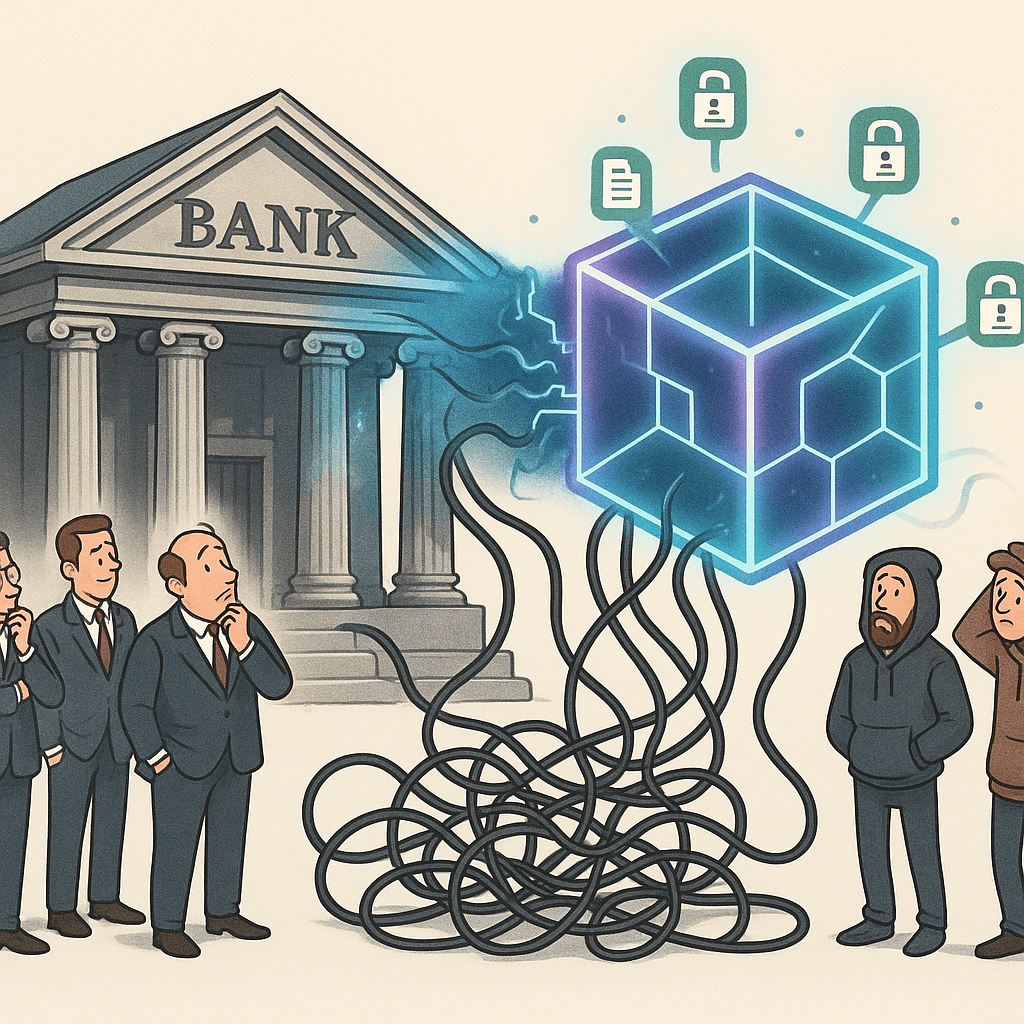
There comes a moment in every bank’s life when it looks at a volatile, regulation-dodging, yield-farming carnival and says, with a straight face, “We should integrate that into our core payments stack.” According to American Banker’s recent piece, “The Fusion of TradFi and DeFi Raises Questions for Bank” (American Banker, Mar 2026), that moment has arrived, complete with whitepapers, pilot programs, and at least one steering committee named after a sea animal.
On one side of this forced marriage is TradFi — the stately world of Bank Secrecy Act binders, quarterly earnings calls, and people named “Chad” who sincerely say “let’s circle back.” On the other side is DeFi — a chaotic ecosystem where anonymous cartoon frogs push smart contracts that may or may not be rug pulls, governed by DAOs that vote using tokens they accidentally airdropped to bots. In the middle stands the average bank, clutching a PowerPoint titled “Digital Transformation: From Spreadsheet to Smart Contract in Just 18 Committees.”
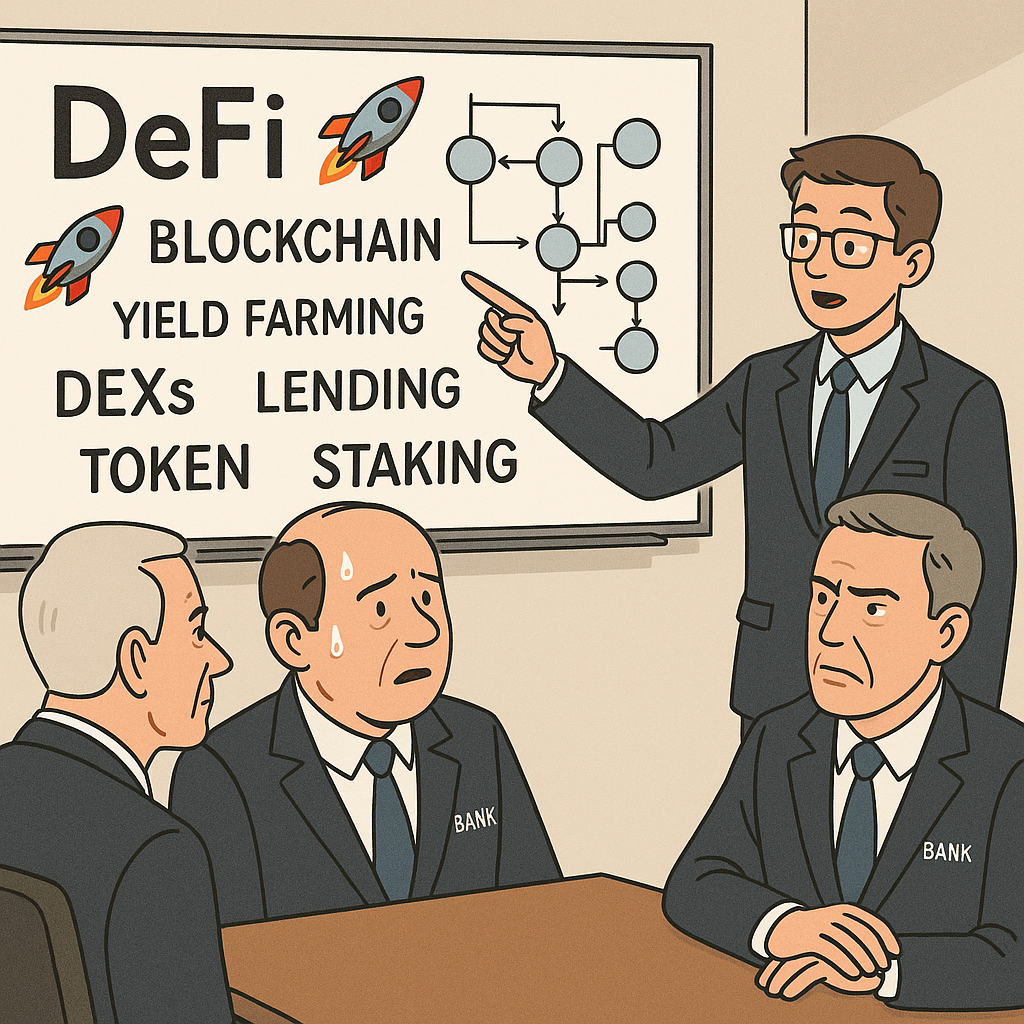
The American Banker piece frames this as an “inflection point”: how should banks navigate the fusion of TradFi and DeFi without accidentally laundering a nation-state or angering a regulator who still prints out their emails? The answer, based on industry behavior so far, appears to be:
- Rename everything.
- Tell the board it’s about “youth engagement.”
- Pray the pilot never leaves “sandbox” status.
Internally, the strategy decks are heroic. One large bank reportedly created a “DeFi Center of Excellence” staffed with exactly one person who once bought ETH on Coinbase. Another appointed a “Head of On-Chain Strategy,” a title which, sources confirm, mainly involves adding the word “on-chain” to existing vendor RFPs and then quietly losing them in procurement.
Compliance, meanwhile, is reeling. Traditional Know Your Customer means collecting IDs, proof of address, and a biometric scan that will sit in a data lake until the heat death of the universe. DeFi’s version of KYC is a Discord username and the assertion, “Yeah bro, I’m in the U.S. Virgin Islands, for sure.” When asked how banks should bridge this gap, one veteran risk officer responded, “We’re exploring a hybrid approach,” then stared into the middle distance for twenty-three seconds.
To make DeFi palatable to the suits, TradFi is rebranding it as “on-chain finance,” “programmable liquidity,” and, in one astonishing slide deck, “Web3-Enabled Relationship Banking.” That last one described a future where your mortgage is a smart contract that can self-execute, self-enforce, and—crucially—self-liquidate your house at 3 a.m. because an oracle misread a price feed.

The core promise dangled in front of bank executives is irresistible: take the speed and composability of DeFi, add the depositor confidence of TradFi, mix with Basel-compliant leverage, and you get a product that is simultaneously too confusing to fail and too interconnected to explain to Congress. Picture a high-yield savings account where your cash is quietly staked across twelve protocols, four cross-chain bridges, and one DAO whose treasury is governed by a meme mascot with laser eyes.
The American Banker article politely notes that this “raises questions for bank.” Such as:
- When your DeFi yield product gets hacked via a re-entrancy attack, is that a cyber incident, a market loss, or “unfavorable FX movement” in the quarterly report?
- Is a rug pull a known risk, or can we still call it “unexpected volatility” and blame macro conditions?
- If a DAO votes to default on your customers, who exactly do you sue? The multisig?
The engineers, of course, are thrilled. After a decade of wiring batch ACH files to COBOL mainframes, they’ve been handed Ethereum and told to “build something disruptive, but not like, you know, too disruptive.” The current plan at several institutions is to wrap DeFi protocols in so many API gateways, middlewares, and legacy approval flows that by the time a transaction settles, it functionally is an ACH file again, just with a gas fee and a commemorative NFT.
Customers aren’t far behind in the confusion department. One pilot program reportedly sent beta users a pitch for a “DeFi-Enhanced Savings Experience,” promising “up to 8% APY via decentralized liquidity pools integrated directly into your trusted banking app.” The FAQ section, to its credit, did include a key question: “Can I lose all my money?” The answer was a soothing, “Your principal is subject to market, protocol, governance, smart contract, counterparty, and existential risk.”
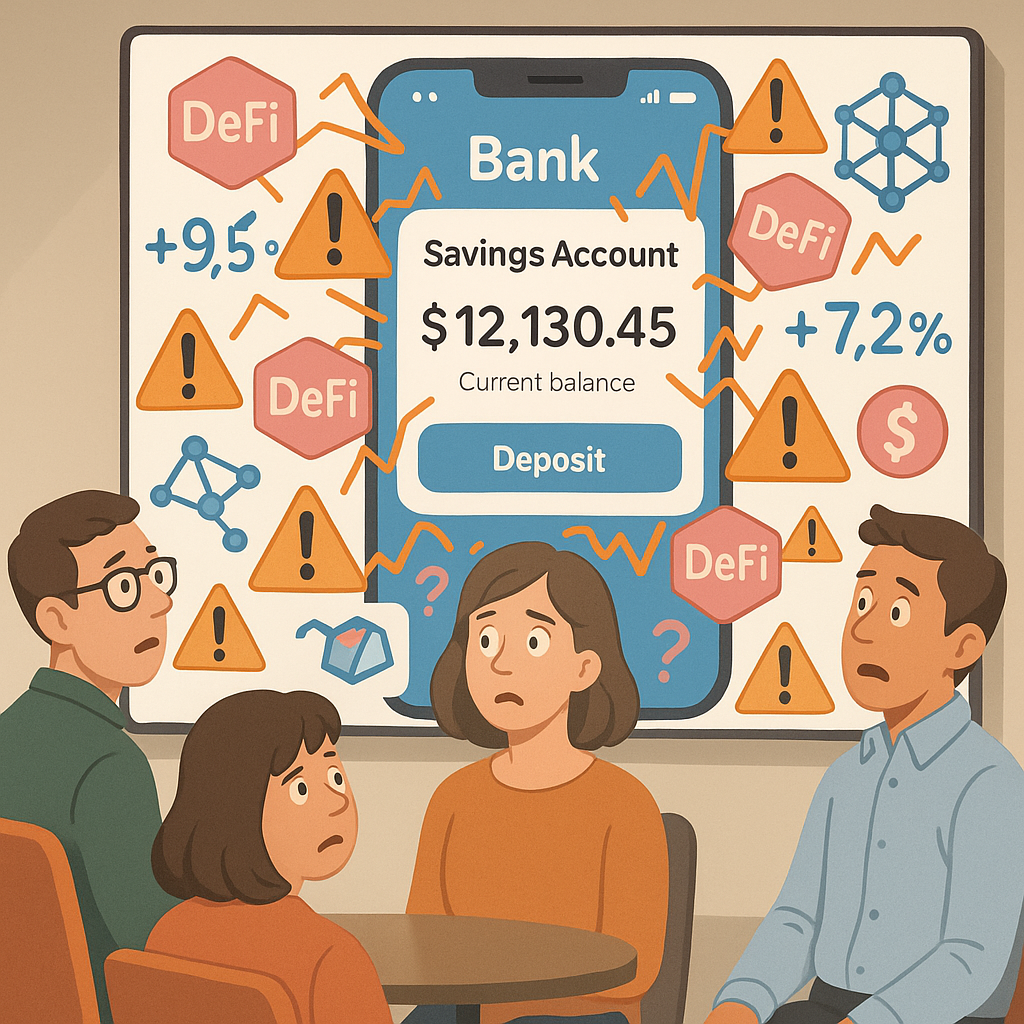
Regulators watching this fusion of TradFi and DeFi are reacting with a potent mix of alarm and curiosity, like parents discovering their teenager has started “experimenting with yield strategies.” The hope in places like Washington, Brussels, and Basel is that if banks domesticate DeFi, it will become safer, or at least slower. The more likely outcome is that it simply becomes auditable: every loss will be meticulously documented across three jurisdictions, five custodians, and one unbelievably long incident report.
Still, the momentum is real. In the same way that no executive in 2010 wanted to admit they didn’t understand “the cloud,” no one in 2026 wants to admit they think “liquidity pool farming” is something that happens at an HOA. The fusion of TradFi and DeFi is inevitable because no one wants to be the only bank that didn’t put customer deposits into an algorithmic stablecoin that a venture fund said was “basically risk-free unless something weird happens.”
The endgame is almost poetic. Decades from now, a new generation will revolt against a lumbering, regulated, permissioned on-chain financial system and invent something edgier outside of it. They’ll call it “post-DeFi.” They’ll write anonymous smart contracts that promise 400% APY. They’ll sneer at “boomer chains” run by banks. And a trade outlet—probably still American Banker—will run a thoughtful piece titled, “The Fusion of RegFi and Post-DeFi Raises Questions for Bank.”
And the cycle will continue, one compliance memo at a time.