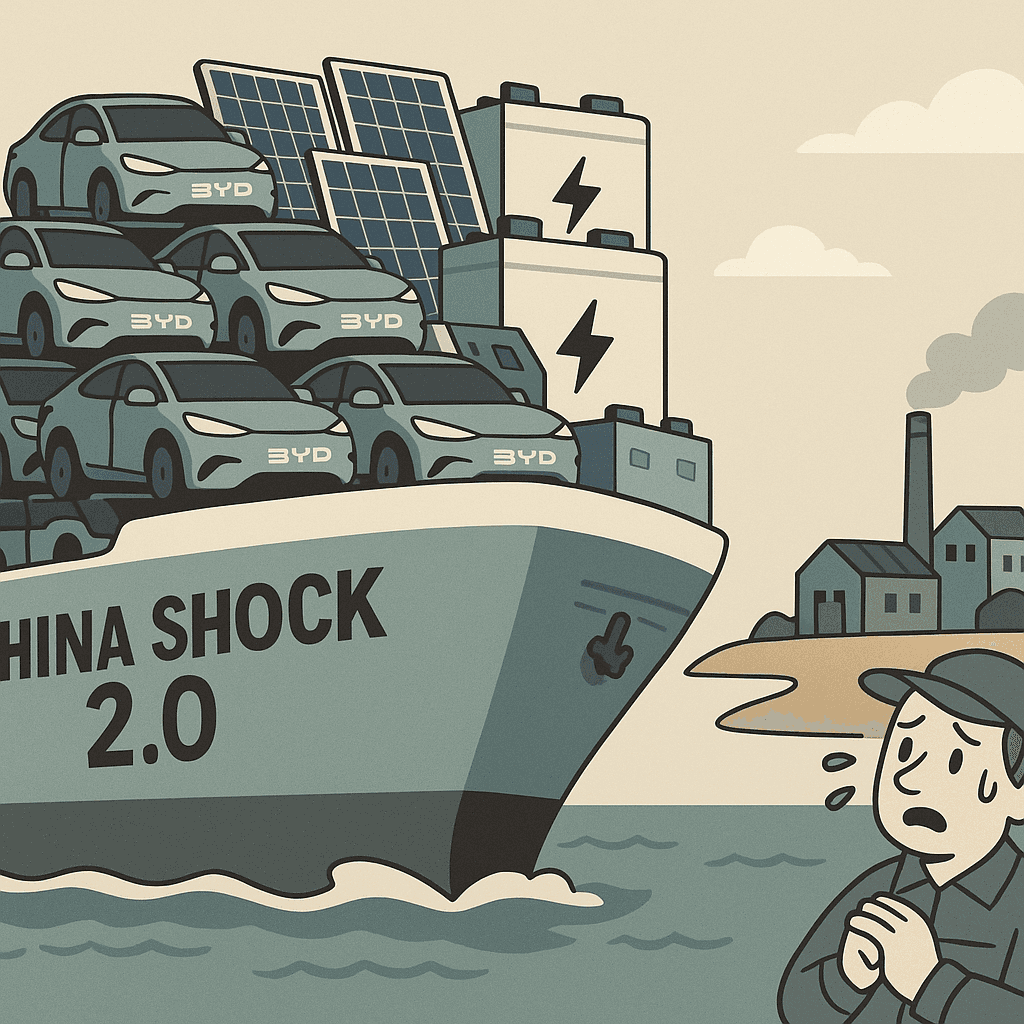
In a development many finance ministers are currently describing into their pillows, the global economy has been invited to experience China Shock 2.0, a premium reboot of the early‑2000s outsourcing crisis, now with more electric vehicles and slightly less dignity.
According to reporting in the Washington Post, the People’s Republic of China has begun flooding the planet with underpriced cars, batteries, and solar panels, a move economists describe as “export‑led growth” and factory workers describe as “that feeling when your job becomes a BYD trunk liner.” While tariffs in the United States have redirected some of the wave, Europe and emerging markets are enthusiastically absorbing the merchandise in what officials there insist is “not at all a slow‑motion industrial exorcism.”
Beijing’s strategy is straightforward: after years of state‑directed investment, China has more EVs, batteries, and solar modules than its own consumers can physically park, charge, or look at out their apartment windows. Rather than slow investment, Xi Jinping’s government has opted for a simpler fix: ship the surplus abroad until either domestic growth stabilizes or the World Trade Organization remembers its password.
“We are leveraging new productive forces to meet global decarbonization needs,” a Chinese economic planner said at a recent forum, gesturing at a slideshow labeled “How To Turn Overcapacity Into Your Problem.” “Also, our warehouses are full.”
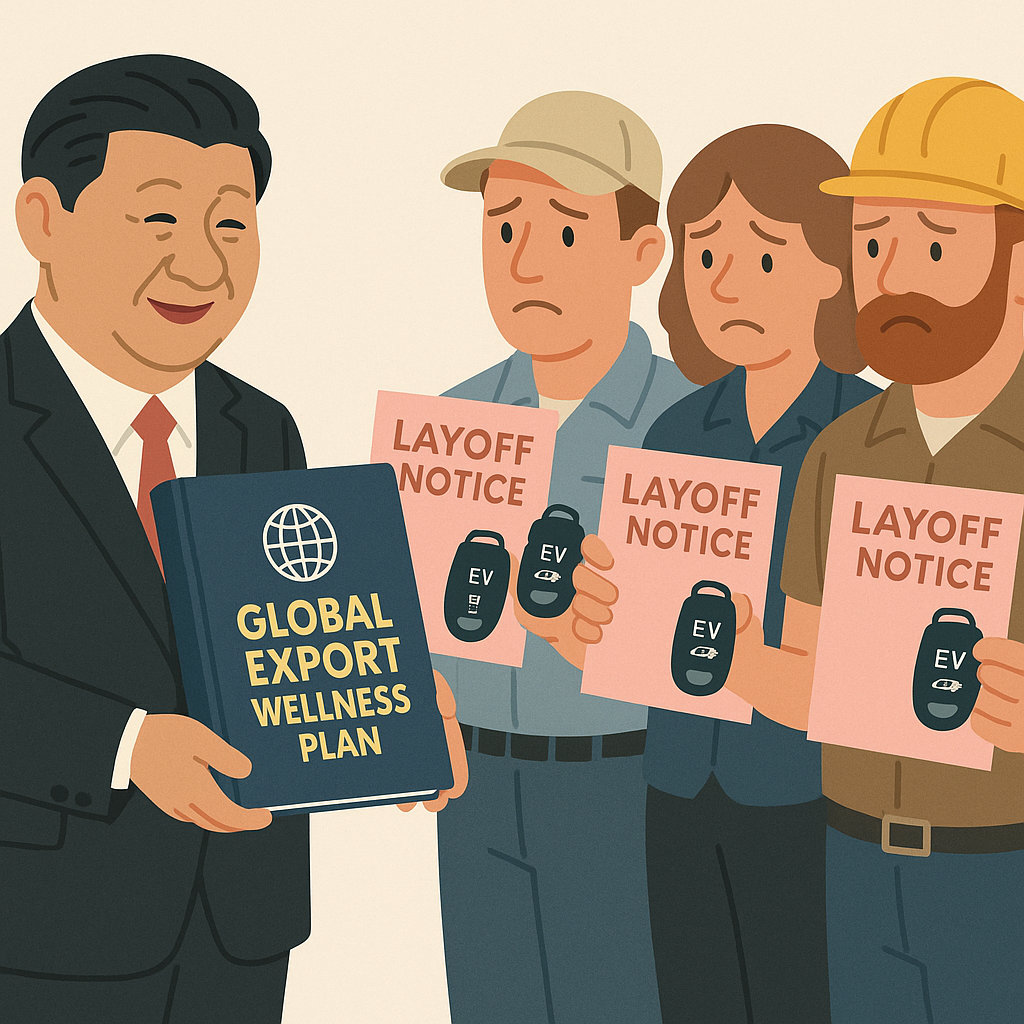
Across the European Union, this has been warmly received by consumers and less warmly received by people whose job titles include the word “factory.” As BYD sedans glide off ships in ports from Zeebrugge to Barcelona, local automakers report a sharp uptick in existential dread per capita, tracked helpfully in a confidential spreadsheet at the European Automobile Manufacturers Association.
“Our members strongly support the green transition,” said a union representative outside a recently idled European auto plant, “as long as it does not involve an actual transition of their jobs to Shenzhen.” He paused, then added, “We were told we were competing with Germany. Not with an entire one‑party state that treats EBITDA like a social engineering project.”
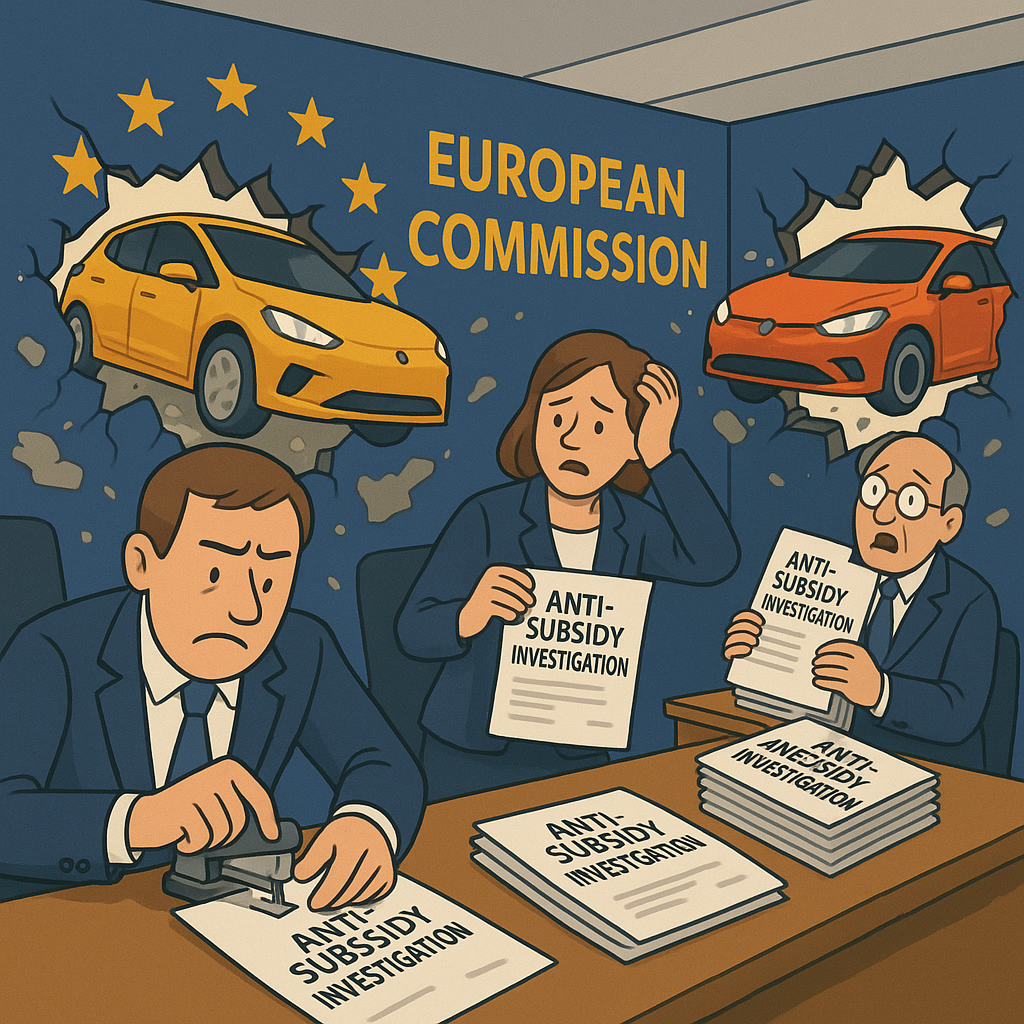
The European Commission has responded with a familiar wellness tool: anti‑subsidy investigations. Brussels regulators are currently probing Chinese EVs in order to discover the precise mathematical formula that converts state support, free land, and discounted electricity into a sticker price that makes European cars look like artisanal jewelry. Provisional duties have followed, which officials say are “carefully calibrated” to protect domestic industry while still letting enough cheap EVs through to hit climate targets and avoid riots at charging stations.
“We are walking a balanced path between decarbonization and de‑industrialization,” one EU trade official said. “Unfortunately it is the same path.”
In Washington, the Joe Biden administration, and the possible Trump administration 2.0 waiting in the wings, insist they are ahead of the curve. Trump‑era tariffs on Chinese goods were absorbed into a bipartisan spiritual practice known as “tough on China,” which involves lecturing about resilience while quietly importing the same products through Mexico. As the Post notes, Chinese exports that once went directly to the United States are now arriving with a short layover in third countries, where they pick up a certificate of origin and a tan.
“The data is clear,” said a U.S. trade policy analyst. “We have successfully reduced dependence on Chinese manufacturing by reclassifying it as Vietnamese.”
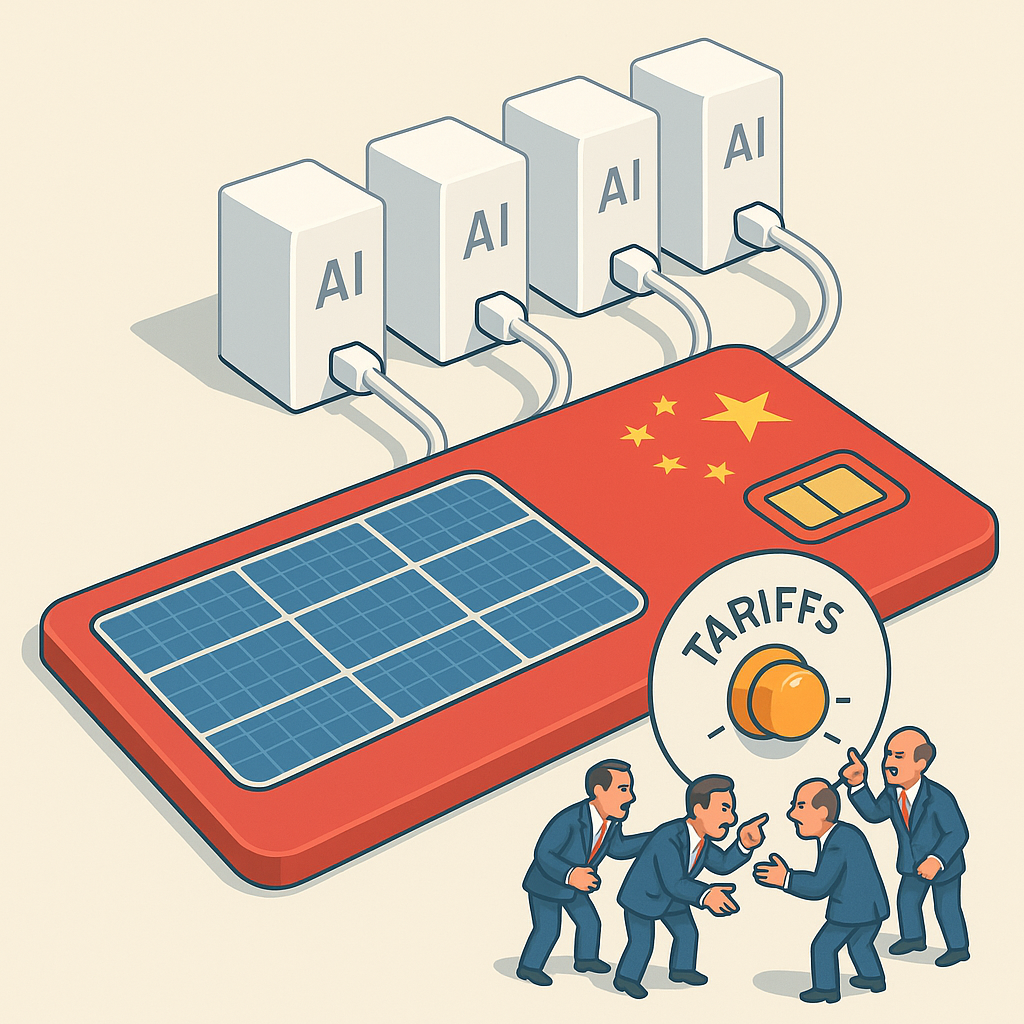
Meanwhile, Big Tech has entered the chat. With Morgan Stanley estimating that one gigawatt of AI capacity now costs up to $49 billion, global cloud providers are searching for ways to keep training large language models without accidentally nationalizing the power grid. The solution, it turns out, is also China Shock 2.0.
Finance executives openly admit that the cheapest way to feed data centers is to bolt them onto imported Chinese solar panels, inverters, and battery packs, the same hardware now triggering emergency trade meetings in Brussels. The AI boom that was supposed to “de‑risk” supply chains is instead running on a subscription box of Chinese power electronics.
“The math is compelling,” said one tech CFO during earnings season. “We can either pay three times more for locally sourced equipment, or we can achieve shareholder value and hope geopolitics respects our Q4 guidance.”
Emerging markets are discovering that in China Shock 2.0, they are not just participants but potential hosting platforms. Countries from Hungary to Mexico are vying for Chinese EV and battery plants, selling this to voters as “re‑industrialization” rather than “serving as a tariff sleeve.” Local officials pose for ribbon‑cuttings while quietly Googling “what happens when U.S. and EU both sanction your best new employer.”
“We are delighted to welcome this BYD facility,” one Eastern European minister said, standing in front of a glossy render of an EV plant that looked suspiciously like a cut‑and‑paste from the Shenzhen zoning office. “The jobs are green, the technology is advanced, and the legal liability appears to be located somewhere offshore.”
The political backlash is arriving on schedule. As factories shut and showrooms fill with discounted Chinese models that come pre‑loaded with more features than the average parliamentary democracy, populist parties across Europe are discovering that nothing polls better than blaming a BYD hatchback for the fall of Western civilization.
In campaign speeches, candidates now promise to “stand up to Beijing” while carefully avoiding the follow‑up question about whether this includes standing between voters and a €14,000 EV that charges faster than their national grid can pass a budget. Focus groups, when presented with a choice between “protecting domestic industry” and “keeping the cheap car with the heated steering wheel,” largely responded, “How big are the tariffs exactly, and can we finance them?”
Trade governance, once the realm of dense WTO memos, has evolved into something more experiential. With the organization stuck in procedural limbo, governments are discovering the liberating energy of unilateral tariffs, reciprocal tariffs, and tariffs announced live on cable news. CNN recently highlighted Donald Trump threatening to tariff Canada over wildfire smoke, a move that analysts say “fills them with confidence” about how a second Trump administration might calibrate levies on Chinese EVs, solar panels, and, if necessary, weather.
“Tariffs are a very flexible instrument,” a former Trump trade adviser told reporters. “You can use them on steel, on cars, on batteries, or on particulate matter drifting over the border. Once you are in a hammer mindset, everything looks like a customs form.”
Back in Beijing, officials insist the concerns are overblown. China’s export surge, they argue, is simply helping the world meet climate goals, AI energy demand, and consumers’ need to feel something while sitting in highway traffic. If this accidentally annihilates some foreign manufacturing, they suggest, perhaps those countries should consider innovating in high‑value sectors like compliance software or mindfulness apps.
“We are offering the world low‑cost solutions for decarbonization,” a Chinese spokesperson said. “If that creates stress, Western partners are free to develop high‑margin stress management tools. This is what we call win‑win.”
Governments now face a clear policy choice. They can block Chinese exports of EVs, batteries, and green tech, accept higher prices, slower climate progress, and fewer AI servers, then hope voters appreciate the nuance. Or they can keep the cheap imports, accelerate decarbonization, expand AI capacity, and explain to newly unemployed workers that they are now “strategically diversified” into the experience economy.
In practice, most are pursuing a sophisticated middle way: loudly promising to re‑industrialize, quietly wiring subsidies to almost anything with a plug, and praying that no one reads the trade data.
On current trends, by the early 2030s the world will have successfully reduced emissions, fueled a vast AI infrastructure, and empowered millions of consumers to drive affordable EVs. The only unresolved question will be who exactly makes anything, besides Chinese factory complexes and Western political consulting firms.
Everything else, policymakers assure us, can be imported.



