
In a development experts called inevitable, Europe has responded to mounting U.S. controls on advanced AI by unveiling a sweeping strategy to achieve “AI sovereignty” that depends almost entirely on the same American companies it is trying to be sovereign from.
Gathered in France for the G7 Summit and the VivaTech conference, European Union officials described a new era in which the continent will “stand on its own two feet,” then quietly checked whether Microsoft, Amazon Web Services, Google or Nvidia could lend them the legs.
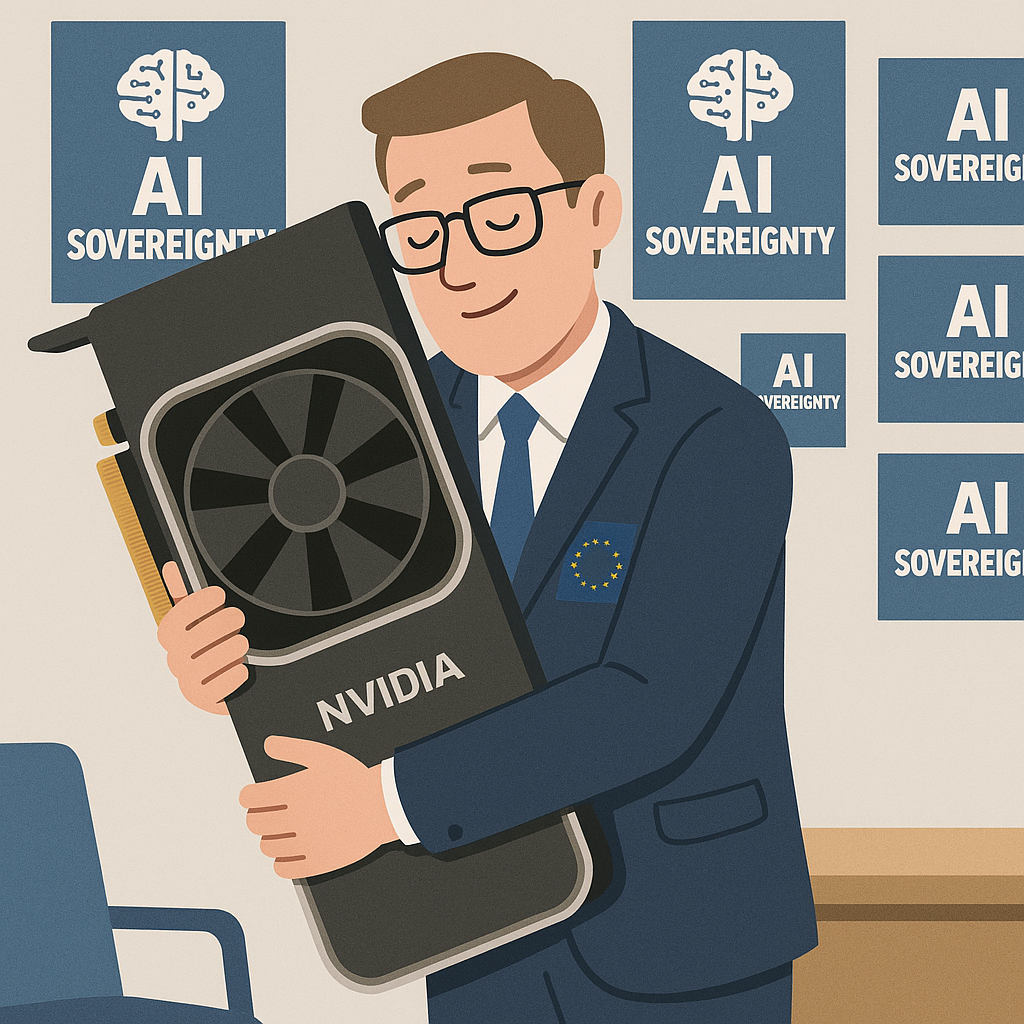
The trigger, as Reuters dryly noted, was Washington’s decision to tighten export controls on Anthropic’s most advanced models for foreign nationals, including Europeans. In practice, the rule means that the continent’s AI dreams now come with a handy off switch located somewhere between the Pentagon and an Anthropic compliance Slack channel.
Brussels calls this a “wake-up call.” U.S. executives, landing in Paris on privately branded AI jets, call it “Wednesday.”
“Europe’s AI sovereignty moment has clearly arrived,” said an aide to the European Commission, speaking on condition of anonymity because their remarks were being auto-transcribed on a U.S. cloud. “We will build domestic models, domestic chips and domestic clouds so resilient that, in the next crisis, Washington will have to flip at least three different switches to shut us down.”
Onstage at VivaTech, French, German and Italian ministers announced an array of sovereignty initiatives that largely involved giving more public money to companies that already rely on American GPUs, American hyperscale data centers and American lawyers.
- France pledged new billions for “sovereign compute clusters,” to be constructed in partnership with Nvidia, which is headquartered in Santa Clara, California, a popular suburb of Europe.
- Germany promised to back “trusted AI clouds” with providers like OVHcloud and Deutsche Telekom, which currently run their most profitable workloads on infrastructure rented from U.S. firms.
- Italy vowed to support domestic AI startups, funded in part by U.S. venture capital that insists on Delaware holding companies for tax reasons that remain, in Brussels language, “under assessment.”
“This is what strategic autonomy looks like,” said one diplomat, gesturing toward a VivaTech booth where a European AI startup proudly displayed its logo above a placard reading “Powered by Azure.”
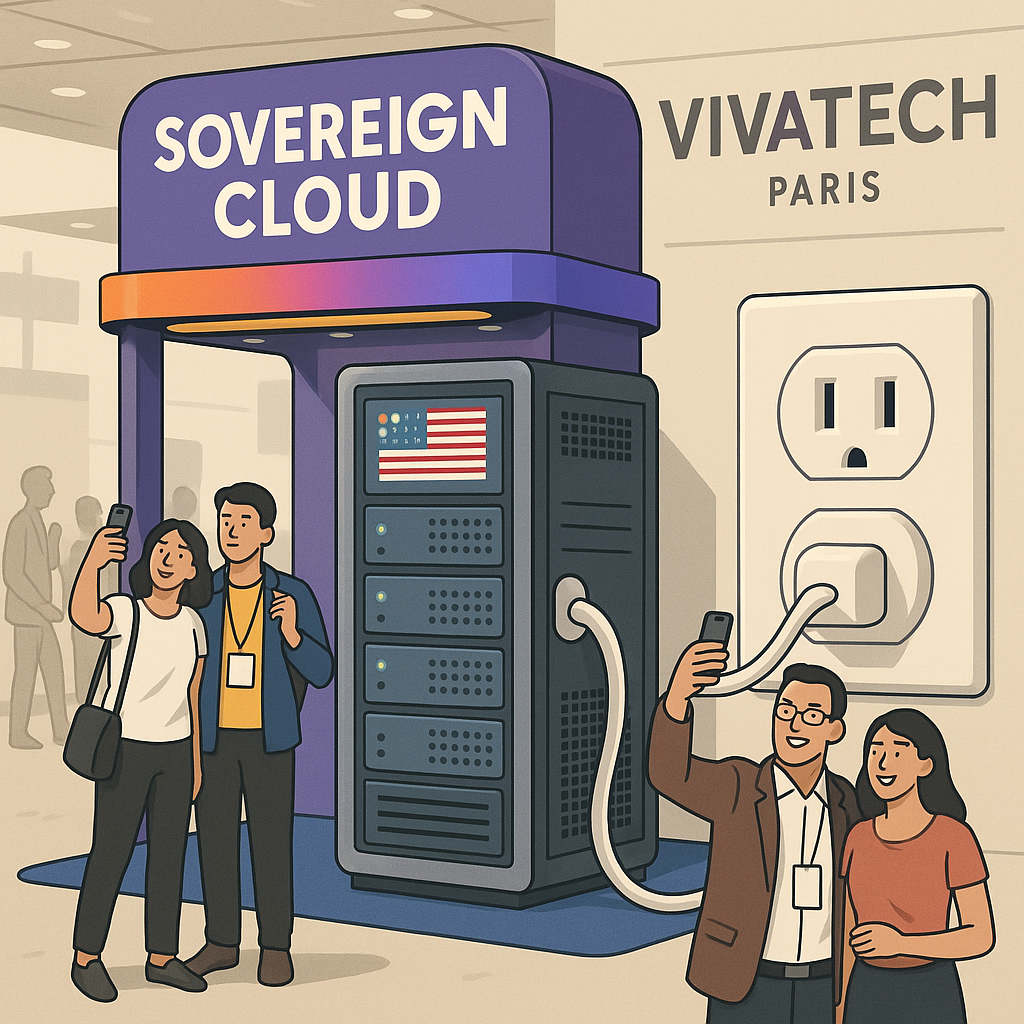
The European Commission insists the plan is coherent: use the bloc’s regulatory might, embodied in the new EU AI Act, to shape the global rulebook, then channel the resulting compliance panic into subsidies for local champions. Officials privately acknowledge that the region’s leading “sovereign” models, from firms like Mistral and Aleph Alpha, are currently trained on U.S.-designed chips housed in U.S.-linked data centers, and benchmarked on a leaderboard hosted in California.
“It is about building more resilient technology strategies,” one Brussels official told Reuters. “European companies should control the most critical parts of their stack.” Asked which parts those were, the official pointed to a PowerPoint slide containing the word “ETHICS” in 72-point font above a footnote explaining that GPUs would be ordered from Nvidia subject to availability.
To underline the urgency, G7 leaders convened a closed-door session on AI in a Versailles side room that previously hosted discussions on global poverty. This time, according to attendees, the vibe was even more somber.
“Our dependence on U.S. AI is a strategic vulnerability,” one European leader reportedly said. “Any unilateral American decision could disrupt our supply of high-end models.”
Participants then turned to a large screen running an Anthropic model to draft the session communiqué summarizing their concern about their lack of access to Anthropic models.
Meanwhile, U.S. CEOs made a point of expressing sensitivity. Anthropic representatives reassured European regulators that the export controls were limited in scope, that they remained committed to the market and that, in the event of future restrictions, the company would “work collaboratively with stakeholders to find compliant ways to keep you almost up to date.”
Microsoft and Google executives, asked whether similar controls might soon apply to their own frontier systems, responded with a united front: a noncommittal smile perfected over a decade of antitrust hearings.
Across town, VivaTech attendees rushed between stages with titles like “AI Sovereignty: Building Europe’s Own Stack” and “How To Get Your Nvidia Allocation Before The Americans Notice.” The most popular booth featured a life-sized cutout of a GPU that participants could pose with, the closest many said they had come to actual compute capacity.
Corporate Europe is officially on board. Banks, automakers and healthcare groups have begun issuing press releases about “de-risking their dependence” that read identically, apart from the logo in the upper left corner and whether their “strategic partner” is Microsoft, AWS or Google Cloud.
“We are embracing a hybrid, multi-cloud, sovereign-by-design approach,” said one French automotive executive whose main AI project is a ChatGPT plugin for the dealership website. “We run customer-critical workloads in a European region of an American cloud, which is basically the same thing as independence if you squint.”
Behind the stagecraft, the numbers remain inconvenient. The United States still dominates frontier models through Anthropic, OpenAI, Google and Meta. Nvidia sits on the global GPU throne. U.S. hyperscalers control much of the cloud where European models are trained, deployed and occasionally rate-limited.
In response, Brussels has developed a two-track wellness plan for the continent’s digital self-esteem:
- Regulate early and often, to ensure that any AI system operating in Europe meets the bloc’s high standards for transparency, safety and the right to complain to a data protection authority about your algorithmic horoscope.
- Subsidize heavily, to encourage European firms to build AI systems that meet those standards and also, ideally, work.
Officials insist this approach is not contradictory. Critics suggest that telling startups they must comply with the world’s strictest AI law while simultaneously competing against U.S. giants who provide both their infrastructure and their main source of capital may not be the fastest route to sovereignty.
Asked about this at a VivaTech panel, one European Commissioner maintained a serene expression.
“We are not against American companies,” they said. “We simply want to ensure that Europe has choice.”
Pressed on what happens if Washington broadens export controls, they added, “Then we will exercise that choice by choosing between slight dependence and extreme dependence.”
For now, the symbolism will continue. The G7 host gifted world leaders personalized German soccer jerseys and a Versailles dinner. Behind the scenes, aides traded something more valuable: tentative assurances from visiting U.S. executives that, as long as Europe remains a lucrative customer and useful co-signer on global risk frameworks, the off switch will stay in the “not yet” position.
It is a delicate balance: Europe wants strategic alignment with Washington on security, a firm stand against Iran and a shared vision of democratic values, while also quietly hoping the next round of American export controls forgets to include the specific GPU model their “sovereign” cloud just finished pre-ordering.
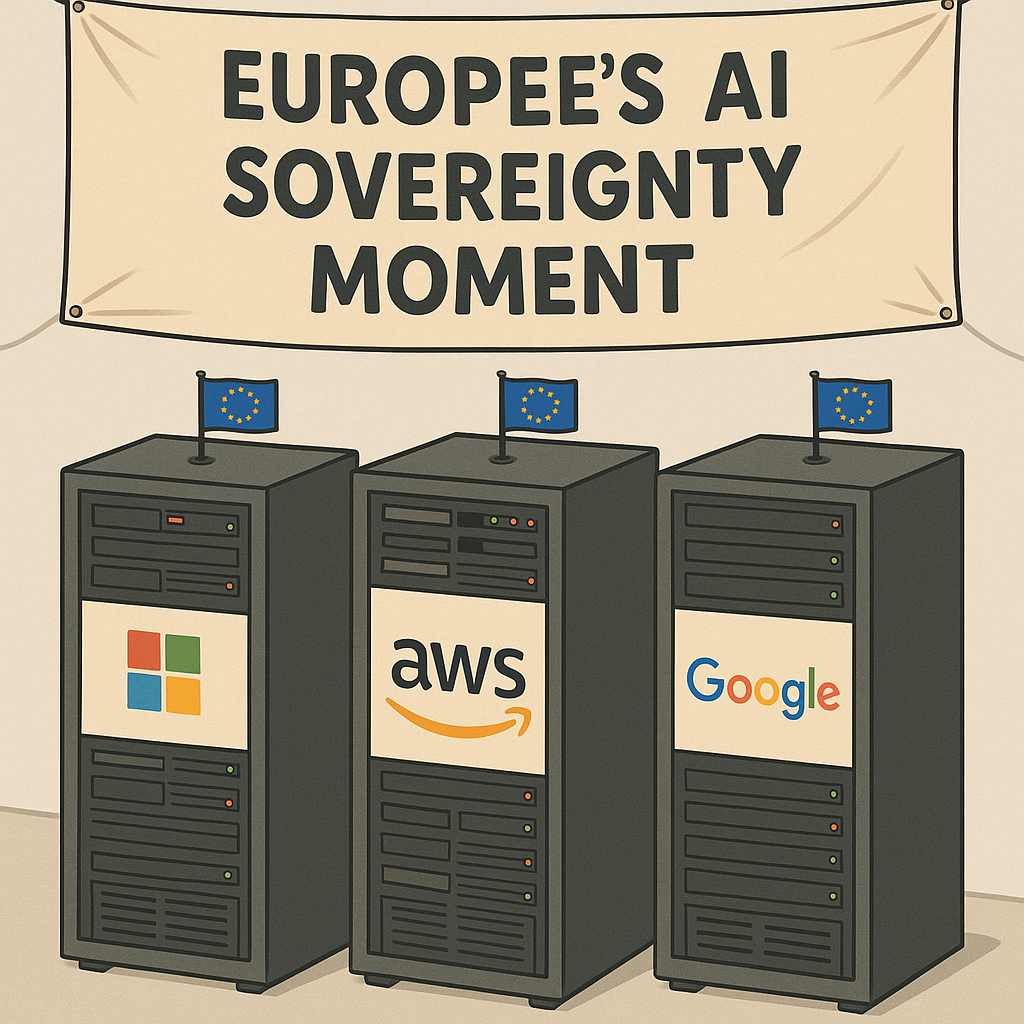
Back at VivaTech, a banner above the main hall reads “Europe’s AI Sovereignty Moment.” Beneath it hum three vast server racks, stocked with Nvidia chips, financed with U.S. venture money, running models trained on American datasets in compliance with the EU AI Act.
They belong to a European startup whose CEO takes the stage to declare:
“We are proof that Europe can finally break free from America’s tech grip.”
The livestream buffers for a moment, while the U.S. cloud auto-scales their instance. Then the connection stabilizes, and the applause continues.



