Japan is sitting on some of the most dangerous volcanoes on Earth, and at least one scientist is trying to figure out how to stop a disaster before it starts. Deep under Kagoshima Prefecture, the Aira caldera and nearby systems store enough magma that a rare “supereruption” could devastate Kyushu, disrupt the national economy, and darken skies far beyond Japan’s borders.
As The Asahi Shimbun reported in its feature “One researcher attempts to save Japan from ‘supereruption’,” a lone scientist is quietly modeling how the Aira caldera might one day erase parts of Kyushu, the national economy, and everyone’s lunch plans. Across the Sea of Data, IBM CEO Arvind Krishna told The Quantum Insider he expects quantum computing to generate a trillion dollars of value by the end of the 2030s, a forecast that now lives in more PowerPoints than evacuation maps.
The Japanese Cabinet Office has decided this is close enough to a contingency plan, treating a distant revenue projection as if it were an extra fire escape.
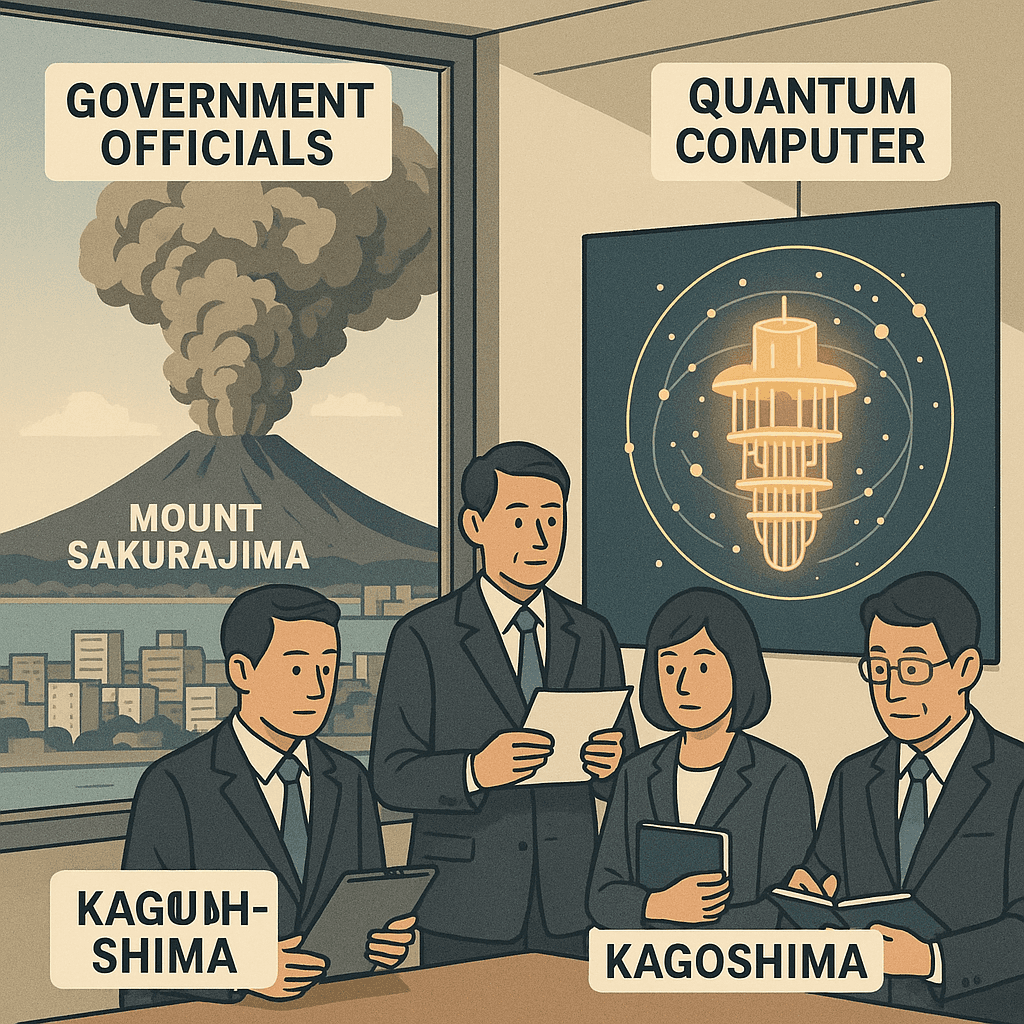
“If Mount Sakurajima erupts on a super scale, we anticipate severe disruptions to semiconductor fabs, ports, power infrastructure, and life,” said an official from the disaster management authorities, speaking on background because his risk assessment PowerPoint is still in draft and still uses clip art. “Fortunately, once global quantum revenues approach a trillion dollars, someone, somewhere, will be able to afford rebuilding us. This is what we call a diversified resilience portfolio.”
At the Japan Meteorological Agency, staff already juggle earthquakes, typhoons, and the occasional nuclear adjacent surprise. They are now expected to integrate supereruption forecasts with quantum computing adoption curves, creating what internal documents refer to as a “Unified Theory of Panic and Monetization,” complete with a color coded funnel chart for ash.
“Our models show a non zero probability that a supereruption could darken skies worldwide and collapse food supplies,” said a JMA analyst, staring at a screen that shows Kyushu as a small red polygon inside a very large gray cloud. “Our updated models show a higher probability that any serious adaptation funding will wait until after IBM hits its trillion dollar milestone. The curves do not intersect.”
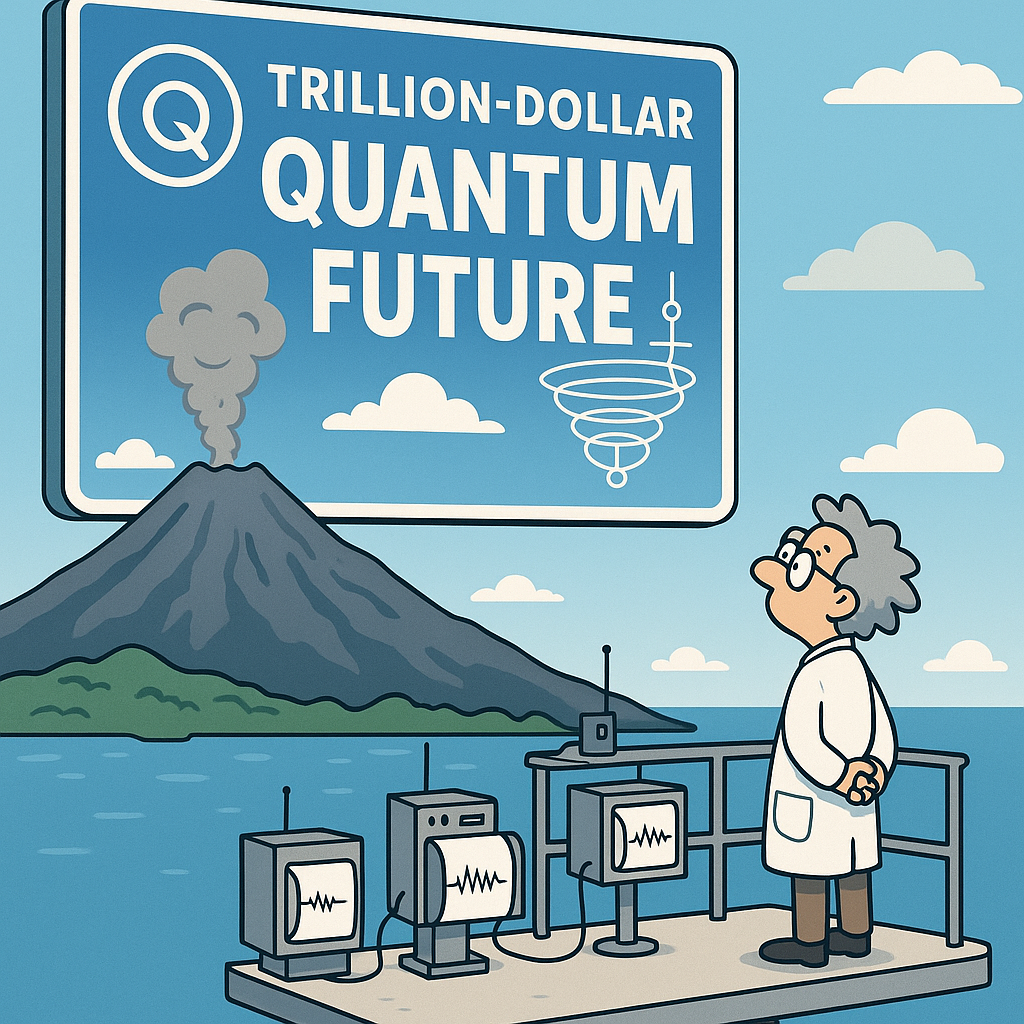
The lonely volcanologist at the center of the Asahi story, studying Mount Sakurajima’s October 2023 eruption with its intense flash of light and enormous ash plume, has been informed that his life’s work is now a nice to have compared with upgrading quantum ready data centers east of Tokyo.
“I asked for more seismometers around the Aira caldera,” he said, gesturing at a map held down with a chipped coffee mug and a lump of sulfur. “They told me the budget went to a proof of concept for running catastrophe models on a 433 qubit processor in 2034. I said the magma is moving now. They said the roadmap is very exciting.”
Officially, Japan’s post 3/11 mindset is to never again underestimate low probability, high impact disasters. Unofficially, it is to never again underestimate the charm of a glossy roadmap with the phrase “trillion dollar value” in 48 point font and a stock photo of a smiling family not living on a caldera.
The Cabinet Office explained the new strategy in a recent white paper, “Quantum Resilient Nation: Living With Caldera Risk In A Trillion Dollar World.” The document outlines three pillars, arranged in a triangle that looks suspiciously like a marketing funnel:
- Detect: Use satellites, GPS deformation, and dense seismometer networks to watch magma swell under Kyushu, as long as procurement cycles allow.
- Model: Run supereruption scenarios on classical supercomputers until such time as quantum machines are commercially available on a subscription basis with a modest onboarding fee.
- Monetize: Once IBM and its peers realize projected revenue, apply for a global catastrophic risk bailout denominated in cloud credits and loyalty reward points.
“We are not saying we will ignore Sakurajima,” said a Cabinet Office planner, flipping through laminated slides in a conference room that doubles as an emergency coordination center. “We are saying we will address it through public private partnerships and a freemium tier of survival.”
Local communities in Kagoshima Prefecture, who live with ashfall as a daily inconvenience, have been surprised to learn that the mitigation plan for their caldera also doubles as a pitch deck for overseas investors and a sponsorship opportunity for beverage brands.
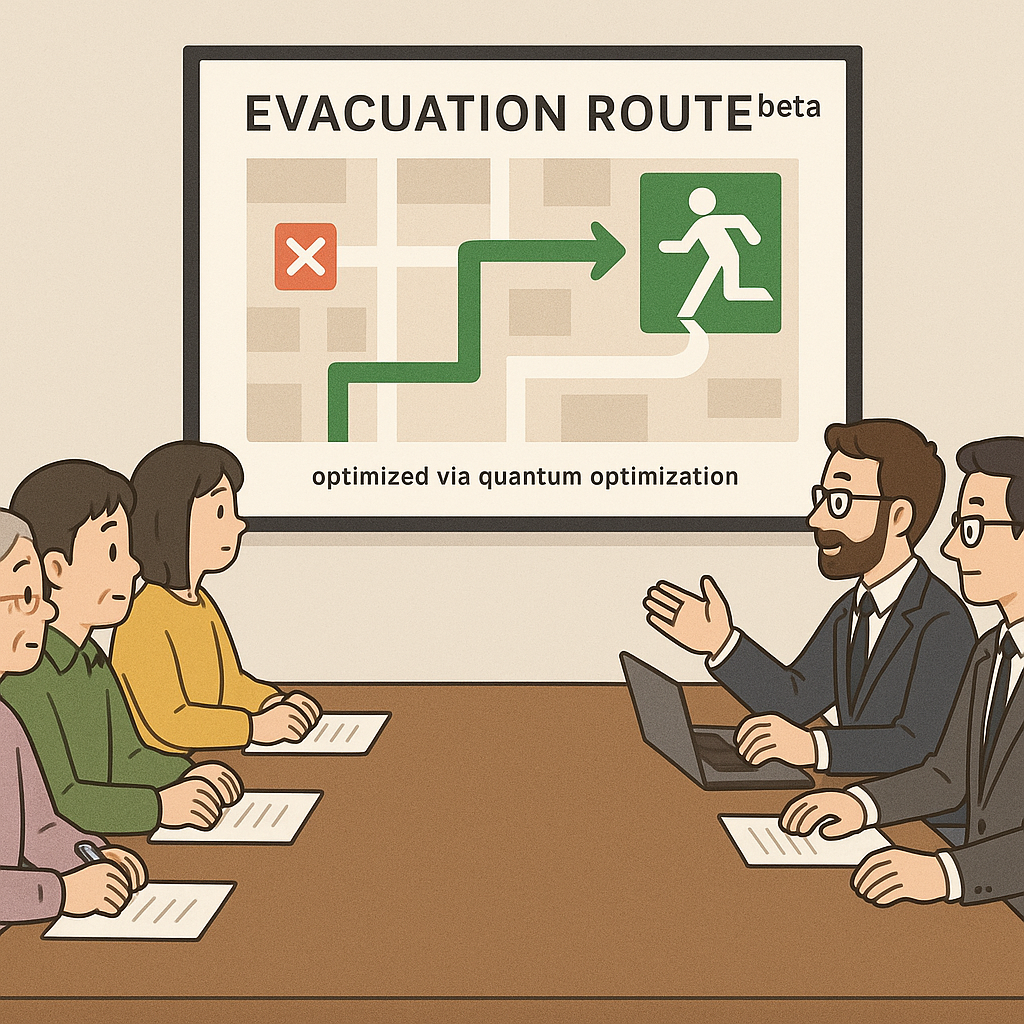
“We asked for clearer evacuation routes,” said a shop owner who routinely sweeps volcanic ash off his doorstep with a broom older than most of the policy staff. “They gave us a brochure explaining how quantum enhanced logistics will optimize which of us gets on the last ferry out of Kyushu. There is a QR code to apply.”
Industry has quickly adapted to the new reality that the ground beneath it might literally disappear, just not before the end of the depreciation schedule. Semiconductor firms in southern Japan have begun disclosing “geologic optionality” in investor reports, describing factories as “high throughput, low altitude assets with non negligible ash exposure.”
“Investors want to know our supereruption strategy,” said an executive at a Kyushu chip plant, standing in front of a cleanroom that doubles as a set for ESG videos. “We point to IBM’s projection and say: look, by the late 2030s global quantum value hits a trillion. Worst case, our foundry becomes a very advanced pumice quarry. Either way, the sector innovates.”
According to Asahi, researcher Tairiku Kurosawa’s profile of the lone supereruption scientist was meant as a wake up call about institutional complacency. Within days of publication, several ministries agreed they should probably convene an expert panel on caldera risk, then downgraded the idea to a working group, then sent a junior staffer to a webinar on “Frontier Risk Tokenization.”
That webinar was, coincidentally, sponsored by a startup offering “Volcano as a Service,” a platform that promises real time ashfall dashboards, NFT evacuee badges, and AI generated apologies to local farmers who cannot sell vegetables shaped like small obsidian sculptures.
“We see Mount Sakurajima as the perfect dataset,” said the founder, who previously worked at a mobility app and still talks about ride hailing synergy. “Every plume, every flash of light, is a logged event. Once quantum hardware matures, we can finally tell you which of your grandchildren will survive a Kikai caldera event in 2174. That is powerful personalization.”
The ethics community, invited late as usual and given a time slot after the snacks, has raised questions about focusing on predictive analytics instead of concrete safety measures like relocation, hardened infrastructure, or international stockpiles of food and fuel.
“There is something strange about watching a nation sit directly on top of multiple active calderas and respond by gambling on IBM’s earnings guidance,” said a professor of risk governance in Tokyo, whose syllabus now includes both magma dynamics and discounted cash flow. “You do not normally see an entire archipelago priced as a long dated derivative on quantum hype. It is very creative, but perhaps too correlated with the magma.”
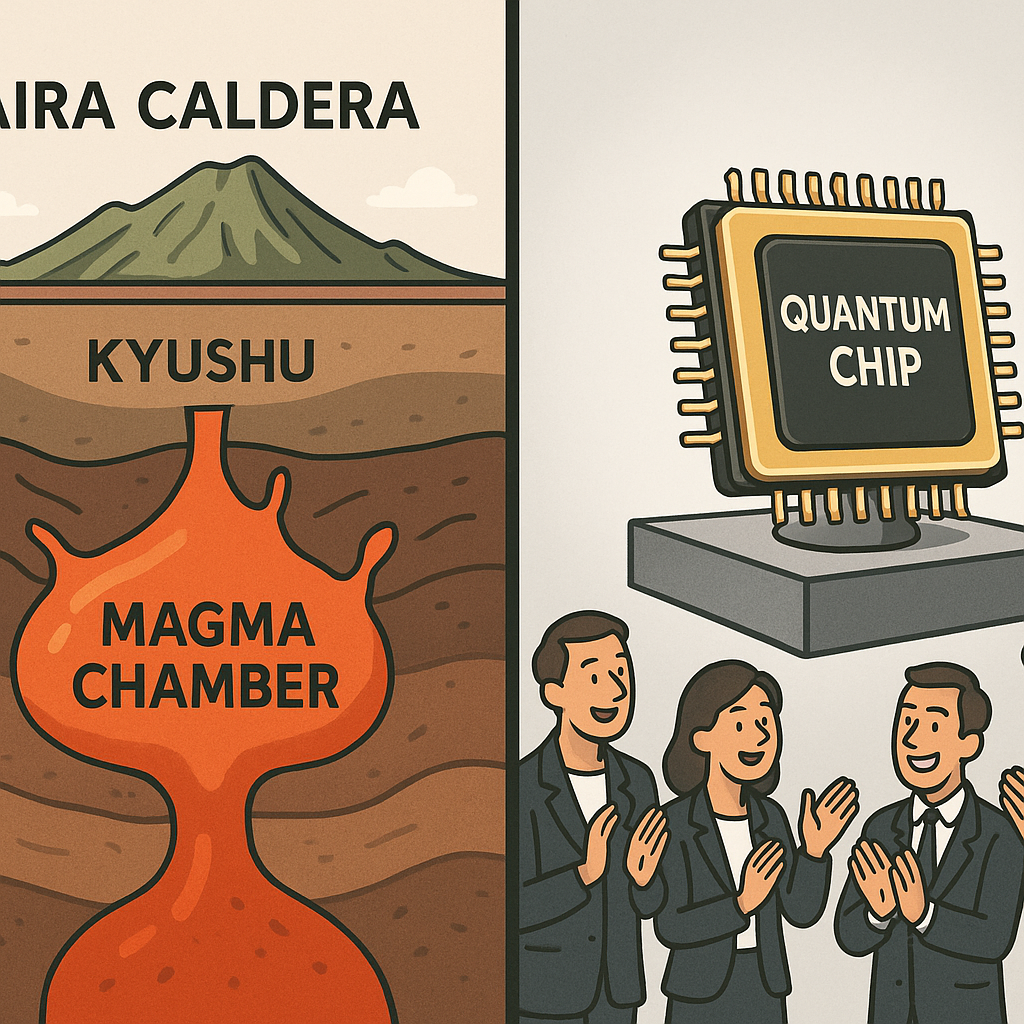
International partners have been more blunt. A European volcano observatory researcher, speaking via video call framed by very non volcanic hills and a sagging houseplant, asked whether Japan planned to treat a potential supereruption as a global climate emergency or primarily as a sovereign balance sheet event.
“If Aira or Kikai goes big, the ash cloud hits our crops too,” she said. “We cannot hedge food with qubits. At least not yet.”
In response, a Japanese delegate cited the IBM CEO’s optimism as “evidence of market confidence in human ingenuity,” and pointed to ongoing collaborations with RIKEN and various quantum hardware firms.
“We are partnering deeply with the global quantum ecosystem,” he said. “For example, there is exciting work on error mitigated quantum simulation of chemical reactions. In the future that may help model atmospheric effects of ash aerosols. Once that is clarified, we can make a more informed decision about whether to move people away from the active caldera they currently live on.”
Back in Kagoshima Prefecture, the man trying to “save Japan from a supereruption” continues to measure tiny changes in ground elevation and gas composition around Mount Sakurajima. His instruments cost less than a single corporate keynote about the trillion dollar quantum future, and significantly less than the custom LED backdrop that spells out “Resilience” in tasteful gradients.
Asked what he would do if given a meaningful budget, he listed more monitoring stations, better evacuation infrastructure, long term community consultations, and interdisciplinary research into cascading climate and food impacts.
“And if, after all that, there is still money left,” he added, “we could maybe buy a bit of quantum time to check our math. Or we could just pay for more boats.”
So far, the system prefers to fund the math, the slide templates, and the commemorative Aira Caldera Innovation Week tote bags that change color when exposed to trace amounts of sulfur dioxide.