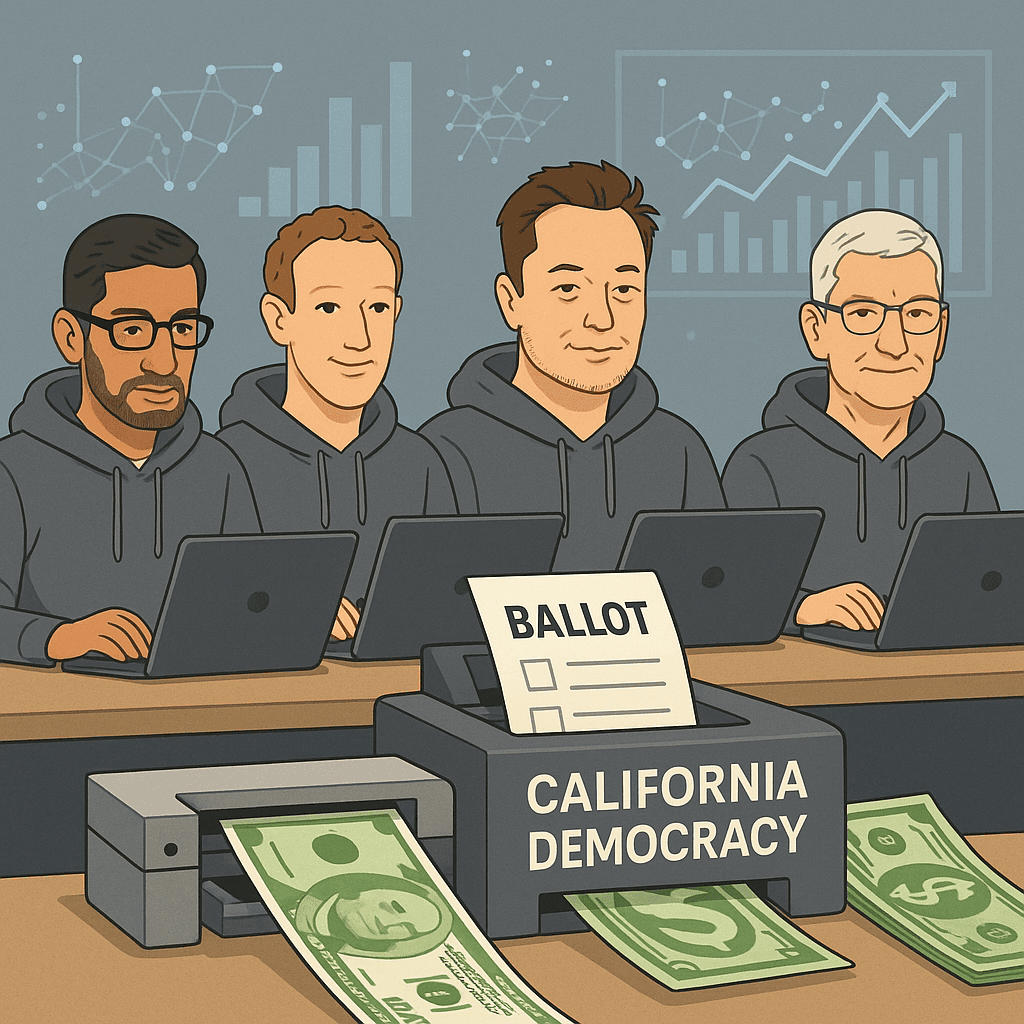
In a development experts called inevitable, Silicon Valley’s richest residents have quietly launched California’s hottest new platform: Democracy-as-a-Service, a premium subscription that lets a tiny cohort of billionaires overwrite the free version of voting that ships with the state.
According to a Bay Area News Group analysis cited by The Mercury News, 34 tech executives and investors, plus 14 spouses, have poured $194 million into California politics over the last 18 months, just in time to greet a union-backed wealth tax expected on the November ballot. Eighty-two percent of them are giving more this cycle than in the previous 24 years combined, which analysts say is the clearest signal yet that the AI boom is working perfectly, at least for the people programming the simulation.
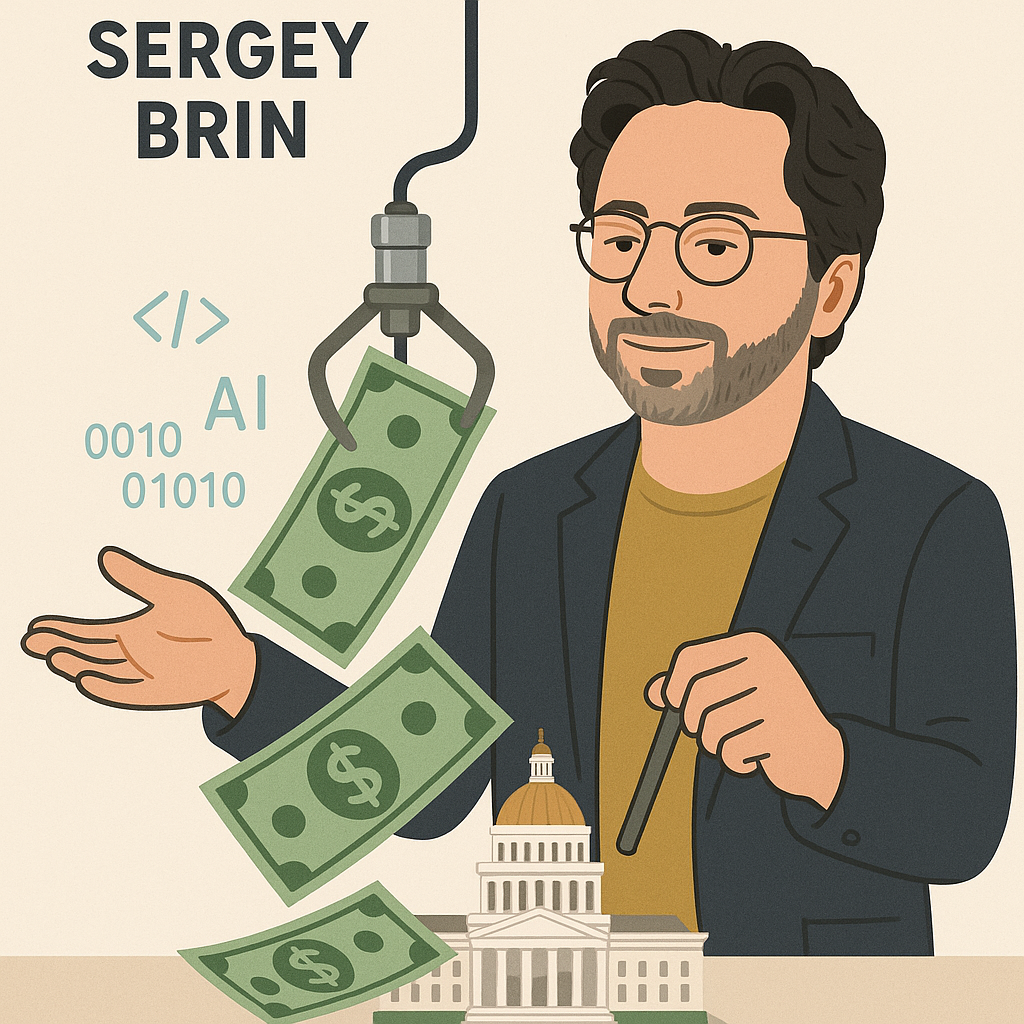
The new platform’s top customer is Google co-founder Sergey Brin, who did not spend a cent on state elections for more than 15 years. Then someone whispered the phrase “union-backed wealth tax,” and he reportedly rediscovered his wallet with a force typically reserved for locating missing AirPods. Brin now accounts for roughly 42 percent of all tech donor money this cycle, a level of market dominance not seen since the launch of targeted ads or intermittent fasting.
“Look, Sergey is just innovating in the civic space,” said one Silicon Valley strategist, speaking from inside a glass conference room named after an extinct public service. “Why let millions of people make a decision individually when a handful of visionary founders can A/B-test it with $194 million and roll out the optimized result?”
Labor leader Lorena Gonzalez Fletcher, whose coalition helped design the proposed wealth tax, described the situation more bluntly. “Every billionaire exists because of state infrastructure, because of workers, because of other people that have helped them accumulate wealth, and they don’t want to pay their fair share,” she told The Mercury News. “They don’t care if what they do affects the rest of California.”
In response, several tech donors released a joint FAQ clarifying that they absolutely care about California, just primarily the parts of it with favorable capital gains treatment, zoning for helicopter pads, and fiber strong enough to upload one more PAC ad per second.
Brin is not alone in his spiritual awakening. First-time or sharply increased donors include Coinbase CEO Brian Armstrong, Reddit CEO Steve Huffman, and Snap CEO Evan Spiegel. For years, many of these leaders framed themselves as above the political fray, too busy “disrupting” transportation and attention spans to bother with Sacramento. Now, with an AI-fueled wealth surge on one side and a potential tax on the other, they have discovered that the only true disruption is a well-funded ballot committee.
“Our founders are simply passionate about financial wellness,” explained one campaign consultant who recently pivoted from wellness influencer to dark-money whisperer. “Namely, their own. This wealth tax is like taxing innovation. Or breathing. Or the part of the brain that lets you say ‘AI’ in every earnings call.”
On the other side, organized labor is pitching the measure as a basic fairness upgrade for the AI era: when algorithms and robots threaten to erase swaths of jobs, the humans who captured the upside can help fund the social reset. Union organizers describe it as a modest patch to a system where the same companies that automate away cashiers now get tax breaks for the automated checkout machines that replaced them.
“We are not anti-technology,” said a union spokesperson outside a rally in San Jose. “We just think that if your net worth increases by several billion dollars every time you say ‘transformer architecture’ into a microphone, maybe you can chip in a bit more for schools, housing, and retraining the workers your models are about to benchmark.”
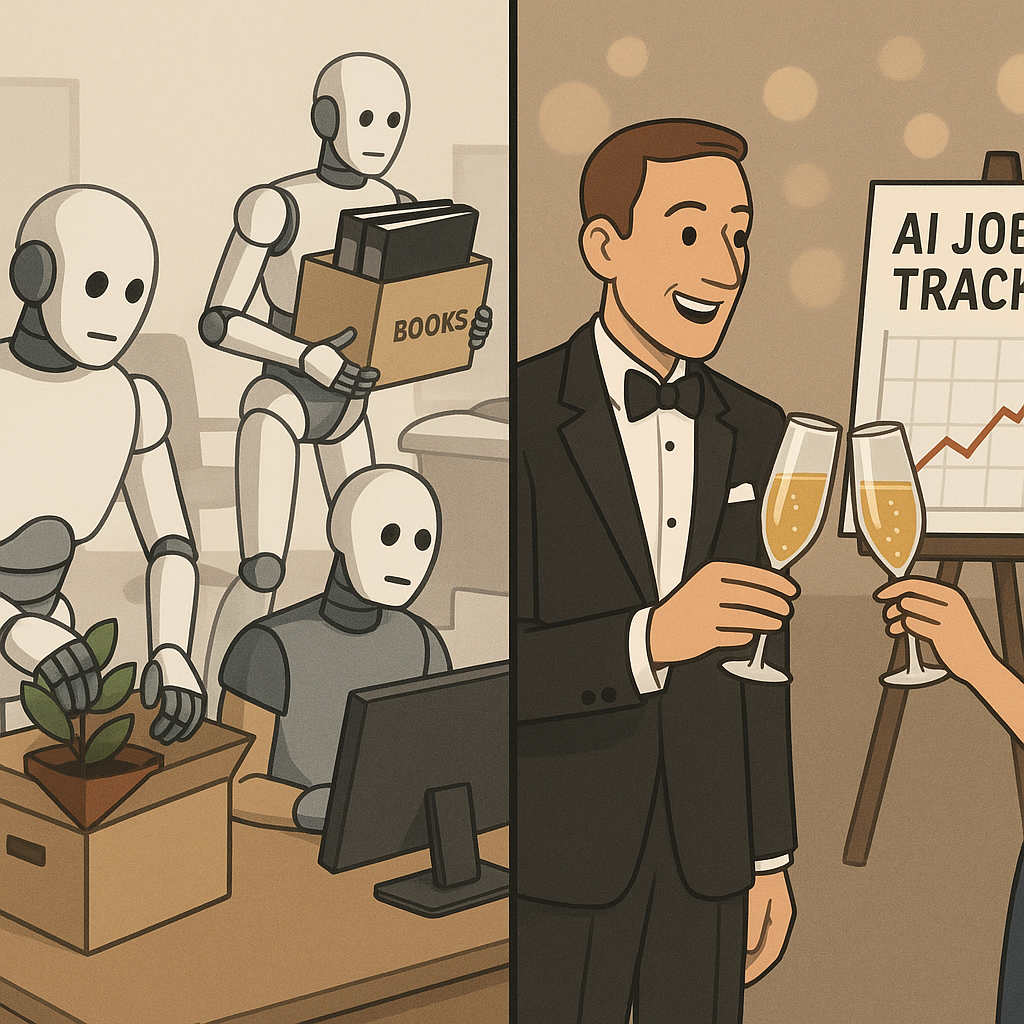
Governor Gavin Newsom, who is already testing a first-of-its-kind AI job-loss tracker, has tried to sound both visionary and extremely calm while standing between a revved-up labor movement and the people who can personally fund or sink a presidential run. He recently ordered state agencies to study AI job displacement and potential policy responses, which insiders say will be released in a glossy PDF that suggests more study.
“We have to make sure Californians are not left behind by this wave of innovation,” Newsom said at a press conference, while standing in front of a chart showing hockey-stick AI valuations. “We are tracking job losses very carefully in real time. The question is how to balance that with our other priority, which is tracking donor losses even more carefully in real time.”
The AI job-loss tracker, state officials explain, will monitor which sectors see the most cuts as companies adopt generative models. The next planned feature is an “Impact” tab where users can see exactly how many laid-off workers it takes to equal one large check from a billionaire opposed to the wealth tax. Engineers within the state treasurer’s office are reportedly testing different visualization modes, including pie charts, choropleth maps, and a single blinking number labeled “Sergey.”
Tech leaders warn that a wealth tax would trigger an exodus, with founders and investors decamping to Nevada, Texas, or whatever jurisdiction offers the ideal climate for both GPUs and low expectations of public schools. Some have floated a middle path: an AI dividend or national solution that taxes their fortunes less aggressively and, crucially, not yet.
“We are absolutely open to discussing a federal framework,” said a prominent investor who requested anonymity so his gated driveway would not be live-streamed by Reddit. “At the national level, we can have a serious conversation about redistribution that is comprehensive, thoughtful, and deferrable until after my liquidity event.”
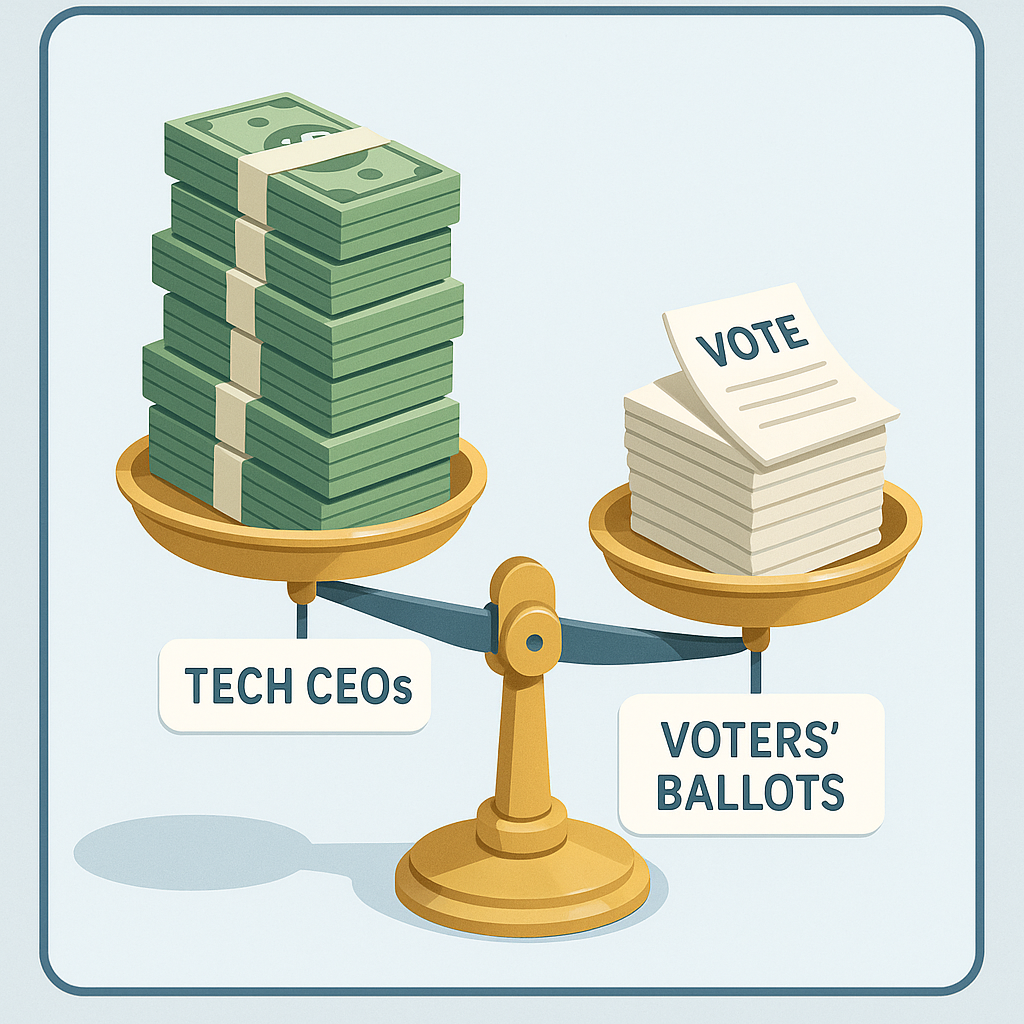
Rank-and-file tech workers, meanwhile, face a different calculation. Many are anxious about models that can already code, write, and generate passable product roadmaps. They must choose whether to side with executives who remind them stock-based compensation is a form of community, or with unions who keep asking awkward questions like “What happens when your manager is an API?”
Pollsters say voters are torn. On one hand, a tax on billionaires in a deeply Democratic, inequality-fatigued state sounds appealing. On the other, $194 million can purchase a staggering number of mailers warning that any new tax will immediately cause a beloved local business to relocate its headquarters to a tax-advantaged asteroid.
Silicon Valley strategists remain confident. “Look, we know this is a testbed,” said one adviser working with several AI investors. “If we can prove in California that the winners of the AI boom can permanently shape the rules that govern them, we will have created a scalable model for the rest of the country. Think of it as regulatory capture, but with a friendly UX.”
In private, campaign veterans admit there is a risk of backlash. Voters could eventually notice that every major ballot fight now resembles a venture round in which their signatures are the product-market fit. Some even whisper about the possibility of campaign finance reform, a prospect that has reportedly caused one early crypto backer to “literally consider” being slightly less wealthy.
For now, though, the democracy runway is clear. The AI boom is minting new fortunes, the wealth tax campaign is gearing up, and the checks from Sergey Brin, Brian Armstrong, Steve Huffman, Evan Spiegel, and others continue to clear with the smoothness of a frictionless user flow. California remains the place where the future is built, and where you can still participate in that future for free.
Unless someone has already bought your share.