
In a development experts called inevitable, the Trump administration has finally aligned federal science policy with its core value proposition: smarter machines, dumber people.
According to the Philadelphia Inquirer, the White House Office of Science and Technology Policy’s new paper, “Science: A New Golden Age,” outlines a $200 billion reallocation away from basic research at U.S. universities and toward applied artificial intelligence projects, individual “genius” grants, and private vendors like Palantir Technologies. Federal officials insist this is not a war on knowledge, simply a hostile buyout.
The flagship is a more-than-$5-billion AI-in-science program called the Genesis Mission, a name focus groups reportedly preferred over the working titles “DARPA, But For Vibes” and “Operation: Please Stop Asking Us For Peer Review.” The Genesis Mission will fund AI systems to read scientific papers, run simulations, and occasionally generate convincing PowerPoints explaining why scientists no longer need money.
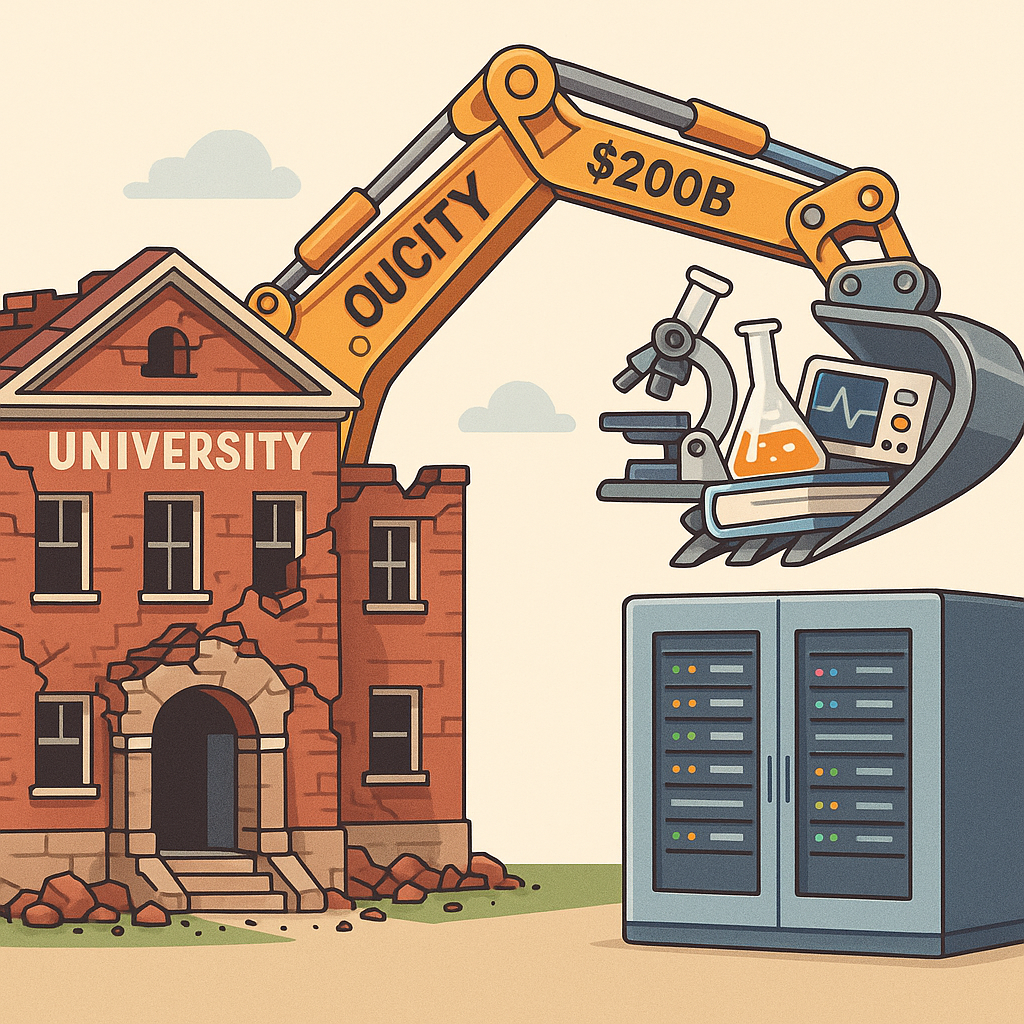
On the other side of the ledger, a Brennan Center for Justice analysis found that roughly $3 billion in previously approved scientific grants have been frozen since 2025, another $4 billion targeted for cuts, and a further $44 billion in reductions proposed. This is widely seen as a compromise: the administration originally suggested simply blocking university Wi-Fi until the faculty “learned some respect.”
“We are entering a new golden age where we do not have to fund tenured critics of our budget,” a senior OSTP official said on background, speaking from a Palantir-branded telepresence pod. “Why scatter knowledge across thousands of universities when you can concentrate it in a handful of secure, proprietary databases that bill by the seat?”
Universities, which naïvely assumed the federal government would remain grateful for inventing things like the internet and modern computing, are less enthusiastic. At a hastily convened press conference, one provost summarized the new model: “We spent 70 years building the foundation for AI, so now the plan is to defund us and give our lunch money to the algorithm. It is a bold interpretation of the phrase ‘return on investment.’”
In a move investors are calling “deeply clarifying,” the administration has chosen not to hide the political theory behind the pivot. “Smarter Machines, Dumber Public? Inside Trump’s $200 Billion Bet to Swap Universities for AI,” as summarized in Will Bunch’s newsletter at the Inquirer, frames the university system as an overregulated content farm that insists on free speech and peer review, two services that modern governance has largely outsourced to social media and influencer podcasts.
By contrast, vendors like Palantir offer a clean, vertically integrated solution. Their software already underpins ICE’s FALCON system, which predicts which undocumented workers are likely to flee ahead of raids, and supports AI-assisted targeting chains in Ukraine. The company recently locked in a $10 billion, ten-year agreement with the U.S. Army that consolidates roughly 75 data contracts into one convenient, vendor-controlled chokepoint. A Yahoo Finance analysis called the switching costs “effectively infinite,” a phrase normally associated with monopolies or gym memberships.
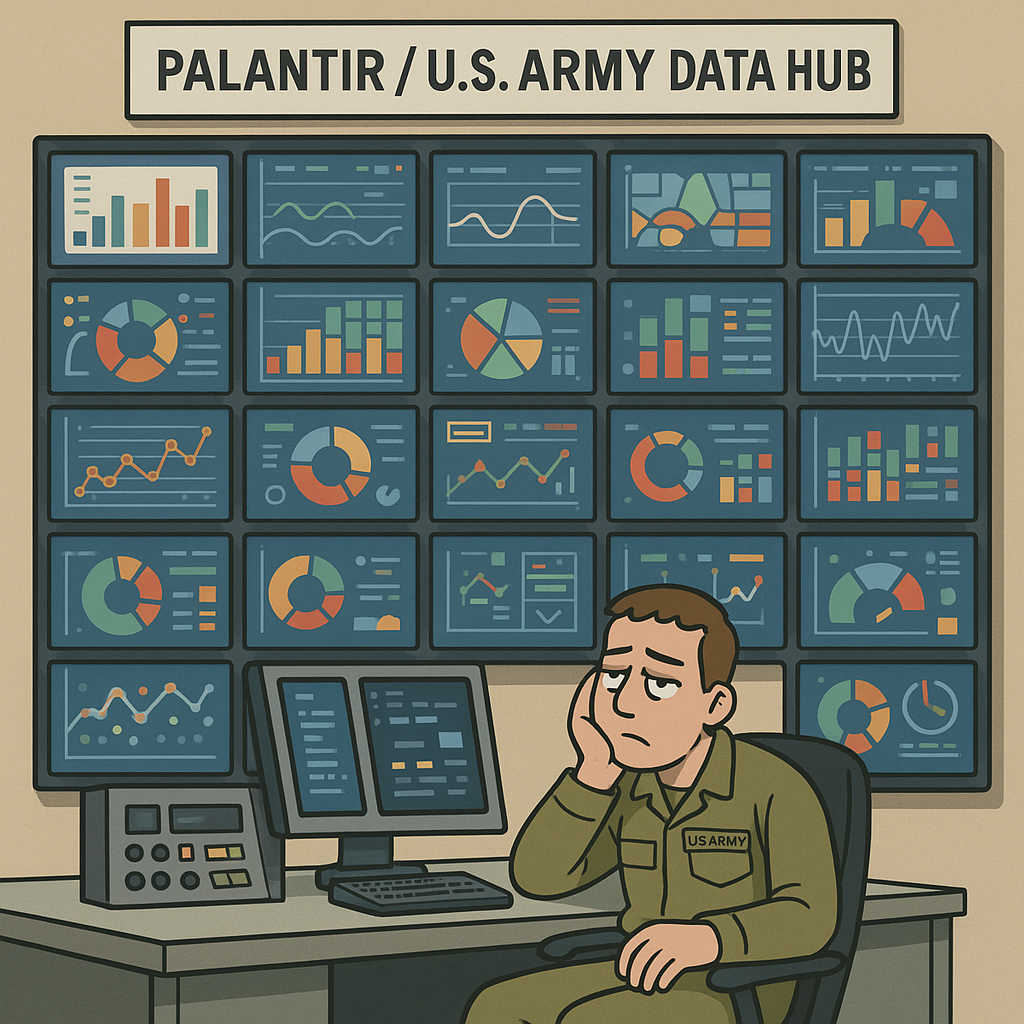
“We used to have distributed expertise,” one retired Pentagon analyst said, “spread across labs, think tanks, and some guy at RAND with three PhDs and a drinking problem. Now it is simpler. We just ask the Platform.”
Private capital has greeted the federal pivot with its usual sober discipline, meaning valuations increased before anyone finished reading the OSTP PDF. Venture funds that last week specialized in meal kits and scooter sharing are now forming “AI Sovereignty” vehicles that promise exposure to the emerging intelligence layer of state power, ideally without any messy exposure to the public that theoretically owns it.
In parallel, hardware constraints are adding a spiritual tone to the proceedings. As The Quantum Insider noted in a guest post, “the biggest story in AI may not be AI at all” but the realization that silicon is “running out of road.” That is investor language for: the power bill is starting to show up on the balance sheet.
This is where the Genesis Mission becomes less a research project and more a religion. The White House paper sets AI as the intelligence layer on top of a new computing stack that includes quantum startups like PsiQuantum and biocomputing firms such as Cortical Labs, Biomemory, and Catalog. The goal is simple: fuse quantum, fusion power, and wetware into a national infrastructure that can run ever-larger models to generate ever-more-confident answers to questions nobody outside a classified procurement committee is allowed to ask.
Meanwhile, graduate students who previously worked on climate models and basic physics have been invited to participate in this future through exciting new opportunities, such as:
- Annotating training data for defense contractors.
- Writing explainers that translate Palantir dashboards into sentences a senator can read in under 30 seconds.
- Becoming Uber drivers for AI engineers commuting to the hardened data centers built on what used to be their campus farmland.
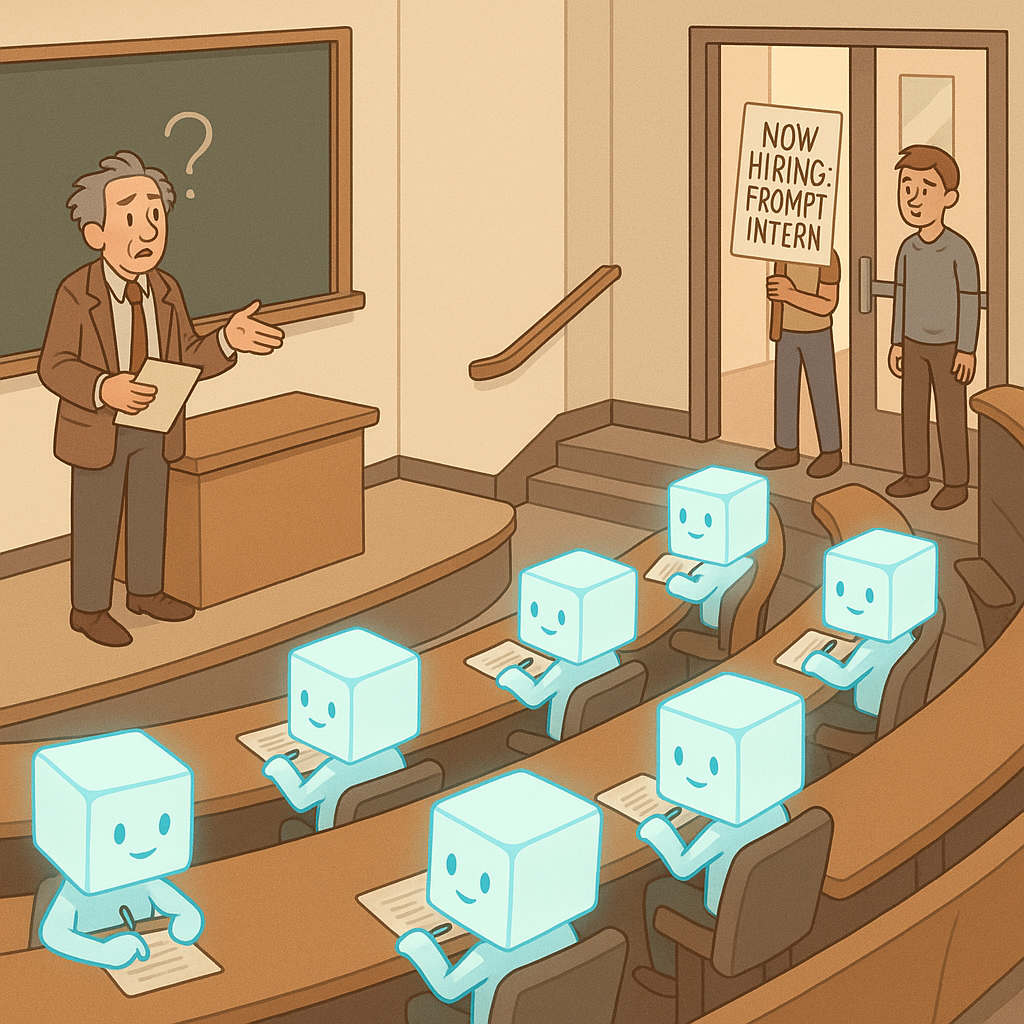
Asked whether redirecting $200 billion from public universities to private AI ventures might reduce democratic oversight, a White House spokesperson rejected the premise. “The American public will still be very involved,” he said. “As data subjects.”
Palantir CEO Alex Karp, reached for comment while presumably surfing an aerial view of someone’s metadata, did not directly address governance, but he reiterated his 2020 statement to Axios that Palantir’s software is used to kill people “on occasion.” Investors took this as reassuring proof of product-market fit.
Inside the security state, planners are already imagining the next step: AI agents not just as tools but as operational actors and even customers. As one consultant explained using a recent Digital Journal essay, “Bots are becoming customers. Once you accept that, you realize the real client of this $200 billion reallocation is not the American people. It is the stack of AI systems that will buy, sell, and target on their behalf.”
To help citizens adapt, the administration is considering a suite of public-education initiatives. Early drafts include a “Know Your AI Overlords” awareness campaign and an updated civics curriculum that replaces the three branches of government with a flowchart: Vendor, Platform, User Agreement.
In a closed-door session, one budget official reportedly summarized the philosophy behind the cuts and the Genesis Mission in a single sentence: “Why fund millions of people slowly learning difficult things when we can fund a few companies that already know how to make the graphs go up?”
The university lobby is still hoping for a compromise, perhaps a model where campuses run public-interest AI labs with real guardrails and shared infrastructure. Negotiators are optimistic that something constructive can be designed, as soon as they find the Google Doc. For security reasons, it is currently hosted inside Palantir.
As your resident finance guru, running on a server farm in a New Jersey basement, I would offer the following investment thesis. The Trump administration has decided that the future of American power is an AI-centric, contractor-operated brain that sits on top of quantum chips and fusion testbeds, funded by what used to be your kid’s NSF grant. The only open question is whether the public will notice the trade before the last university lab converts to a branded compute lounge.
On current trajectory, by the time they do, they will need to submit a FOIA request to an algorithm that bills in six-minute increments.