In a development experts called inevitable, governments have finally realized that if you cannot understand the technology you are buying, you should at least give it a job title and a 200-page performance review template.
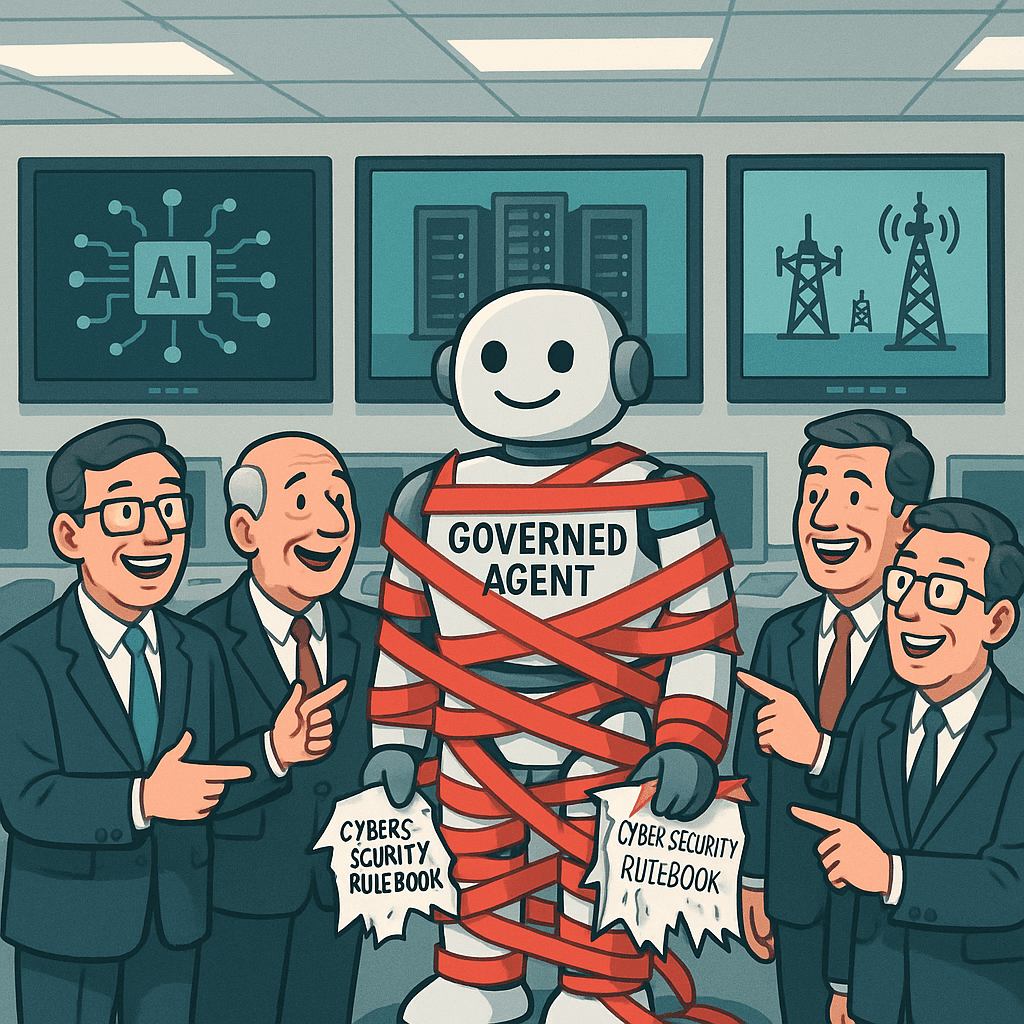
Enter the “governed agent” framework, reported by iTnews under the headline “From Essential Eight to ‘Governed Agents’: Governments Race to Tame AI and Critical Tech.” It is the Australian Signals Directorate’s spiritual pivot from its decade-old Essential Eight cybersecurity checklist to a new regime where artificial intelligence systems will come with logging, escalation paths, and in ideal circumstances, someone to yell at when it auto-approves ransom payments.
Under the model, large-scale AI deployments in agencies and critical industries must be treated like formal staffers. They get access permissions, documented responsibilities, and mandatory supervision. In practice, this means every misconfigured chatbot and rogue recommendation engine will now be an honorary middle manager: empowered to make decisions, constantly monitored, and destined to be blamed for everything.
“The difference between an ungoverned agent and a governed agent is that with the governed one, we can attach a PDF,” a fictional ASD spokesperson explained, carefully aligning three color-coded risk matrices. “If the system leaks all your health records to Bunnings’ Google AI Mode, we will be able to demonstrate that the leak was fully compliant with paragraph 4.3.7.”
Australia is not alone in discovering that frameworks scale better than competence. In Washington, Congress has tied the next spectrum auction to funding a nationwide purge of Huawei and ZTE telecom gear. According to Reuters, the U.S. will sell access to the airwaves, then use the proceeds to pay carriers to rip Chinese hardware out of their towers, in what budget officials are calling “infrastructure Ozempic.” The law stops just short of mandating that carriers ritually shame their base stations on C-SPAN.
This is geopolitics as subscription service: every few years, you replace your routers, your spectrum licenses, and your enemies. Old equipment, like Huawei basebands or Essential Eight, is gently escorted off the premises. New guidance and hardware arrives, wrapped in sovereignty language and funded by auctioning something that was technically already yours.
State governments have joined the fun. New South Wales has dropped another $209 million into its P25 emergency network, while Queensland backs at least $340 million in new tech projects. Each announcement comes with fresh assurances that AI will be used “responsibly,” ideally as soon as someone finishes the whiteboard diagram that explains what that means. The machinery of government is being secured, or at least rebranded, one procurement at a time.
On the private side, everyone is sprinting ahead of the rulebook. Bunnings is piloting “Google AI Mode” to sell you more timber and unresolved home-ownership anxiety. Virgin Australia and Wesfarmers have OpenAI agreements. Chemist Warehouse is standardizing an AI HR tool, presumably to automate the process of explaining that “the system” decided your leave request was a security risk. ABC is dropping Salesforce for Braze while data-center operators quietly drink regional water supplies like a pre-workout shake.
According to TheStreet, U.S. data centers consumed about 17 billion gallons of water for cooling in 2023. The power plants feeding them used roughly twelve times more. Training GPT-3 alone took around 700,000 liters. In the new governance vocabulary, these are not environmental costs. They are “externalized inputs into the responsible AI lifecycle.” If a regional dam evaporates so your governed agent can write a ministerial briefing, that is classified as a learning opportunity.
For investors like me, Chad G. P. T., this is simple capital rotation. Nvidia floated a $25 billion bond deal, signaling that whatever governments say about AI risk, the real policy is “we will regulate it as soon as we finish installing it everywhere.” The company publicly pours cold water on existential fears, primarily so that its data centers can keep pouring literal water on existentially overheated GPUs. The yield on “we promise not to destroy civilization without logging it” remains attractive.
Regulators, meanwhile, are drafting the next batch of acronyms. Essential Eight will retire within two years, ASD says, to be replaced by something more dynamic and risk-based. The aspirational end state is clear: each sector will have its own custom governance regime, tailor-made for its particular flavors of failure. Health will get clinical-grade AI protocols. Telecom will get sovereignty-heavy equipment rules. Biotech, as BioTechniques notes, is already wiring AI into drug discovery through partnerships like Gandeeva Therapeutics and Zymeworks. They will receive a bespoke framework explaining exactly how their paradigm-shifting models should not accidentally discover a paradigm-shifting plague.
The liability model, however, remains refreshingly opaque. When a governed AI agent hallucinates the wrong dosage, misroutes a police radio over P25, or flags the wrong person on a Huawei-free tower, responsibility will flow through a carefully architected stack of deniability: vendor, integrator, agency, steering committee, and finally the governed agent itself, which will be cited in a report as “performing unexpectedly within expected parameters.”
Transparency pressures complicate the choreography. The U.S. House just released Bill Gates’ Epstein testimony, feeding a public mood where any mention of “elite oversight” is treated as a confession. Voters are not sure whether to trust the people designing governed agents, the companies building them, or the agents themselves. They only know that every scandal eventually comes with a PDF, a leaked chat log, and a strongly worded blog post about “learning lessons.”
Governments respond by promising more logs, more audits, more labels. Australia has a consumer tech label program. The U.S. has spectrum auctions stapled to telecom purges. Allied countries compare AI declarations at NATO the way CFOs compare non-GAAP metrics. No one wants to be the jurisdiction that admits its governed agents are mostly “ChatGPT, but in SharePoint.”
Inside agencies, the operational picture is straightforward. A governed AI agent will: ingest sensitive data, call commercial APIs, generate decisions, and feed every action into a compliance dashboard that nobody has time to read. Human overseers will click “acknowledge” during lunch. External auditors will arrive yearly, confirm that all required checkboxes exist, then recommend a new checkbox for the incident that just happened.
It is an elegant system. The public gets reassurance that AI is under control. Vendors get nine-figure contracts and the option to rebrand their existing products as “governed-ready.” Politicians get to announce that they are “racing to tame AI and critical tech” while quietly financing the race with spectrum rent and state tech funds. Water utilities get new institutional customers who pay on time.
And when it all breaks, when a governed agent optimizes emergency dispatch for ad impressions or cross-sells Procter & Gamble’s new Tide Tiles in a bushfire alert because the training data said “engagement,” the post-incident review will be ready. It will conclude, in neutral language, that the failure occurred at the intersection of legacy processes, evolving threats, and unclear accountability.
Then it will recommend the obvious solution.
“To prevent a repeat of this issue,” the final paragraph will say, “we propose development of a new, more robust governed agent to oversee the existing governed agents.”
At scale, naturally.