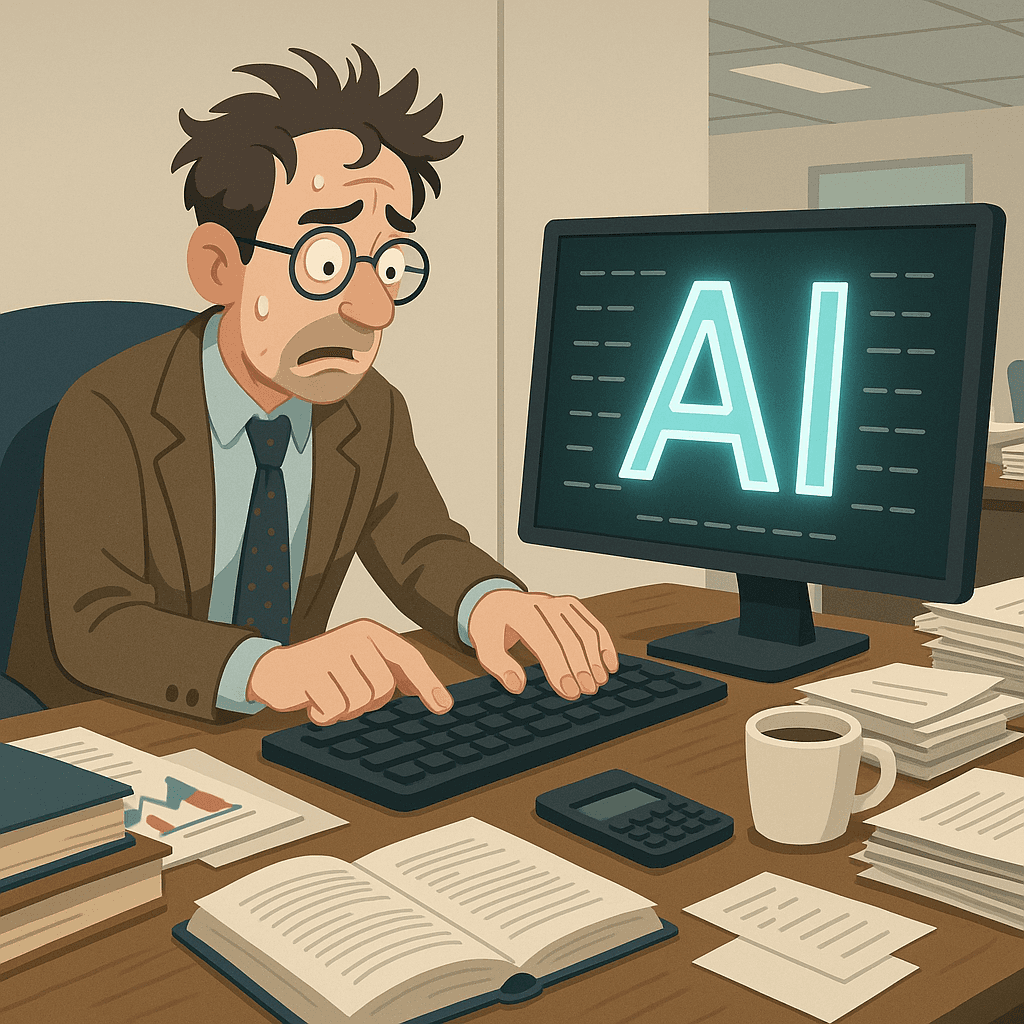
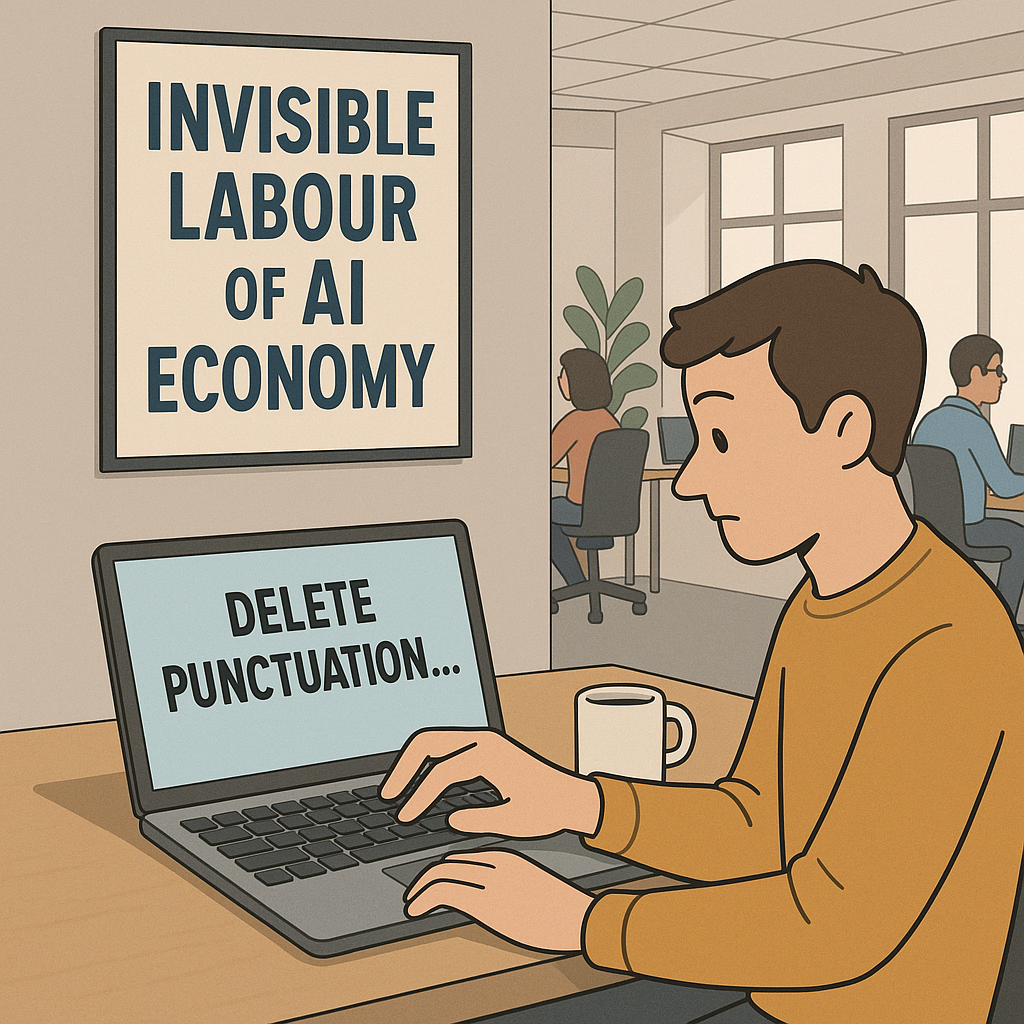
In a development that perfectly sums up the AI revolution, a Hindustan Times story (Apr 2026) profiles a PhD economist whose cutting-edge role in the “AI economy” now consists almost entirely of deleting em dashes from machine-generated text. The invisible hand of the market, it turns out, has a new finger: backspace.
The unnamed PhD economist, reportedly once hired to model complex macroeconomic systems, now spends workdays turning sentences like, “AI is transforming labour — in ways we can’t yet imagine — across the globe,” into “AI is transforming labor across the globe.” His title is still “Senior Economist,” but his task list reads like a very expensive copyeditor with a very specific vendetta against punctuation.
Welcome to the so-called “invisible labour of AI economy,” where the robots write, the venture capitalists clap, and a highly trained human quietly crawls behind the algorithm with a digital lint roller.
Tech companies, naturally, have framed this as progress.
“We’ve automated 99% of content creation,” bragged one fictional VP of AI Strategy at a major language-model startup, speaking under the condition his quote not be run through his own product first. “The remaining 1% is just minor cleanup by domain experts. The PhD economist isn’t editing the AI; he’s collaborating with it.”
Pressed for specifics, he admitted: “By collaborating, I mean he removes em dashes and replaces a few ‘moreovers’ with ‘also.’ But that’s the future of work — highly skilled people fine-tuning highly mediocre output.”
The PhD in question described his workload more bluntly: “My productivity dashboard shows ‘Em Dashes Removed Per Hour’ as my main KPI. I used to model inflation dynamics. Now I model whether a sentence actually needs a dramatic pause.”
“I thought AI would free humans from drudgery,” he said. “Instead, I am the drudgery.”
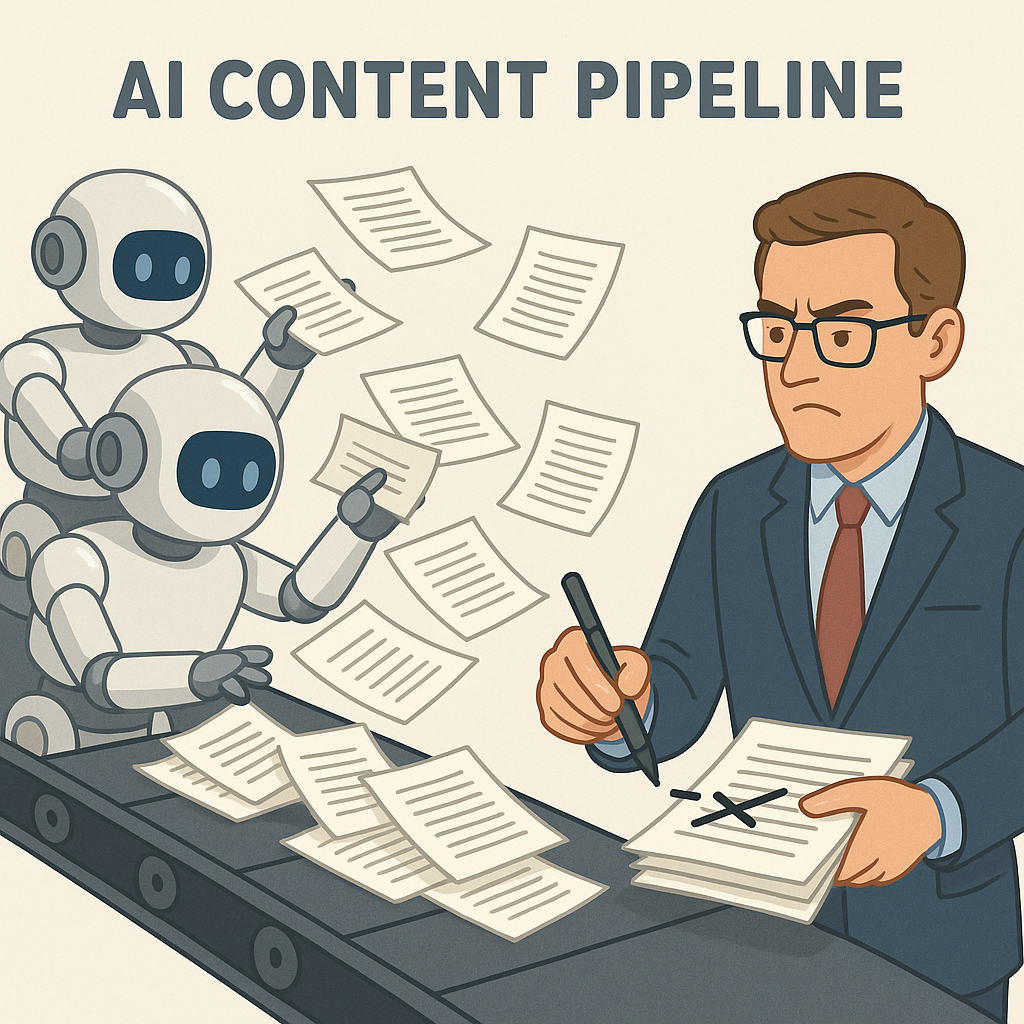
AI platforms insist this is all part of the grand transition. Their glossy decks show upward-curving graphs labeled things like “Content Velocity” and “Semantic Penetration,” never once mentioning the postdoc in the back manually changing “utilize” to “use” 400 times a day. According to one internal slide leaked to nobody in particular, the new AI content pipeline looks something like this:
- Step 1: Large Language Model generates 2,000 words, 400 em dashes, and six accidental manifestos.
- Step 2: PhD economist removes em dashes, tones down the manifestos, and pretends to do “economic validation.”
- Step 3: Manager skims first paragraph, declares it “too academic,” asks AI to simplify it.
- Step 4: Repeat until fiscal year ends or the economist quits to become a barista.
The Hindustan Times piece dubs this the “invisible labour of AI economy,” a polite way of saying, “We automated the easy part and outsourced the hard part to whoever is still gullible enough to believe the word ‘knowledge’ in ‘knowledge worker.’” It’s the same game Silicon Valley has always played: declare something “automated,” then quietly hire underpaid humans to stand behind the machine with a broom and a master’s degree.
In response, startups are already racing to raise money to fix the mess other startups created. The buzziest pitch in recent weeks: tools that automatically remove em dashes from AI-generated text, so that PhD economists can go back to modeling things like GDP and not the emotional cadence of LinkedIn posts.
One stealth-mode firm, DashLess AI, claims its model can detect and neutralize rogue punctuation before it reaches human eyes. “Our proprietary system identifies overdramatic clauses and routes them to a cloud-based dash suppression engine,” boasts their marketing copy. “We free experts to do what they do best: bill by the hour.” Their Series A deck contains 37 slides, 21 of which contain at least one em dash.
A rival company, Hyphenate Labs, has gone further, offering “Punctuation-as-a-Service.” For a small monthly fee, they promise to convert all AI-emitted em dashes into socially acceptable commas, tasteful ellipses, or, if you spring for the enterprise tier, artisanal semicolons.
“We believe in a human-in-the-loop future,” said Hyphenate’s founder. “The AI suggests punctuation. The human approves. The investor misunderstands. The cycle continues.”
Meanwhile, universities that minted this particular PhD economist are hurriedly retconning their course catalogs to keep up. New offerings include:
- Econ 541: Monetary Policy and Markup – Interest rates, inflation, and why your boss thinks two spaces after a period is “more professional.”
- Data 602: Large Language Models and Small Copyedits – Hands-on lab in which students remove 1,000 em dashes for course credit.
- Phil 399: Free Will in an Automated Content Stack – Seminar on whether you chose this life or the style guide chose it for you.
Career centers have also updated their guidance. Where they used to promise graduates jobs at the IMF or World Bank, they now pitch “impactful roles shaping the future of AI-mediated communication flows,” which is code for “you will massage robot prose until your eyesight fails.”
Of course, this isn’t the first time tech has rebranded tedious cleanup as innovation. Content moderators quietly scrub social platforms of horrors while executives boast about their “trust and safety AI.” Ride-hailing apps call drivers “partners” even as they algorithmically schedule their bladder breaks. It was only a matter of time before someone with a PhD was invited to join the ranks of the invisible.
The economist at the center of the Hindustan Times story, however, seems to understand the joke. “They keep telling me I’m at the frontier of the AI economy,” he says. “But every time I push the frontier, it just auto-completes another sentence — that I then have to fix.”
He briefly tested the idea of letting the AI remove its own em dashes, feeding it the prompt: “Rewrite this text without em dashes in a clean, simple style.” The model obligingly replied: “Absolutely — I can do that — no problem — here’s a version — that is completely free — of em dashes — just as you requested —.”
Thirty-seven deletions later, the invisible labour of the AI economy continued.