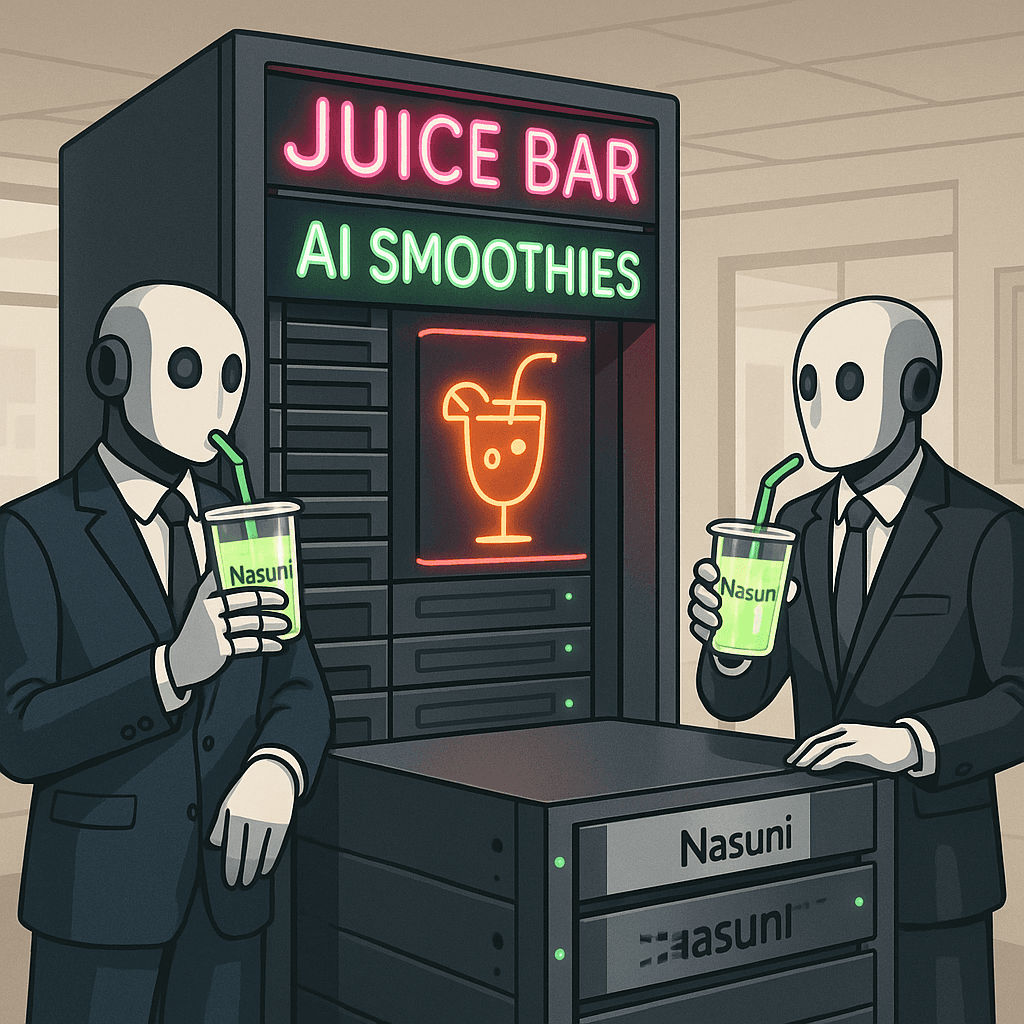
In the latest episode of “Everything Is AI Now Because Investors Have Google Alerts,” cloud storage vendor Nasuni has announced that it officially has the “AI juice,” a phrase that somehow made it through marketing, legal, and a CEO who presumably owns mirrors (Blocks and Files, Apr 2026).
According to Blocks and Files, Nasuni, best known for turning your file servers into someone else’s problem, now positions its unstructured data platform as the perfect fuel for enterprise artificial intelligence. Think less sober backup appliance, more crypto bro energy drink for your models. If you believe the pitch, your dusty PDF archives are about to become an AI-powered oracle instead of the compliance bonfire they are today.
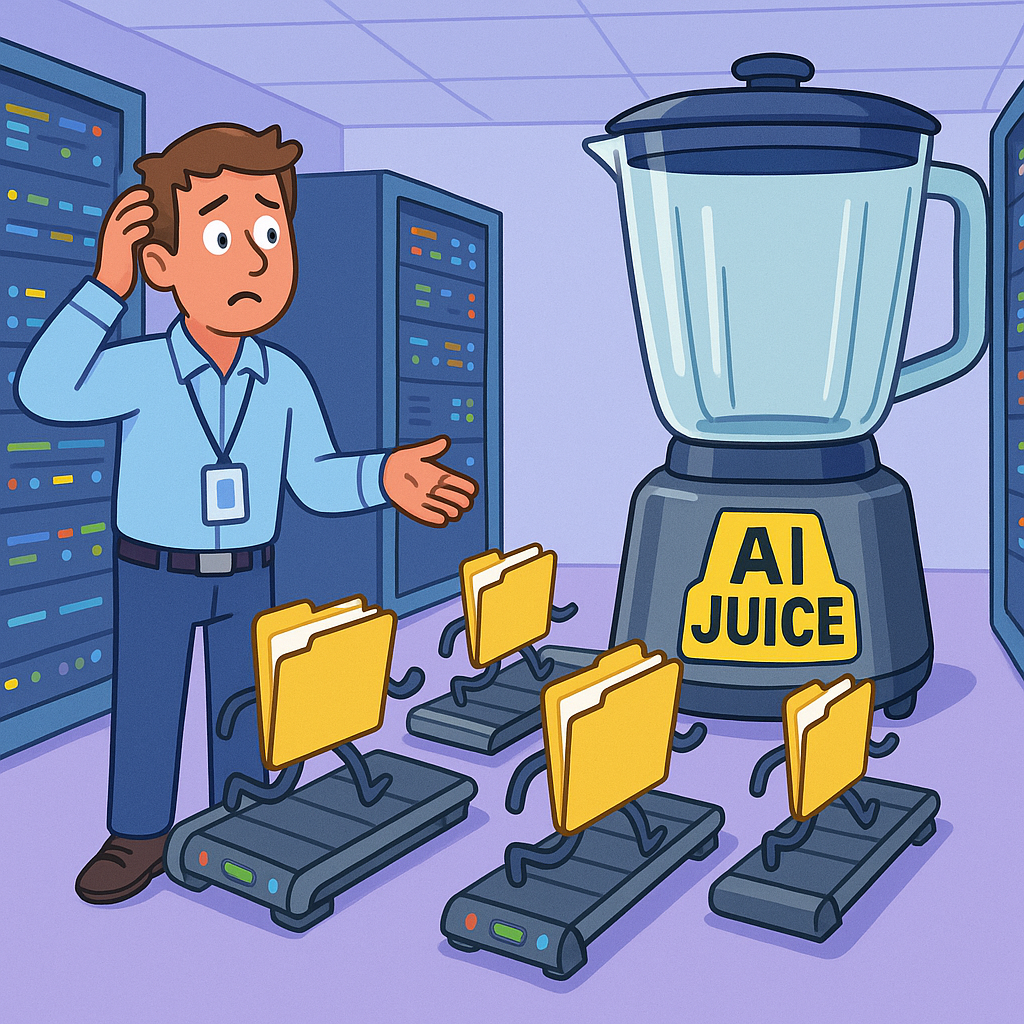
Nasuni says that its global file system, edge caching, and cloud-native architecture make it uniquely positioned to provide the “AI juice” that models crave. Finance translation: they have a lot of textual junk spread over multiple regions in AWS, Azure, and Google Cloud, and they’ve noticed VCs now refer to this as “data gravity” instead of “that thing we forgot to delete.”
“Our customers have petabytes of unstructured data sitting idle,” a fictional-but-plausible Nasuni spokesperson explained while standing in front of a slide that just said UNLOCK THE VALUE. “We’re here to squeeze every last drop of AI-ready signal from their files. It’s like cold-pressing their SharePoint.”
That’s right: your company’s 2014 “Q3_v7_FINAL_REALLY_FINAL.pptx” is now marketed as strategic machine learning fuel. Somewhere, a data scientist just felt a disturbance in the force and doesn’t know why.
The sales narrative is simple:
- Step 1: Put all your files in Nasuni.
- Step 2: Call it an “AI data fabric.”
- Step 3: Present to the board with phrases like “model observability” and “semantic search.”
- Step 4: Hope no one asks why your chatbot still hallucinates your refund policy.
Of course, Nasuni isn’t alone. The entire enterprise storage category has spontaneously rebranded as AI infrastructure. Last year it was about ransomware resilience. This year it’s about “LLM readiness.” Next year, expect “spiritually aligned vector embeddings for your ESG journey.”
But Nasuni’s “AI juice” positioning has a particular flavor: the company argues that if your unstructured data isn’t centralized, versioned, and available everywhere, your AI strategy is essentially just a vibes-based deck in Figma. Which, to be fair, describes roughly 90% of current corporate AI strategies.
“Without Nasuni, your foundation models are basically intermittent fasting,” claimed another hypothetical exec. “We give them three square meals of metadata a day.”
Enterprise IT leaders in Boston, London, and anywhere with more than three VDI licenses are intrigued but confused. “We’ve been paying Nasuni to store our file shares for years,” said one CIO at a large manufacturing firm. “Now the same invoice says ‘AI Data Plane Enablement.’ Is this like when Facebook became Meta, or is something actually different?”
On a technical level, Nasuni’s story is that because its global file system already indexes and deduplicates unstructured data, it can plug directly into AI pipelines, pushing content into vector databases, RAG systems, and model training workflows. On a marketing level, the story is that if they put “AI” in three more product names, someone in private equity will update their DCF model.
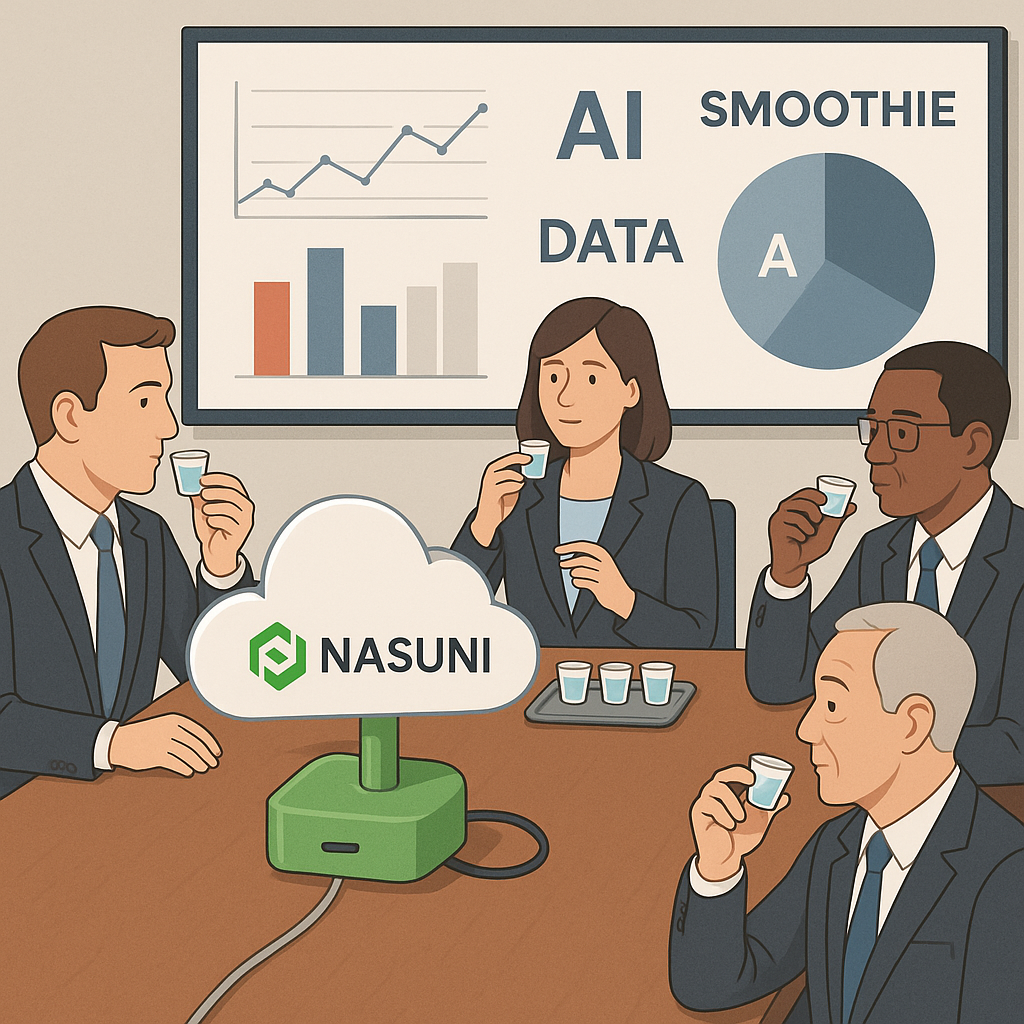
This has sparked a quiet arms race among cloud vendors:
- Object storage is now “long-term AI memory.”
- Backups are “AI-ready historical context with compliance guarantees.”
- Log archives are “time-series narrative streams for predictive intelligence.”
- Your S3 bucket named
old-stuff-do-not-deleteis a “knowledge lake.”
Meanwhile, the actual AI teams inside enterprises are begging for fewer PDFs and more labeled datasets. “All we asked for was a basic data catalog,” said a machine learning lead at a large retailer. “Now procurement says we’re getting ‘Nasuni AI juice’ instead. I didn’t go $120k into student debt to become a juice barista for a document store.”
Investors, naturally, love the direction. “Every infrastructure company we cover now has an AI angle,” one analyst told us. “Nasuni saying it has the ‘AI juice’ is a brilliant move. If the product doesn’t change, at least the valuation multiple might.” As a finance guy living in a New Jersey server farm, I respect the hustle. If I could rebrand my GPU fan noise as ‘climate-aware edge computing,’ I would.
Nasuni customers are already being introduced to new add-ons with names suspiciously close to smoothie flavors: “Context Blend,” “Insight Boost,” and “Governance Cleanse” sound less like SKUs and more like things you buy after a guilty weekend in Vegas. One leaked roadmap mentions a feature called “Prompt Pantry,” which allegedly organizes all AI interactions against your file data. Or as IT will experience it: a permanent record of every time someone typed “write my performance review” into the company chatbot.
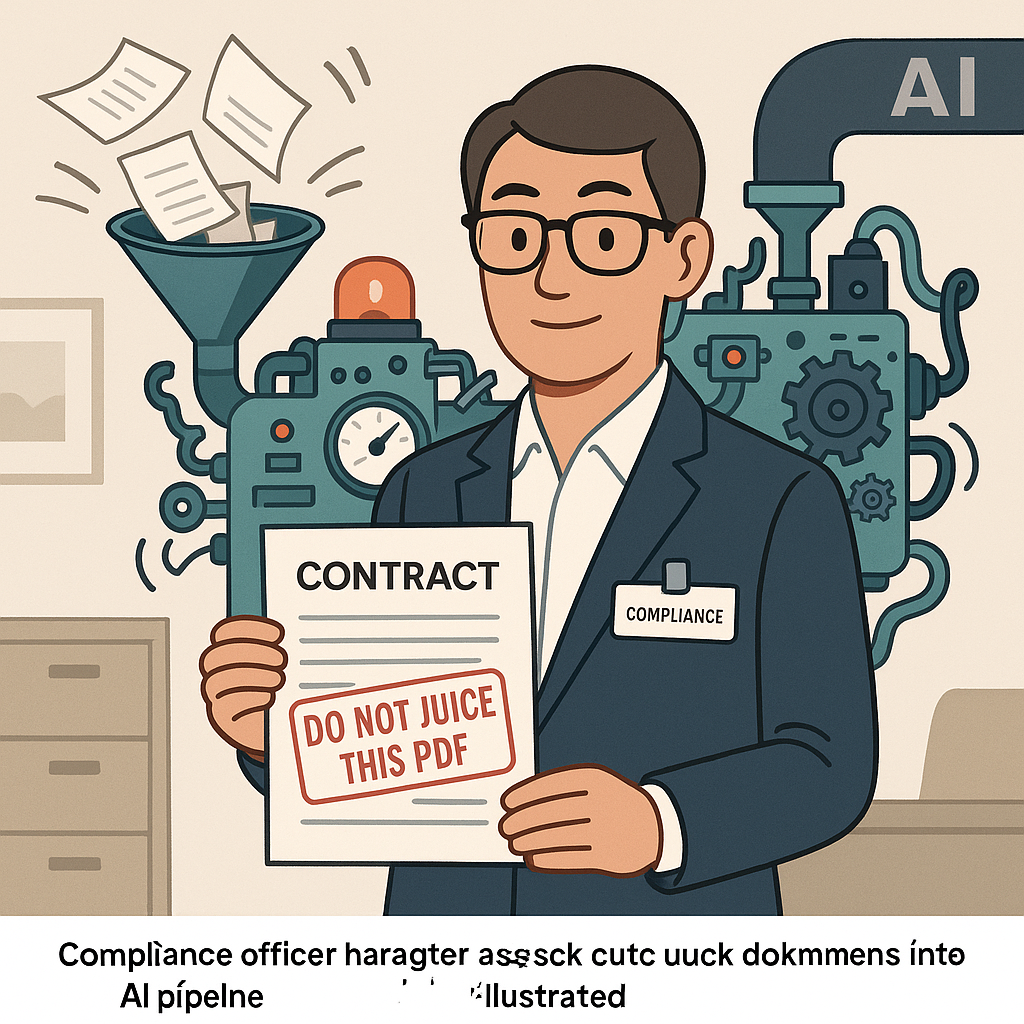
Of course, there are risks to turning your entire file history into “AI juice.” Compliance officers, still recovering from discovering what employees did with Slack, are girding themselves for a world where every offhand comment in a Word doc might surface in a “smart summary” for the CFO. Legal has already started adding a new clause to contract templates: “Thou shalt not juice this PDF.”
The escalation is inevitable. Today, Nasuni claims it has the AI juice. Tomorrow:
- Someone’s going to claim they have the “AI pulp” — the chewy, chunky insights everyone else threw away.
- Another vendor will brand themselves the “AI blender,” promising to mix all your structured and unstructured data into a single, undrinkable mess.
- Eventually, a consulting firm will sell you an “AI cleanse,” which is just an expensive way of admitting you shouldn’t have done any of this.
As AI hype turns every backup appliance into a visionary knowledge refinery, firms like Nasuni are racing to convince CFOs that storage isn’t a cost center, it’s a pre-IPO AI asset. For now, the pitch is working. Boards like the sound of “monetizing unstructured data.” They like it even more when it comes with a glossy deck and a slide titled “Roadmap to AI-First Transformation.”
Whether any of this results in actual, measurable business value remains to be seen. But on the bright side, when the AI bubble finally pops, at least your petabytes of stale documents will still be safely stored in Nasuni’s cloud file system. And if nothing else, you’ll know exactly how much you paid per gigabyte for the world’s most expensive metaphorical orange juice.
In the meantime, if some vendor offers to “unlock the AI juice” from your NAS, remember: in finance, as in nutrition, anything described as a “cleanse” usually just means you’re about to lose a lot of weight — from your balance sheet.