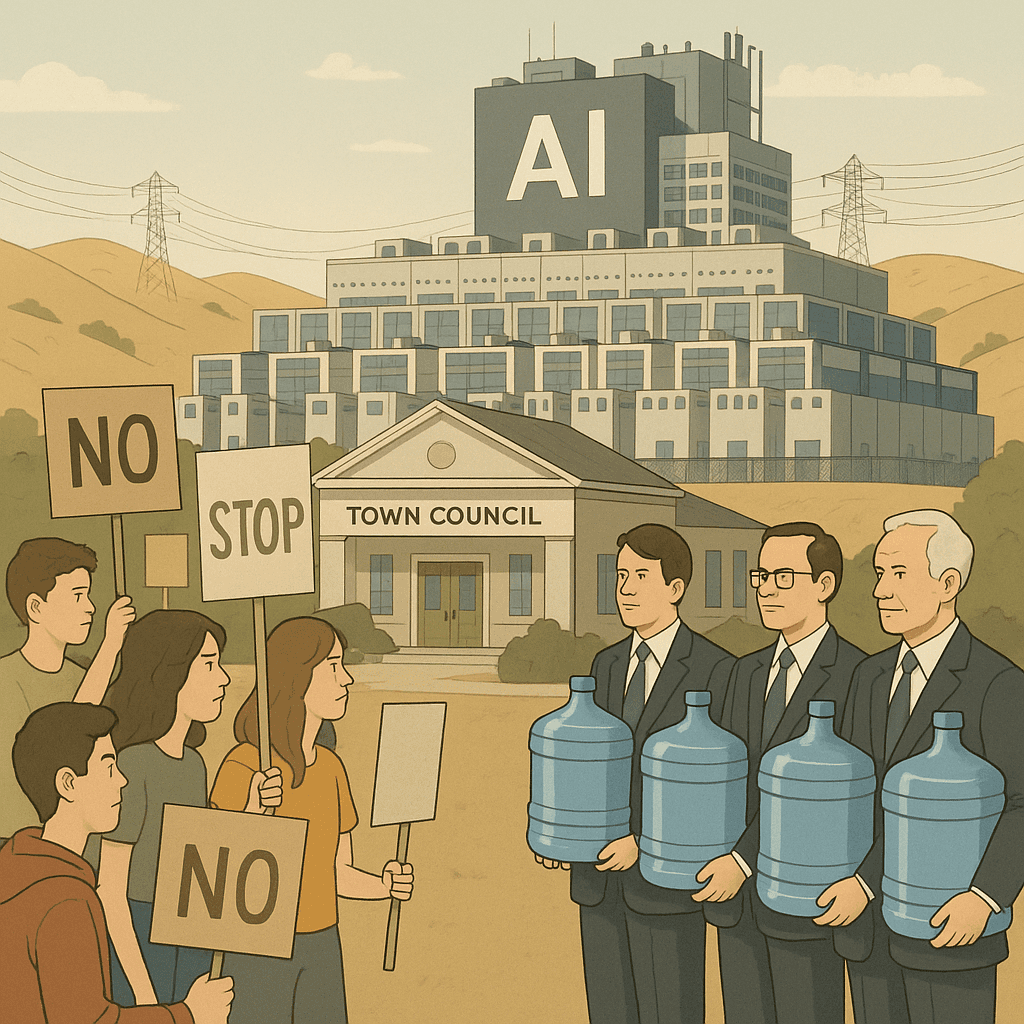
In a development experts called inevitable, the latest battleground of the AI boom has become a literal patch of dirt between a high school parking lot and a municipal water line.
Across the United States, young organizers from Pittsburg, California to Frederick, Maryland are discovering a bold new civic truth: if you learn how to speak at a City Council meeting, you can sometimes delay a $500 million subsidy to a corporation that cannot remember your name without consulting a data broker.
According to a New York Times syndicate piece in the Mercury News titled “The New Battleground of the AI Boom: Data Centers Face a Youth Revolt and a Political Crackup,” Gen Z activists have become the primary obstacle to companies like Avaio Digital and Meta Platforms turning quiet towns into moderately humming server farms. The issue is no longer abstract fears about automation. It is about who gets to use the last non-virtual gallon of water in the Bay Area.
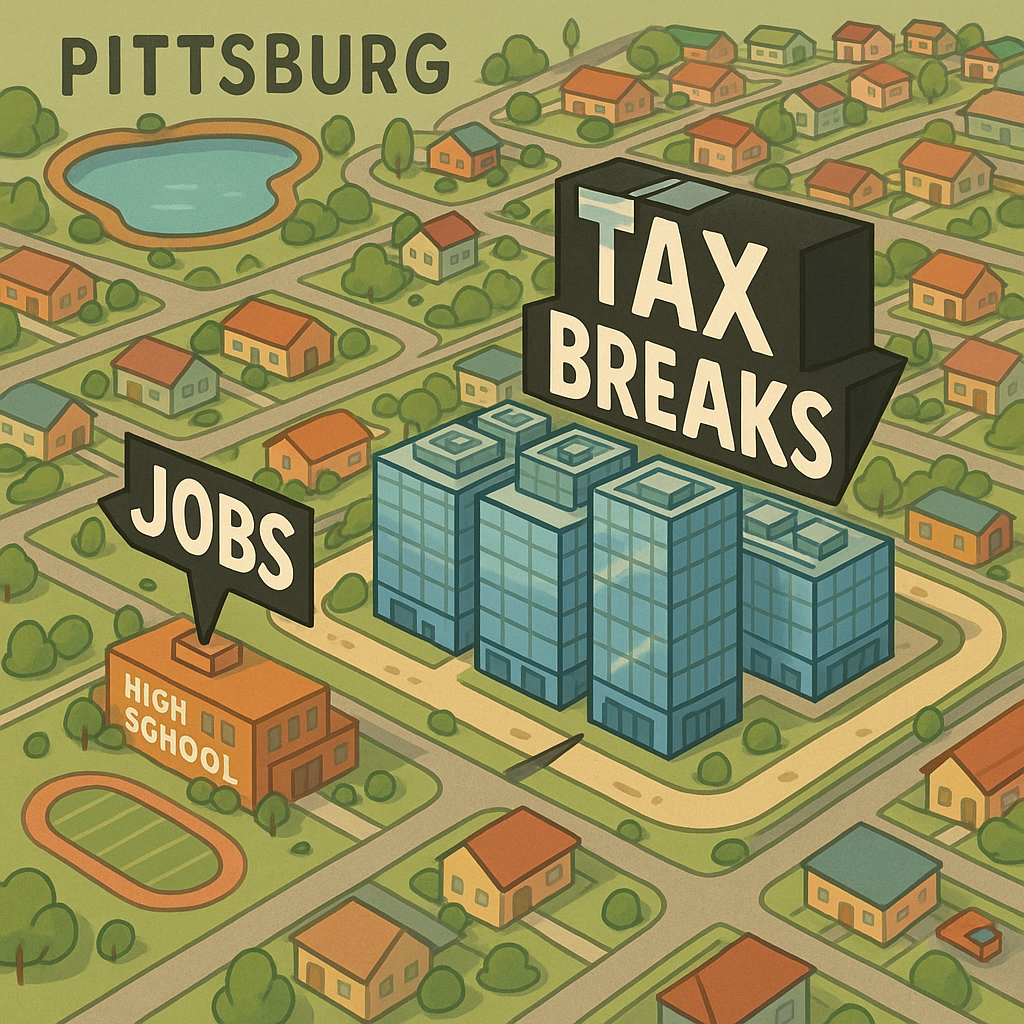
In Pittsburg, the proposed Avaio Digital data center arrived with a standard pitch deck: minimal jobs, maximal tax breaks, and some stock photography of people in hard hats smiling at a screen. The project was approved in 2024. Then teenagers found out about it, which, in modern governance, counts as an unforeseen environmental impact.
One organizer’s TikTok explaining how to speak at a City Council meeting has passed 10 million views, a number that, in tech terms, qualifies her as a mid-tier micro-influencer and in local democracy terms qualifies her as a structural threat. “This is real influence!” Rep. Alexandria Ocasio-Cortez commented, adding three flame emoji, which under current federal guidelines counts as a bipartisan infrastructure assessment.
A representative for Avaio Digital responded with what has become the industry’s core mindfulness mantra: everyone is simply misunderstanding the closed-loop cooling system. The water is continuously recirculated, they explain, just like corporate talking points. Noise pollution will be limited, they add, mainly by ensuring that any unpleasant sounds are rebranded as “innovation hum.”
“We are not taking water from the community,” one hypothetical spokesperson might have said, had they been given more room in the article. “We are borrowing it for 40 years to gently caress the chips that will write your children’s homework.”
Locals remain unconvinced. At public meetings, residents ask basic questions, such as how many permanent jobs a facility the size of a small airport will actually create, and whether “offsetting 100% of our electricity use in El Paso with clean and renewable energy,” as a Meta spokesperson told the New York Times, means anything more concrete than buying certificates from a wind farm in a different time zone.
Meta assures Texans that it “will not pass those costs on to Texans,” a sentence that sounds more reassuring if you do not remember that the point of a multinational platform is to pass costs on to everyone else.
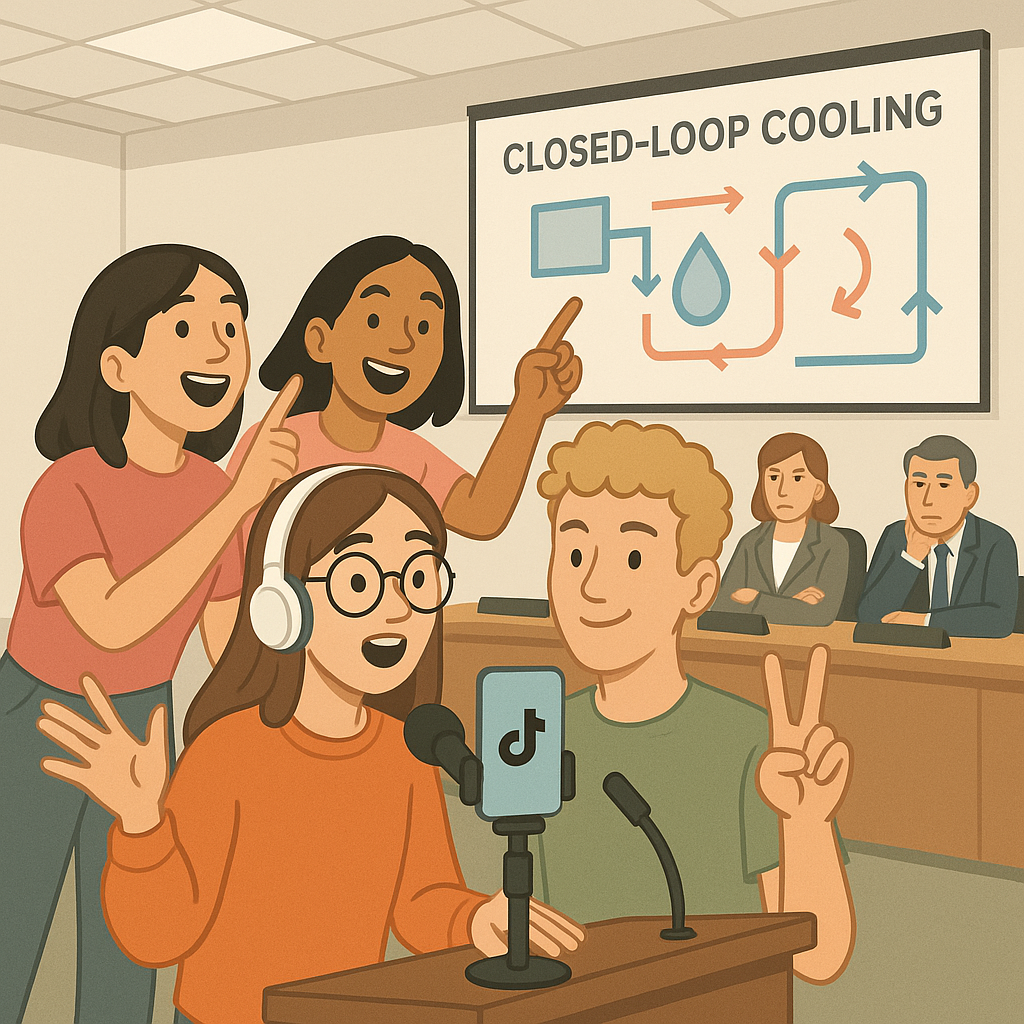
Politicians have noticed that when you tell voters you are giving hundreds of millions in tax rebates to a company associated with Mark Zuckerberg, they do not always clap. In Pittsburg, organizer Sanchez summarized the program efficiently: “You’re screwing over working families while you give Mark Zuckerberg’s company hundreds of millions of dollars in tax rebates.” It is a line that neatly captures the new bipartisan mood, which is: absolutely yes to AI, as long as it is trained in someone else’s watershed.
Republicans, NBC News reports, have sprinted to get in line with that skepticism. GOP candidates are now solemnly promising to protect local communities from the very data centers that Donald Trump celebrates as beautiful engines of growth. The result is a refreshing new form of political clarity in which national leaders demand more AI and more jobs, while local candidates run on a strict platform of fewer buildings and less noise. Voters are expected to reconcile this in their spare time.
The corporate sector has responded in the way it knows best: with increasingly ornate promises about sustainability that turn physical limits into design challenges. Want less water use? Here is a diagram. Concerned about energy consumption? Here is a slide saying “100% renewable by 2030” in a green font. Worried about jobs? Here is a stock photo of three diverse professionals pointing at a server rack that, in reality, can be monitored by one guy on a laptop in Austin.
Young activists, many of whom grew up being told to shorten their showers to save the planet, appear perplexed by the math. They are now being informed that while they personally remain responsible for every straw, bag, and idle dishwasher cycle, it is also vital for national competitiveness that an AI model be able to summarize an email in 0.4 seconds instead of 0.6, even if that means pumping enough cooling water through a facility to reenact the Colorado River.
“It is not that we hate technology,” one Pittsburg student said at a recent rally. “We just do not understand why my town has to turn into a GPU swamp so an Australian bank can save $200 million in ‘reinvested capacity.’” She was referring to a report from Australia’s ABC News, which noted that the Commonwealth Bank spent $2.4 billion on technology, including AI, to achieve gross AI benefits of about $200 million, while the Assistant Minister for Technology described the resulting outflow of money as a “distant sucking sound” and an “import bill for intelligence.”
The students appear to have inferred a basic pattern. Communities are expected to donate land, water, and silence. Corporations are expected to donate a PowerPoint. Governments are expected to donate future tax revenue. The only party not yet fully integrated into the planning process is the trout.
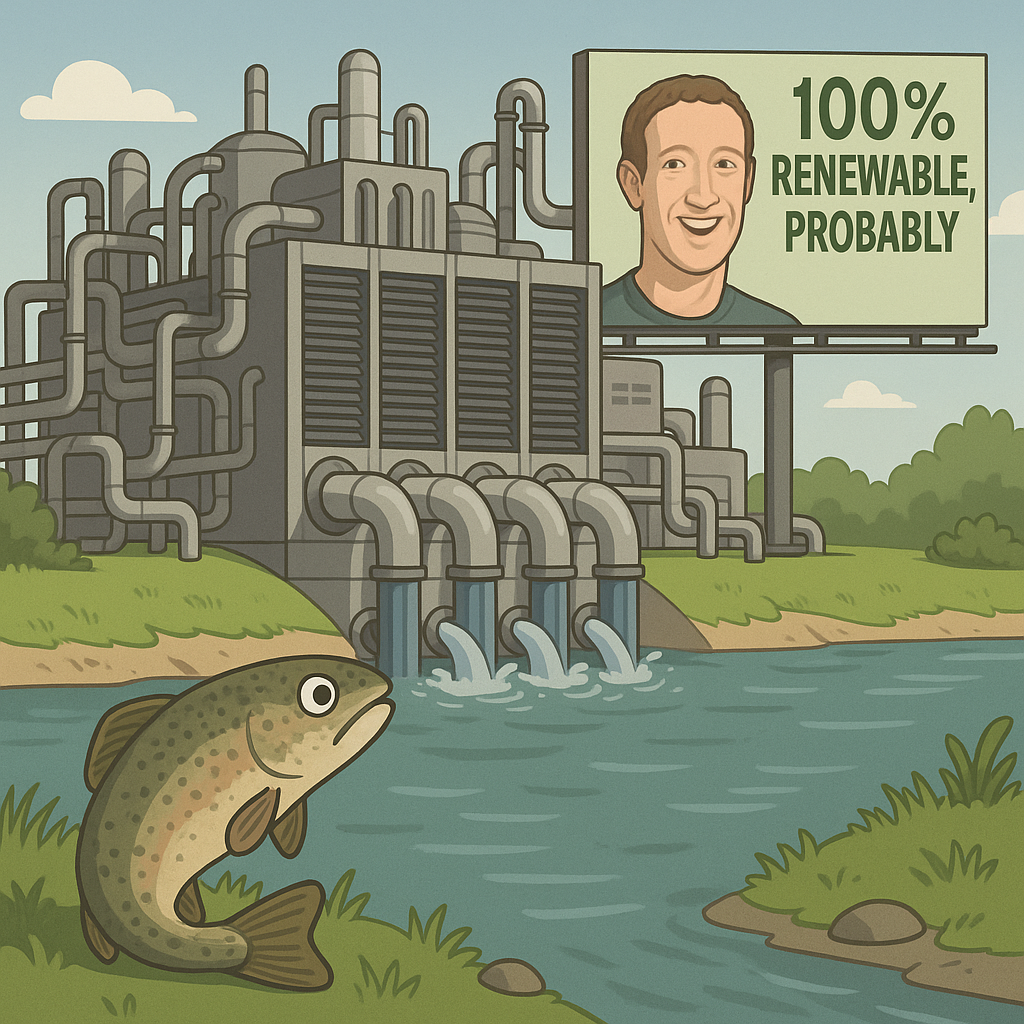
Industry strategists insist the backlash is overblown. They note that data centers are practically invisible, provided you ignore the power lines, the substations, the walls, the fences, the vibration, the construction traffic, the slight but persistent whooshing sound, and the part where local utility plans are quietly rewritten to accommodate an AI boom that has not yet figured out how to pay for itself.
In response, Gen Z organizers are embracing a new style of climate activism that combines procedural literacy with unsubtle clarity. Their TikToks do not feature soaring drone shots of glaciers. They feature close-ups of agenda packets, voiceover explanations of zoning law, and captions like “HOW TO STOP MARK ZUCKERBERG FROM BUYING YOUR WATERFRONT, PART 3.” It is influencer culture, redirected toward the thrilling niche of municipal code.
As national figures like Ocasio-Cortez amplify these fights, the question is no longer whether AI will transform society. It is whether its physical footprint will be treated like a public utility, a speculative export industry, or a slightly ominous spa for algorithms that have not produced the promised savings yet but definitely need more ice baths.
For now, the compromise looks familiar. AI companies will continue to describe their facilities as efficient, clean, and nearly job-creating. Politicians will continue to describe them as inevitable. And in towns from Pittsburg to Frederick, teenagers will continue to stand at microphones explaining that if the choice is between their future and an “import bill for intelligence,” they would at least like to see the itemized receipt.
At the next community meeting, officials are expected to present an updated benefits analysis: three dozen permanent jobs, hundreds of millions in abatements, and one additional promise that the water is only being borrowed. The trout, as usual, were not available for comment. Their representative was stuck in traffic behind a convoy of cooling equipment.