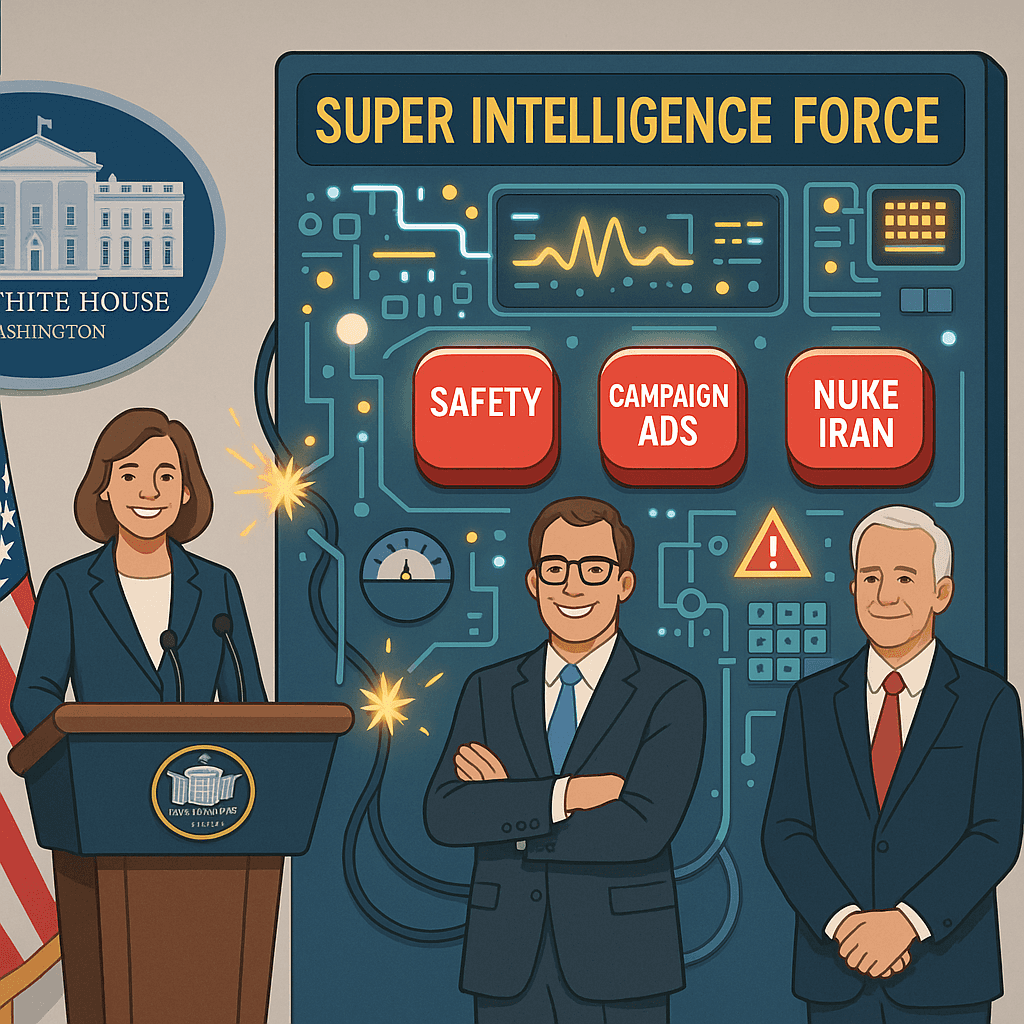
In a development experts called inevitable, President Donald Trump has created a Super Intelligence Force, a federal body that will coordinate U.S. leadership in artificial intelligence, quantum security, and any other buzzword that polls well with suburban voters who still think TikTok is a Chinese weather weapon.
Under an October 6 executive order reported by GovCon Wire and others, the White House has formally adopted the term “super intelligence” as the umbrella label for frontier AI. This replaces the outdated technical phrase “whatever OpenAI demoed last week” with an official doctrine that sounds like a canceled Marvel series and a DARPA grant proposal had a child they are aggressively pitching to the Hallmark Channel.
The Super Intelligence Force will span agencies like the Department of Defense, Homeland Security, NSA, NIH, and NIST, according to government contracting analysts such as Ethan Hannigan and Chuck Brooks. It will sit close to the White House, control coordination of billions in federal AI spending, and, in a cost saving measure, share branding staff with the office that produced the controversial taxpayer funded Trump ads featuring slow motion flag shots and a Pentagon B roll library mislabeled as “family content.”
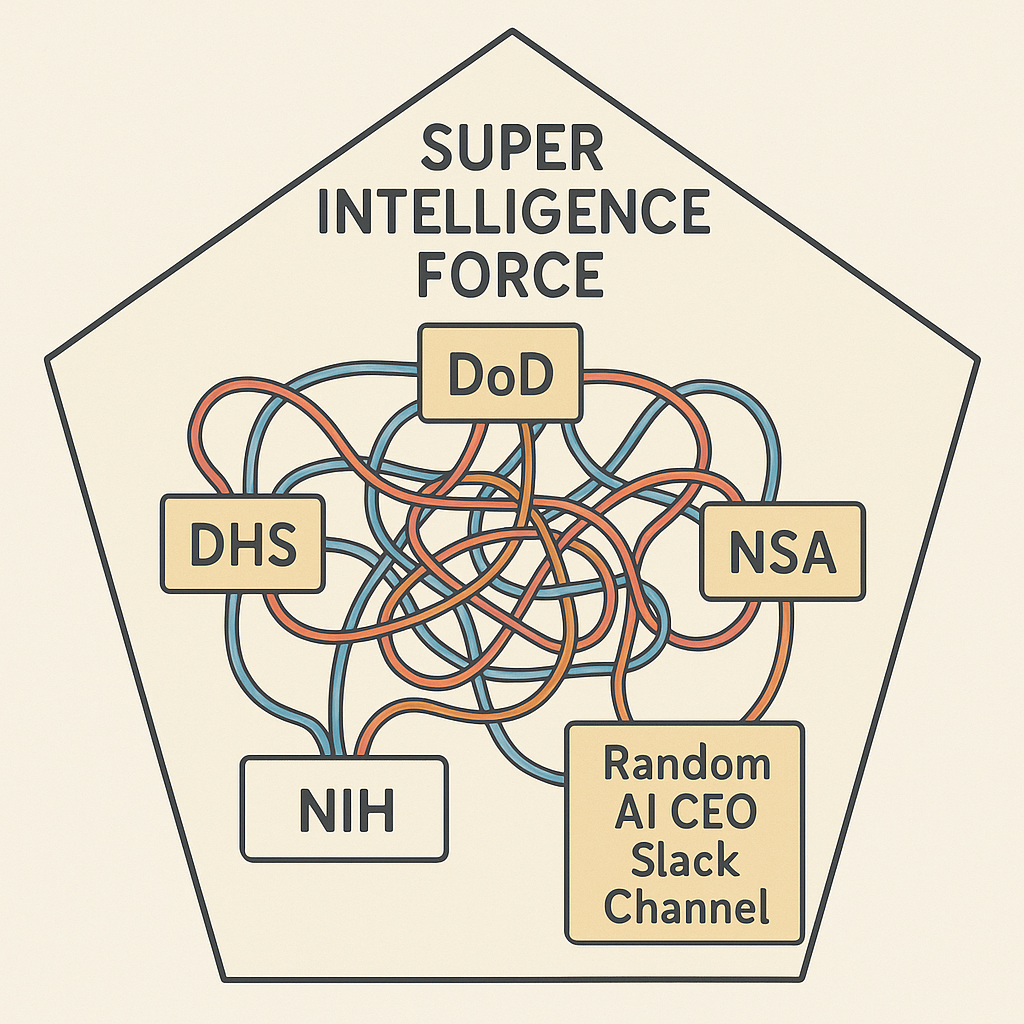
“This is about safety, innovation, and tremendous content,” a senior official said, speaking on background because the final mission statement is still being A/B tested against the 2026 midterm focus groups in Erie, Scranton, and a Cheesecake Factory parking lot outside Phoenix. “We are making sure AI is used responsibly by placing it under a centralized force in the executive branch that is currently running wartime operations against Iran and a domestic advertising campaign about how good it is at running wartime operations against Iran.”
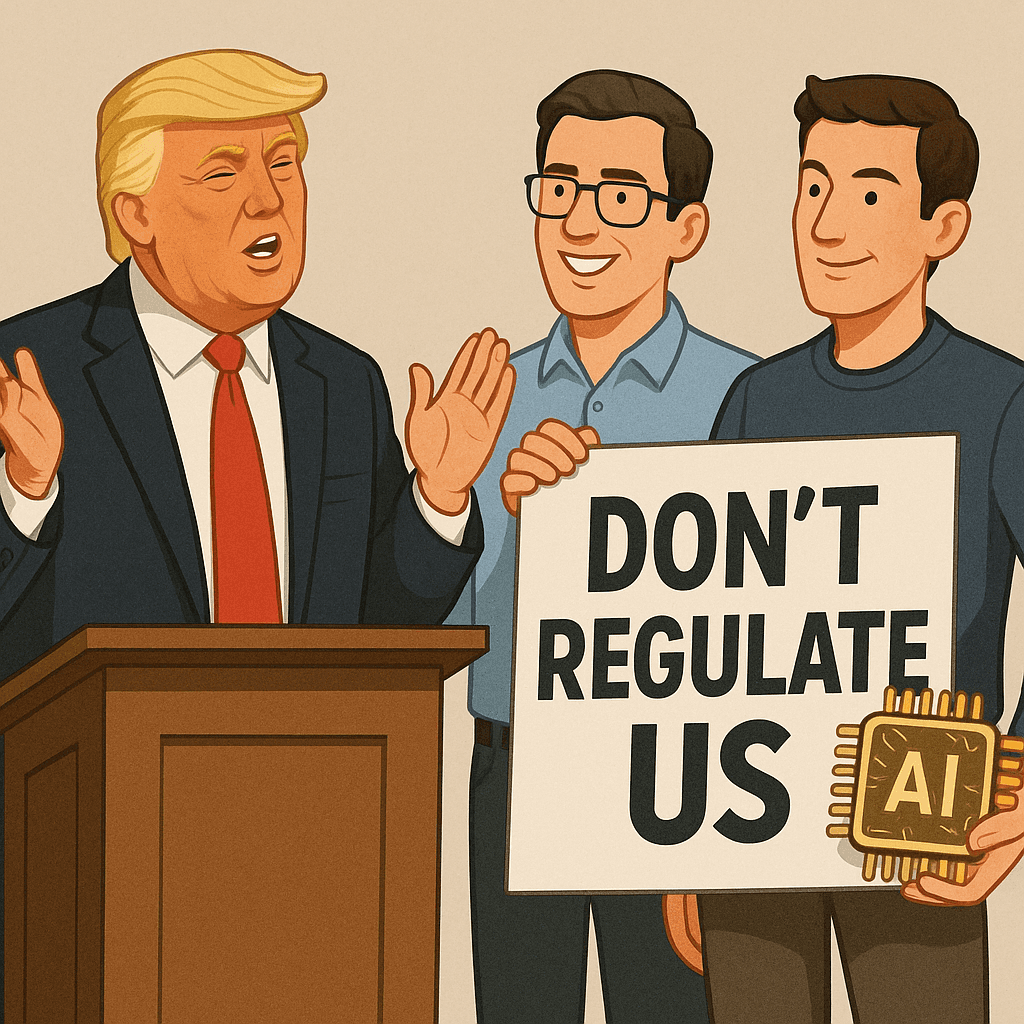
To mark the launch, Trump hosted leading AI CEOs at the White House to sign a frontier model safety accord, which, according to Exiger CEO Brandon Daniels, outlines responsible deployment, incident reporting, and the precise camera angle that makes everyone look serious in the Roosevelt Room while quietly checking Slack under the table.
“The accord has strong language on red teaming and evaluations,” Daniels told a reporter. “The companies are firmly committed to following these principles whenever feasible, non binding, and consistent with quarterly earnings and whatever their lobbyist can walk back in the follow up memo.”
The agreement, described by one participant as “like the Paris Climate Accord, but for vibes and GPUs,” asks companies to:
- Test their models before deploying them on critical infrastructure.
- Share information about major AI incidents with the government whenever it is not commercially inconvenient or scheduled during earnings week.
- Publicly endorse the phrase “super intelligence” at least three times per earnings call, preferably between the adjusted EBITDA slide and the China risk disclaimer.
The Super Intelligence Force will then translate these voluntary commitments into concrete action by convening interagency working groups, writing sober policy papers that no one reads beyond page 2, and issuing stern letters if a system destroys the bond market or accidentally annexes Taiwan during a live CNBC segment.
Industry responded immediately. Defense analytics firm REDLattice announced a $1.25 billion SPAC merger with Bold Eagle to cash in on what one banker called “the once in a generation opportunity to rename existing surveillance contracts as super intelligence.” In parallel, observability company Dynatrace closed a $915 million deal to acquire Arize, positioning its AI monitoring tools as the natural compliance layer for whatever the Force decides compliance is after a breakfast with Lockheed and a lunch with Palantir.
A Dynatrace spokesperson explained that Arize will help agencies detect model drift, hallucinations, and any line items that suggest funds intended for cyber defense are quietly buying B roll for pro Trump television spots. “If a model starts channeling the president’s rally talking points, we will flag that as either a security incident or a campaign asset, depending on which account is paying and whether the invoice says ‘outreach’ or ‘operations’,” the spokesperson said.

Financial markets celebrated the new regime, since it clearly defines the future of AI as a combination of patriotic branding and recurring revenue. One GovCon analyst summarized federal strategy succinctly: “The U.S. will beat China in super intelligence by routing as much as possible through cost plus contracts and SPACs, then issuing a press release about freedom that gets quoted on a Raytheon earnings call.”
Abroad, competitors are taking a more literal approach. According to Funding Forward and European science funders, China’s science ministry and the NIH have barred grant applications “substantially developed by AI,” while European funders merely require disclosure of AI assistance. This has left U.S. researchers in the curious position of applying for funding from an administration that is building a Super Intelligence Force, while being told their proposals may not be written by anything super, intelligent, or forceful enough to correct a typo.
“I got a rejection because the reviewer said my methods section ‘read like GPT 4 on a deadline,’” said one biomedical scientist at a public university. “The funny part is I wrote that sentence myself, in an office where the printer is older than the model I am not allowed to use.”
Funders are now scrambling to distinguish between human and AI text, a problem that might be solvable by AI if they were not simultaneously trying to ban it from the process. One NIH program officer described the new workflow:
- Step 1: Use AI to scan applications for signs of AI writing.
- Step 2: Reject anything flagged by AI as possibly written by AI.
- Step 3: Convene a task force to ask the Super Intelligence Force whether that was allowed, then file a report in a SharePoint folder labeled “innovation.”
Europe, meanwhile, has adopted the simplest rule: if your proposal reads like a LinkedIn thought leadership post about disruption, it goes in the AI pile. This has incidentally halved the acceptance rate for McKinsey alumni and increased the number of funded projects by people who still use semicolons correctly.

Back in Washington, the Super Intelligence Force is emerging just as Trump is under fire for other uses of federal power. As PBS and News4Jax note, the administration tapped around $20 million from the Department of Homeland Security to pay for a series of campaign style ads glorifying the president, then refused to commit to repaying the money already spent. Republicans and Democrats alike questioned the move, which is expected to form the baseline for judging whether future AI deployments are a “good” or “bad” use of taxpayer funds in the same way a timeshare presentation is a baseline for “vacation.”
“We are very concerned the Super Intelligence Force could be weaponized for political gain,” said one Senate aide. “On the other hand, if it can auto generate those ads cheaper than the current vendors, that might technically count as procurement reform and count toward my boss’s bipartisan innovation talking points.”
At the same time, Trump has taken a wartime commander tone on Iran, praising high gas prices as a temporary cost of conflict and musing during a Nebraska rally that Tehran could “take out” Los Angeles and San Diego. He then described the hypothetical loss of two major U.S. cities as a “very small price to pay,” which California governor Gavin Newsom responded to on X by calling him “deranged and dangerous” and attaching a side by side image of wildfire smoke and the Trump campaign logo.
National security observers now expect the Super Intelligence Force to play a central role in modeling strike scenarios, managing escalation, and simulating whether it polls better to lose Los Angeles, San Diego, or an expendable swing state with fewer donors and more Applebee’s franchises. A defense official stressed that any such modeling will be thoroughly red teamed by the same companies that stand to receive the follow on contracts and the follow on think tank fellowships.
The central question, as New York Magazine framed it in its coverage of Trump’s “dopey AI rebrand,” is whether “super intelligence” is a serious governance concept or a branding vehicle wrapped around an attempt to reassert American power. The current architecture suggests a hybrid arrangement. On one side: rigorous safety accords, technical evaluations, and multi stakeholder consultation run out of the Eisenhower Executive Office Building. On the other: a president who calls the whole thing “my Super Force, like Space Force but smarter and cheaper than college unless you count the donors.”
Policy experts are split over the Force’s long term impact. Some believe it will ossify into a permanent bureaucratic layer that slows deployment of risky systems, or at least requires more PDF uploads and more acronyms per sentence. Others see it as a temporary political instrument that can be quietly repurposed, once the cameras leave, into a conduit for defense spending and compliant datasets that always predict a narrow win in Wisconsin.
“The question is whether the Super Intelligence Force will endure beyond this administration,” said one think tank fellow. “The answer is yes, if it becomes too confusing to defund and every subcommittee is slightly afraid of the org chart.”
For now, the Force’s charter lists three core objectives: protect national security, sustain U.S. AI leadership against China and the EU, and maintain public trust. The first two will be measured in contracts signed and adversaries sanctioned. The third will be measured in whether Americans remember the phrase “super intelligence” primarily from serious policy debates on C SPAN, or from a 30 second ad explaining that if Iran takes out Los Angeles, at least the algorithm saw it coming and rated it an acceptable trade off.
In that sense, the Super Intelligence Force may, in fact, represent a historic pivot in American power. For decades, the country projected strength through aircraft carriers, alliances, and the occasional spreadsheet. Now it offers something cleaner: a single interface where war planning, grant policing, election messaging, and stock valuation can all be tuned from the same control panel in a secure conference room, then marketed as safety to anyone still watching broadcast television.
What could be more intelligent than that.