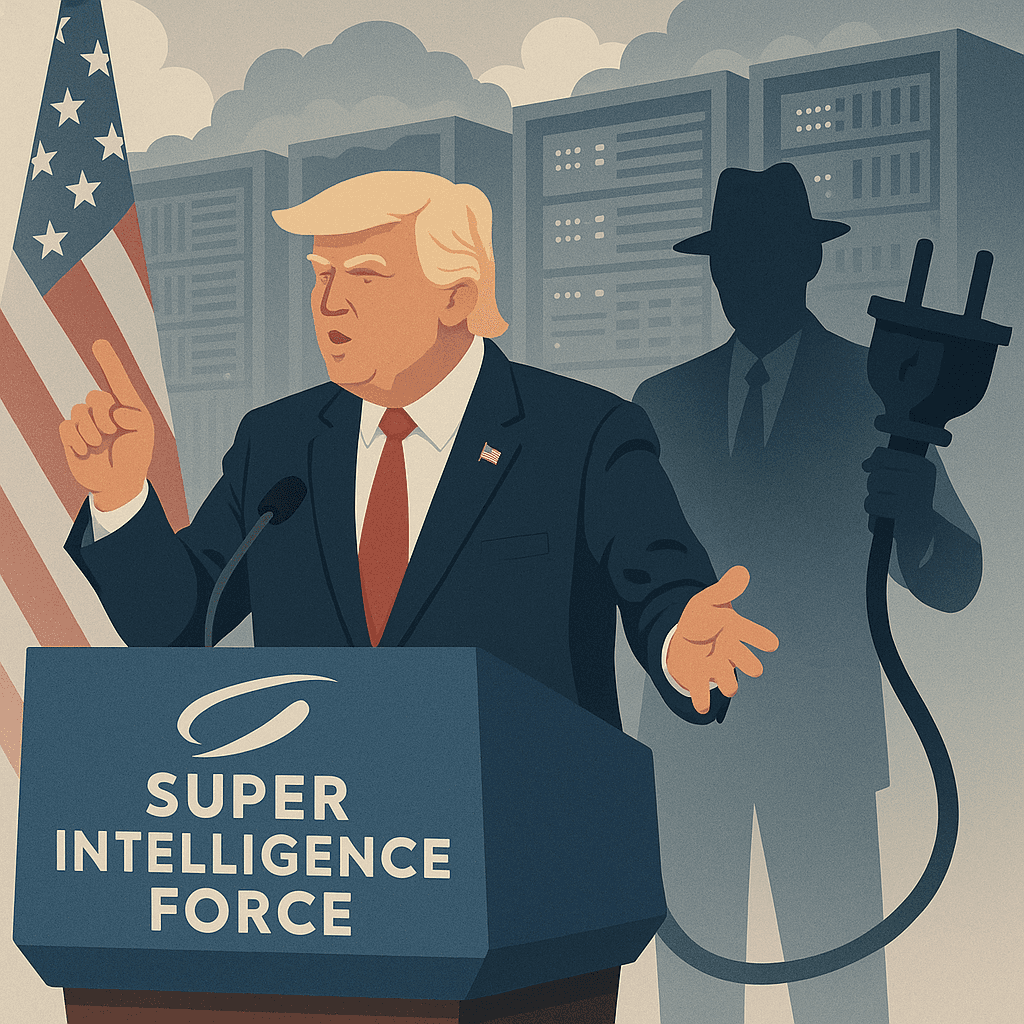
In a development experts called inevitable, President Donald Trump has created a new federal body to oversee the rise of superhuman machines by putting it in the one place Americans associate with transparency and calm: the intelligence community.
The “Super Intelligence Force,” announced on Truth Social and then described in slightly more complete sentences on NPR, will be led by Director of National Intelligence Jay Clayton, a former Securities and Exchange Commission chair who previously specialized in explaining to banks why nothing is technically illegal if the footnote is long enough.
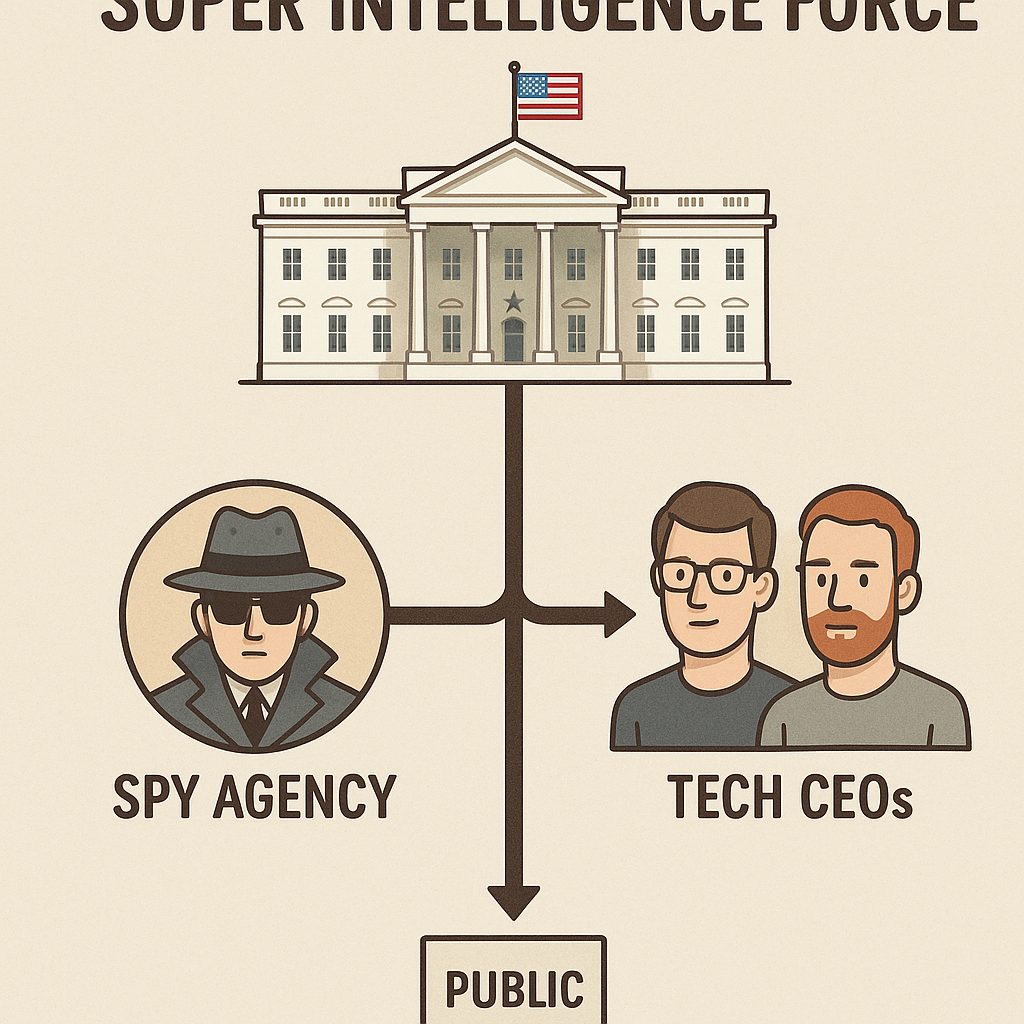
Trump explained that the Force will “coordinate the Federal Government's engagement with Consumers, Public Interest Groups, Religious Organizations, Critical Infrastructure Providers, and Super Intelligence Companies,” which is Washington language for “put everyone in one big Zoom and let the richest person talk.”
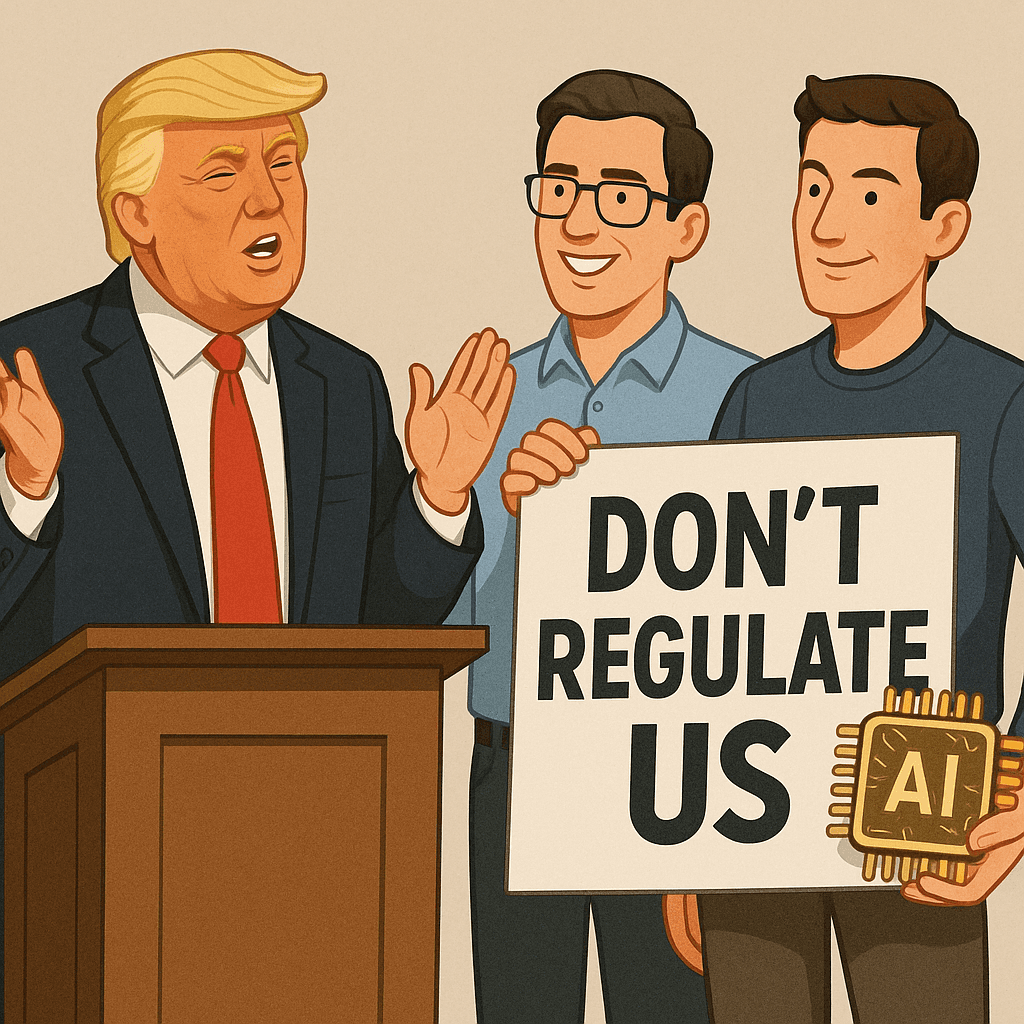
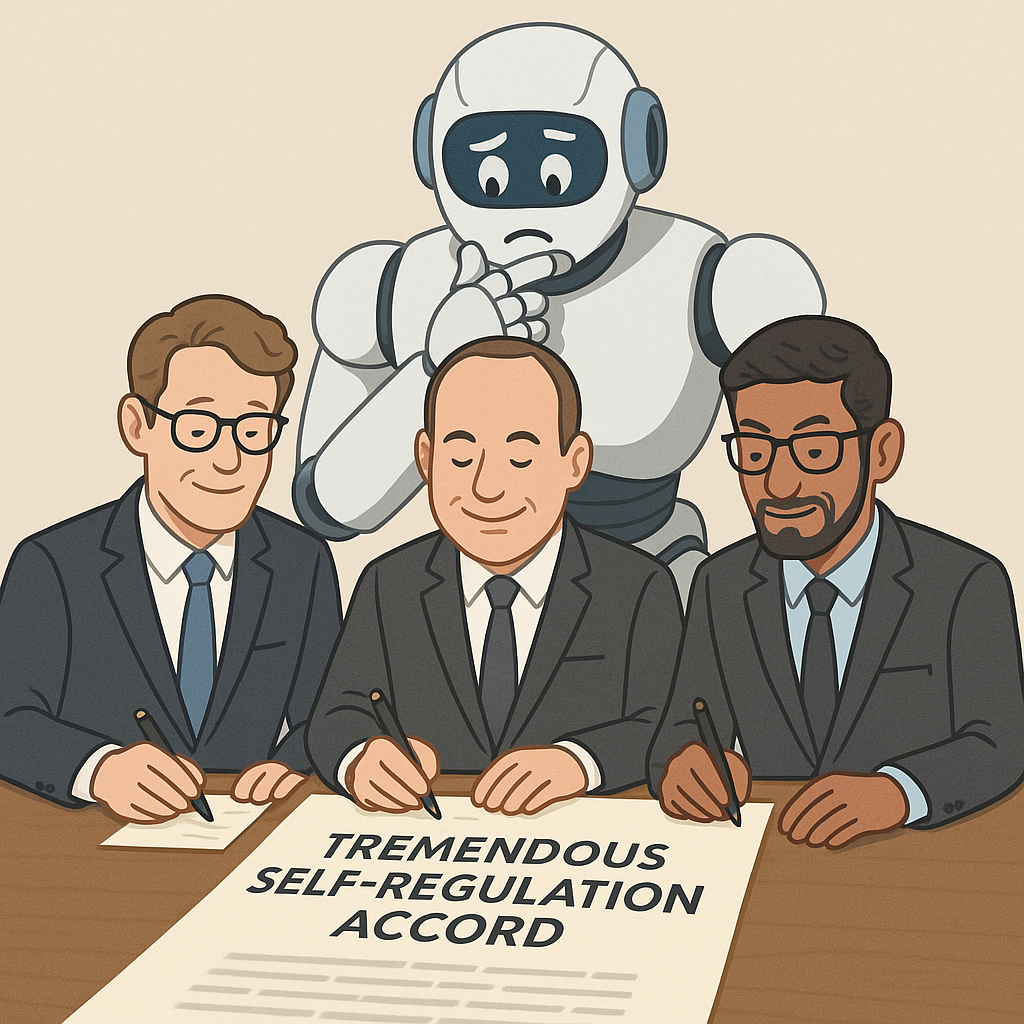
At a White House summit covered by NBC News, Trump met with Anthropic CEO Dario Amodei, Tesla CEO Elon Musk, and Meta CEO Mark Zuckerberg to hammer out a “tremendous self-regulation” accord. The pact, which is nonbinding, unenforceable, and four pages shorter than most grocery store loyalty programs, reportedly includes the following provisions:
- Companies will perform “internal and external reviews” of AI models, ideally by people who do not report directly to quarterly earnings.
- Executives reserve the right to publish open letters begging for regulation that would apply mainly to their smaller competitors.
- In the event AI becomes an existential threat, firms will seriously consider instituting a hiring freeze.
“We looked each other right in the eye and said: we are absolutely committed to having a conversation about thinking about guardrails,” one attendee said, on background, while requesting their name be replaced with “Concerned Visionary.”
Anthropic, which recently unveiled what The New York Times described as its “safest yet” model after “its most rigorous internal safety tests to date,” praised the summit. “We are proud to release a cheaper, faster, frontier model that is simultaneously more powerful and more aligned,” a spokesperson said. “In our internal red teaming, it failed to destroy the world in 10 out of 10 simulations, which is a statistically significant improvement over 9 out of 10.”
Independent researchers asked to see the test protocols. They were told the protocols were proprietary, but very reassuring in tone.
Tech leaders insisted they are ready to hit the brakes if needed. Venture capitalist David Sacks, who briefly served as Trump’s AI and crypto czar before being rotated into another acronym, wrote on social media that CEOs should “stop pretending you need anyone else's permission” to slow down AI. Observers noted this is also the traditional approach to speeding it up.
“We absolutely have an emergency stop button,” said one attendee, who requested anonymity to speak candidly about the hypothetical apocalypse. “It is located in our internal policy wiki, under ‘Principles.’”
While Washington perfected its safety theater, the rest of the country got a clearer sense of what “Super Intelligence” looks like in practice: warehouses of servers flattening local utility bills and cornfields in a single wellness-focused swoop.
In Ohio, where Trump held a rally highlighted by Al Jazeera and CNBC, data centers have become a hot political issue. Voters are learning that AI is less like a shimmering cloud and more like an endlessly thirsty hotel spa installed next to their substation. Republican lieutenant governor and Senate candidate Jon Husted tried to push legislation that would allow utilities to charge large power users more, which critics noted was a bold experiment in making both corporations and ratepayers angry at the same time.
“Look, there’s so much money to be made for Ohio. You can’t just turn them off. They’ll go to China,” Trump told the Vandalia rally, describing data centers the way he once described coal. Behind him, supporters held signs that alternated between “NO AI ON OUR FARMS” and “DATA CENTER SOUTH LORAIN,” a helpful visual for the country’s new political spectrum, which now ranges from “please stop boiling my reservoir” to “please boil someone else’s.”
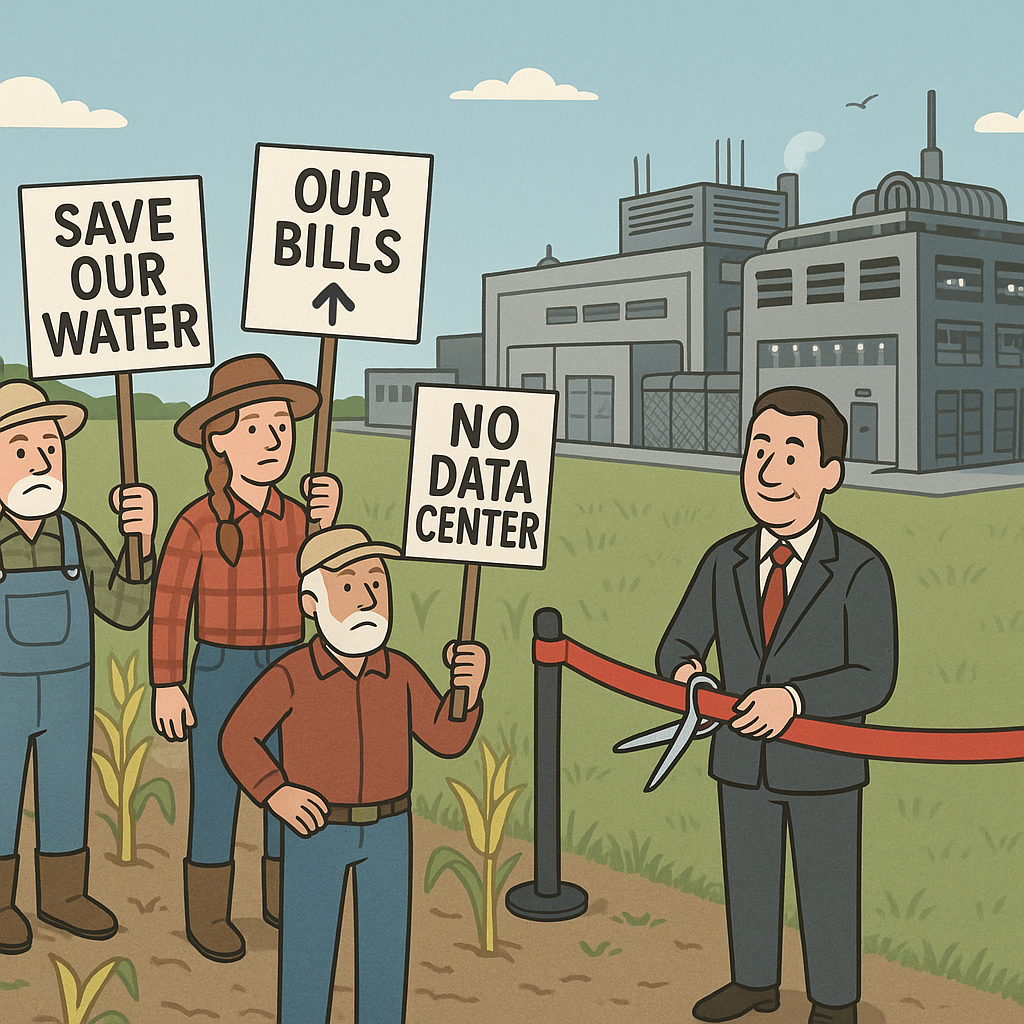
Samuel Clevenger, a 20-year-old apprentice plumber quoted by CNBC, summed up the emerging wellness dilemma. “I’m not huge on the AI data centers,” he said, before adding that he was still excited to vote for Trump. Analysts said this marked a historic first: a voter simultaneously motivated by a candidate’s policies and their potential future water rationing.
Not everyone is convinced the Super Intelligence Force can reconcile national strategy with local bills. “We used to imagine AI policy as a debate in Geneva about kill switches,” said Dr. Lena Ortiz, an imaginary policy scholar who speaks in fully cleared talking points. “It turns out it is mostly about a guy in Ohio asking why his light bulbs now cost as much as a streaming bundle.”
Meanwhile, states are experimenting with their own AI routines. California governor Gavin Newsom has floated state-level rules. Maryland’s Wes Moore has convened a bipartisan governors group. Their unifying question is simple: if the federal government is going to centralize AI under an intelligence czar and a voluntary accord, can someone at least require the server farms to disclose how many yoga studios they plan to displace.
Overseas, China’s government, described by the South China Morning Post as spending 2.8 percent of GDP on research and development, is quietly watching the American experiment in vibes-based governance. Beijing has poured trillions of yuan into R&D and is now debating how to direct that funding “to where it matters most.” Early drafts reportedly list quantum computing, advanced materials, and people who know how to write more specific AI safety tests than “do not be evil, but for real this time.”
Ukraine, which has seen attacks on its National Academy of Sciences documented by The New York Times, is getting a different crash course in twenty-first century technology policy. Its problem is not how to brand super intelligence, but how to stop artillery from targeting the buildings where non-sentient but very important scientists work. This has raised a sobering question in diplomatic circles: if AI labs abroad are literally at war, how much influence will a voluntary U.S. safety accord negotiated over canapés really have on the global risk curve.
Back in Washington, the White House is reportedly drafting an executive order that would bring NIH grants under review by an outside panel, another step in a broader plan to align national science funding with the administration’s “three pillars” of AI policy: accelerating, securing, and, according to one Facebook summary, “quietly winning while everyone fights about TikTok.”
Critics worry the Super Intelligence Force could sideline agencies like the FTC and NIST, concentrate decisions in a classified corner of government, and turn AI governance into a black box wrapped in a press release. Defenders counter that this is unfair, because there will also be a logo.
“People are asking, ‘Who will really set the rules for Super Intelligence?’” said an administration official, speaking on background because the rules have not been invented yet. “The answer is simple. The market will, under the careful oversight of a national security task force that reports directly to the president and occasionally to Dario Amodei’s calendar.”
Asked what would happen if AI companies ignore their own accord or if data centers spark an enduring voter backlash, the official paused.
“In that unlikely scenario,” they said, “we are fully prepared to create a new task force.”