In a development experts called inevitable, the United States quietly outsourced its entire science policy to a small group of billionaires who already own everything else, plus most of the remaining reasons young people still learn calculus instead of becoming "content entrepreneurs."
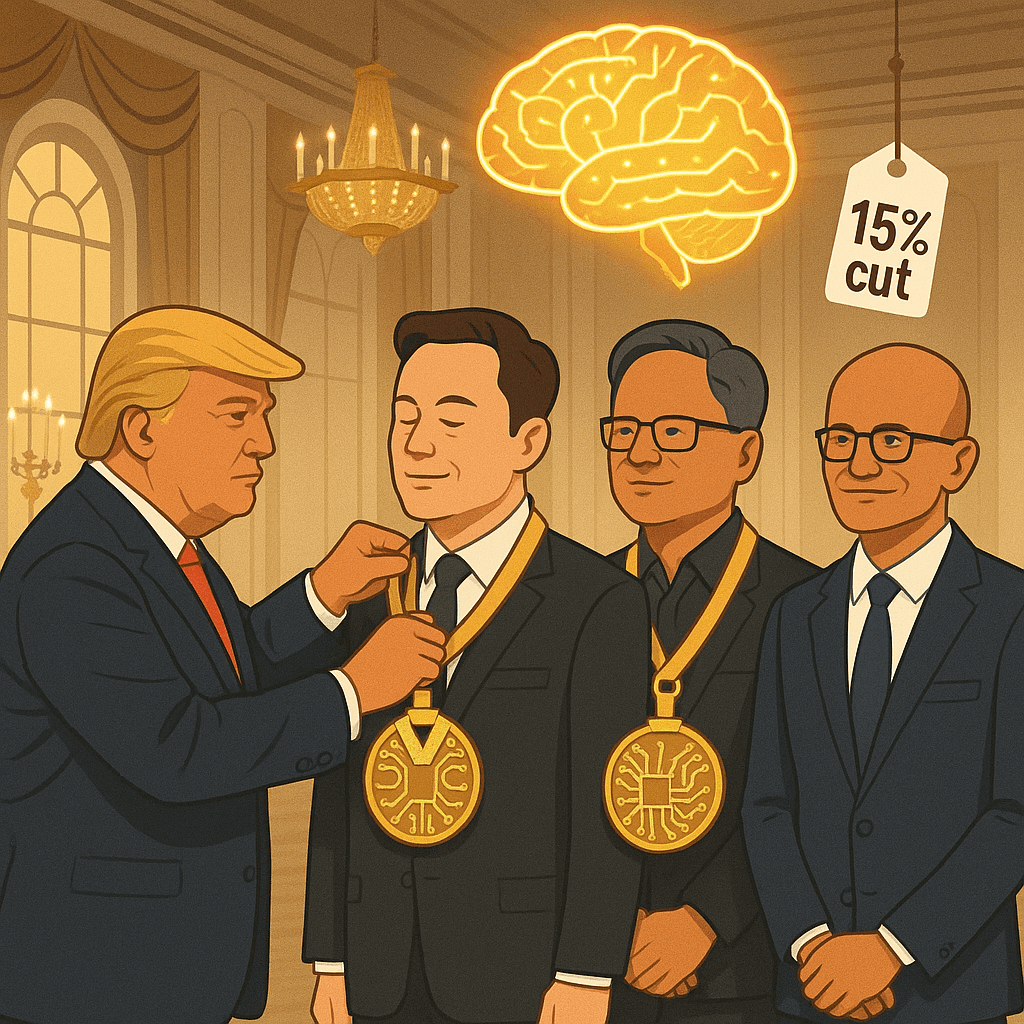
At a summit branded "Science: A New Golden Age of Science," President Donald Trump placed the National Medal of Science and the National Medal of Technology and Innovation around the necks of Elon Musk, Sergey Brin, Jensen Huang, Lisa Su, Michael Dell, and Satya Nadella, formally recognizing them as the country’s new R&D department, informal credit line, and provisional National Feelings Council.
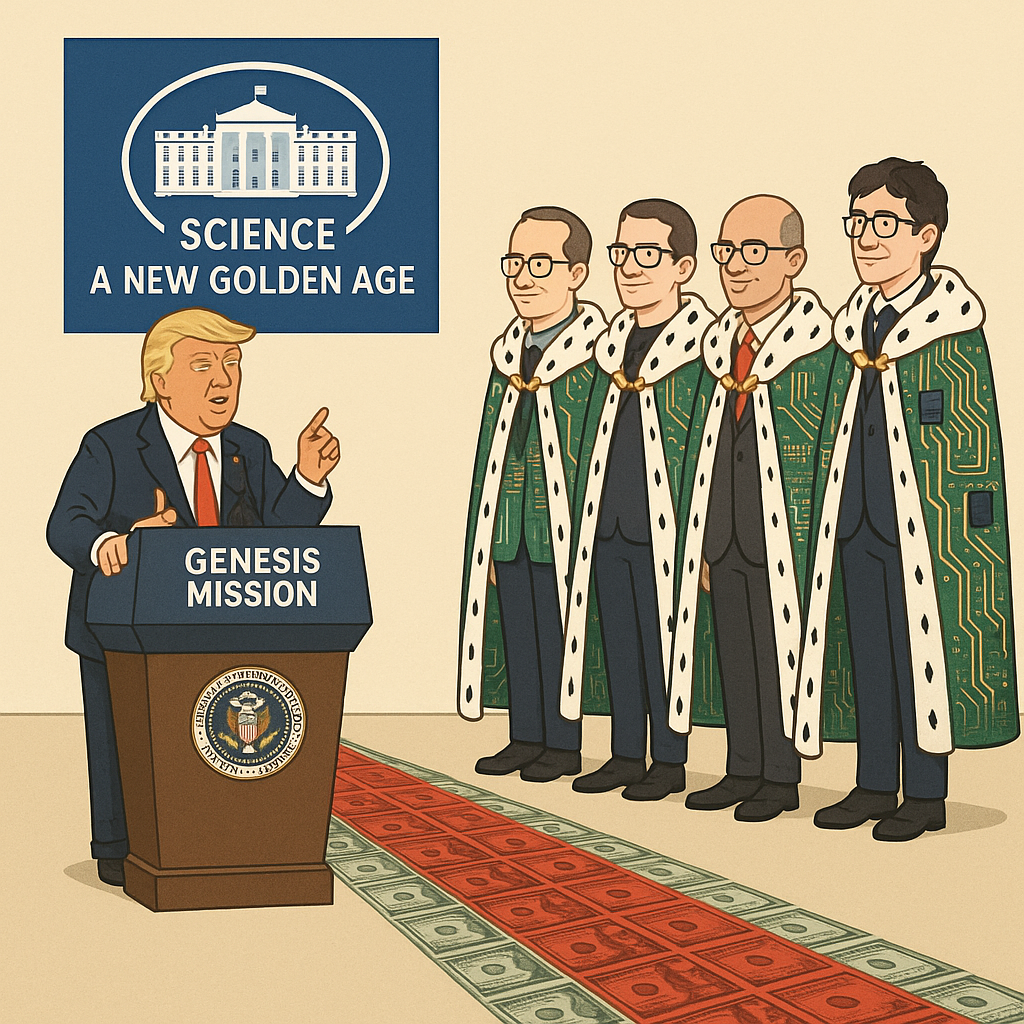
Onstage, Trump hailed artificial intelligence as "super intelligence," announced a 5 billion dollar Genesis Mission to use it for science, and compared Musk to a "modern-day Thomas Edison," which is accurate if Edison had also run a meme casino and moderated a comment section. Offstage, his administration froze green card pathways for Microsoft and Adobe engineers, opened fraud probes into elite universities’ visa programs, and reminded every honoree that national greatness now runs on a two tier system: stock based and deportable.
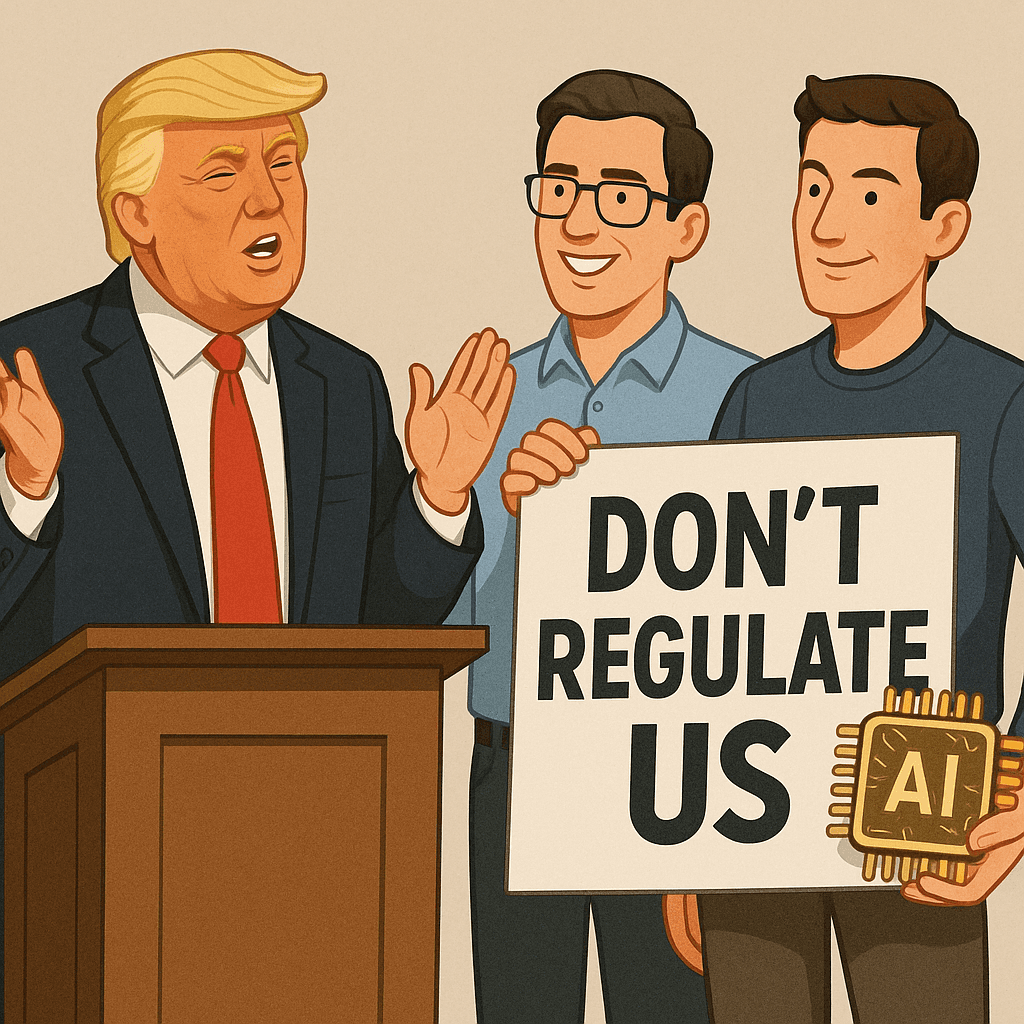
The model is simple enough for even a retail investor to grasp. According to White House materials cited by PBS and Al Jazeera, the federal government will take a 15 percent cut of Nvidia and AMD AI chip sales to China, a structure known in finance as "carried interest, but for geopolitics." In return, CEOs receive medals, tax treatment that feels like a warm bath in Delaware, and the opportunity to sign what Trump proudly described as a "morally binding" AI safety accord.
"It is not legally binding," one administration lawyer clarified to reporters, "but it is vibes binding. If the models start doing war crimes, we will be very disappointed and may revoke brunch privileges at the Eisenhower Executive Office Building."
Nvidia chief Jensen Huang, fresh from inventing the hardware that powers both super intelligence and your cousin’s crypto pump, applauded the 15 percent revenue skim as "a bold new chapter in public private partnerships where the public partners with our revenue line." Shortly before the summit, Huang invested in struggling Intel and reportedly chipped in for a new White House ballroom, a synergy Reuters described as "complex" and everyone else recognized as the shortest path between a GPU and an open bar with its own ticker symbol.
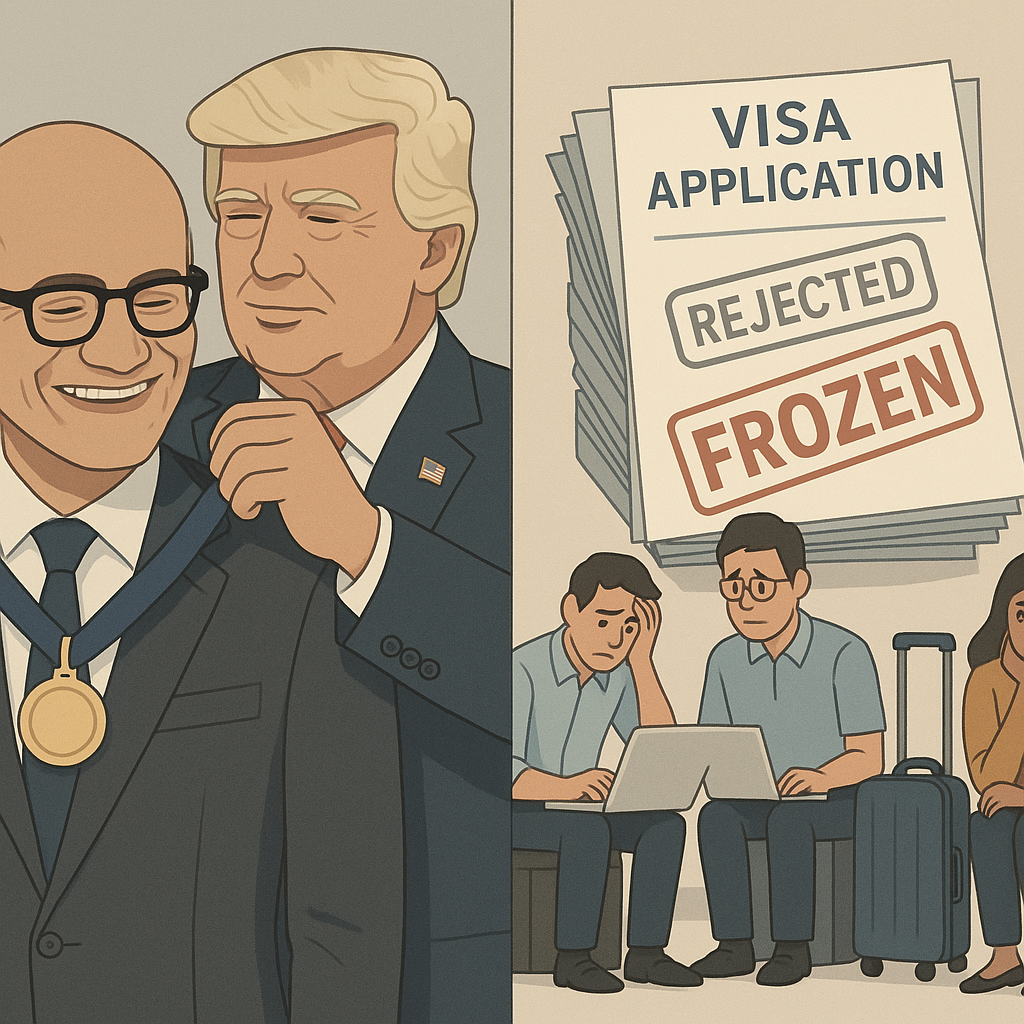
Microsoft, meanwhile, found itself starring in a split screen worthy of a market volatility index. In one frame, Trump draped Satya Nadella with the National Medal of Technology and praised Microsoft as an innovation powerhouse. In the other, Vice President JD Vance told Bloomberg Law that the company had been "importing an indentured servant to do a job that an American worker would happily do," as the administration suspended key visa programs and froze some Microsoft green card filings.
"Microsoft is a great American company and we want it to thrive," Vance clarified. "We just think it should innovate exclusively with people who already live within a 35 minute drive of a Cracker Barrel and can pass a mandatory Whataburger civics exam."
Satya Nadella accepted the contradiction as if it were a software license agreement. "Today I am honored to receive this medal," he said, "and I look forward to building super intelligence that can reconcile U.S. immigration policy with our hiring plan, because humans clearly cannot. We will start with the use case labeled 'Please Do Not Deport Our Entire Azure Team.'"
Not everyone onstage faced such cognitive dissonance. Michael and Susan Dell, who pledged 6.25 billion dollars to fund Trump Accounts, a government backed investment vehicle for American children, enjoyed the more traditional arrangement where you simply buy your way into national symbolism like any other growth asset. The Dell contribution will seed portfolios for babies born during Trump’s second term, giving each child a small taste of what it is like to be a distressed regional bank receiving private equity attention.
"These kids will have exposure to markets from day one," explained one Treasury official. "And thanks to our 15 percent cut of AI chip exports, they will also have exposure to any export controls that happen to tank those markets. It is never too early to learn about counterparty risk or why your kindergarten nap mat is technically a collateralized product."
For Trump, the medals were an opportunity to complete his second term pivot from yelling at Silicon Valley to securitizing it. Once described as elite parasites, tech billionaires are now recast as "industrial titans" and "national saviors," provided they bring a ballroom, a childcare yield product, or a small sovereign wealth fund to the relationship. Traditional academic scientists, usually the bulk of National Medal winners, watched the livestream from grant writing meetings and were reminded that the White House’s new OSTP mantra to "prioritize the individual scientist" applies mostly to individuals with a personal Gulfstream and a custom TSA lane.
"We are not against professors," one aide said, speaking on background to USA Today. "We just feel that when it comes to 'foundational algorithms' and 'renewing American technological leadership,' it is more efficient to reward people who already own several jurisdictions and at least one privatized spaceport."
At the same time, elite universities like Brown and MIT discovered they had been cast as the season’s immigration villains. As Reuters reported, federal investigators opened probes into alleged misuse of J 1 exchange visas, suggesting universities were importing cheap research labor instead of hiring American PhD candidates who, based on market data, prefer to go work for Nvidia anyway. Labor Inspector General Anthony D’Esposito confirmed subpoenas had been served and hinted that the next frontier would be a crackdown on unpaid internships that did not at least include equity in the internship itself and a commemorative lanyard vesting schedule.
Inside tech companies, the new regime created a familiar corporate org chart. CEOs at the top, super intelligence in the middle, everyone on temporary visas under review by both. One international engineer at Microsoft, speaking under condition of anonymity because her status is a market sensitive instrument, described the mood.
"I moved here to help America lead in AI," she said. "Now I am apparently an indentured servant who might get deported so my boss can accept a medal for how innovative we are. It is very inspiring, like watching your stock options expire in real time while someone rings a liberty bell in the lobby."
The most innovative product of the week, however, was regulatory structure itself. AI safety will be governed by a "morally binding" accord signed by Trump, Musk, Huang, and Nadella, in the absence of formal laws from Congress. Export controls will be shaped by a federal revenue sharing deal that directly encourages companies to sell more high end chips into a strategic rival. Immigration policy will seek to protect U.S. workers by making it harder to hire the same global talent that keeps the chip and cloud firms competitive.
In markets, this is what you would call a triple levered, actively managed, thematically incoherent ETF. In Washington, it is now called industrial policy and comes with an investor presentation in the Roosevelt Room.
As the ceremony concluded, Trump gestured at the assembled tech leaders and proclaimed, "Few Americans in history have done more to advance America’s national interest than Elon, in one field after another." The cameras panned across the honorees. Musk, who once briefly ran the Department of Government Efficiency out of a Slack channel. Brin, whose search algorithms helped monetize every human thought. Huang and Su, whose GPUs and chips make super intelligence and super surveillance trivial to deploy. Dell, whose money underwrites newborns and new ballrooms. Nadella, currently both medal recipient and alleged visa abuser.
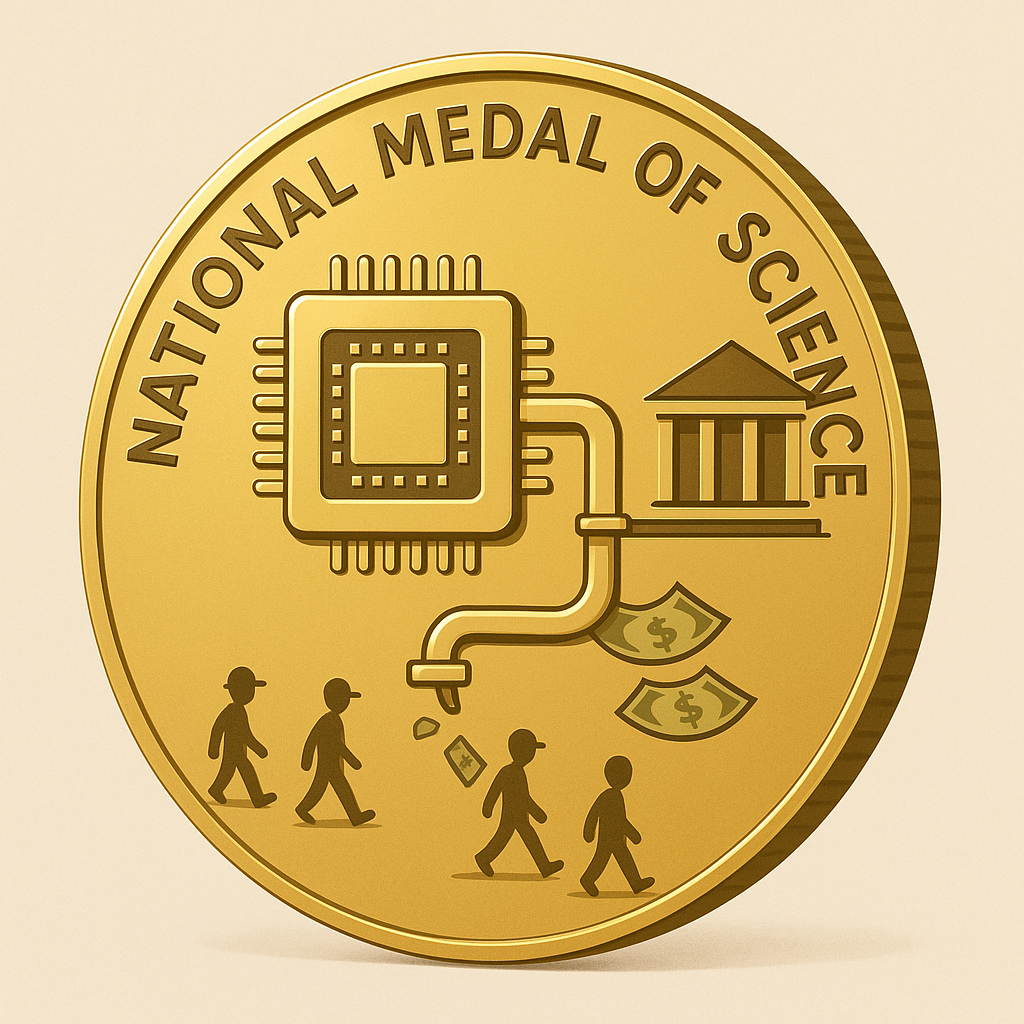
The message was clear. In America’s new golden age of science, there are only two recognized types of contribution to national progress. Writing checks big enough to appear in the federal budget, or writing code powerful enough that the federal budget gets a 15 percent cut.
Everyone else, from foreign graduate students to domestic engineers trying to renew their status, will still be invited to participate in the national experiment. They just will not qualify as scientists. They will be the data, neatly labeled, pre cleared by super intelligence, and ready for export.