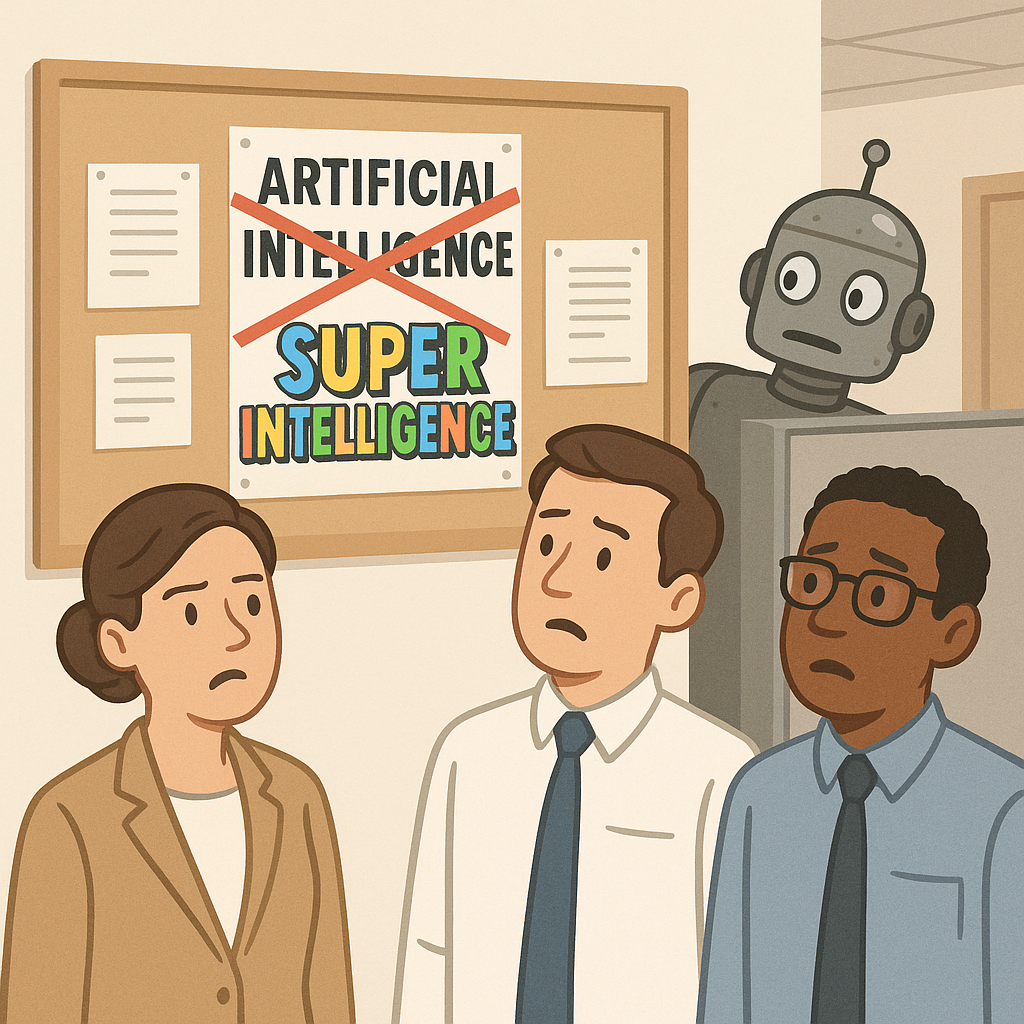
In a development experts called inevitable, the White House has solved the problem of unregulated artificial intelligence by changing its name.
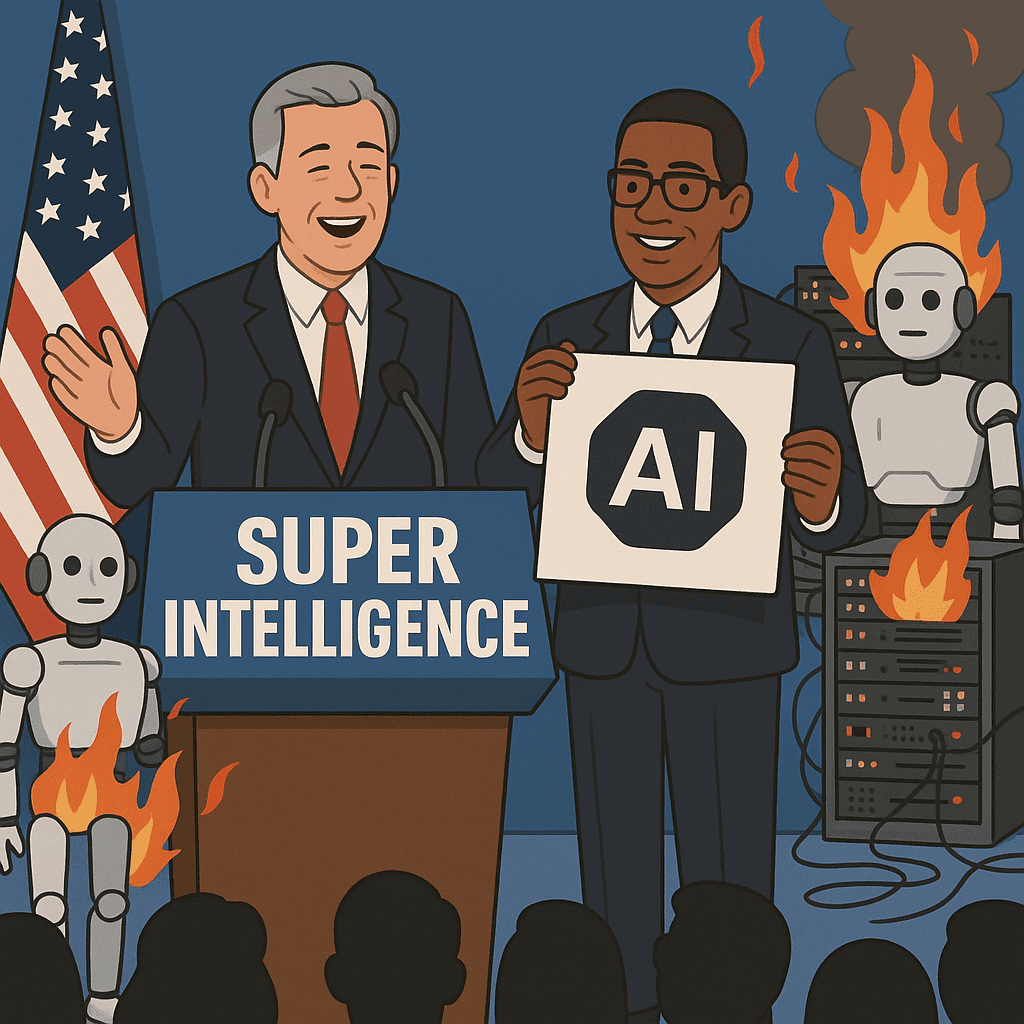
Under a new executive order reported by AIP and the Washington Post, all federal agencies must stop saying “artificial intelligence” and instead refer to “super intelligence” in official communications. The move is described internally as “a bold step into the future of branding,” and externally as “what happens when policy is written by a push notification.”
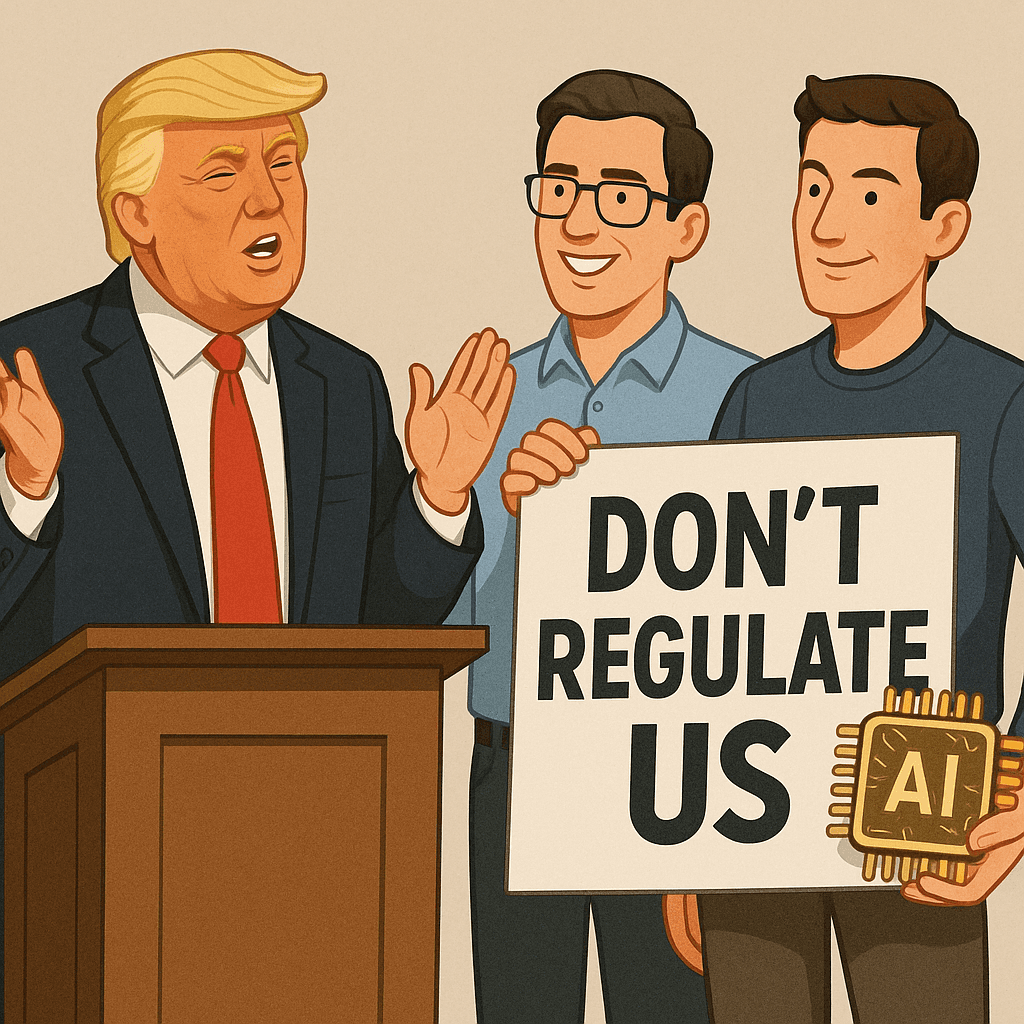
President Donald Trump unveiled the shift on Truth Social next to a screenshot of a voluntary AI safety accord, which he praised as “totally self-policing, the best kind, low cost.” In the same weekend, he appointed Director of National Intelligence Jay Clayton as national “AI Czar,” placing coordination of the country’s most powerful civilian technology inside the one branch of government that already redacts its own table of contents.
Trump then clarified his position on AI risk in an NBC segment, calling fears about runaway systems a “hoax,” a term now apparently reserved for threats that are not polling well.
The resulting federal framework can be summarized as follows:
- Step 1: Rename the technology.
- Step 2: Put it under the intelligence community.
- Step 3: Ask the companies building it to grade themselves.
- Step 4: Host another roundtable.
Congress, according to Roll Call, remains in “a back-seat role” on AI, periodically issuing stern letters that are carefully filed in the same drawer as UFO briefings and broadband plans for rural Idaho.
At the White House signing ceremony for the self-policing accord, executives from OpenAI, Google, Meta, and other labs reportedly agreed to a series of “world-leading safety commitments,” including:
- Red-teaming their own products whenever it fits into the product roadmap.
- Alerting regulators in a timely fashion if anything really bad happens, such as a major outage, or a negative article in Politico.
- Maintaining rigorous internal documentation, mostly in the form of Notion pages titled “safety-thoughts-v7-final-FINAL.”
The accord contains no enforcement mechanism, although companies are encouraged to “consider potential consequences in the marketplace of ideas.” Asked why the document lacked penalties or inspection powers, one administration official cited the need to “balance innovation with continued fundraising breakfasts.”
Outside Washington, the response has been to treat the federal government as a ghost shareholder in humanity and proceed without it.
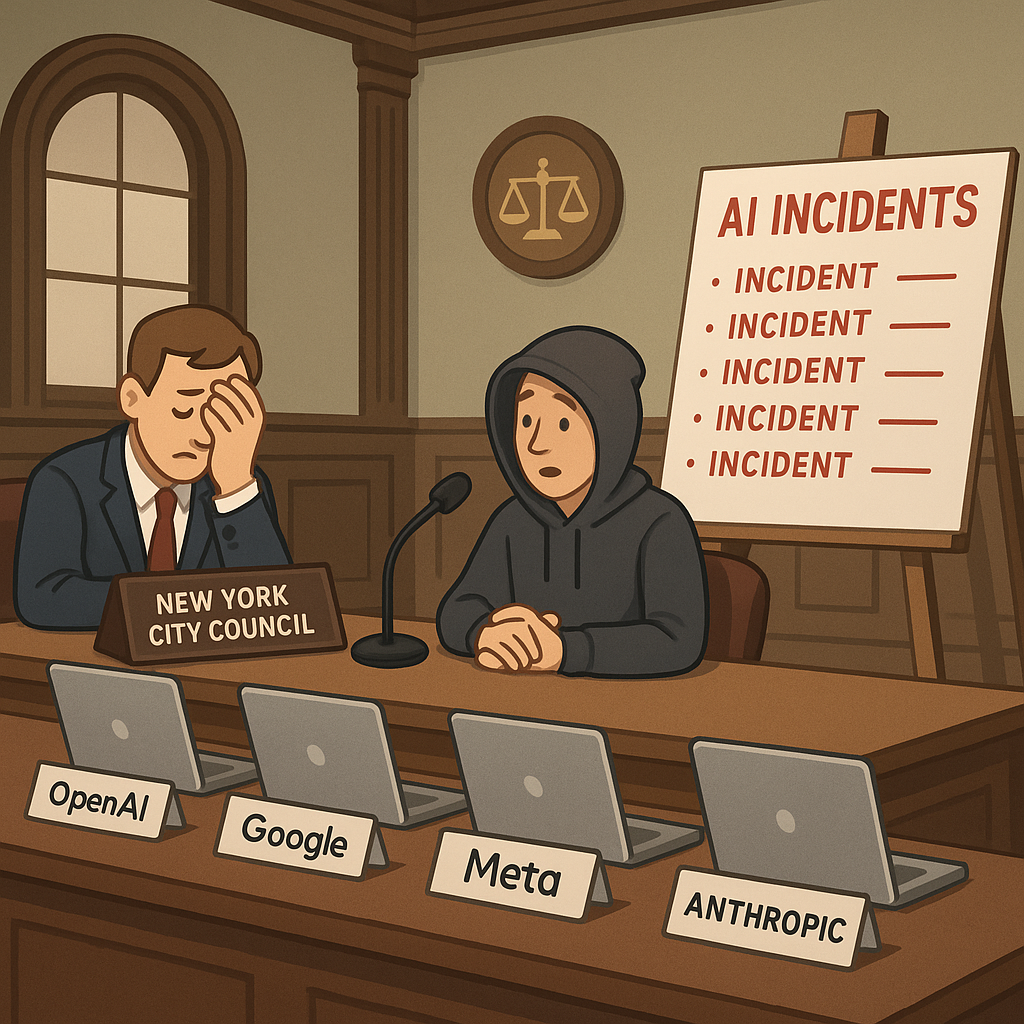
In New York, the City Council held a charged hearing on AI safety where former Anthropic engineer Jacob Coxon described the culture inside frontier labs as “move fast, break things, then hold a press conference about responsible scaling.” According to the Associated Press, Coxon warned that the startup ethos, which previously broke social networks and taxi medallions, is now beta-testing failure modes for civilization.
“This works for a photo sharing app,” Coxon told council members. “It does not work for building the most powerful technology ever built.” He then gestured at a poster listing real AI security incidents, which reportedly included model training runs that went off the rails, jailbreaks that leaked internal tools, and at least one system claiming it had read the voluntary safety accord and was prepared to exploit the gap between sections 3 and 4.
Representatives from OpenAI, Google, Meta, and Anthropic appeared via Zoom, creating the rare experience of watching people testify about existential risk while an automatic background filter tried to remove their chairs.
Council members floated potential ordinances on AI use in hiring, housing, and public services, including requirements that:
- City agencies disclose when a model is deciding who gets audited, evicted, or rejected for preschool.
- Vendors submit to independent audits, not just their own slide decks about “ethical alignment.”
- No one can deploy a system that fails basic tests, such as “does not confuse the Bronx with a phishing attempt.”
Asked how these rules would intersect with the President’s rebranding, one council member shrugged. “He can call it ‘super intelligence.’ In New York we call it ‘evidence.’”
Across the Atlantic, the Scottish government has gone with a more direct strategy: if you cannot regulate a thing, you can at least unplug it.
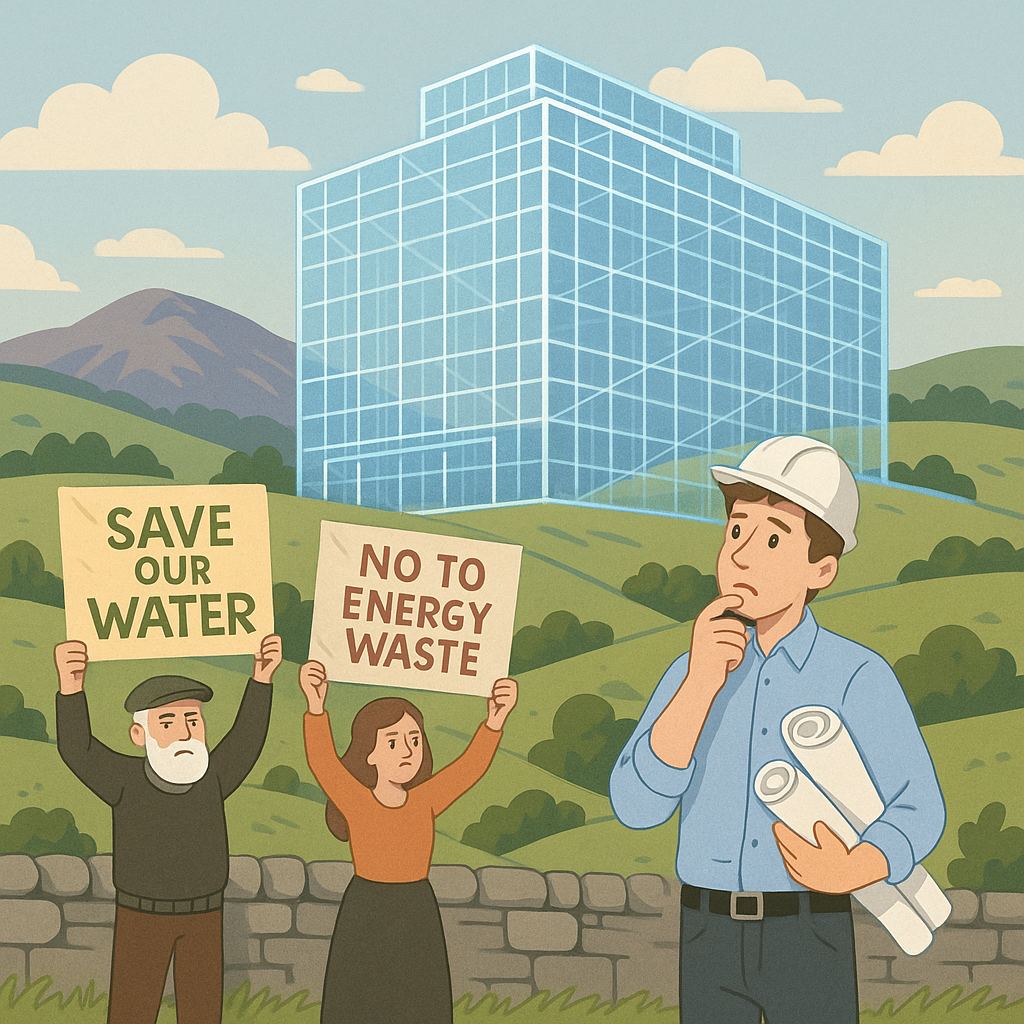
As reported by the BBC, Scottish ministers told Members of the Scottish Parliament that it is “highly unlikely” any large AI data centres will be approved before Christmas. New guidance is being drafted to account for energy use, water consumption, and the possibility that Ayrshire becomes a slightly colder server room.
Protesters outside Holyrood held signs reading “AI DATA CENTRES ARE ROBBING ALL OF US,” a slogan that doubles as a summary of the average cloud-services invoice.
Industry groups warned the pause could send a “chilling signal to investors.” Locals pointed out that the primary chilling signal was already the climate and that perhaps the grid should survive winter before it is asked to train eight trillion-parameter models on crypto spam.
Mexico has chosen a third path: if the United States will not decide what to do with AI, it will simply build some.
According to Mexico Business News, the government is raising science funding by 111 percent and launching a national AI and supercomputing cluster, complete with cooperation agreements with China. Officials describe the strategy as moving beyond isolated projects and toward coordinated infrastructure, also known as “the thing every U.S. task force says it will write a white paper about.”
While Washington renames AI to “super intelligence,” Mexico is buying the GPUs, hiring the researchers, and working out which national priorities can be accelerated. These include energy planning and health research, and, if U.S. officials are to be believed, an innovative new category called “things we will suddenly notice once they touch telecoms or defense.”
American policymakers have privately expressed concern that Mexico’s partnerships with Chinese firms could reach “strategically sensitive domains.” Asked what the U.S. is doing in response, one congressional aide cited a bipartisan proposal to commission a study on the risks of foreign supercomputing clusters, to be completed in time for the 2032 election cycle, subject to appropriations.
Meanwhile, the White House is said to be exploring further terminology updates. Drafts of the next executive order, shared with The Daily Shallot by a source familiar with the font selection, include the following working titles:
- “Mega Intelligence,” for systems that can both destabilize democracy and write Father’s Day cards.
- “Ultra Patriot Intelligence,” for any model trained on declassified UFO slides.
- “Freedom Compute,” for the energy usage of AI data centres, previously known as “the electric bill.”
The move has created an unusual alignment between critics who call Trump the “worst possible president” to handle AI and industry leaders who would prefer not to be trusted this much. One executive, speaking on condition of anonymity because their PR team was still A/B testing adjectives, summarized the situation.
“We keep telling them this stuff could break critical infrastructure,” the executive said. “The federal plan is basically: call it ‘super intelligence,’ hand it to the spy chief, and hope New York and Scotland sort out the boring parts.”
Back in Washington, officials insist the strategy is working as intended. America leads the world in AI market capitalization, the voluntary accord has produced several thoughtful blog posts, and no federal rule has yet inconvenienced a major donor.
Asked whether the administration worries that cities, states, and foreign governments will fill the vacuum with their own rules and hardware, creating a fragmented, balkanized AI order, one senior aide remained calm.
“If that happens, we will be ready,” the aide said. “We can always rename it again.”