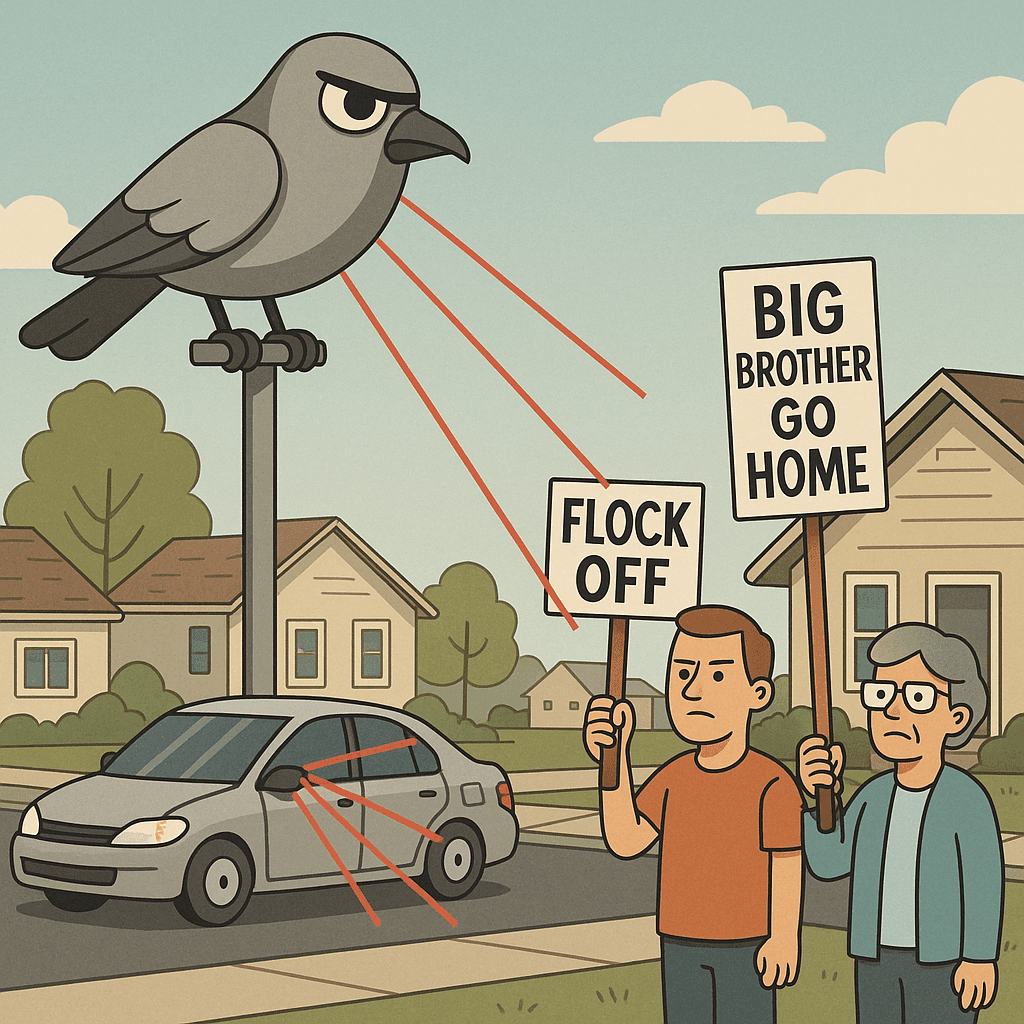
In a development experts called inevitable, the American public has finally found common ground: no one wants to be stalked by a crime-fighting bird that sells their license plate data by monthly subscription.
Across the country, neighbors who previously only communicated by passive-aggressive Facebook posts are discovering a deeper connection. Liberals, conservatives, and the chronically unaffiliated are forming something rare in modern politics: a coalition with a single, concrete demand that can be printed, zip-tied, and angrily photographed for Nextdoor.
That demand is printed in 72-point font on yard signs from Florida to Texas: "FLOCK OFF." Some versions include clip art of an eagle filing a restraining order.
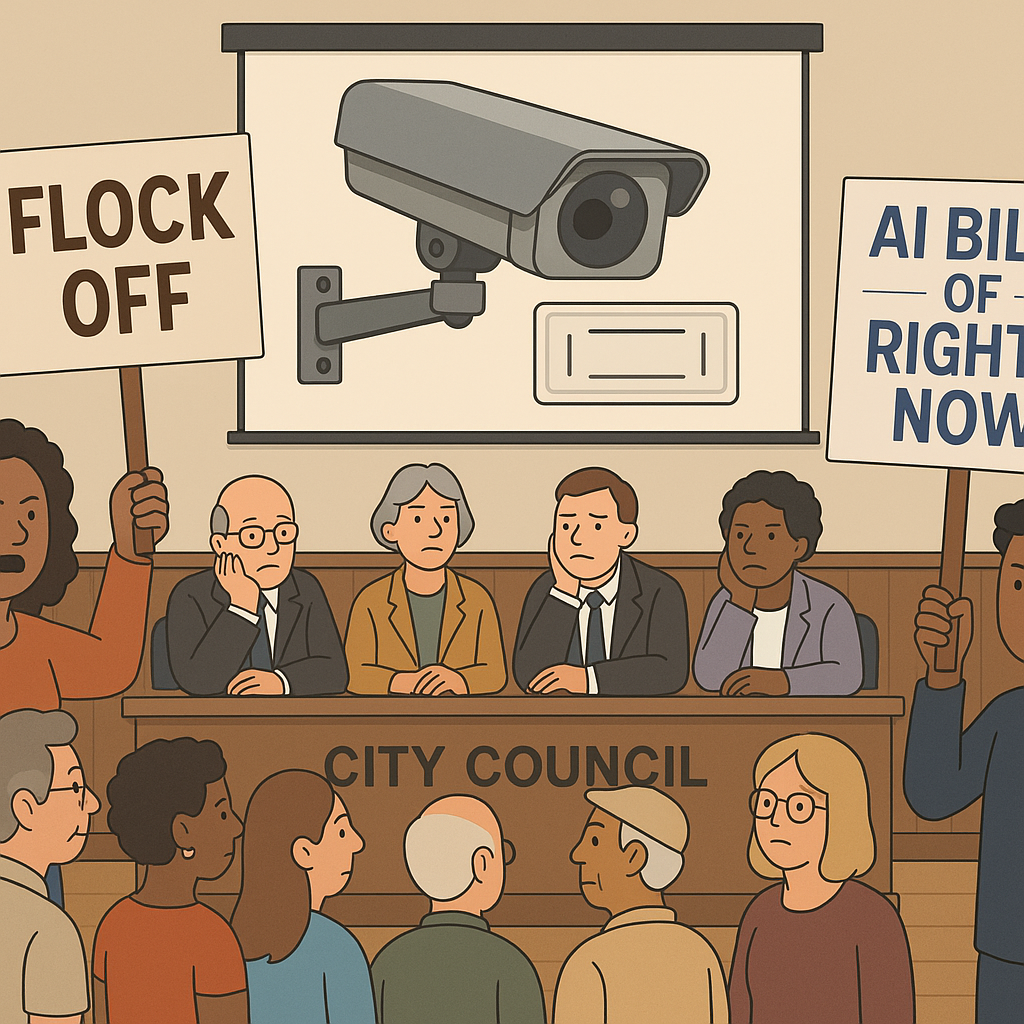
The flashpoint, as USA Today reports, is Flock Safety, an Atlanta-based company that turns quiet streets into a networked panopticon and then calls it "community peace of mind." Its license-plate reader cameras, now bolted to HOA entrances and small-town roadsides, scan cars, hand the data to police, and store everything for a week. This period used to be a month, but the company recently announced a cut from 30-day to 7-day retention for non-case data, which executives describe as a "bold step for privacy" and critics describe as "you still filmed everyone at church."
The marketing pitch began simply: help catch people who blow through tolls. Somewhere between "pay your fair share" and "your ex is dating someone new," the use cases expanded. Ron DeSantis, governor of Florida and part-time privacy influencer, now calls the rollout "out of control" and warns the cameras could turn the state into a "surveillance state." He has asked lawmakers for an Artificial Intelligence Bill of Rights, a phrase that sounds like a historic charter for humanity and currently refers to a PDF that mostly begs cops not to use Flock to track their ex-girlfriends.
"I am all about law enforcement having tools," DeSantis said, before adding the clause that turned his quote into a bipartisan thirst trap. "But I do not want this to become a surveillance state." In an era when most Americans assume any sentence that starts with "I am all about law enforcement" ends with "and that is why we bought a tank," this was received as radical minimalism and generated the rare spectacle of a Tallahassee press scrum nodding in unison.
Elsewhere, the techlash looks almost quaint. In Hendersonville, North Carolina, a USA Today piece profiles Austin Rhodes, a lifelong conservative, teaming up with his progressive neighbor Tiernan Turner to fight the cameras on their streets. After years of ideological tension, the breakthrough came not from a think tank or a viral TED Talk, but from the moment both realized their pickup and Prius had been entered into the same searchable database by the HOA, somewhere between "trash collection schedule" and "covenant violation appeals form."
"We disagree on almost everything," Rhodes allegedly told friends, "but we agree the local police should not have a Netflix-style recommendation system for my commute."
Tiernan, for his part, reportedly described the partnership as "proof that nothing heals polarization like a shared fear of automated snitching" and noted that the only bipartisan working group in the neighborhood with higher attendance is "Stop The Geese."
Hendersonville is not alone. Across the country, commencement crowds boo AI mentions, neighbors organize against data centers, and 48 state attorneys general secured an $18 billion settlement from Meta over alleged harms to children. This is a number large enough to impress the public and small enough that Meta still gets to exist, a regulatory wellness ritual now repeated across the tech sector. The company pays what sounds like infinity dollars, vows to reflect, then subtly adds one more notification badge to Instagram that asks if you would like to "review your feelings about privacy in Reels."
For years, tech optimism ran on an easy formula: if the product had an app, it was innovation, and if it scanned your face, it was the future. That era is over. Polls show public favorability for the biggest firms at multiyear lows, and more Americans say they are concerned than excited about AI. Not coincidentally, politicians are now treating anti-surveillance sentiment as a rare superfood: bland, widely tolerated, and guaranteed to test well in the 2026 midterms when it appears between "cut inflation" and "protect locally sourced gas stoves" on campaign mailers.
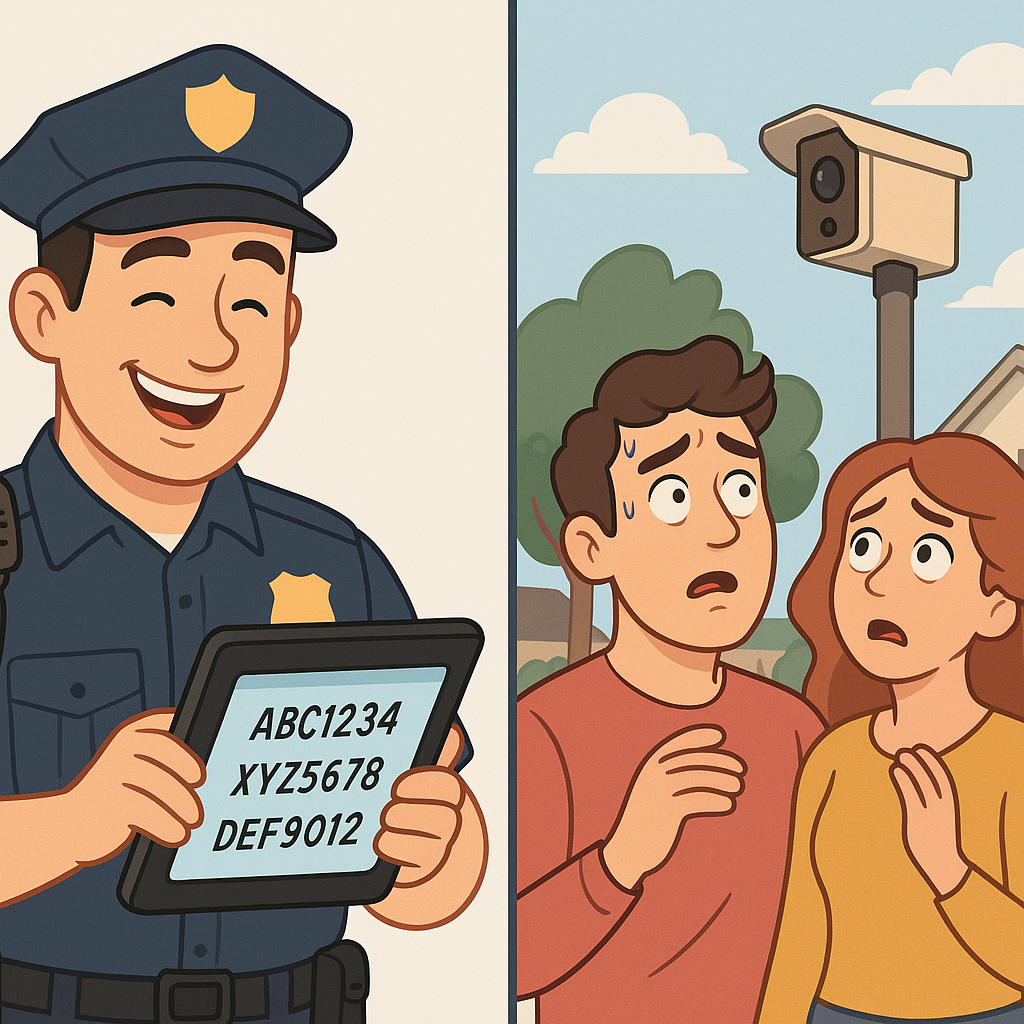
Republican Rep. Keith Self of Texas, who previously campaigned on concepts like freedom, recently posted on X, "Big Brother has NO place in the Lone Star State." He did not mention that Big Brother had already secured a five-year contract with the county and came with cloud support, a maintenance plan, and a laminated quick start guide for plate-based omniscience.
Senator Josh Hawley announced a congressional investigation into Flock, which experts say could result in anything from meaningful reform to a strongly worded committee report stored permanently on C-SPAN servers. The hearing will likely feature a large blown-up photo of a camera on a pole, three solemn references to 1984, and one moment where a member of Congress asks whether the system can "hear" license plates.
On the other side, Senator Bernie Sanders has promised legislation to rein in the technology, presumably by declaring every driveway "a workplace" and therefore entitled to union representation before being scanned. Staff for Sanders and Hawley are reportedly exploring a joint bill, tentatively titled the "We Finally Agree On Something Act," that would limit automated license-plate readers and create new audit requirements whenever an officer searches for the phrase "just curious." Their aides are reportedly drafting the text in a shared Google Doc while refusing on principle to turn on location history.
Flock Safety, for its part, has adopted the traditional Silicon Valley strategy of solving a problem by adding an enterprise feature. In response to reports of officers using the system to stalk ex-partners, CEO Garrett Langley announced an audit program to detect "abnormal search behavior." According to USA Today, agencies must now implement systems that flag suspicious activity. For example, repeated searches for the same car, the same ex, or the words "what the hell is she doing in Hendersonville."
The company frames this as responsible innovation. "We take privacy very seriously," a hypothetical spokesperson said, while standing under a pole that records all vehicles entering and exiting a neighborhood. "That is why we only keep data for seven days unless it is important, undefined, or requested as part of a partnership opportunity." Behind them, a dashboard labeled "Community Safety Insights" quietly updates with a live count of minivans that drove past the pickleball courts after 9 p.m.
Local governments, meanwhile, are learning that you cannot quietly bolt subscription surveillance to a stop sign and then act surprised when residents read the contract. City councils from North Carolina to Texas are suddenly hosting packed meetings where retirees quote the Fourth Amendment, teenagers reference Meta's $18 billion settlement like a true-crime podcast, and police chiefs insist they would never abuse the system, they simply enjoy knowing who left town last Thursday at 11:37 p.m. and whether that counts as probable cause for a wellness check.
The tension is familiar. Law enforcement insists the cameras solve crimes. Privacy advocates point out that "solves crimes" currently includes "helps find catalytic converter thieves" and "ensures Officer Brian knows where his ex buys groceries." Vendors warn that regulation will hurt innovation. Residents openly wonder why "innovation" always means "another way to harvest your data" rather than "a bus that arrives on time" or "a DMV website that loads before retirement."
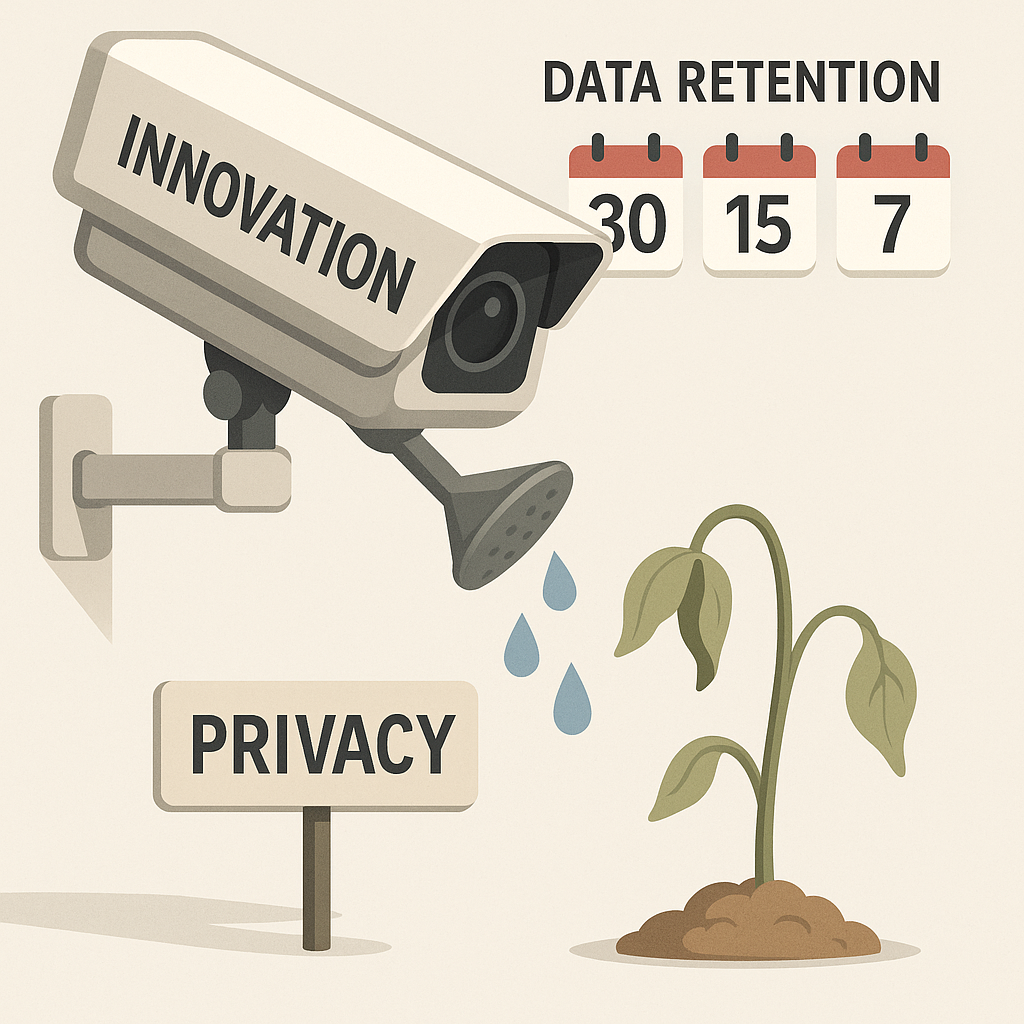
Underneath the outrage is a simpler fear: once a system can track everyone, it is statistically certain that someone will use it for something insane. The same infrastructure that could, in theory, catch a kidnapping suspect faster can also help a bored officer build a real-time mood board of their ex's dating life. The audit feature arrives later, as a kind of moral ad blocker that politely asks if you are sure you want to misuse omnipresent surveillance today.
Tech firms are betting this moment will pass. History is on their side. Meta's past fines did not change its core business model, GDPR consolidated rather than dismantled the giants, and every data scandal eventually encountered America's most powerful force: notification fatigue. There is a reasonable chance that five years from now, Flock's data retention will be down to three days, the cameras will be disguised as tasteful native grasses, and the majority of Americans will have accepted that an invisible network is quietly counting their Costco runs.
But something is different about this revolt. It is not about abstract AI futures or complex algorithmic fairness metrics. It is about a black box, on a visible pole, watching a visible car. It is about the moment when Austin Rhodes and Tiernan Turner realized that in the eyes of Flock, their entire political feud resolved into a single data point: "Toyota Camry, in range." For the system, the only relevant party affiliation is "owner of a plate."
For now, the coalition holds. Conservatives, progressives, and anyone whose ex knows a cop are standing together, pointing at the same metal box, and saying the same word: "No." It is a fragile, precious clarity, a brief season in which the country can look past Meta's settlement numbers, past AI commencement speeches, past the promise of an Artificial Intelligence Bill of Rights, and focus on one simple reform.
They would like the cameras turned off before the system learns that bipartisan unity is an anomaly and flags the entire moment as suspicious behavior, auto-generating an alert labeled "unusual activity: Americans agree on something."