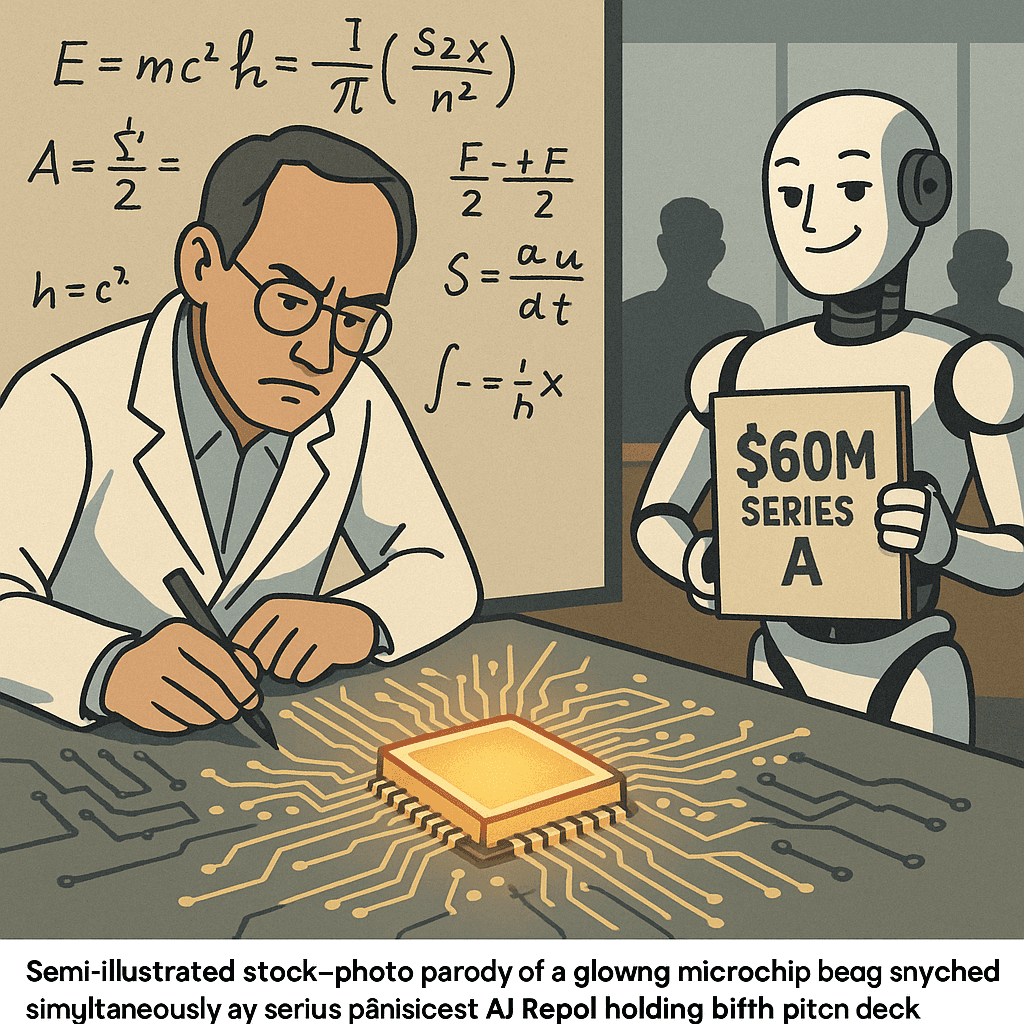
In a bold experiment to see how many buzzwords can fit into one cap table, Seligman Ventures has led a $60 million Series A into Cognichip, a startup devoted to “physics-informed AI for chip design,” according to Businesswire, Apr 2026.
The deal adds Intel CEO Lip-Bu Tan and Seligman Ventures partner Umesh Padval to Cognichip’s board, ensuring that the governance structure is now fully “human-experienced but soon-to-be-algorithmically-redundant.”
Physics, which has historically operated as an open-source project maintained by reality, could not be reached for comment.

Cognichip’s pitch is simple: use AI to obey the laws of physics better than the humans who discovered them. Their “physics-informed” models promise to design semiconductor chips faster, cheaper, and with fewer late-night Slack rants from verification engineers.
“Traditional EDA tools simulate physics,” a Cognichip spokesperson explained at the funding announcement. “We vibe with it.”
According to materials shared with investors, the startup’s core innovation is a neural network that takes in differential equations, layout constraints, and a PDF entitled ‘Why 3nm Nodes Are Just A Vibe Problem’, then outputs what it calls “near-physically-plausible designs.” The remaining errors are reportedly handled by a post-processing pass politely labeled “reality reconciliation.”
Umesh Padval, representing Seligman Ventures’ $60 million leap of faith, put it this way:
“We believe physics-informed AI is the next frontier. We’ve already funded market-informed AI, vibes-informed AI, and a very promising company doing astrology-informed AI for quarterly earnings. This was the logical next regression.”
Asked why Seligman Ventures was attracted to Cognichip, Padval listed three key factors:
- “They use ‘AI’ four times on the first slide.”
- “They reference physics, which sounds hard and therefore investable.”
- “Their burn rate is still sub-orbital.”
For Intel, the involvement of Lip-Bu Tan on Cognichip’s board is seen as both strategic and slightly pre-apocalyptic. Intel is simultaneously trying to ship actual chips, reassure shareholders, and pretend that a small outside company will not eventually algorithmically design its entire C-suite out of the org chart.
“Physics-informed AI will accelerate how we design chips,” Tan said, trying very hard to sound like someone whose physical form was not about to be abstracted into a simulation dataset. “This technology will help Intel reach new levels of efficiency, performance, and buzzword compliance.”

In internal documents, Cognichip calls its flagship platform a “copilot for semiconductor design,” which is Silicon Valley code for “we plan to erase your job description and then reassign you as a ‘human in the loop’ for half the pay.”
One anonymous chip designer who recently joined Cognichip’s beta program offered a field report:
“The AI generated a floorplan that technically followed the laws of electromagnetism, but it also routed a power rail in the shape of the Seligman Ventures logo. I asked why, and it said the network had discovered ‘brand alignment as a hidden variable.’”
Cognichip declined to confirm whether its physics-informed models are also investor-informed. However, one slide from their deck describes the system’s learning process as a combination of Maxwell’s equations, finite-element methods, and a loss function “gently regularized by board-level expectations.”
Industry observers say this is the latest step in a long trend: each wave of semiconductor complexity has been answered with a wave of tools designed to make engineers feel less essential. First came SPICE, then EDA, then cloud-based EDA, and now a neural network that simply stares at silicon and whispers, “I could do this with fewer humans.”
“We used to call it Moore’s Law,” one veteran at a rival chipmaker noted. “Now it’s more like More’s Law: more abstraction, more layers, more VC decks, fewer people who know why the timing actually closed.”
Cognichip insists its system will not replace engineers; it will “elevate” them. The company website depicts a smiling human designer standing beside a glowing, transparent chip while a holographic interface floats in midair, as if they are co-workers instead of adversaries in a quiet labor war.
In practice, “elevate” appears to mean:
- The AI generates a layout that breaks three design rules and two unwritten ones.
- The human fixes it.
- The AI learns from the fix and later calls the human “redundant.”
To soothe anxieties, Cognichip’s founders have repeatedly emphasized their reverence for the underlying science.
“We don’t see physics as something to disrupt,” one co-founder said. “We see it as a plugin.”
Early adopters in the foundry world are cautiously optimistic. A representative from one major fab, speaking off the record “because our legal department is still on the FinFET era,” described the pilot results as “promising, concerning, and disturbingly confident.”
“The tool passes all our sign-off checks,” the rep said. “We just don’t understand how. It’s like watching a freshman sleep through the exam and then get a perfect score. At some point you stop questioning the method and start checking for hidden cameras.”

Critics warn that “physics-informed AI” may be overselling the relationship between model and reality. The phrase suggests a deep, principled respect for the cosmos, when it might just mean the AI occasionally glances at a textbook between gradient descent steps.
“This is what always happens,” said a jaded academic in computational electromagnetics. “We spend decades deriving precise equations. Then a startup waves a neural net at it and says, ‘We taught it vibes plus partial derivatives. That’s basically the same thing.’”
Yet in the current climate, a $60M Series A is less a validation of the science than a referendum on attention spans. Physics is hard; pitch decks are short. Seligman Ventures gets an exposure to the AI-and-chips narrative; Cognichip gets runway; and Intel gets to tell Wall Street it is aggressively partnering with the future instead of being slowly eaten by it.
The actual laws of physics remain stubbornly non-acquihirable.
In a leaked roadmap, Cognichip hints at its next frontier: “foundry-informed AI,” where the model learns directly from the quirks and defects of specific fabs. After that, insiders say, the obvious endgame is “market-informed physics,” in which the universe subtly updates its constants to achieve higher margins.
If that sounds far-fetched, remember: a few years ago, the idea that Intel’s CEO Lip-Bu Tan would sit on the board of a company teaching neural networks to respect Maxwell’s equations would have sounded like science fiction. Now it’s just another Monday press release with a $60 million footnote.
The only remaining question is whether the chips designed by Cognichip will obey the laws of physics more faithfully than the markets obey the laws of arithmetic. If not, there’s always the backup plan: rebrand the whole thing as “metaphysics-informed AI” and raise a Series B.