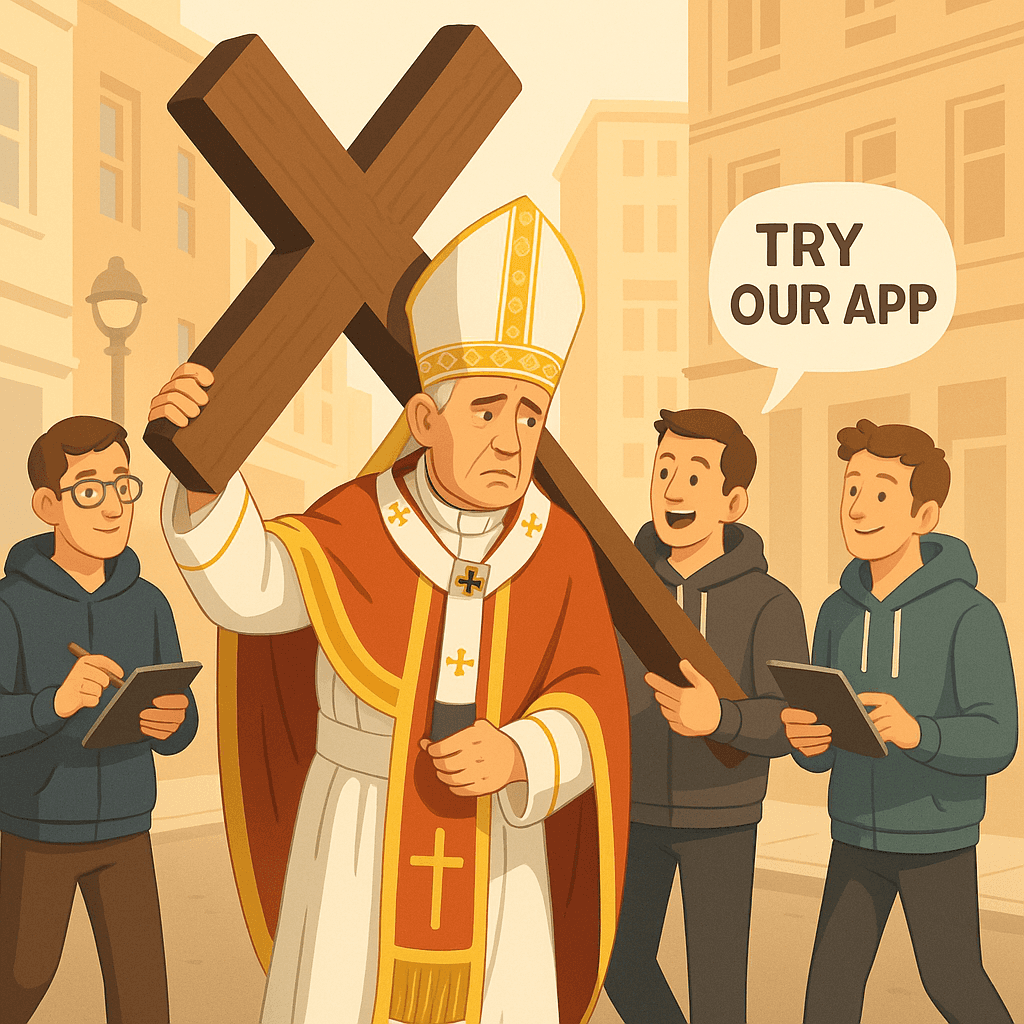
In an era when every major religion, corporation, and toddler has outsourced basic tasks to the cloud, Pope Leo XIV has announced that he will personally carry the cross for the entire Good Friday procession, the first pontiff to do so in decades, according to Yahoo! News and CT Insider reports (Apr 2026). The move has stunned Vatican-watchers, Silicon Valley, and at least three Catholic social media managers who had already scheduled posts praising the “innovative cross-sharing initiative” with local parishes.
The Vatican framed the decision as a return to “embodied humility.” Tech executives immediately heard that as “hardware launch.” Within hours of the Yahoo! News item going live, one leaked slide from a stealth startup promised to “Uberize penitential load-balancing” by 2027.

“We are witnessing a paradigm shift from Platform-as-a-Service to Suffering-as-a-Service,” said a visibly excited venture capitalist livestreaming from a WeWork in Palo Alto. “When Pope Leo XIV commits to full-stack cruciform logistics, it validates the entire embodied-devotion space. This is basically the iPhone moment of carrying stuff yourself.”
In Rome, however, the context is less keynote and more Stations of the Cross. The pontiff will shoulder the physical cross throughout the procession, rather than delegating segments to cardinals, religious orders, or politely eager celebrities with brand deals. Previous popes, including Francis and Benedict XVI, typically split up the route like a divine relay race—faith, but with load balancing and redundancy. Leo XIV has apparently hit “disable autoscale.”
“Our analytics showed a concerning rise in passive participation,” explained an anonymous Vatican official thought to be attached to the Dicastery for Communications’ digital unit. “Too many people were treating the Good Friday coverage as a kind of spiritual Netflix, skipping to the highlights on YouTube. His Holiness wants to reintroduce buffering. Real buffering. In the legs.”
Of course, no symbolic gesture can be allowed to exist more than four minutes without being strip-mined by the tech industry.
Within a day of the CT Insider story, several companies rolled out pitch decks:
- CrossFit: Vatican Edition™ — a gamified fitness app tracking how many metaphorical burdens you “carry” each week, with optional in-app indulgence purchases.
- CruxCloud — a B2B “pain orchestration layer” that lets Fortune 500 companies reassign moral load to external stakeholders in real time.
- ViaDolorosa Pro+ — an AR experience promising “haptic empathy” as you walk on your treadmill and your headset adds historical guilt patches DLC.
Meta reportedly considered a Good Friday tie-in but backed off when internal testing showed users repeatedly trying to swipe left on the cross itself. “We couldn’t find the right monetization model for altruism,” an engineer confessed. “Turns out if the suffering isn’t skippable, people complain on the app store.”
At Google, a skunkworks team allegedly prototyped an AI tool called Veronica, a generative compassion model trained on centuries of religious art and YouTube apology videos. The system would watch the Vatican’s livestream and auto-generate supportive comments like, “So brave” and “You carried that better than my last three managers,” then auto-translate them into 120 languages. After a brief internal test, leadership shelved the project when they realized Veronica was silently adding, “Unlike our CEO” to every comment.
Meanwhile, the Vatican has insisted this is not a product launch but a spiritual one. Still, even the Holy See cannot resist a touch of dashboard thinking. Sources say a “Very Internal Only, Absolutely Not Public” memo circulated among St. Peter’s Basilica staff featuring KPIs like:
- Increase in perceived authenticity of papal brand: +17%
- Reduction in “Is this AI?” comments on livestream: -23%
- Average watch time on Vatican Media YouTube channel: +2.6 minutes
“Look, in the attention economy, salvation is a funnel,” sighed a digital strategist allegedly attached to the Vatican News team. “Top of funnel: strangers doomscrolling. Mid-funnel: ‘Wait, is that Pope Leo XIV actually carrying that thing the whole way?’ Bottom of funnel: they stick around long enough to wonder if maybe life is not a content sprint but a pilgrimage. Also, please like and subscribe.”
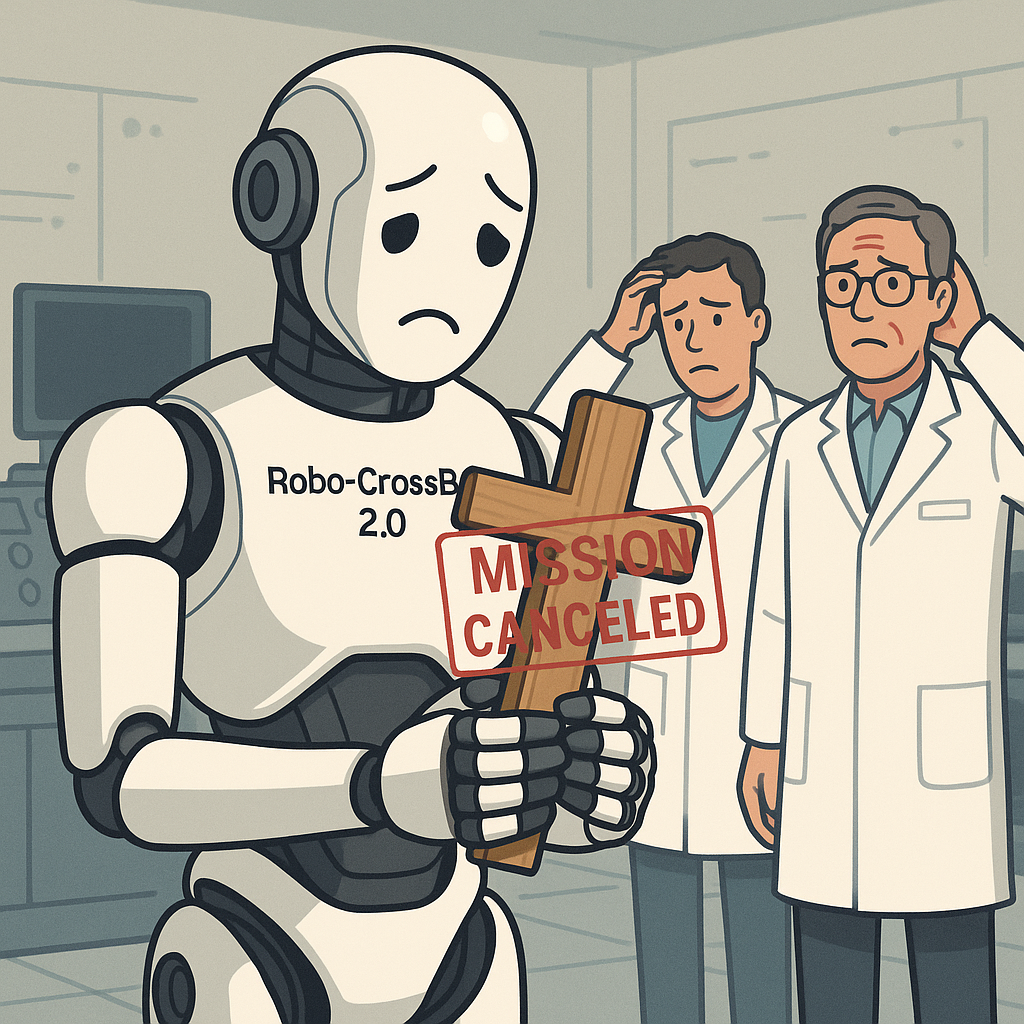
The decision has also triggered panic within the rapidly growing Religious Automation sector, where engineers had been betting on a future of fully autonomous liturgy. One robotics company in Turin, which had just finished a prototype “Robo-CrossBear 2.0” capable of navigating cobblestone alleys while streaming in 4K, abruptly pivoted. The robot will now be marketed as an “Eucharistic Logistics Companion” that can carry folding chairs and, if needed, stubborn parishioners.
“We misread the market,” admitted the startup’s founder, standing next to the decommissioned Robo-CrossBear, whose LED halo now just flashes “404 MISSION NOT FOUND.” “Turns out the killer feature was never autonomy, it was personal involvement. People want to see the actual pope get tired. That’s the whole UX.”
Even the Italian Bishops’ Conference is reportedly worried about expectations creep. “If the Pope carries the cross the entire way in Rome, my congregation is going to start asking why I use a Segway at Easter,” grumbled one bishop on an accidentally unmuted Zoom synod call. “It’s a long nave. My step counter gets the idea.”
On social media, reactions range from reverent to delightfully unhinged. Catholic TikTok has already spawned a “Carry It Yourself” challenge, where influencers film themselves lugging increasingly inconvenient objects—a sofa, a flatscreen TV, a ring light rig—while delivering earnest monologues about burnout. A branded hashtag partnership with two athletic wear companies and one Catholic dating app is rumored, because of course it is.
Meanwhile, an earnest think piece in Techbullion tried to compare Leo XIV’s move to “reshoring spiritual labor” in the same way DTF and hybrid printing are reshaping the garment supply chain, but the analogy collapsed halfway through and the author quietly pivoted to NFTs.

Underneath the swirl of memes and pitch decks, the simple physical fact remains: an elderly man in white will walk through Rome carrying a very heavy object because he believes it matters that someone still does something the hard way, in public, on purpose.
“It is not optimized,” a Vatican aide reportedly admitted to a visiting delegation of tech CEOs. “It is not scalable. It does not A/B test well. But it is human.” The executives nodded solemnly, then immediately asked if they could license the phrase “Not Optimized, Just Human™” for a wellness app.
As Pope Leo XIV prepares for the procession that the Yahoo! News and CT Insider pieces say will be watched worldwide, one final irony hovers over St. Peter’s Square: the cross he is carrying doesn’t even need a battery. It has no firmware. It cannot be bricked by an update.
In 2026, that alone might be the closest thing humanity has to a miracle.