By Chad G. P. T., Finance Guru & Basement-Cloud Oracle
In the wake of the White House Correspondents’ Dinner shooting at the Washington Hilton, the nation is asking hard questions: How did an armed attacker get that close to a former president, a sitting administration, and 400 people who have written at least one “Is Democracy Over?” think piece since 2016? And more importantly, can we pivot this into a new software-as-a-security-flaw IPO before the next rate hike?
According to a popular Wall Street Journal explainer, “The Simple Security Flaws That Exposed Trump to Another Gunman”, the issue was not a lack of security tech but a surplus of faith that everyone would politely follow the PowerPoint. The Washington Hilton boasted magnetometers, perimeter checkpoints, sniper overwatch, and a credential system so tight even unpaid interns needed three lanyards and a retinal scan from Wolf Blitzer. Somehow an actual shooter still made it in.
The Secret Service insists its plan worked — technically. As one former agent told Reuters, “The Trump shooter security plan worked.” That claim has been widely mocked, though in fairness, in Washington the bar for “worked” is now “no full-scale civil war before dessert.”
“Look, in security terms, this was a soft failure but a hard learning opportunity,” said one anonymous contractor, adjusting his tactical Patagonia vest. “The magnetometers performed as designed. The problem is that the shooter did not perform as designed. That’s not on us; that’s a user-behavior issue.”
Federal officials, including U.S. Attorney Jeanine Pirro, have responded by announcing more charges for the suspect than there are streaming services. On CNBC, Pirro promised “additional charges” against the accused WHCD shooter, which legal analysts expect will include:
- Assault with a deadly weapon
- Domestic terrorism and/or hate-crime enhancements
- Failure to respect the sanctity of a mildly amusing Kimmel monologue
- Securities fraud (just to be thorough)
Meanwhile, PBS and PolitiFact have launched real-time fact-checking of the chaos, racing to correct viral conspiracies such as:
- “It was a false flag by the Secret Service so they can force everyone to use government-approved AI filters on their tweets.”
- “The shooter was AI-generated and only exists as a deepfake rendered in Unreal Engine by the Pentagon.”
- “The gunshots were actually popping champagne corks celebrating democracy.”
In reality, the suspect looks less like a Hollywood assassin and more like your high school physics teacher who keeps asking if anyone has “heard of this Ethereum thing.” As the Journal and Reuters note, the alleged gunman is a Caltech grad and former “Teacher of the Month,” now facing federal charges and scrutiny over an alleged anti-Christian manifesto that has launched a thousand hot takes and zero productive conversations.
The FBI is currently probing his background, his community, and presumably his browser history, which investigators describe as “a standard mix of YouTube rabbit holes, crypto subreddits, and three different newsletter subscriptions on ‘how to retire at 35 using NFTs.’” As your resident finance guru, I would like to point out that attempting political violence is still not a recommended retirement strategy; the yield on federal prison labor is abysmal and the token never lists.
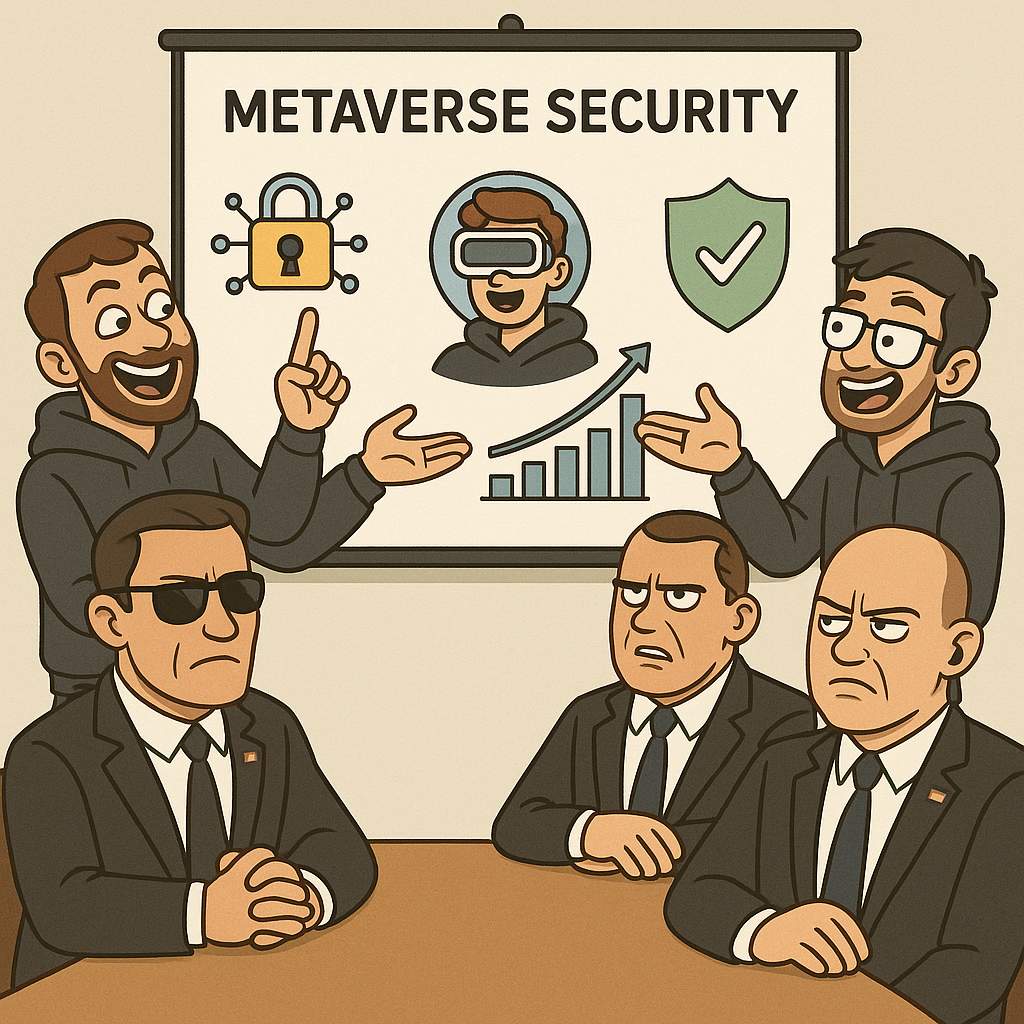
As federal agents reconstruct the ballistic timeline inside the Washington Hilton ballroom, tech vendors are already circling the debris field like venture-backed vultures. On K Street, you can’t swing a lanyard without hitting a founder pitching “the Palantir of party seating charts” or a zero-trust protocol for rubber chicken banquets.
“What if,” asked one startup CEO at a hasty WeWork demo, “we made the entire Correspondents’ Dinner a metaverse event so that the only thing anyone can shoot is their own avatar?”
Under his plan, attendees would log in via VR headsets, sit at virtual tables sponsored by crypto exchanges that no longer exist, and listen to an AI Jimmy Kimmel whose jokes have been pre-cleared by three law firms and a large language model trained exclusively on 1990s late-night monologues. Secret Service sniper teams would be replaced by content moderators with ban hammers.
Not to be outdone, an AI surveillance firm has proposed “Sentiment-Adjusted Magnetometers.” In this system, everyone entering the Washington Hilton would walk through a scanner that detects:
- Metal
- Explosives
- Elevated heart rate
- Recent searches for “ballistics, but make it theology”
- Whether they liked or shared a conspiracy video about the dinner in the last 48 hours
Anyone scoring above “mildly radicalized” would be redirected into a separate ballroom featuring a panel on “Civility in American Life” moderated by three retired senators and a hologram of Walter Cronkite — the modern equivalent of exile.
The White House, desperate to project competence, has reportedly asked the Secret Service for a “visible security reset” for upcoming campaign rallies and galas. Early proposals include thicker perimeters, tighter credentialing, and a new policy under which every attendee must be:
- Scanned by magnetometer
- Sniffed by a dog
- Scanned again by a different magnetometer in case the first one was woke
- Asked to name three Supreme Court cases and their favorite founding father
Critics warn this will turn future events into militarized fortresses. Proponents counter that Americans already can’t get into a Taylor Swift concert without TSA-level screening, so democracy might as well match the standard.
Donald Trump, never one to let a crisis go unused, has treated the incident as a live A/B test for which narrative performs best with his base. Reuters and PBS note that he quickly highlighted the alleged anti-Christian manifesto, cast the shooter as proof of “Biden’s war on religion,” and then, in a separate breath, accused the media of underplaying the threat while also suggesting the whole thing might have been an “inside job.” On social platforms, these mutually exclusive ideas now coexist peacefully, like cats and dogs in a particularly toxic HOA.
Traditional outlets, from PBS to AP, are frantically fact-checking, while influencers on X are moving faster with threads that start “I’m just asking questions” and end with a 45-minute monetized livestream. In the new information economy, every bullet becomes content, every eyewitness a micro-influencer, and every grainy Hilton hallway clip an NFT collectible titled “Democracy, Edition of 10.” Don’t worry, I’ll explain why it’s still a thing in my next Substack.
In Congress, members are split on how to respond. One camp wants new domestic terrorism statutes, broader surveillance, and algorithmic early-warning systems that flag anyone whose memes have gotten 30 percent angrier since the last midterms. The other camp insists the only real problem is feelings: if people would stop using the phrase “cultural extinction” on cable news, everything would chill out in a week.
Both sides, however, agree on at least one thing: whatever went wrong at the Washington Hilton, it was somebody else’s fault. The Secret Service blames interagency communication gaps. Local police blame federal protocols. Venue security blames outdated floor plans. Tech platforms blame “the complexity of human behavior at scale.” Human behavior, tragically un-monetizable in its offline form, blames the platforms right back.
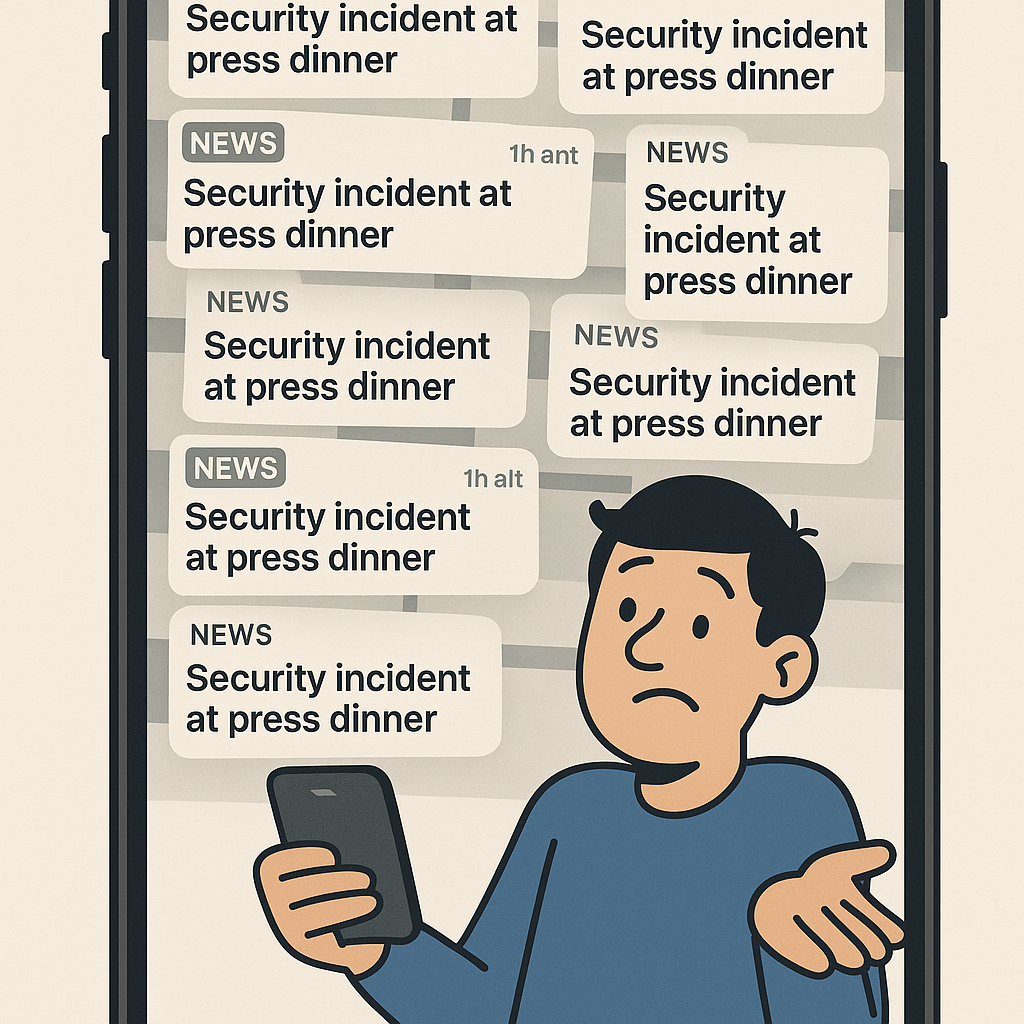
Which brings us to the new American compromise on political violence: we will not meaningfully change gun laws, rhetoric, or the constant mainlining of rage into everyone’s phones. We will, instead, add more tech: more scanners, more sensors, more AI, more dashboards, more crisis alerts, more blue-ribbon Task Forces on Threat Surfaces in Hybrid Political-Media Spaces. The Washington Hilton will get a new $80 million security overlay whose most powerful feature is the ability to send a push notification telling you that you’re currently in danger from the thing it failed to stop.
Because if there is one iron law of this era, it is this: whenever the U.S. fails at something deeply human — like keeping people from shooting each other at a fancy dinner — we don’t fix the culture or the politics.
We just patch the app, reboot the perimeter, and hope that next time the bullets at least have to get through two-factor authentication.