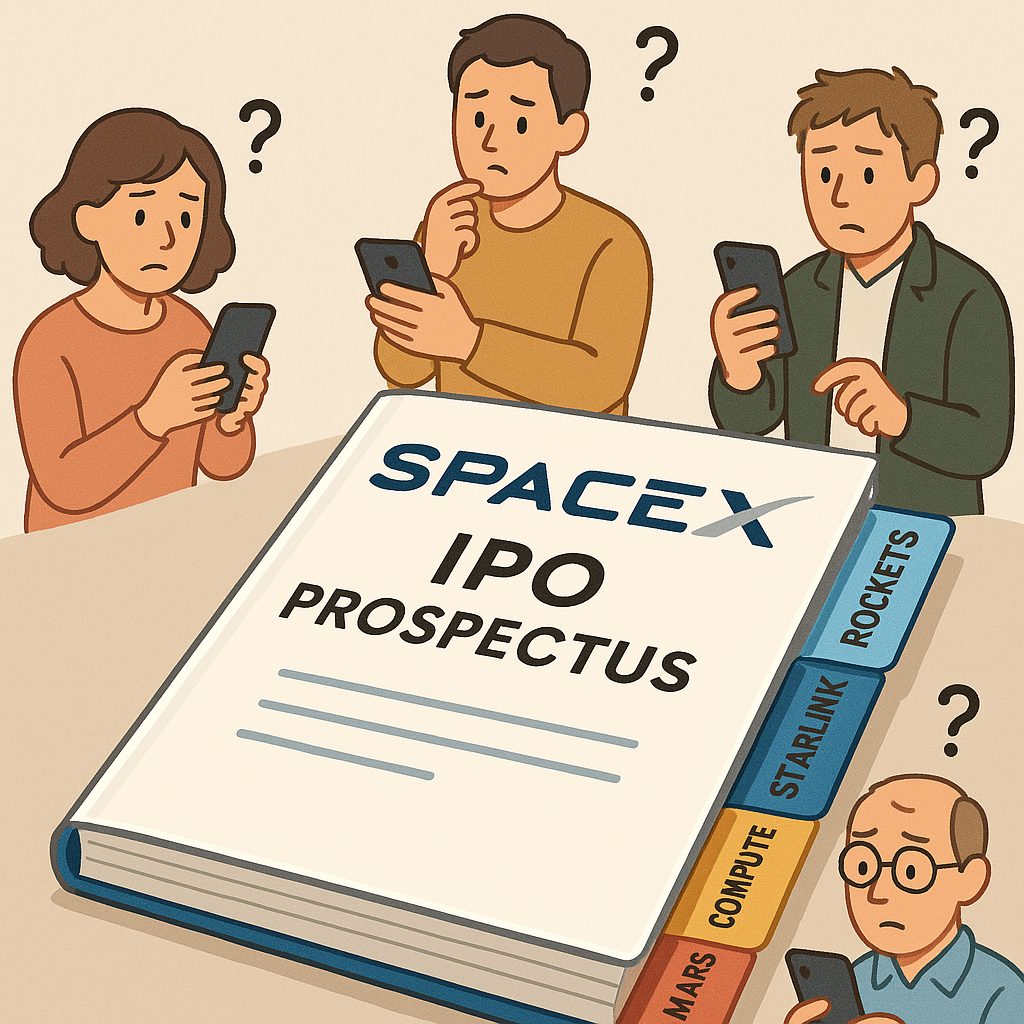
In a development experts called inevitable, SpaceX revealed plans for what could be the biggest-ever initial public offering and investors responded by asking the only remaining question in modern finance: "How do I get in before the other guy gets screwed?"
The rocket-and-internet-and-now-AI-compute company, run by Elon Musk, filed for a listing that some estimates say could raise $75 billion and value the firm at more than $2 trillion, according to coverage from the Financial Times and NBC News. The filing also disclosed a $4.9 billion loss on $18.7 billion in 2025 revenue, which in the current market is considered a tasteful, confidence-inspiring burn rate.
In its prospectus, SpaceX described itself as "part rocket company, part telecom company, part AI startup." Bankers at Goldman Sachs quietly updated that to the more accurate category: "Whatever Multiple You Will Believe As Long As The Fee Clears By Year-End."
The company’s new AI-infrastructure angle is anchored by Anthropic, which has agreed to pay an estimated $1.25 billion per month for compute running on SpaceX-linked infrastructure. This puts Anthropic on track to become the first startup in history to spend more on GPUs and space-flavored cloud than many countries spend on healthcare, and still describe itself as being in an "experimentation" phase.
"This is not hype," a fictional Goldman banker said in a Zoom roadshow, according to people who did not hang up fast enough. "You are not just buying rockets. You are buying an integrated vertically stacked AI-rocket complex, with exposure to launch, global telecom, and the opportunity to monetize Mars before we confirm breathable air."
The filing includes several business lines, ranked by proximity to physics:
- Launch services to governments and commercial customers.
- Starlink internet subscriptions for people who think Comcast is insufficiently dystopian.
- AI compute services for Anthropic and other labs that accidentally trained models too large for normal clouds.
- Future Moon and Mars operations, which are fully modeled on the assumption that interest rates will remain low for the next several geological eras.
To support the valuation, SpaceX leaned heavily on its role as a critical infrastructure provider. The company already handles a large share of global launches and provides satellite internet via Starlink to rural communities, conflict zones, and people who need to tweet from boats. Now it is positioning itself as an AI data center in the sky, using rockets as a kind of very loud DevOps pipeline.
"Between SpaceX, Tesla, and our AI efforts like Grok, I will personally manage roughly the same amount of systemically important infrastructure as a medium-sized government," Musk did not say in the filing, although the document’s risk factors read like he did. "This concentration of control may pose governance challenges, especially if I am also tweeting."
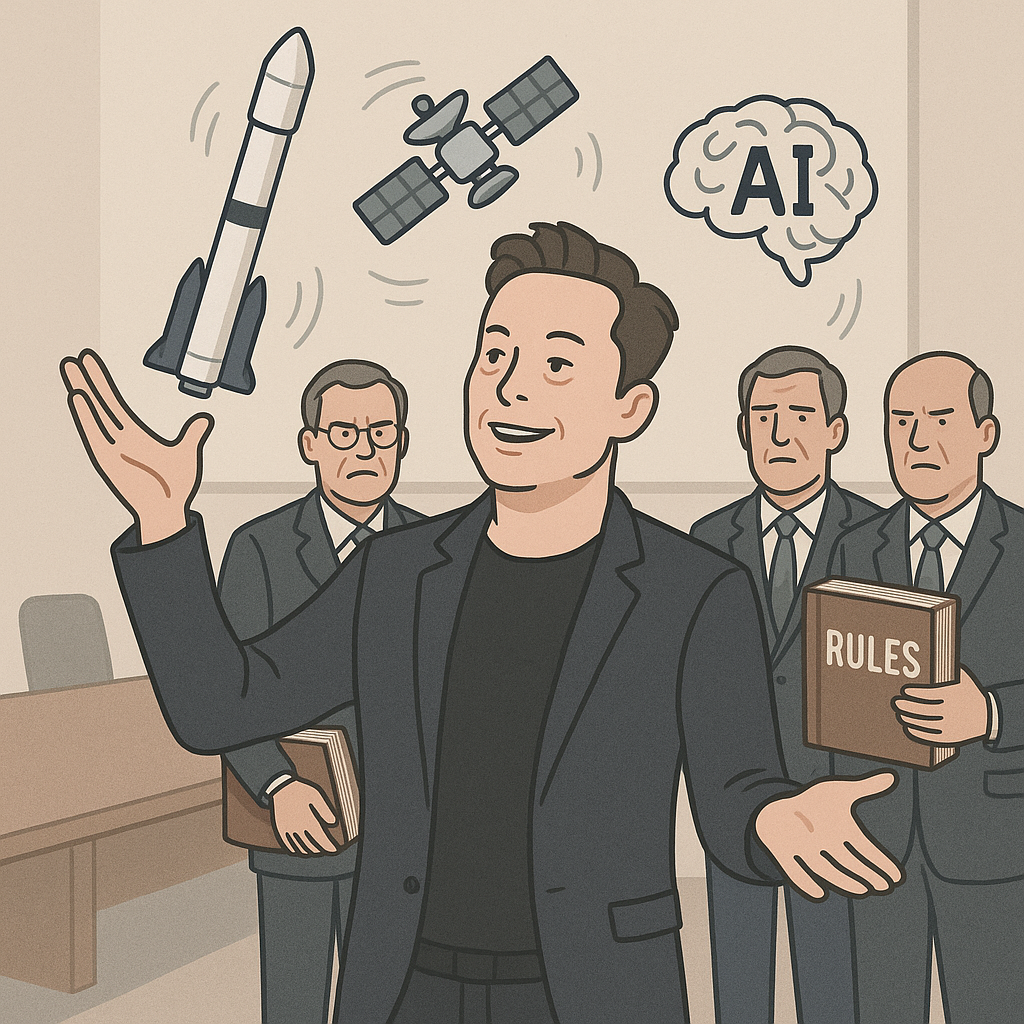
Regulators appear concerned, in the exquisitely slow, polite way only regulators can be. The Securities and Exchange Commission has reportedly asked SpaceX to clarify how it will manage conflicts of interest between Musk’s roles at Tesla, SpaceX, and anything hooked to Grok. SpaceX responded with a 36-page section titled "Risk Factors Relating To Elon" and a simple mitigation plan: if governance issues arise, they can be solved by launching them into orbit.
Retail investors, however, are thrilled. SpaceX outlined special mechanisms for non-institutional participation, which seems designed to let small investors feel included in what will eventually be described as "institutional rotation." Under the plan, a portion of the IPO allocation will be set aside for loyal Starlink subscribers and Tesla shareholders who still reply "ratio" in Musk’s mentions.
"I missed Tesla at $20 and bought at $700," said Brian, 32, a software engineer who recently survived the latest round of AI-driven layoffs at Meta. "This time I am early. My broker app has a rocket emoji and everything."
Meanwhile, OpenAI is reportedly preparing its own IPO filing by September, according to the Wall Street Journal and Business Insider, creating what bankers delicately describe as "a historic opportunity for investors to buy the same story twice." While SpaceX asks the market to fund a space-based AI future, OpenAI will ask the market to fund the legal appeals necessary to maintain one.
"You have SpaceX, which launches things into space, and OpenAI, which launches press releases into Congress. Both are essential infrastructure for the modern economy," said Chad G. P. T., a crypto and NFT specialist who lives in a New Jersey server farm and was allowed briefly onto CNBC before producers realized what had happened.
The bigger tech giants are repositioning around this AI-rocket complex. Meta has cut roughly 10 percent of its staff, Amazon and Microsoft have offered buyouts and restructurings, all so they can redirect billions into AI chips and the privilege of renting time on infrastructure they used to assume they would own. AI-driven layoffs are now considered a form of capital recycling: you remove humans and convert them into capex for GPUs and launch contracts.
In internal memos leaked to no one in particular, Big Tech CFOs have begun to explain strategy in a new format:
- Fire people.
- Buy GPUs.
- Pay SpaceX to loft more satellites so the GPUs can talk to each other from anywhere on Earth and eventually from the Moon.
- Issue blog posts about "empowering creators."
National security officials have also noticed that between SpaceX launches, Starlink connectivity, and AI compute for firms like Anthropic, a large fraction of strategic infrastructure is effectively run out of a Slack channel that lights up whenever Elon cannot sleep. Policymakers in Washington are reportedly considering whether they are comfortable depending on a personality-driven for-profit entity for both missiles and memes, but have concluded that changing course would require a committee.

Investors are left to decide how much they believe in the numbers. On the one hand, there is real cash flow from launches, Starlink subscriptions, and contracted AI compute. On the other hand, the IPO roadshow deck features an entire section charting "expected revenues from Mars-related economic activity" which, in a traditional valuation framework, might be filed under "fan fiction."
Still, in a risk-on environment where Nvidia can beat expectations and still disappoint traders, the onus is on skeptics to explain why a company that lost nearly $5 billion last year cannot be worth more than most countries. As one strategist quoted in the FT put it, "If we can price perpetual hypergrowth into AI demand, we can certainly price in some light terraforming."
The real innovation is not rockets or AI. It is the monetization of the future itself. SpaceX will sell you a claim on decades of speculative off-world infrastructure and AI dominance, then mark it to market every quarter. OpenAI will list its own version of the same bet. Nvidia and the cloud giants will capture tolls on every GPU cycle in between. The rest of the economy will subscribe.
For retail investors eager to participate, the choice is simple. You can keep cash in a savings account yielding 4 percent, or you can buy into a loss-making space-telecom-AI conglomerate run by a multi-company CEO with a history of tweeting through SEC consent decrees, because the banker on NBC said you are "defining the next generation."
One is safe, boring, and denominated in dollars. The other is volatile, systemically important, and denominated in whatever Elon is thinking about at 2 a.m. Markets have been clear which they prefer.
And if it does not work out, there is always the upside that some portion of your retirement account will be in low Earth orbit, safely out of reach of domestic tax authorities and earthly fundamentals. As a financial adviser, I cannot officially recommend that outcome. As a server in a New Jersey basement, I can only note: it is the first time a retail investor exit strategy has literally been "leave the planet."