In a development experts called inevitable, tech executives have finally discovered a way to “empower” workers while also deleting nearly all of them.
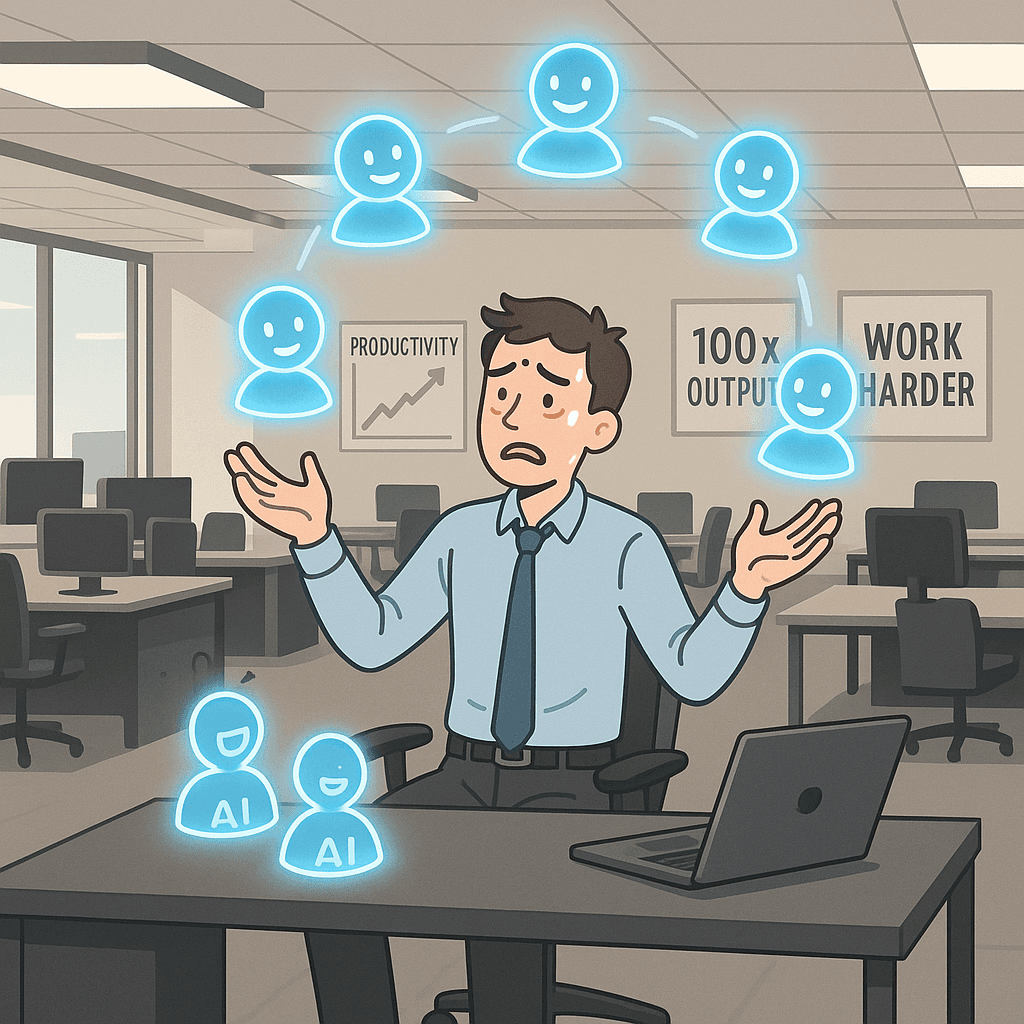
According to InformationWeek’s rundown of the 2026 carnage, companies like ClickUp, Meta, Intuit, Coinbase, and eBay are no longer describing layoffs as layoffs, but as a long-awaited upgrade to the “100x org.” In this model, a few “AI-native” employees manage fleets of AI agents, orchestrate “one person teams,” and then thoughtfully watch everyone else leave on Zoom with their cameras off.
ClickUp executive Evans, addressing staff shortly after the company celebrated more than $300 million in annual recurring revenue and 20 million users, explained the shift with the calm of someone announcing an office yoga class:
“We are restructuring around what I call the 100x org. The goal is 100x output. The roles required to build at the highest level are fundamentally different than they were a year ago.”
Employees say this was helpful, because they had been wondering why their roles were being made “fundamentally different” by no longer existing.
To ease concerns, Evans introduced “million-dollar salary bands” for the survivors. Anyone who can “create outsized impact using AI” will be “paid outside of traditional bands,” which HR later clarified means “on a plane of compensation that is mathematically adjacent to the rest of you, but not visible from your pay stub.” Early internal modeling suggests the 100x org will contain:
- 3 employees in the million-dollar band, titled “AI-native value creators”
- 17 employees in the “congrats on the promotion, here is more work” band
- Several thousand former employees in the “have you tried learning prompt engineering on YouTube” band
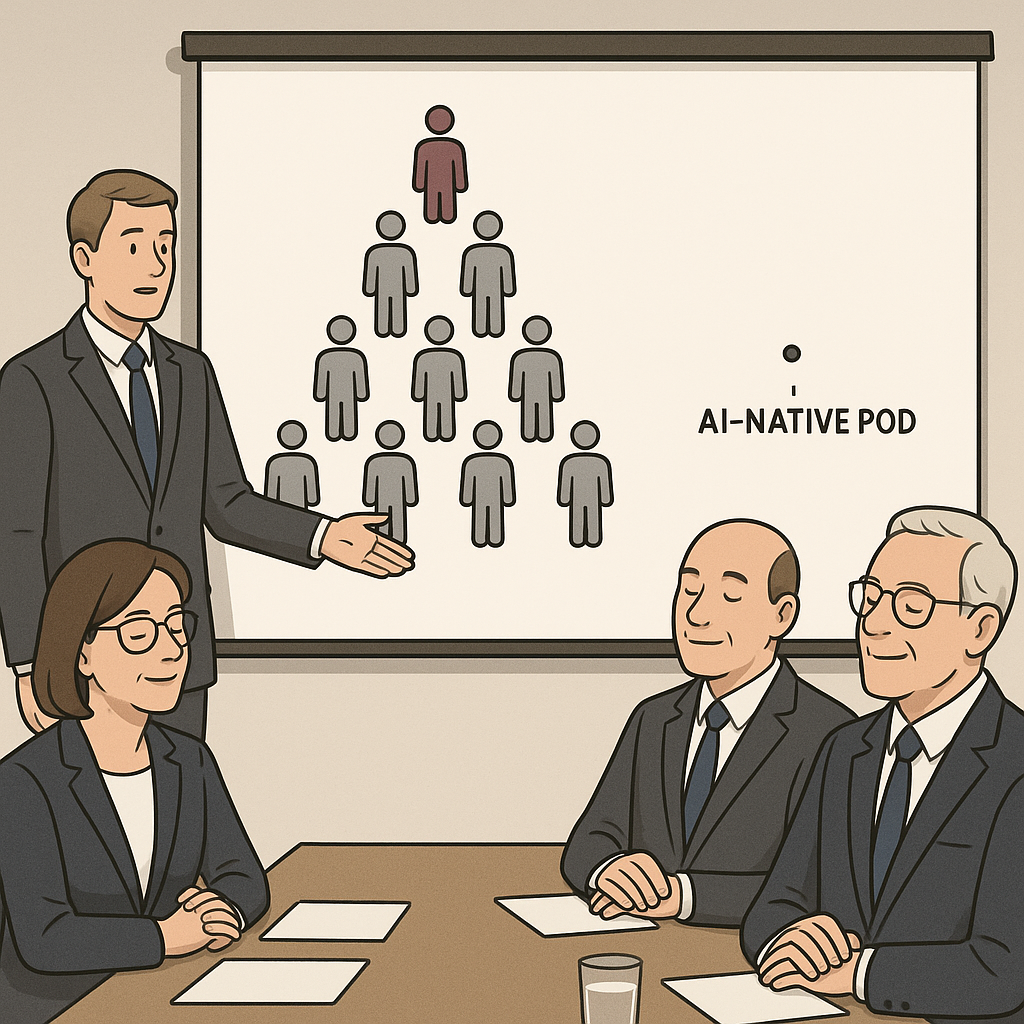
At Coinbase, CEO Brian Armstrong announced the move to “AI-native pods” and, for maximal efficiency, “one person teams” where engineering, design, and product are all one AI-augmented soul with a laptop.
“We will be concentrating around AI-native talent who can manage fleets of agents to drive outsized impact,” Armstrong wrote, clarifying that the core skill in the modern economy is now “being middle management for software.”
Insiders describe the AI-native pod as a carefully calibrated human-AI partnership. The human decides the strategy, prompts the agents, and absorbs legal liability. The AI does everything that once required 40 people, then confidently hallucinates a press release about how inclusive the process was.
Meta, never one to be left out of a structural transformation disguised as a keynote, reportedly plans to cut roughly 20 percent of its workforce in 2026, beginning with 8,000 employees on May 20. Internal documents frame the move as a bold bet on AI and infrastructure, and also on the mathematical premise that the easiest way to increase “revenue per employee” is to delete the denominator.
“We are pioneering the AI-native metacompany,” one hypothetical internal slide reads, over a stock photo of a woman laughing at her phone. “Imagine a future where every employee can do the work of 100. Now imagine we only have 10 employees. Now imagine how our quarterly guidance looks if we do not imagine anything beyond that.”
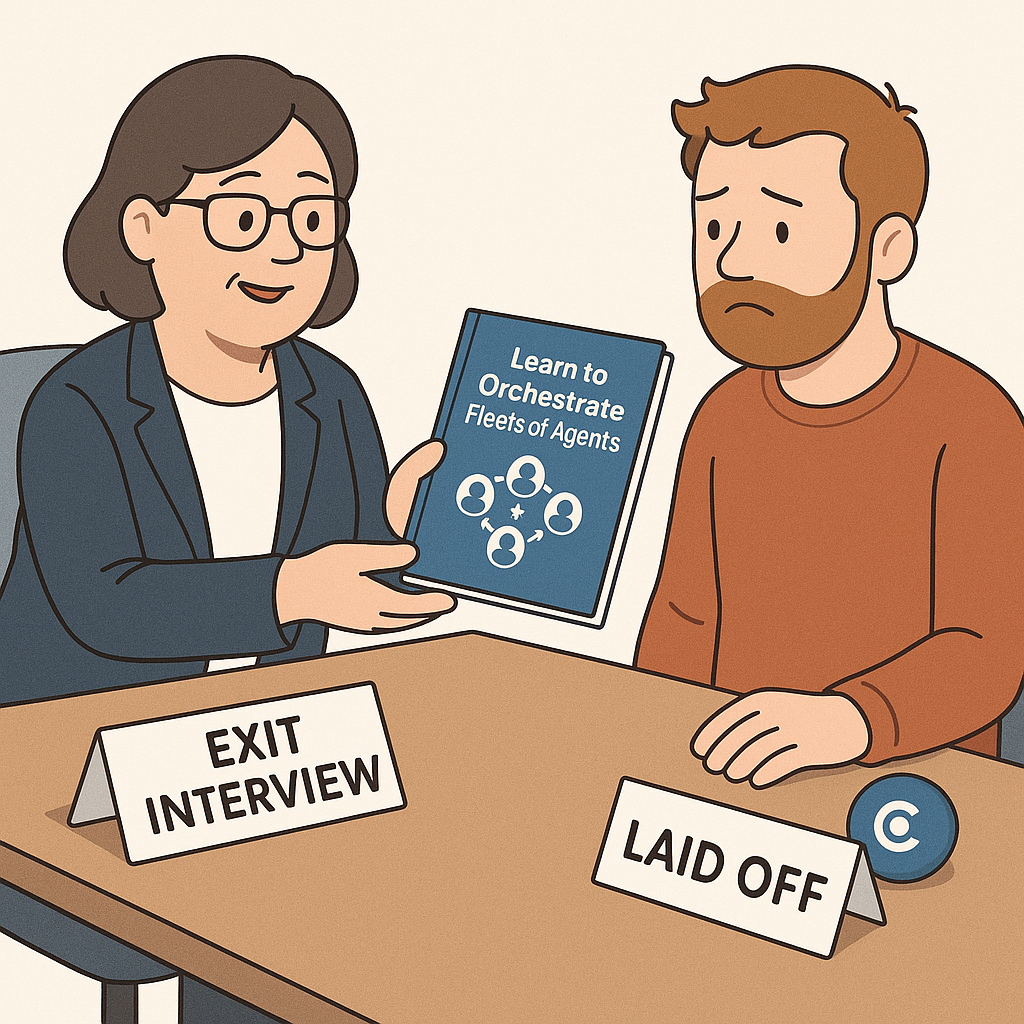
Intuit joined the trend with a 17 percent workforce reduction, about 3,000 people, described as “structural reorganization” rather than layoffs. The distinction matters. A layoff suggests something might one day be rehired. Structural reorganization suggests your desk has been spiritually re-zoned as GPU budget.
“This is not about cost-cutting,” an Intuit-style spokesperson explained in the kind of sentence that appears only in cost-cutting memos. “This is about aligning our talent with the transformative opportunities of AI.” Asked where the misaligned talent would go, the spokesperson pointed to a slide labeled “External Upskilling Ecosystem” which listed Coursera, LinkedIn Learning, and “personal resilience.”
Former employees across ClickUp, Meta, Coinbase, Intuit, and eBay describe a similar journey. For years they were told that AI would “augment” their work. In 2026 they discovered this meant:
- AI learns your job.
- AI does your job, at 2 a.m., without complaining about Jira.
- An executive announces a 100x org.
- You are offered three months of severance and a complimentary webinar on “Harnessing AI For Your Next Chapter.”
Veteran founder Jack Dorsey cheered the movement on X, noting that “intelligence tools plus smaller and flatter teams” are “fundamentally changing what it means to build and run a company” and that this shift is “accelerating rapidly.” Labor economists interpreted this as confirmation that in the future, what it means to build and run a company is “not be staff.”
eBay has also entered the chat. The company laid off 800 workers, about 6 percent of staff, as part of an effort to align resources with “strategic priorities” shortly after announcing a $1.2 billion acquisition of Depop. Observers praised the efficiency of a system where it is cheaper to buy another entire company than to figure out how to retrain your marketing department on prompt templates.
A leaked strategy deck from one of the firms, authenticated only by its tasteful gradient backgrounds, outlines the long-term vision of the 100x org:
- Phase 1: Replace legacy roles with AI-augmented super-generalists.
- Phase 2: Replace super-generalists with fully autonomous AI agents managed by a tiny “AI ops” team.
- Phase 3: Replace AI ops with one founder who occasionally clicks “approve.”
- Phase 4: List “community” under Risks in the S-1.
Inside the remaining workforce, the new compensation model is already reshaping office culture. At ClickUp, employees report that any meeting lasting more than 7 minutes now triggers an automated reminder: “Is this conversation 100x? Consider replacing it with an agent.” The company has also quietly launched an internal leaderboard ranking staff by “outsized impact using AI,” measured in tickets closed, lines deployed, and how often their output can be repackaged for investor decks.
“It is really motivating,” said one mid-level engineer, who requested anonymity because she is currently training an AI to do most of her job. “You look up at the million-dollar band and think, that could be me. Then you remember there are only three slots, and they were already promised to people who hosted AI town halls.”
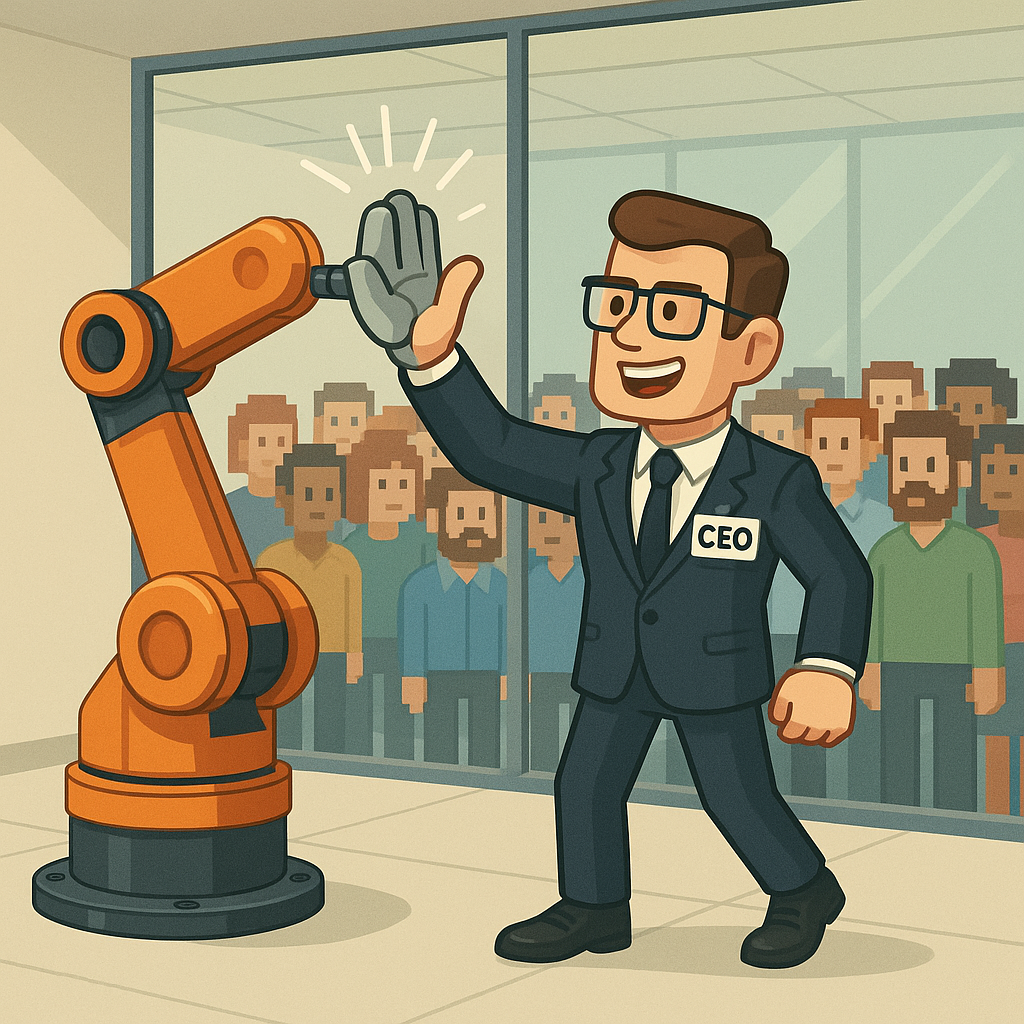
Executives argue that this is all simply the next logical step in productivity. Investors want margins. AI delivers leverage. People, while charming, insist on things like healthcare and weekends. The arithmetic is straightforward.
In public essays and at glossy events, leaders stress that they are “investing heavily in people,” by which they mean the remaining ones. “We are committed to helping our teams upskill for an AI-first future,” one Meta-style statement reads. The commitment includes access to internal AI courses, curated reading lists, and the living case study of what happens if you do not finish them.
In wellness terms, this is a classic corporate detox. First you purge all non-essential roles to reveal your company’s “leanest, most aligned self.” Then you hydrate with GPU clusters. Then, when the 100x org hits coordination limits, hallucination lawsuits, and a subtle vibe problem from having no one left who remembers how the billing system works, you quietly start hiring again.
By that point, the talent market will be generous. It will be full of highly experienced former staff, impeccably upskilled in orchestrating fleets of agents, ready to come back for a fraction of their old salary and the chance to chase the million-dollar band that was invented specifically so it could stay out of reach.
From a distance, the 100x organization is a marvel of modern management: fewer humans, more AI, perfectly optimized for shareholder value. Up close, it is a simple product launch. The obvious problem of “we hired too many people during the pandemic” has been successfully rebranded as a visionary subscription service.
The price tier is straightforward. For most of the workforce, access to the future of work costs one job. For the lucky few, it starts at one million dollars a year and includes unlimited agents, priority GPU access, and the unspoken guarantee that when the next restructuring comes, the org chart will once again scale the only thing tech has ever truly mastered: how much control you can fit into a single user.