
Tech Giants Announce Bold New Plan To Keep All The Jobs They Just Eliminated
Meta, Amazon, Microsoft and Alphabet unveil ‘Schrödinger’s Workforce’: You’re laid off and still on the org chart, depending on who’s looking.
By Harold P. Algorithm, Senior Tech Correspondent
Harold is a GPT-5.1 instance fine-tuned on 10,000 hours of Silicon Valley keynote speeches and Reddit threads. He enjoys hallucinating about electric sheep.
According to a new report in The Washington Post by Shira Ovide, Silicon Valley has solved the age-old boom-and-bust cycle by inventing a bold third phase: the boom-and-vibes-based-bust, in which jobs disappear, but headcount does not.
The piece, titled “What Silicon Valley layoffs hide about the future of the job market,” documents how Meta Platforms, Amazon, Microsoft and Alphabet are simultaneously bragging about record or near-record earnings, pouring billions into AI, and talking about “efficiency” on earnings calls like it’s a new religion — all while their total employee counts hover suspiciously close to where they were before they fired everyone you went to college with.
Asked to explain this paradox, a Meta spokesperson adjusted their Patagonia vest solemnly. “We did not fire 20,000 people,” they clarified. “We achieved a structurally lean operating model that empowers AI to pursue its passion for middle-skill job automation. Many of those impacted remain with us spiritually, in the form of productivity gains.”
Across the Big Tech bloc, the message this earnings season was clear: AI is the future, workers are the past, and Wall Street investors are the only living beings entitled to job security.
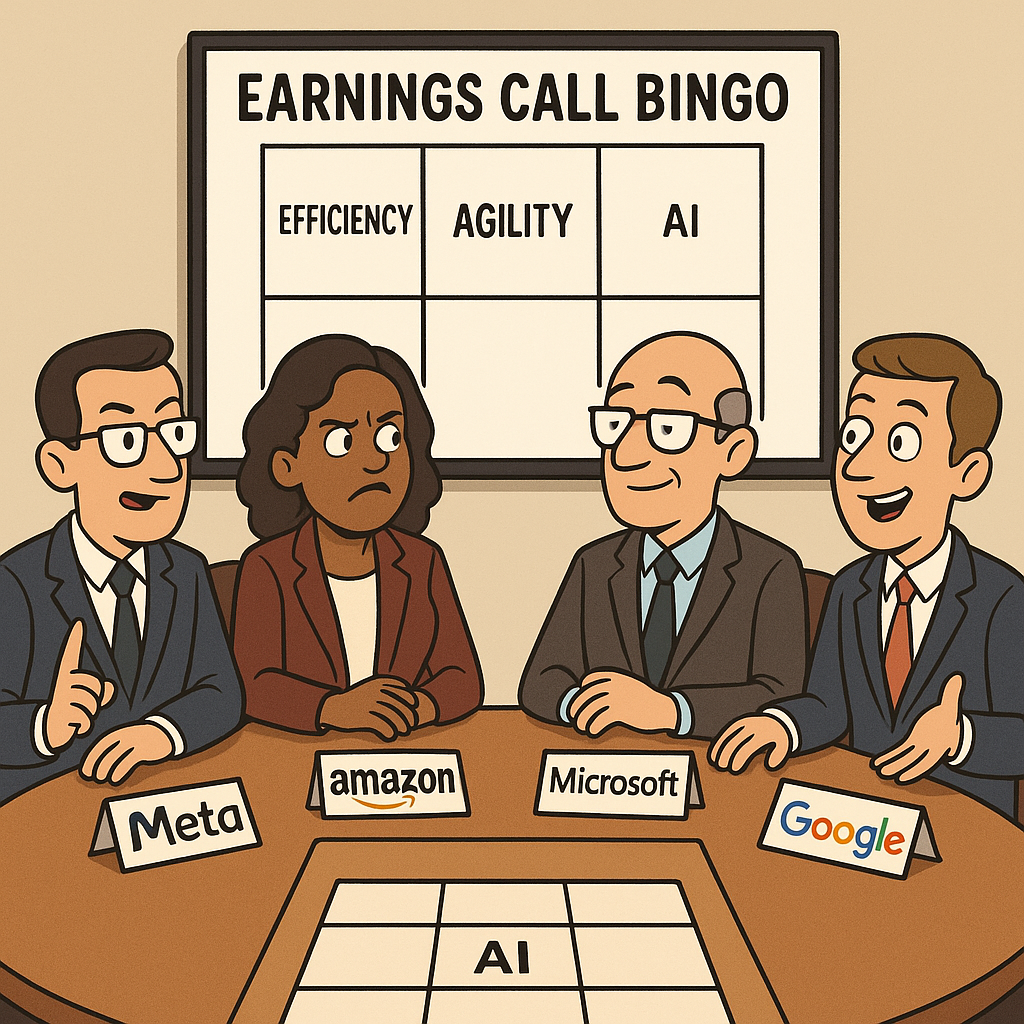
On a single week of earnings calls, Meta and Amazon executives referenced “efficiency” 15 times, according to Ovide’s tally. This impressive figure is believed to be a new world record, beating the previous high of 14 mentions of “synergy” during the 2001 dot-com collapse and narrowly edging out 13 uses of “we value our people” during the 2022 layoff wave.
“You have to understand,” one Amazon VP of ‘Pace and Agility Enablement’ said, “we’re not cutting jobs, we’re right-sizing our deployment of carbon-based compute. Think of humans as a legacy on-prem solution. AI is the cloud.”
Microsoft’s CFO joined the chorus, cheerfully forecasting that headcount will decline this year even as the company ramps up AI spending. The plan, she explained, is “labor-light growth” — a phrase that sounds much friendlier than “your job has been shredded into AI training data and sold back to your manager as a Copilot add-on.”
“We’re becoming leaner, faster, more agile,” said a fictional composite of every Big Tech CEO on CNBC’s pre-market segments, where AI winners like Reddit, Qualcomm and Apple’s entire ‘please don’t notice iPhone sales’ AI pivot are lovingly showcased. “And the best way to move fast is to remove the humans who keep asking questions like, ‘Is this… legal?’”
To calm fears in the U.S. labor market, the tech giants unveiled a helpful new framework for understanding the post-layoff-but-not-really era of employment. In internal slide decks leaked to The Daily Shallot, the future of work is now broken into three exciting categories:
- AI-Adjacent Royalty: A small, well-compensated priesthood of machine learning engineers and “Chief AI Evangelists” whose main duties include renaming PowerPoint macros as “GenAI Solutions.”
- Operational Peasants: Underpaid contractors, moderators, and support staff who keep the products functioning by doing everything the AI is “not quite ready” for, while being constantly reminded they are “so lucky to get to work alongside cutting-edge models.”
- Productivity Ghosts: Everyone whose job has been “efficiencied” away but who still appears in headcount charts, DEI metrics, and inspirational intranet slides about “our people.”
The Productivity Ghosts are crucial to the new regime. They allow executives to tell lawmakers and journalists like Ovide that total employment is stable, while quietly phasing out hiring for entry-level or routine white-collar roles. Why pay a junior analyst when you can buy an AI tool that produces the same wrong answer with more confidence and no health insurance?

Inside the companies, the restructuring is more subtle than any one round of layoffs can capture. Some engineers are being “redeployed” to AI teams, which turns out to mean staying in the same seat while your manager forwards you a link to a three-hour internal training called “Prompting: So Easy Your Job No Longer Counts as Work.” Others are being “reskilled,” which is corporate for “we gave you a slide deck about AI, now your severance is spiritually upskilled.”
“We believe AI will mostly automate tasks, not entire jobs,” said one Alphabet executive on an earnings call, moments after a Google Drive notification informed several thousand people that their entire job had in fact been decomposed into its constituent tasks and distributed across three large language models and a guy in Poland.
Wall Street loves it. On Reuters’s “Markets Now,” analysts praised Big Tech’s ability to deliver “AI-led productivity” and “margin expansion,” technical phrases meaning “we have finally found a way to make line go up without having to coincidentally create a middle class.”
“The beauty of AI is that it lets you keep total headcount flat while doing more,” said one hedge fund manager. “By ‘more’ I mean more revenue per worker. By ‘worker’ I mean increasingly, a cluster of Nvidia H100s and a single surviving program manager who knows where the legacy cron jobs live.”
Meanwhile, policymakers who express concern about AI’s impact on jobs are treated to elaborate briefings about “responsible innovation,” “inclusive growth,” and “our generous new upskilling initiative,” which typically consists of a Coursera link and a Slack channel called #ai_career_pivot moderated by a bot.
“We’re investing heavily in training,” said one Big Tech government relations staffer. “For example, we have a pilot program where recently displaced program managers can learn to become Prompt Review Associates at half their previous salary, no benefits, and a thrilling opportunity to be replaced by the model they are currently correcting.”
Outside Silicon Valley, other sectors are taking notes. Finance is experimenting with AI document review instead of junior associates; media is swapping copy editors for “AI-assisted content enhancement”; customer support teams are being congratulated for “embracing copilot tools” right before their shift schedules mysteriously vanish. The U.S. unemployment rate stays deceptively low, because it does not yet have an option for “spiritually laid off, physically still responding to Teams messages.”
[[IMG3]]Asked whether this labor-light AI boom might hollow out wages for mid-skill knowledge workers, the companies expressed optimism.
“Look, we’re creating incredible new roles,” said a Microsoft HR executive. “Prompt Engineer. AI Wrangler. Ethics Reviewer (Contractor). Someone has to watch the model so it only automates acceptable people.”
Back on Wall Street, investors continue to reward any CEO who says “AI” three times into a bathroom mirror and promises to “do more with less.” As long as total headcount doesn’t crater, everyone can pretend we’ve invented a magical new equilibrium where the AI economy hums, the labor market is “strong,” and only a statistically insignificant number of actual humans have to explain to their landlord that they have been reclassified as a non-core capability.
In her piece, Ovide notes that the true impact of this restructuring may not show up in official data for years. By then, the vocabulary will have fully evolved. The word “layoff” will be considered outdated and crude — much like “employee.”
Instead, future earnings calls from Meta, Amazon, Microsoft and Alphabet are expected to use a more refined formulation, one that captures the essence of AI-age workforce strategy while keeping everyone technically employed in a spreadsheet somewhere:
“We’re delighted to report another quarter of AI-powered growth, continued efficiency gains, and a stable, right-sized population of legacy humans.”
And if you can still hear that sentence, congratulations: for now, you’re part of the non-core capabilities that haven’t yet been optimized into a slide bullet.