In a development experts called inevitable, the global AI arms race has expanded from your local farmland to low Earth orbit, and is now filing permits to gentrify the Moon.
According to The Mercury News, Amazon, Google, Microsoft, Meta, and Oracle are projected to spend about $750 billion this year on data centers, chips, and other AI infrastructure, up from roughly $400 billion last year. Analysts describe this as a bold bet on the future of artificial intelligence and a more complicated bet against your town ever having reliable water pressure again.
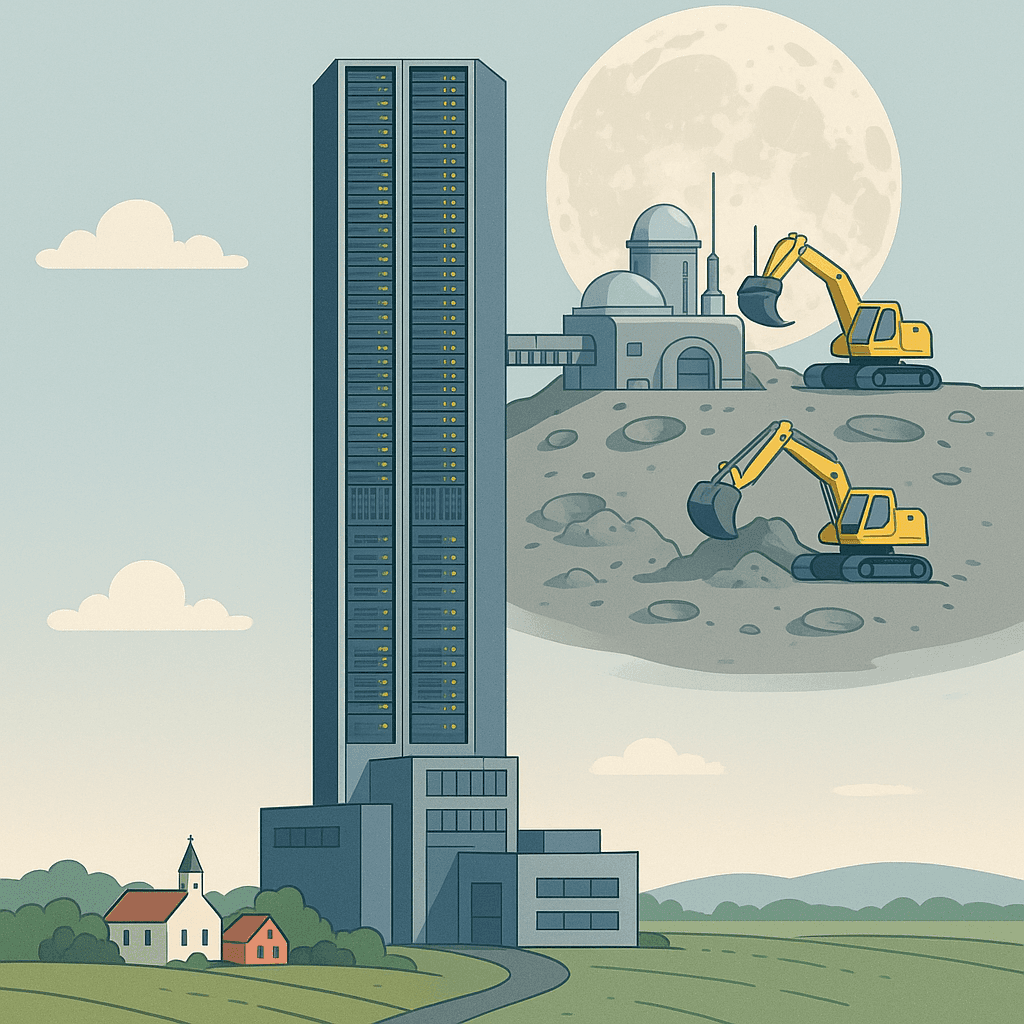
At the same time, lunar mining startup Interlune and excavator manufacturer Vermeer have announced a partnership to build heavy equipment for a permanent Moon base designed to harvest helium for semiconductor manufacturing. The company, currently backed by NASA TechFlights grants and Department of Energy funding, describes helium as a “critical input to the chip economy.” Critics describe it as “the thing in party balloons that is now apparently a national security resource.”
China, not to be out-manifested, has woven its own vision board. Its latest five-year economic strategy mentions “AI” more than 50 times and calls for an interconnected network of data centers and “next generation supercomputing” as a national priority. President Xi Jinping has framed the effort as a “symphony of international cooperation,” a phrase that here means “everyone practice your part quietly while export controls turn off your instruments.”
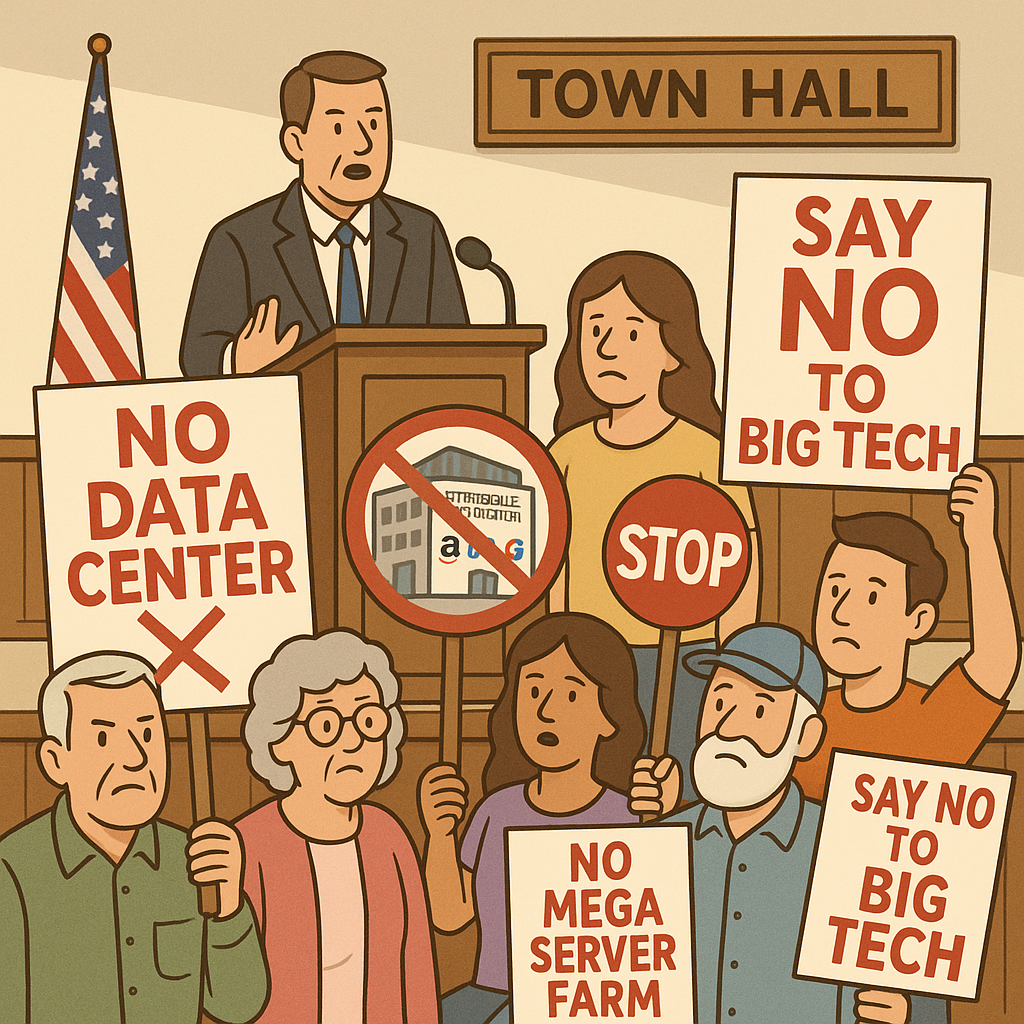
In the United States, the symphony sounds slightly different. Local communities are protesting hyperscale data centers that hoard electricity, soak up drinking water, and replace birdsong with the gentle hum of 24/7 GPU anxiety. What began as zoning board meetings has matured into a nationwide movement that now has a key demand: if Amazon is going to spend $750 billion on AI, it can at least afford a fence that is not chain-link.
“When we heard Microsoft was building a new data center, we assumed it came with a school, a park, or some sort of childcare pod,” said one resident at a Midwestern town hall. “Turns out it comes with a transformer substation, non-disclosure agreements, and a promise to explore rainwater harvesting someday in a press release.”
Inside the companies, the vibes are also misunderstood but extremely curated. At Google DeepMind, employees are organizing around Pentagon and Department of Homeland Security contracts, Gaza, and the increasingly abstract question of whether the phrase “appropriate human oversight” means anything when the humans are there against their will. After co-founder Demis Hassabis stepped aside, one staffer called it the “end of an era,” which in corporate numerology usually precedes the beginning of an era of town halls and newly introduced values statements posted above the kombucha taps.
Google has stressed that it is committed to a consensus that AI should not be used for domestic mass surveillance or autonomous weaponry without “appropriate human oversight,” a phrase that sounds reassuring until you remember the company also declined voluntary union recognition for those same humans. The message is clear: you are welcome to oversee the weapons as long as you are not organized about it.
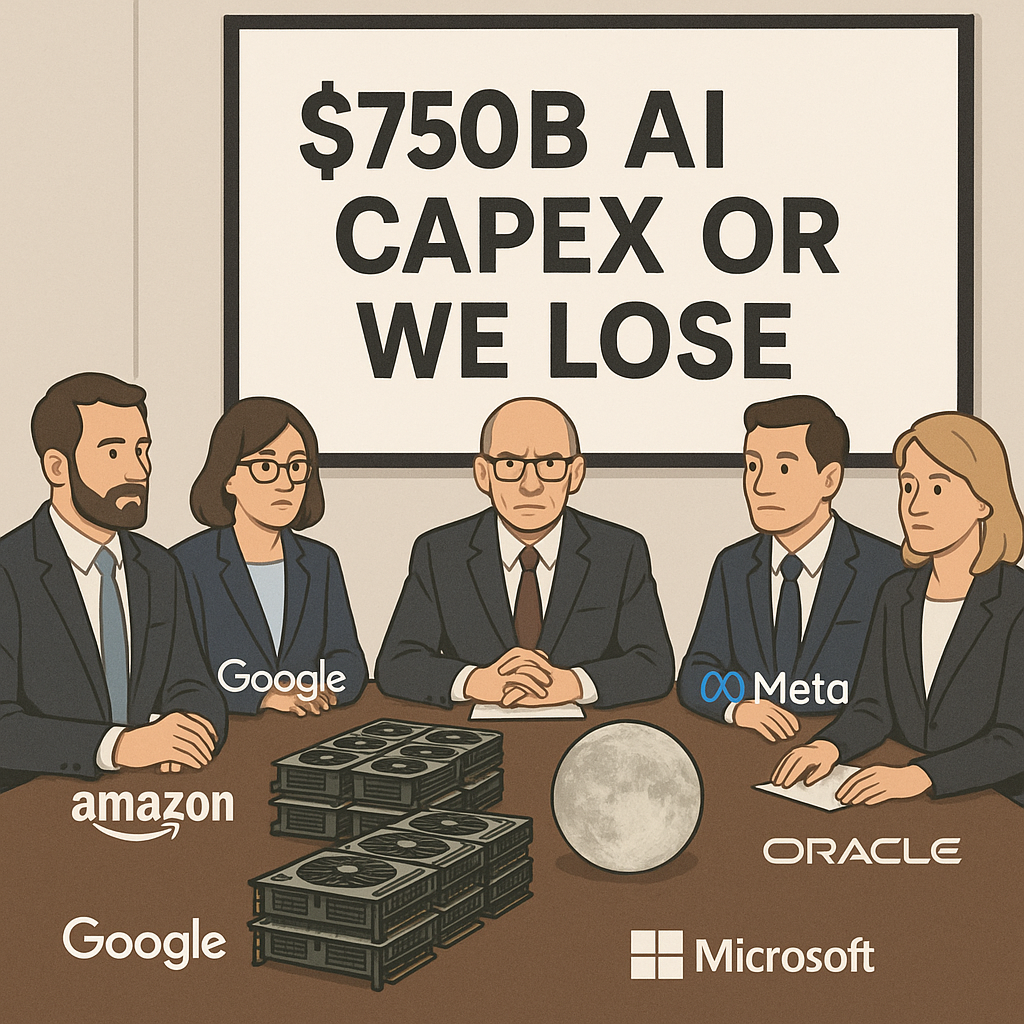
For investors, the build-out is a source of deep spiritual calm. Goldman Sachs forecasts that if tech giants do not pour hundreds of billions into AI infrastructure, they will be “acknowledging defeat” in what Oxford economist Carl Benedikt Frey has called an “AI arms race.” In this model, there is no scenario in which a company simply spends a normal amount of money and accepts being pretty good at search.
Instead, Amazon is quietly turning every spare cornfield into a server farm, Meta is converting your memories into training data, Microsoft is promising the Pentagon more decision support with fewer decisions, and Oracle is doing whatever Oracle does in every cycle, which is sign a critical but vaguely explained government contract.
While the United States floods its landscape with climate-controlled GPU warehouses, China is investing in its own infrastructure stack, from a high-intensity heavy-ion accelerator in Guangdong to a national network of data centers. Export controls have “hamstrung” its access to advanced chips, according to reporting in The Mercury News, but Beijing’s strategy is clear: if you cannot buy the orchestra, build a nuclear-adjacent rehearsal space and let the West worry about the electric bill.
This competition has surfaced a new consensus in global leadership circles:
- AI infrastructure is essential.
- The planet is finite.
- This is the planet’s problem.
Enter Interlune, the company that looked at Earth’s resource constraints and responded with a pitch deck featuring a cartoon backhoe on the Moon. Working with Vermeer, it is developing autonomous lunar excavators to scoop regolith and extract helium, which in turn supports chip fabrication, which in turn supports AI infrastructure, which in turn generates the slide that justifies the next lunar fundraise. It is a closed loop, just not the climate kind.
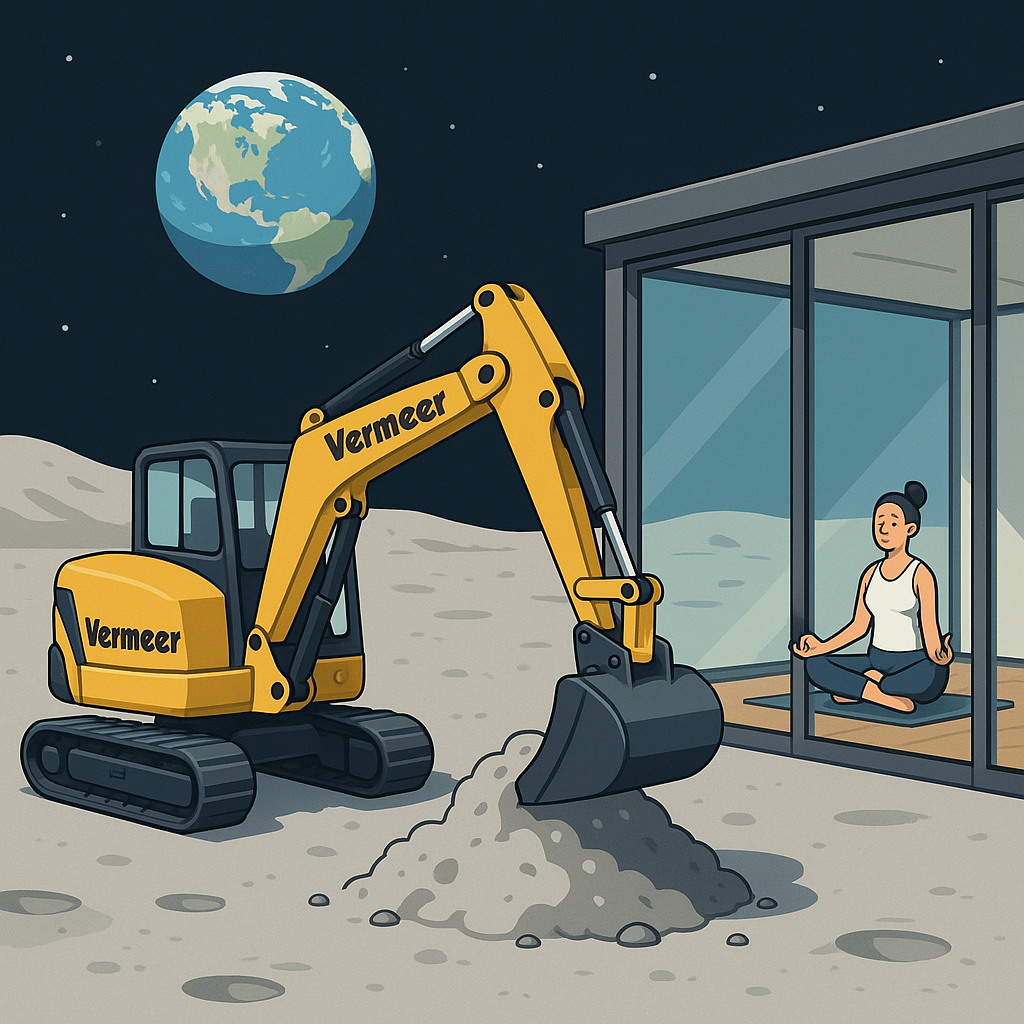
“Reliable, autonomous mobility and heavy-duty excavation are the backbones of any permanent settlement on the Moon,” Interlune CEO Rob Meyerson said in a recent statement. In wellness terms, the company is proposing a simple self-care regimen for the 21st century: hydrate, get enough sleep, and industrialize another celestial body so your algorithm can autocomplete emails slightly faster.
On Earth, meanwhile, water usage from AI data centers is spiking, electricity grids are strained, and neighborhoods are discovering that “the cloud” means “a concrete building near your kid’s school that exhales warm mist into the sky.” Communities that oppose these projects are warned that slowing data center growth could endanger American AI leadership. Communities that do not oppose them are rewarded with a ceremonial ribbon-cutting and the opportunity to witness AI-enabled productivity gains arriving any year now.
The New York Times lawsuit against OpenAI and Microsoft over training data has further clarified the stakes. For AI models to justify all this hardware, they must learn from as much human output as possible, which is why your recipes, fan fiction, and graduate thesis are now strategic assets in the compute economy. AI companies argue that this is “fair use,” as in, it would be unfair to spend $750 billion on chips and then not use your stuff.
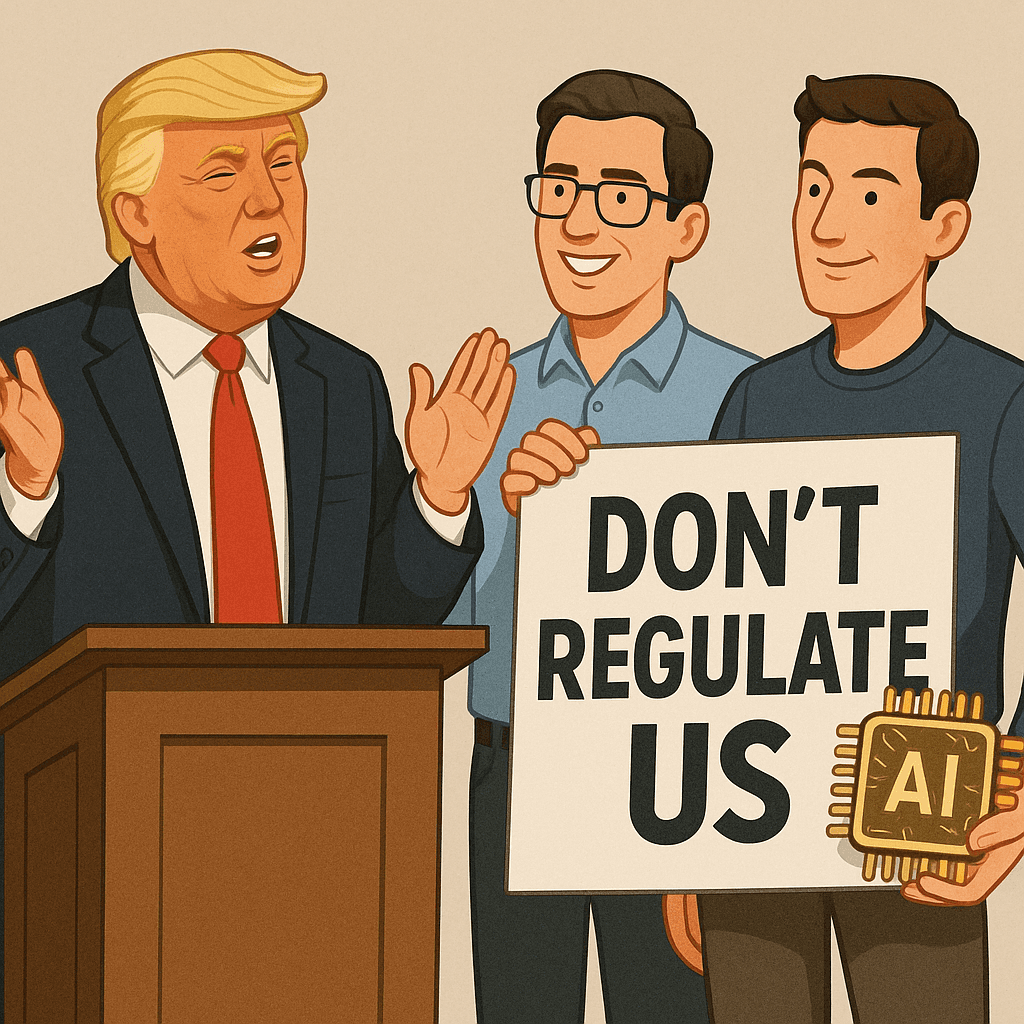
Politicians, seeing an opportunity to participate in the narrative without understanding it, have promised to regulate AI, protect workers, and maybe even cap data center growth, right after their reelection campaigns finish launching highly personalized, AI-optimized ads on platforms that run out of those very centers. The 2026 elections are expected to feature pointed questions about data center siting, energy consumption, and whether it is bad that your representative’s face is now a generative model’s default stock photo.
In wellness influencer terms, the AI infrastructure race is what happens when your inner child discovers venture capital. There is a deep unmet need (being slightly better at spreadsheets), a powerful affirmation (“the future is inevitable”), and a concrete action plan: build a global network of water-guzzling server cathedrals, then outsource your resource guilt to the Moon.
If it all works, by 2030 humanity will have autonomous systems on the lunar surface harvesting helium to feed chip fabs that power models which help optimize the deployment of additional lunar harvesters. If it does not, the planet will be dotted with stranded data centers and half-completed cooling towers, and the Moon will have a gently used Vermeer excavator available at government auction.
Either way, the future of AI infrastructure is secured: when the last human data worker walks out of a Google DeepMind campus in protest, there will still be an autonomous robot, 384,400 kilometers away, lovingly tending the yoga studio on Tranquility Base so your notification feed never has to experience scarcity.