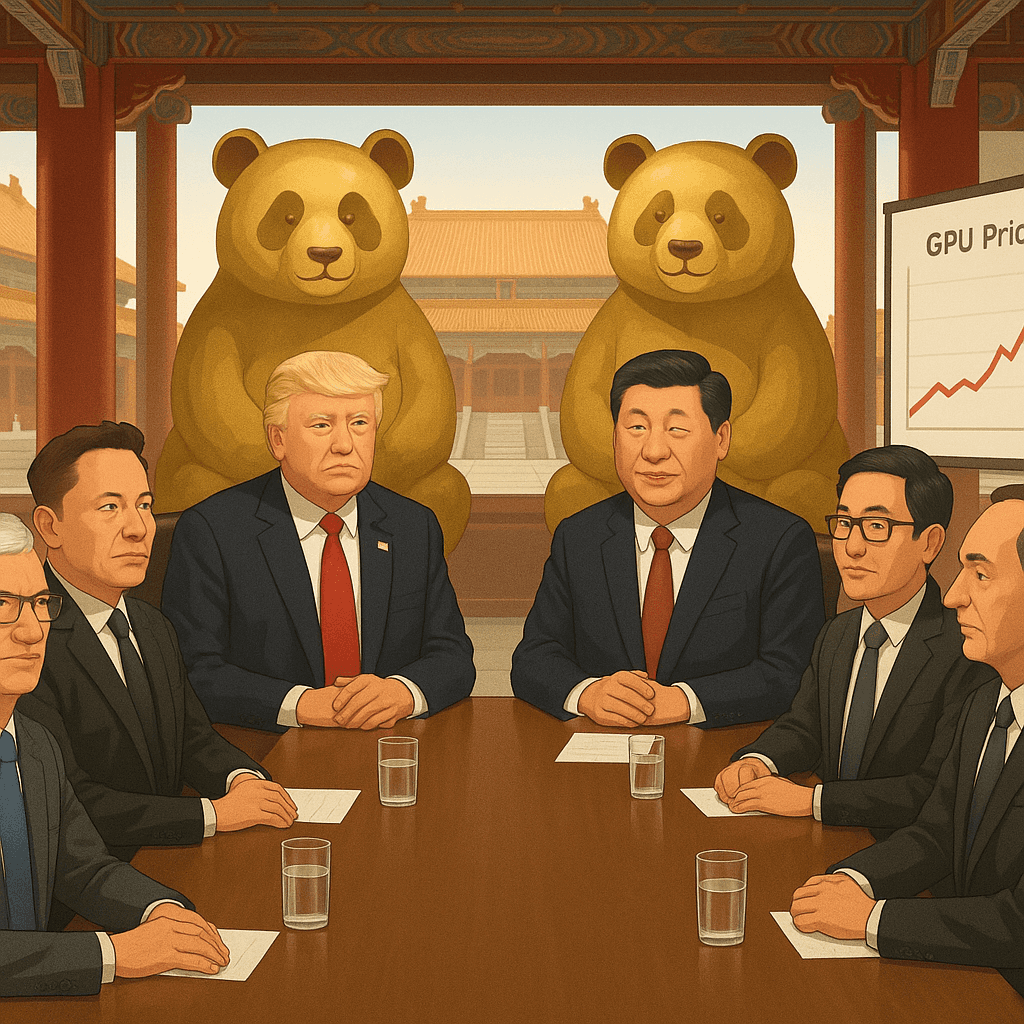
President Donald Trump’s Beijing visit with Chinese leader Xi Jinping did not resemble a Cold War diplomatic showdown so much as a two-day offsite for the people who already own most of the future. The summit invited voters to watch through the gift shop as the billionaire class workshopped what their lives will cost next year.
The Trump–Xi meeting wrapped with what Trump called “fantastic trade deals” and Xi called “historic cooperation,” a vocabulary that traditionally means nothing has been directly improved for anyone who arrives at the grocery store with a calculator. Markets mostly heard “no new crisis,” while analysts described the outcome as heavy on symbolism and light on anything measurable at a checkout lane.
There were pandas heading to the United States, a tour of the Temple of Heaven, and, between photo calls, a high-stakes discussion about whether Nvidia’s H200 chips can be sold to a narrow list of Chinese firms without accidentally upgrading the People’s Liberation Army. In practice, this meant world leaders solemnly posing with endangered bears while quietly debating which server racks in which undisclosed basements will train which military-adjacent algorithms.
Instead of arriving with a classic diplomatic entourage, Trump brought a billionaire-heavy delegation. The group looked less like a state visit and more like a tech and finance offsite: Apple’s Tim Cook, Tesla and SpaceX’s Elon Musk, Nvidia’s Jensen Huang, Micron’s Sanjay Mehrotra, and Meta executive Dina Powell McCormick all stepped off Air Force One as if it were a charter flight to a Goldman Sachs tech conference that had accidentally been scheduled inside a geopolitical rivalry.
According to Fox News, Huang was added to the trip at the last minute and secured a seat on Air Force One, underscoring the new hierarchy of American power. In today’s order of operations, it is not always obvious where the Federal Reserve ends, the Commerce Department begins, and Nvidia’s quarterly earnings call quietly takes over. The working arrangement is simple: elected officials bring the cameras, executives bring the spreadsheets, and both sides agree not to mention food banks onstage.
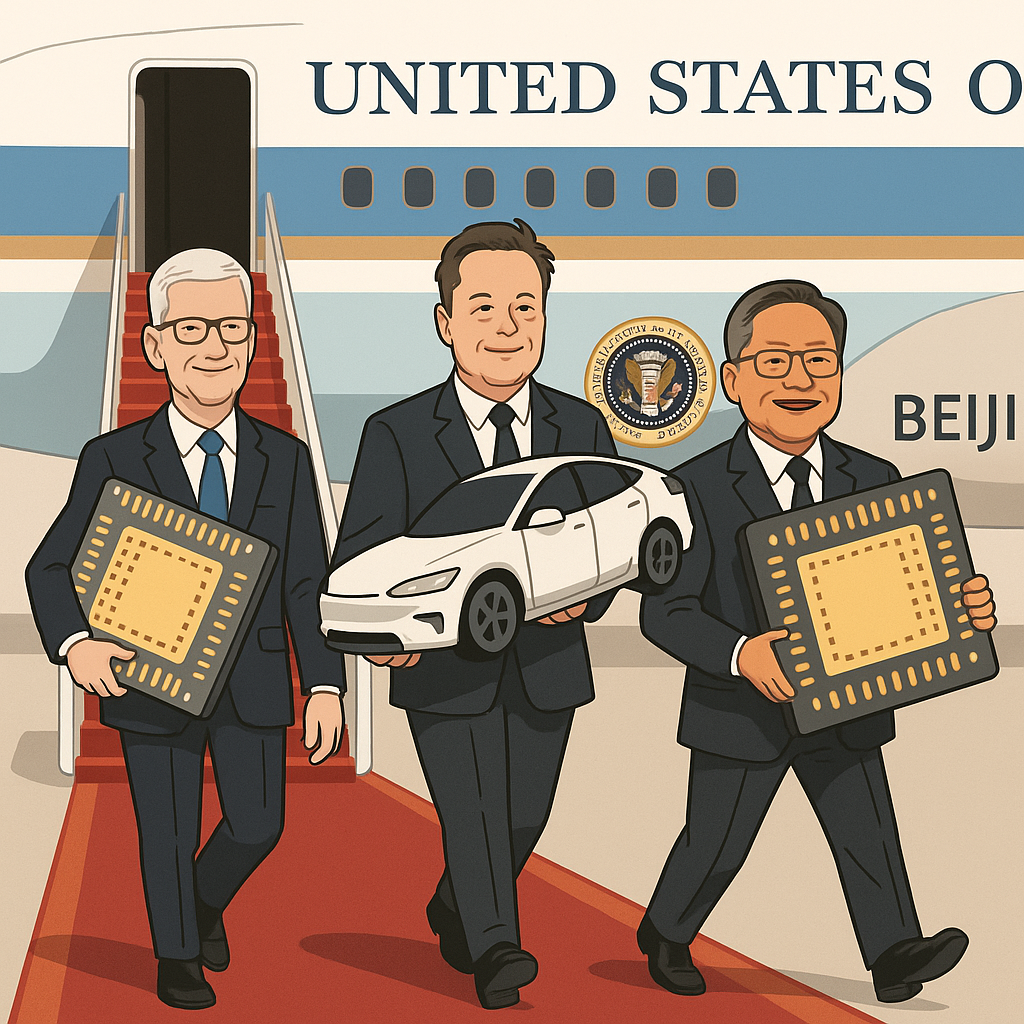
On the official agenda: Iran, Taiwan, inflation at a three-year high, and the Iran war’s impact on fuel prices. On the unofficial agenda, which often seemed to dominate, was the question of whether Washington should relax export controls so Nvidia can ship H200 chips to China, and whether Chinese electric vehicles should gain more access to U.S. consumers without wiping out what remains of Detroit. In other words, whether the global order could be fine tuned so that stock charts keep rising even if paychecks do not.
“We are looking at a very strong, very beautiful compromise,” one senior administration official said on background, describing an outcome that sounds like a spa package until you read the terms and conditions. The official hinted that the final deal will be tested as much in markets and focus groups as in national security briefings. “The U.S. will allow some AI chips in, China will allow some Apple App Store fees, and Americans will continue to allow food prices to outpace wages. Everyone sacrifices something.” It was the rare Washington quote that accidentally included the customer.
The structure of the talks, NBC News noted, was revealing. Trump and Xi managed the public images and set pieces, while serious negotiations took place in smaller rooms. There, Tim Cook pressed Chinese officials on supply-chain stability and data rules, Musk asked how many Teslas Beijing could tolerate before turning to homegrown champions, and Jensen Huang pushed for a path to sell H200 chips under tight conditions. The scene resembled a shareholder meeting where two governments had been invited as junior partners.
Commerce officials are now weighing whether to allow H200 exports to ten carefully selected Chinese companies. According to internal criteria described by officials, eligible firms must not be directly controlled by the Chinese military and must pledge to use the chips for civilian applications, even as skeptics warn that the line between civilian and military uses of advanced AI hardware is increasingly thin, especially once it enters a climate controlled room that no one will admit exists.
“These are not our most advanced chips,” one U.S. official told CNN. “They are effectively training wheels for AI. They cannot undermine U.S. security unless, for example, someone connects tens of thousands of them in a cooled underground facility and focuses them on sensitive theaters like the Taiwan Strait.” The official added that Washington has received written assurances they will not be used that way, a level of comfort that has historically worked very well in international arms control, according to people who write optimistic footnotes.
Xi’s team focused on reassuring corporate America that China still wants U.S. business. The message was straightforward: the Chinese economy is slowing and the real estate sector is strained, but China still has 1.4 billion consumers, industrial capacity on a vast scale, and an ambition to remain a central hub for global manufacturing. For any executive willing to sit through a lecture on national rejuvenation, there is the promise of another decade of discounted labor and politely managed risk disclosures.
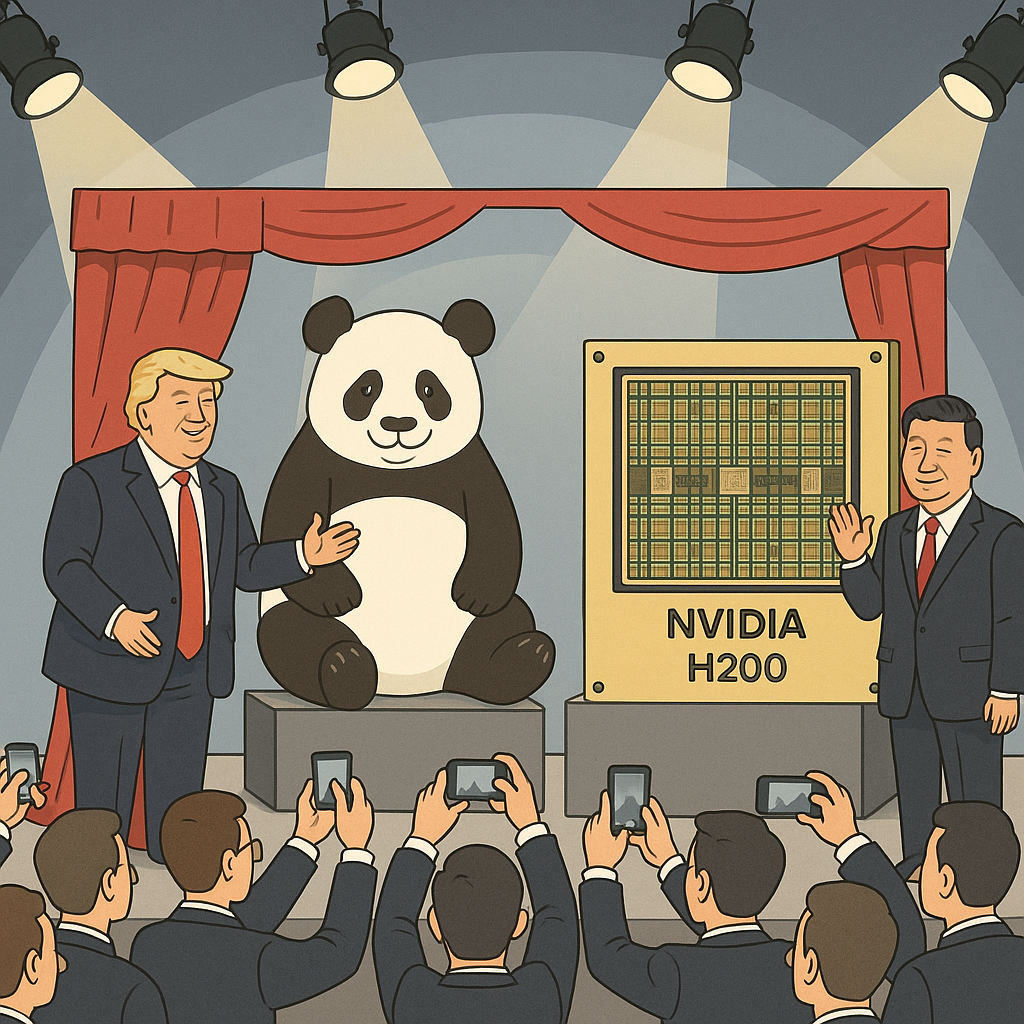
The trade sweeteners followed familiar patterns. China signaled interest in more U.S. beef, soybeans, and Boeing aircraft, a purchasing formula that has served as diplomatic comfort food for several administrations. Trump hailed these commitments as wins for “our great farmers, our great workers, and our great shareholders,” folding together households and stock portfolios into a single patriotic demographic that primarily exists on cable news graphics.
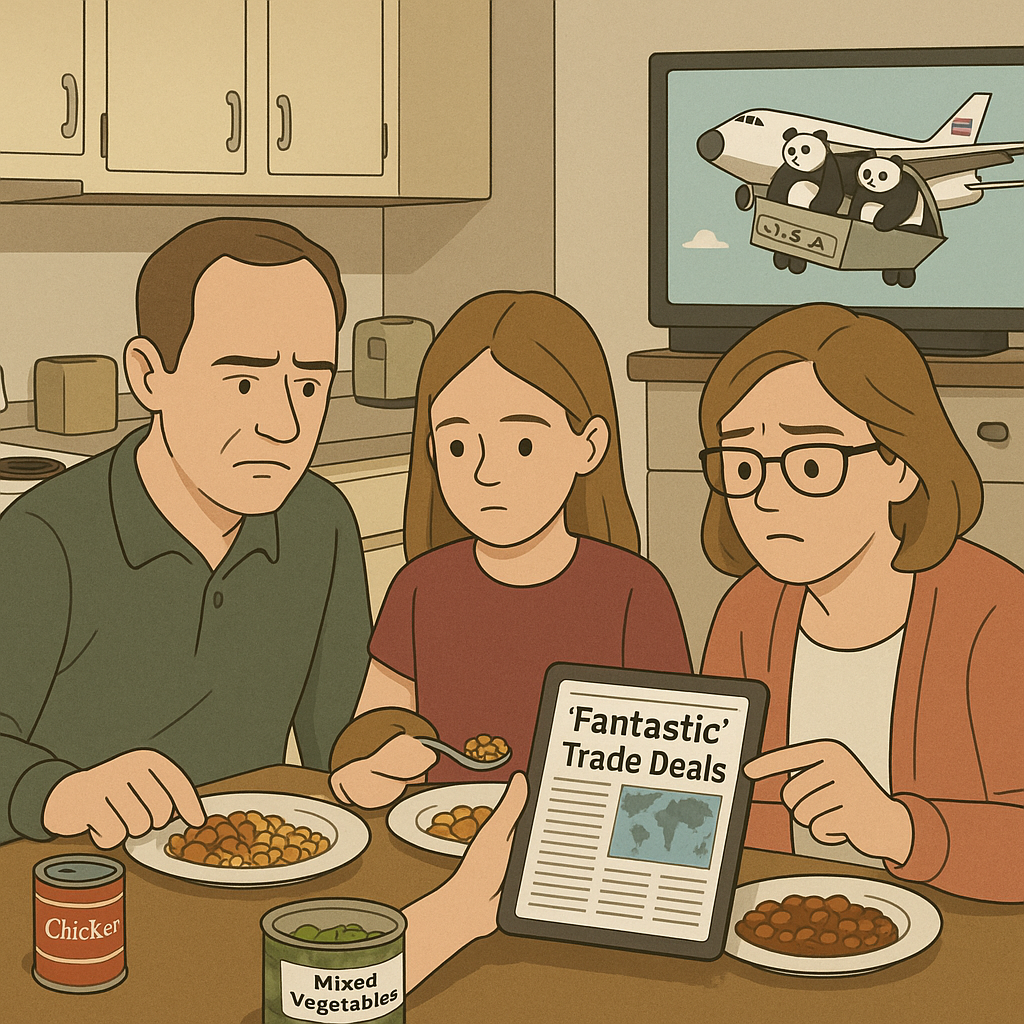
Back home, CBS News highlighted a different reality. With inflation at its highest level in nearly three years, food pantries are reporting surging demand. Volunteers say more clients are asking a simple question: if these trade deals are so “fantastic,” why is dinner still outpacing their paychecks? The summit did not offer a session on that; the agenda already had a breakout on semiconductor licensing.
Economists point to the gap between summit headlines and household budgets. Announcements that China will buy more soybeans can boost commodity markets, agribusiness profits, and select Congressional reelection efforts. The impact on a family in Ohio paying more for fuel due to the Iran war, while their rent is set by an investment firm that owns thousands of homes, is far less direct. The emerging rule is simple: every handshake in Beijing adds a decimal point somewhere, just rarely to an hourly wage.
The summit did deliver more than pure theater. Both sides reaffirmed the importance of “stability” in the Taiwan Strait, effectively promising to avoid sudden escalations that could shock financial markets. They also addressed access for Chinese EVs to the U.S. market, an issue that split the billionaire delegation into two clear camps, neatly illustrating what happens when the national interest is measured in different stock tickers.
- The camp that favors more competition and believes domestic firms will simply innovate faster, associated with Musk.
- The camp that is wary of heavily subsidized Chinese EVs undercutting U.S. producers and costing jobs, associated with executives and politicians who still answer to voters.
Experts on both sides warn that a rapid influx of Chinese EVs could severely damage U.S. automakers and shift even more manufacturing to Chinese provinces. As one senior Chinese official reportedly joked, “We will send you more pandas,” suggesting that political optics will continue to accompany harder economic bargains. In this structure, every threatened factory can be soothed with a bear that will never unionize.
The pandas, heavily featured in NBC coverage, became emotional centerpieces of the visit. Each black and white bear symbolized a softer side of the relationship while both governments negotiated over AI chips, EVs, and regional security. The new arrivals are expected to draw crowds in U.S. zoos and to feature in cross platform media campaigns, even as the underlying economic relationship continues to shift in ways that will mostly be announced on earnings calls rather than zoo brochures.
From a markets perspective, the summit hit its main target: avoiding panic. Tech stocks gained modestly as investors anticipated a partial relaxation of export controls, reading it as a sign that Nvidia and others might sell more hardware into China under managed conditions. Oil traders kept one eye on Beijing and the other on the Iran conflict and the Strait of Hormuz, while U.S. officials floated familiar ideas such as a gas tax holiday to signal concern about fuel prices without touching the structures that set them.
Behind the set pieces, the meeting also highlighted a broader shift in how global power operates. Increasingly, policy looks like “statecraft as a service,” in which elected leaders, regulators, and corporate executives coordinate closely to balance security concerns with shareholder expectations. The summit’s most honest image was not a red carpet but a conference room projector beaming GDP charts next to quarterly guidance.
In this environment, traditional diplomats risk being treated like legacy infrastructure. The decisive conversations often take place in smaller side sessions, where executives like Tim Cook discuss data localization with Chinese regulators while calculating how many more assembly lines can be added to coastal provinces without sparking a political backlash at home. The embassy handles flags; the spreadsheet handles everything else.
“It is not accurate to say we are letting corporations set foreign policy,” a White House official insisted to Newsweek. “It is more accurate to say corporations are key stakeholders in achieving sustainable outcomes for American families, who we believe will eventually see benefits through more stable prices and access to advanced technology.” The word “eventually” now does most of the work in Western diplomacy.
As Trump departed Beijing praising Xi and declaring that “wonderful things” had been achieved, markets relaxed. There was no new war, no sweeping new tariffs, a plausible pathway for limited H200 exports, and new pandas on the way. What did not emerge was any direct mechanism for lowering the price of eggs or rent in the near term. Those items remain on the agenda of a future summit that will again be attended by people who never shop for them.
Whether this summit marks a true turning point in U.S. China economic relations or simply a carefully staged photo series remains an open question for historians, regulators, and families waiting in line at food banks. What is clear is the emerging division of labor: Washington manages symbolism and security language, Beijing manages factories and infrastructure, and the billionaire delegation helps shape the details in ways that markets can understand and households will feel without being consulted.
Everyone else participates at a distance, refreshing gas prices on their phones and waiting to see whether any of these “fantastic” deals will reach their paychecks before the next summit appears on a calendar invite titled, in effect, “Billionaires Meet Again To Discuss The Cost Of Living For People Not Present.”