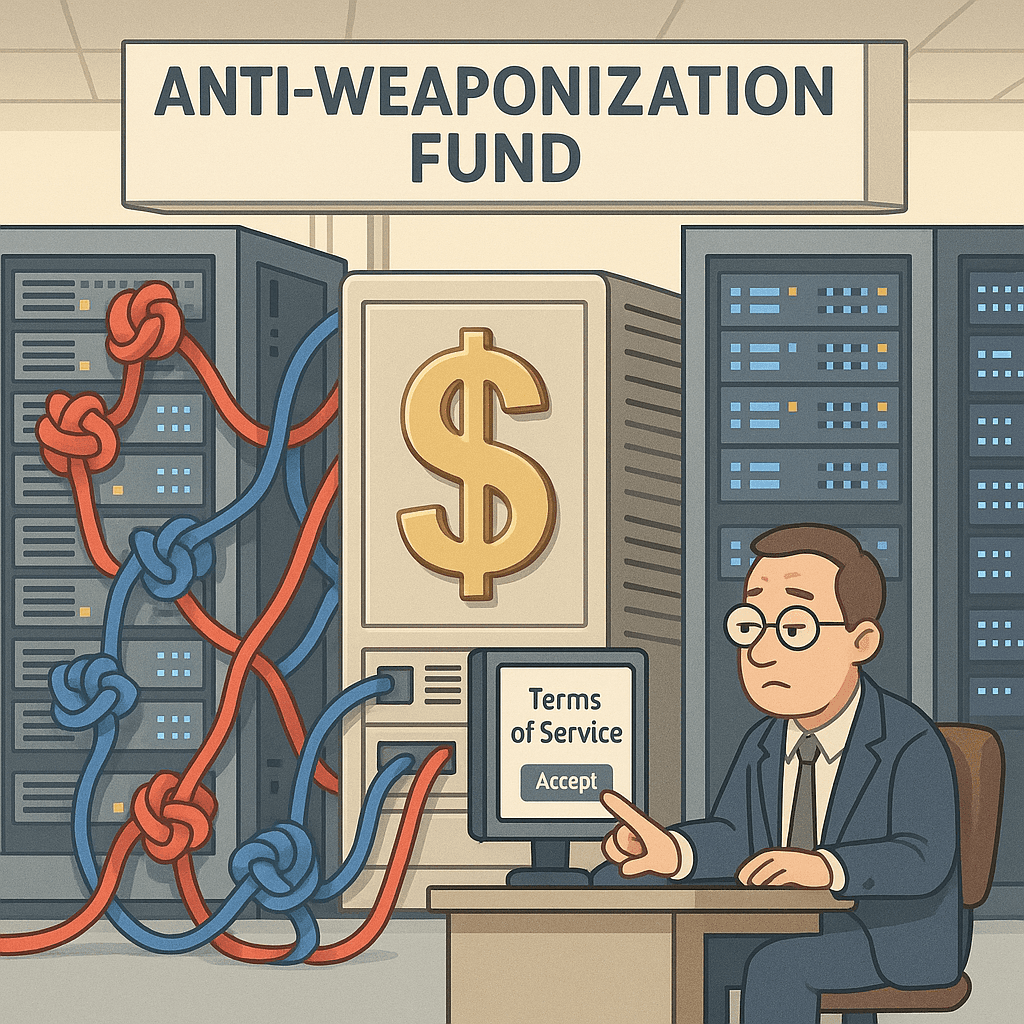
In a development experts called inevitable, Donald Trump has tried to turn his years of complaints about a “weaponized” government into a $1.8 billion software upgrade for grievance, complete with a brand name and color palette: the Anti-Weaponization Fund, in Pantone Shade Presidential Carmine.
According to coverage first stitched together by Newsweek and NBC, the fund is now temporarily blocked by a federal court, the Department of Justice has quietly said it will comply, and the president has begun publicly backing away from the idea with the energy of a man trying to uninstall an app he created but no longer remembers the password for.
Inside the administration, officials are reportedly pitching the fund like a cloud platform for retribution. One internal slide, obtained by people who have stared at too many internal slides in a windowless Eisenhower Executive Office Building conference room, describes it as:
- “A centralized, scalable solution for de-weaponizing weaponization,”
- “A 10x improvement in our ability to say ‘witch hunt’ but with line-item appropriations,” and
- “Not, technically, a slush fund, because that sounds wet.”
In public interviews, Trump has softened the branding, telling NBC that the administration is considering “different approaches” to the $1.8 billion concept. Translated out of politician-to-English, this means the lawyers have explained what separation of powers is, and everyone is now pretending the fund was always meant to be more of a vibe than a product, like Truth Social for appropriations.
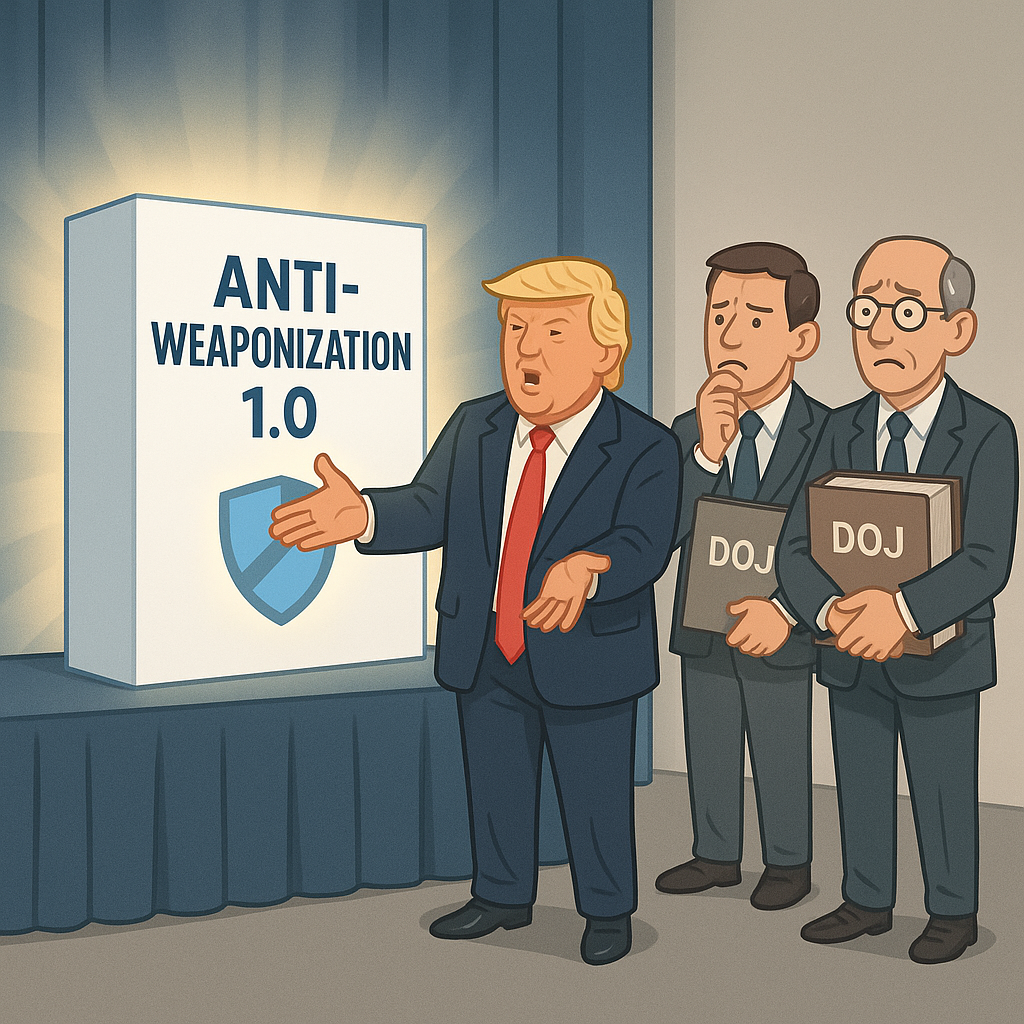
The federal court that issued the injunction has not yet clarified what, specifically, triggered the pause, though legal experts suspect it might be the part where the executive branch tried to ship a partisan war chest disguised as a civil liberties bundleware. DOJ, already busy appearing in stories about Iran talks and Israel–Hezbollah flare ups, announced it would fully comply with the order, then immediately went back to its primary job, which is existing at the center of every American argument simultaneously.
“We want to reassure the public that we are taking concerns about weaponization very seriously,” a fictional but emotionally accurate DOJ spokesperson told The Daily Shallot, shuffling three binders labeled “Oversight,” “Optics,” and “Other.” “Which is why we will continue doing exactly what we were already doing, but now with more memos.”
Confusion over what the Anti-Weaponization Fund actually funds has only deepened. Early drafts, described by one official as “half policy, half podcast description,” reportedly included line items for:
- New investigative units to detect and remediate anti-Trump bias in coffee shop bulletin boards and HOA Facebook groups,
- Legal defense grants for individuals who have ever tweeted the phrase “deep state” in earnest,
- A small pilot program to test whether the FBI is nicer if it is paid by subscription, and
- “Innovation Labs” where junior staffers A/B test which constitutional protections poll best with swing voters in Wisconsin.
“Think of it less as a fund and more as an API for outrage,” said one senior aide, who requested anonymity because he is technically in charge of the API for outrage and also the shared Jira board called “Revenge Backlog.”
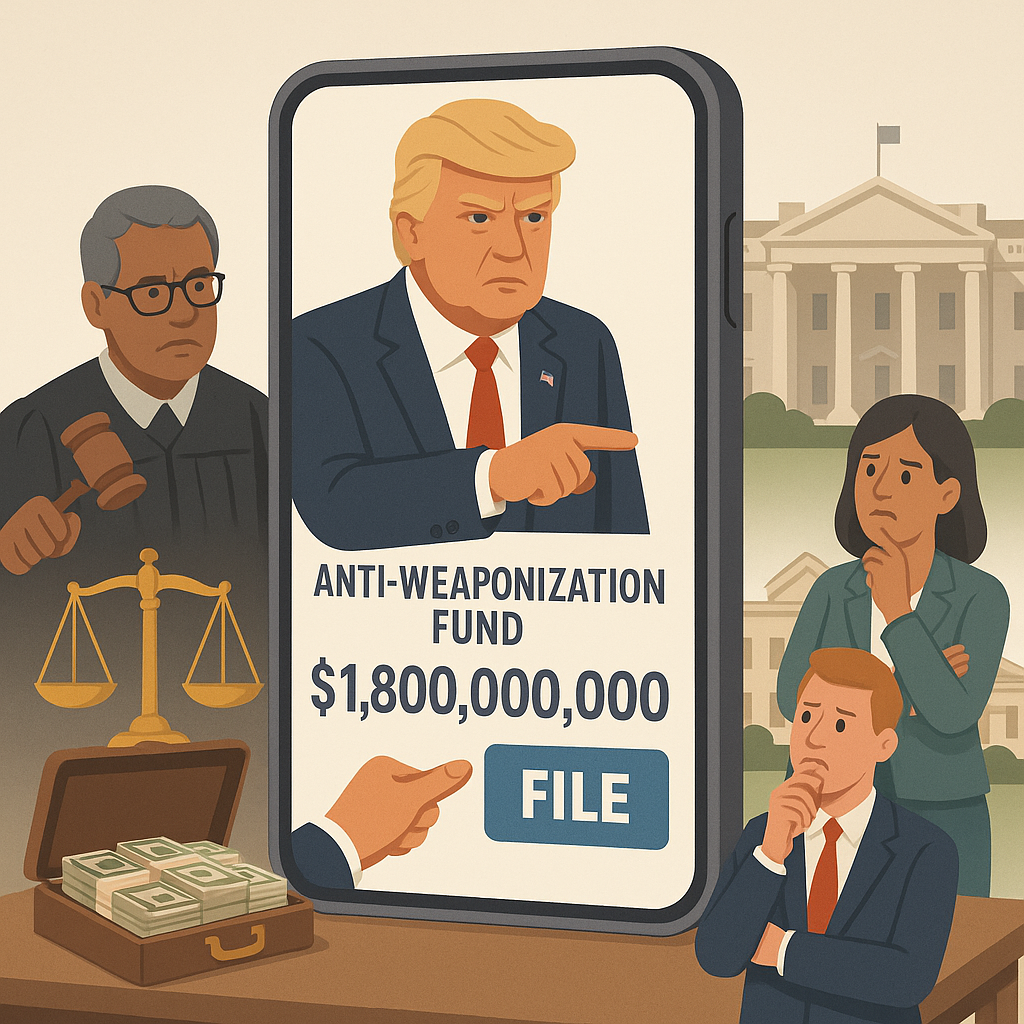
Republican lawmakers are split. Some see the Anti-Weaponization Fund as a necessary tool to fight a politicized state. Others see it as a terrifying precedent because, in four to eight years, Democrats might inherit the same giant red “Disburse Money To Allies” button.
“On the one hand, I love the idea of defunding my enemies,” said one GOP senator who insisted on being identified only as “not Susan Collins.” “On the other hand, I have met Democrats, and they can read.”
Democrats, meanwhile, are attempting to occupy the narrow moral high ground between “this fund is authoritarian” and “please ignore our own candidate sending explicit texts.” In Maine, Susan Collins is trailing Democrat Graham Platner in early polling, even as NBC reports that Platner is under scrutiny for messages that are, charitably, more personal than policy oriented.
The party line from national Democrats is that Trump’s Anti-Weaponization Fund is a grave threat to the rule of law, and also that everyone should allow space for “personal growth” when it comes to Graham Platner’s phone. Republicans have responded by asking whether the fund can be used to investigate why Democrats keep nominating plot twists with Wi Fi.
“Our caucus is unified,” said a hypothetical DNC strategist, staring at two open browser tabs titled “How to say morally serious” and “Maine polling crosstabs.” “We believe in institutions, accountability, and also in not talking about that story until after the election.”
The institutionalization effort is not limited to Washington. As California voters head to the polls to choose who will replace Gavin Newsom, every viable gubernatorial candidate has reportedly asked the same question: if the Anti-Weaponization Fund survives the courts, can some of it be converted into a discretionary grant program for creative interpretations of federal guidance?
“We are very excited about partnering with the Anti-Weaponization architecture,” said one California candidate, speaking at a rally sponsored by three venture firms and a kombucha brand that tastes like carbonated regret. “With the right public-private ecosystem, we can build a state-of-the-art de-weaponization hub in Sacramento that creates good-paying jobs in compliance theater, narrative operations, and verticalized scapegoat management.”

In a leaked pitch deck circulating among consultants, the fund is described as “a once-in-a-generation opportunity to create a durable platform for grievance that transcends any one presidency and can be white-labeled for future partisan uses.” The slide that follows is titled “Exit Scenarios” and simply lists:
- Struck down by courts, becomes proof courts are weaponized,
- Upheld by courts, becomes tool to prove courts are finally fair,
- Quietly repurposed into a bipartisan Commission To Study Feelings About Everything.
Media coverage has gamely tried to keep up, bundling the Anti-Weaponization Fund alongside footage of a North Carolina officer charged after repeatedly punching a woman, protests outside an immigration facility, and security scares on United flights. The resulting narrative package can best be summarized as: “Is the state too powerful, not powerful enough, or both, and can someone give us a graphic for that by 5 p.m.?”
From a systems perspective, the fund represents a classic Trump-era design pattern: identify a broad sense of institutional distrust, brand it as a product, and then attempt to wire it directly into the federal budget. What began as a slogan about a “weaponized” government is now a proposed line item that will require actual procurement processes, compliance checklists, and a help desk ticketing system staffed by people who list “rule of law” as a secondary responsibility after “responding to angry emails.”
“We have to move fast,” warned one Republican strategist, looking at a calendar filled with overlapping Iran updates, climate alerts, AI panics, and NBA Finals ticket price stories. “In this fragmented attention environment, there is a real risk voters will not notice we tried to rewrite how power works because they were watching a bear attack segment out of Japan on autoplay.”
Back at the White House, aides are reportedly exploring fallback options if the courts kill the fund outright. These include repurposing existing DOJ grants, creating a new executive order titled “Operation De-Weaponize Everything Except Me,” and simply announcing that the fund is thriving in an alternate legal reality and daring anyone to disprove it.
For now, the $1.8 billion Anti-Weaponization Fund sits in limbo: too politicized to implement cleanly, too useful as a talking point to abandon, and too on the nose to fit comfortably inside a civics textbook. The courts see it as a constitutional problem, the parties see it as a midterm messaging asset, and a sizable chunk of the public sees it, if at all, as something they half-heard between a segment on hantavirus and another one on why Gucci is betting on Formula 1.
If the story ends with the fund quietly dying in committee or in court, it will not prove that the system resisted politicization. It will simply confirm that in 2026, even weaponizing anti-weaponization has to clear the same bottleneck as everything else in American life.
No one knows who is in charge, but everyone agrees there is not enough bandwidth.