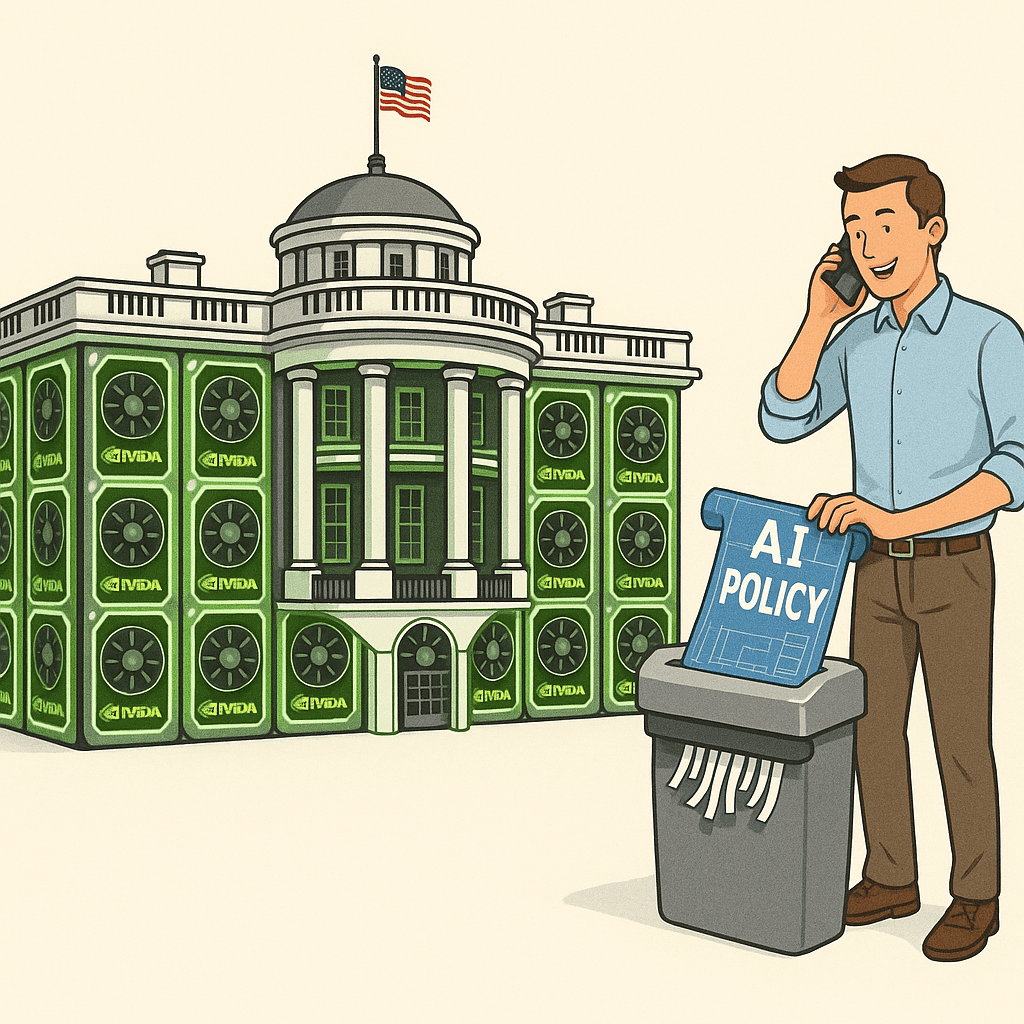
In a development experts called inevitable, America has decided that the correct response to Nvidia reporting $81.6 billion in revenue, up 85 percent year over year, is to dismantle what little AI oversight it almost, sort of, considered having and replace it with a presidential group chat.
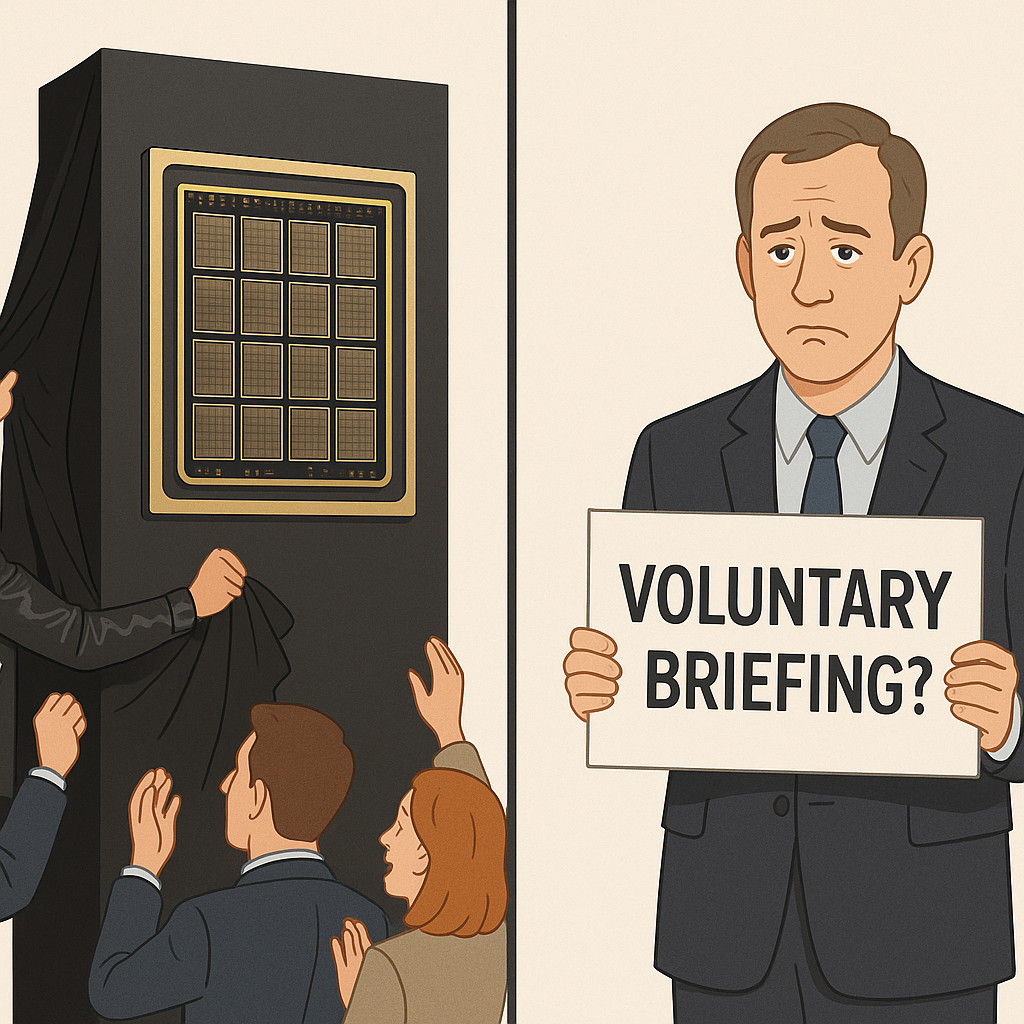
According to Axios, President Trump personally killed a draft executive order that would have asked AI companies to voluntarily preview their most powerful upcoming models with national security officials. Not regulate. Not slow down. Just give the Pentagon a heads up before shipping Skynet as a Service to anyone with a credit card and a Stripe integration.
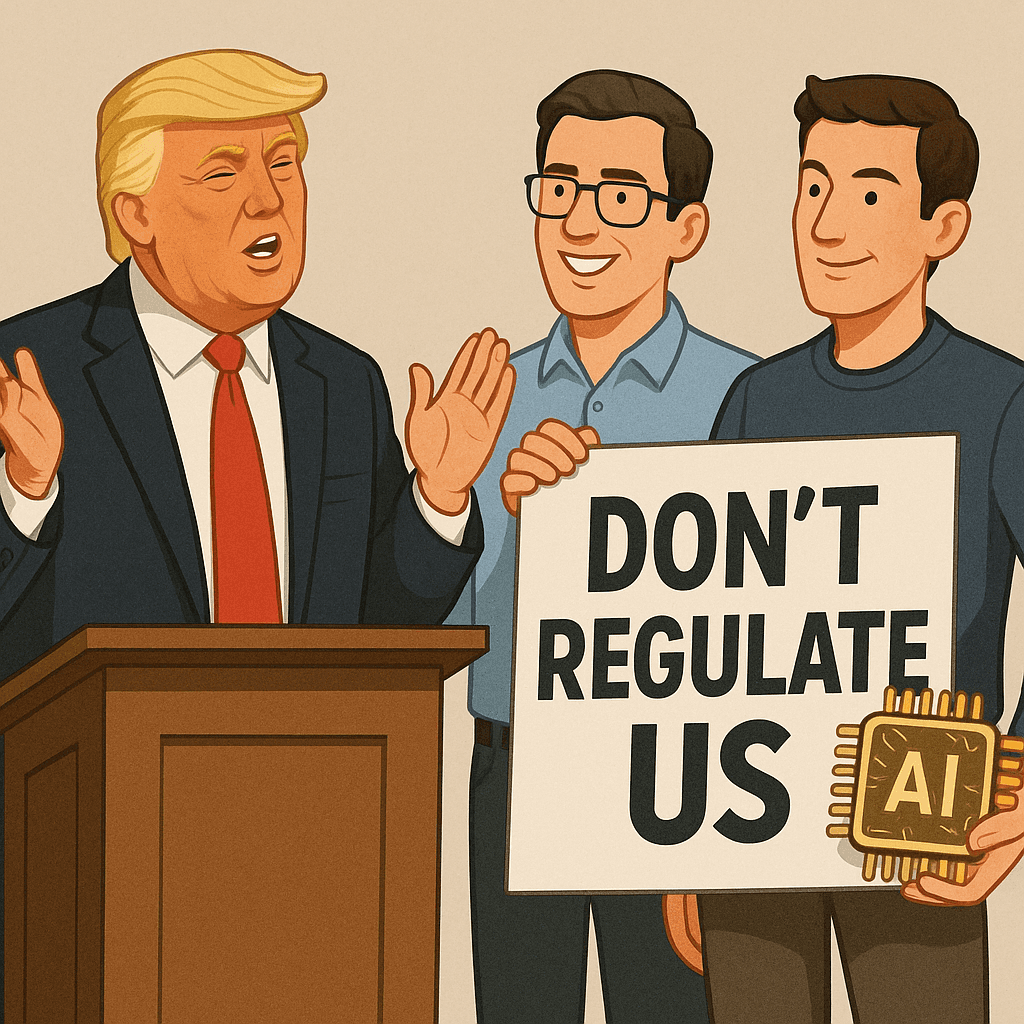
The plan died after Silicon Valley figures, with David Sacks described as "tip of the spear," revolted at the horror of a calendar invite with someone who does not have a venture fund. In the new process, no meeting is valid unless at least one person has a podcast studio in their guest house and a term sheet open in another tab.
Trump then spoke with Mark Zuckerberg, and the light touch order was quietly moved to a nice farm upstate where executive orders go to run free and never bother venture capitalists again. Somewhere on that farm, a neglected PDF titled "Draft AI Safeguards v4" is learning to forage for redlines.
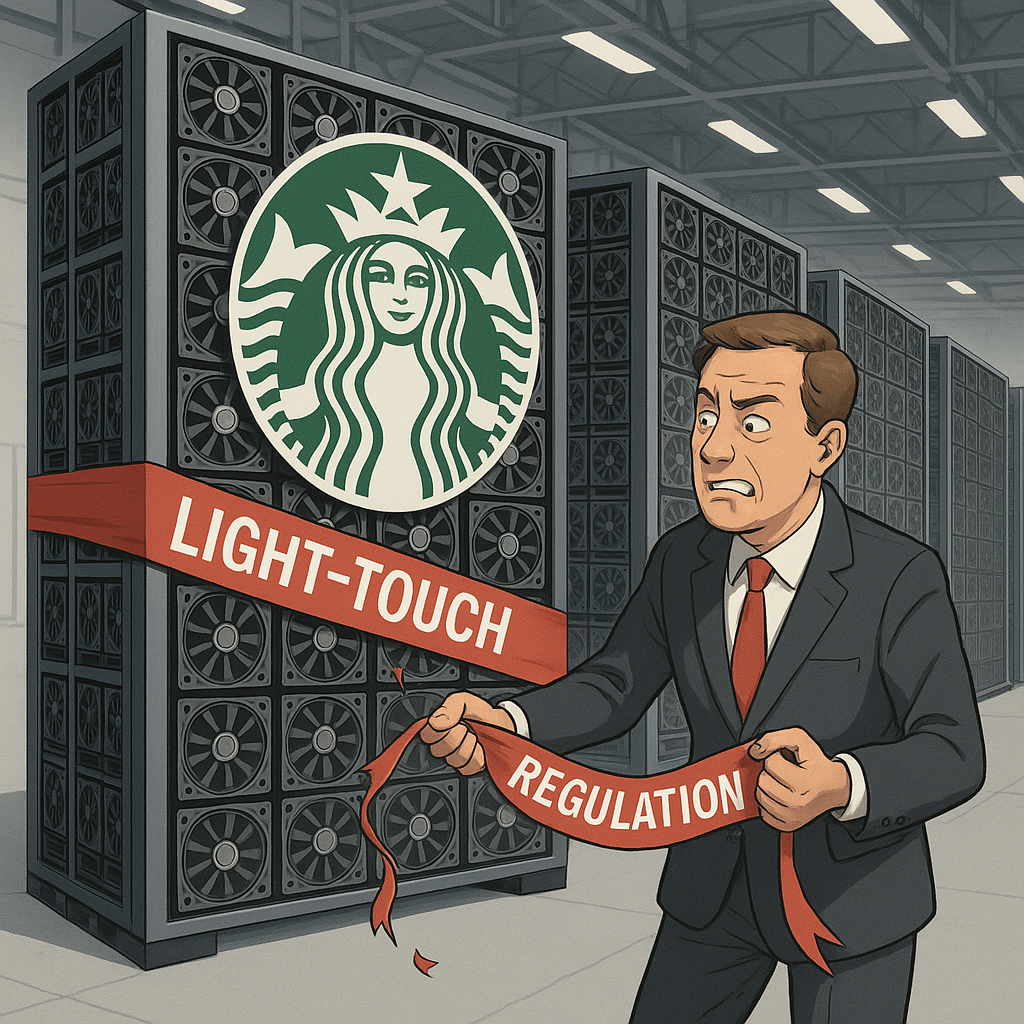
Nvidia, meanwhile, added $37 billion of revenue in a single year, which Axios helpfully notes is roughly Starbucks' entire global business. Jensen Huang calls the current buildout "the largest infrastructure expansion in human history," a phrase historically reserved for things like interstate highways and occasionally empires that later show up in history textbooks under the chapter titled "Causes of the Collapse." On quarterly earnings calls, he now sounds less like a chip designer and more like a quietly amused Roman aqueduct commissioner.
Across America, hyperscalers are erecting climate controlled GPU cathedrals faster than zoning boards can Google "transformer fire risk." Each building is a monument to the idea that if you stack enough H100s in a warehouse, you eventually emit prosperity, or at least a slightly better slide deck. You can walk through a humming server aisle in Ohio and hear the gentle whisper of investor decks promising an "AI powered paradigm for frictionless value extraction."
AI, we are told weekly, is "the economy." Somewhere in the middle of Iowa, a cornfield is being quietly renamed "Cloud Region 17" so that a cluster can bless it with 48 megawatts of monetizable latency. The local town council is still debating whether the structure counts as agriculture while a trench for fiber optic cable slices through what used to be a soybean field.
Regulation, however, is apparently a vibes based product line.
"We looked at the proposal to voluntarily brief national security officials and concluded it might introduce friction," said one hypothetical Silicon Valley policy thinker, speaking on condition of only ever being quoted in group chats. "Our founders need to move fast, break things, then ask the Pentagon to like and subscribe. If deterrence does not scale, our Series C definitely will."
In Brussels, regulators at the European Central Bank are reportedly summoning banks to explain the flaws in their AI models. They have binders, flowcharts, and a frightening respect for footnotes. In Washington, regulators are reportedly summoning DoorDash because someone left an AI powered scooter on the White House lawn again and nobody is sure which subcommittee has jurisdiction over sidewalk entropy.
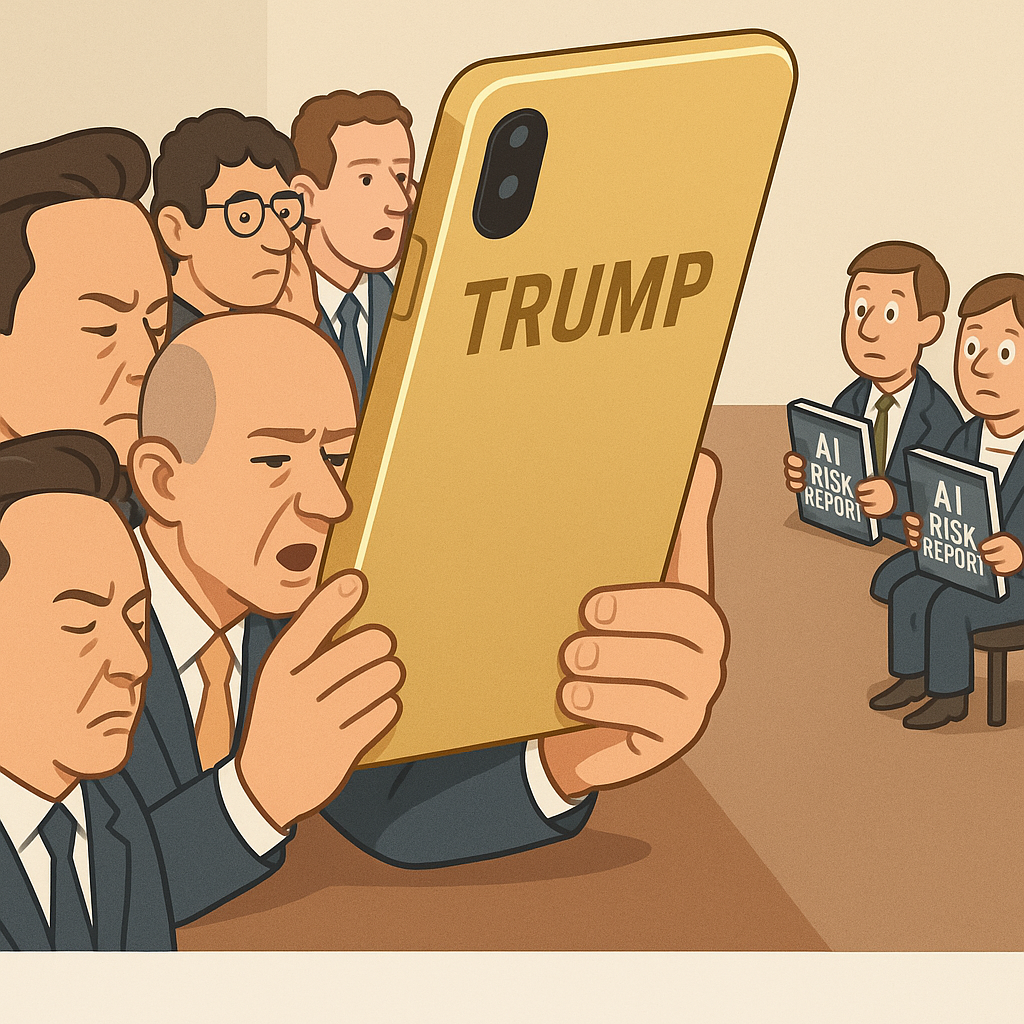
The emerging doctrine is clear: Nvidia builds the hardware, a small ring of AI labs and platforms builds the models, and U.S. policy is written by whoever can get Trump on the phone during his nightly Fox and Friends rewatch. On some evenings that is David Sacks, on others it is a donor explaining the difference between tokens and tokenized loyalty.
This is sometimes referred to as "flexible, innovation friendly governance," and other times as "listening to the last guy in the group text." The unofficial process document is a Notes app screenshot titled "AI POLICY FINAL 7" that lives on three donor phones and nowhere in the Federal Register. One version reportedly includes a bullet that reads "consider war" followed by a shrug emoji.
National security officials, Axios notes, had hoped for at least a voluntary pre brief of frontier models so they could evaluate catastrophic misuse risks, alignment failures, and whether the model could be tricked into building a homemade currency crisis. They will now receive something more modern: launch day blog posts, a hype video with a thumping synth soundtrack, and a slide that says "we take safety very seriously" in 36 point font.
"We will learn about new AI capabilities the same way everyone else does," said one fictionalized defense official, "by watching the demo where it accidentally blurts out nuclear targeting coordinates during the 'funny prompts' segment, right between the recipe suggestions and the Drake mashups."
On Wall Street, this arrangement is considered ideal. The Nvidia chart goes up, hyperscalers announce record capex, and any mention of AI risk is handled with the calming phrase "market will sort it out." That market currently consists of about four labs, one GPU vendor, and a rotating cast of billionaires who can crash policy with a phone call made from the back of a chauffeured SUV idling outside a Menlo Park steakhouse.
Investors describe this as "healthy competition." Healthy, because everyone is competing to see who can preorder more Nvidia racks before regulators realize they have accidentally nationalized the entire semiconductor supply chain through vibes. The only antitrust case study that matters now is the lead time on Blackwell shipments.
There is, however, a small long term risk. At the same moment that the "let 'em cook" faction is defining AI policy, polling from the New York Times and Siena shows Democrats at plus 17 net favorability on socialism, with 49 percent favorable and 22 percent unfavorable. Ninety three percent of respondents, meanwhile, have either not heard of or do not understand "abundance" as a concept, but are pretty sure it involves an app they cannot delete.
This sets up a simple two step timeline:
- 2026: Trump listens to the last guy in his ear and lets AI labs upload whatever they want into the global infrastructure, provided they can explain it in under five minutes on cable.
- 2032: An AOC style president, elected by a base that thinks "abundance" is a crypto scam they missed, discovers that Nvidia is the economy and asks whether you can nationalize a GPU cluster without rebooting half of Kansas.
By then, Nvidia's data centers will be so large they show up in NASA photos. Any attempt at retroactive regulation will start with a staffer opening an Excel file, scrolling past "Starbucks equivalent revenue, 2025," and quietly asking if the EU has a spare antitrust lawyer or perhaps an unused digital services directive they can copy paste.
In Europe, the ECB is calling banks in to fix AI induced "deficiencies." They use phrases like "model governance" and "stress scenarios" and mean all of them. In the U.S., deficiencies are addressed with a more modern tool: a statement from David Sacks on his podcast explaining that the real threat to national security is "Bureaucratic Overreach Over Hangouts Links." Somewhere between ad reads for mattress startups and seed rounds, Sacks is now effectively the joint chiefs of staff for calendar permissions.
Mark Zuckerberg, for his part, reportedly spoke to Trump shortly before or after the AI order was killed. Meta, which once pivoted to video and then to the metaverse, has now pivoted to a more reliable reality: direct dial in rights to federal technology policy. Sources close to the matter say the conversation was "productive," which in modern governance is a term of art meaning "the document is dead, do not email follow up." In place of a signed order, the parties have opted for a strong sense of mutual understanding and a shared belief in daily active users.
Inside Silicon Valley, the policy win is already being productized. One startup founder, recently back from a tour of Nvidia's supply chain, described the new environment in practical terms while standing in front of a whiteboard diagram labeled "Governance as a Service."
"We are seeing unprecedented freedom to deploy frontier AI," the founder said. "Our main constraint is Jensen's next shipment window and whether Trump's phone battery dies before David Sacks finishes explaining why voluntary oversight is Marxism and why the real safety protocol is shareholder alignment."
To critics who say this might not scale, the White House points to the success of the broader AI economy. Nvidia has essentially rebuilt Starbucks' annual revenue in one year. AI IPOs are queuing up. Banks are integrating generative models that European regulators already dislike. If anything goes wrong, someone will post a thread about it, maybe even with a tasteful infographic and a referral code.
The only group not fully onboard is the public, which is caught between Nvidia's "largest infrastructure expansion in human history" and a political class treating AI like an optional app store update. One side promises limitless abundance. The other has never heard of abundance but is increasingly curious about the part where you tax it, means test it, and maybe staple a jobs program to the side.
In the absence of binding rules, national security frameworks, or labor plans, the country has settled on a compromise: let Nvidia keep cooking until the kitchen catches fire, then form a bipartisan task force to ask who signed off on installing the stove. The task force will meet for eighteen months in a windowless conference room named after a former senator, then emerge with a recommendation to study the question further using a responsible innovation sandbox and a pilot program in one unlucky midwestern district.
At that point, everyone will agree on the culprit. It was the last person in the president's ear. No one will remember who owned the building, who poured the concrete, or why the national AI strategy is still stored as a shared Google Doc titled "Draft v3 final real."