In a development experts called inevitable, President Donald Trump’s high-stakes Beijing summit with Xi Jinping has quietly pivoted from a geopolitical reckoning over Taiwan, Iran, and tariffs to what sources described as “an on-prem strategy meeting for Earth’s remaining GPUs.”
Trump arrived in Beijing to an elaborate honor guard, a children’s choir, and what NBC News dutifully labeled a “pomp-filled” ceremony. Within hours, the pageantry was overshadowed by the arrival of the real VIP: Nvidia CEO Jensen Huang, who, according to The Washington Post, literally hitched a ride on Air Force One after not making the initial attendee list.
Officials insist the trip is about “serious issues” like the U.S. war in Iran, the security of Taiwan, and Trump’s demand for “totally reciprocal” trade. Markets, however, have already decided it is mainly about whether Jensen Huang and Elon Musk can keep their chip supply uninterrupted long enough to push SK Hynix across the trillion-dollar mark.
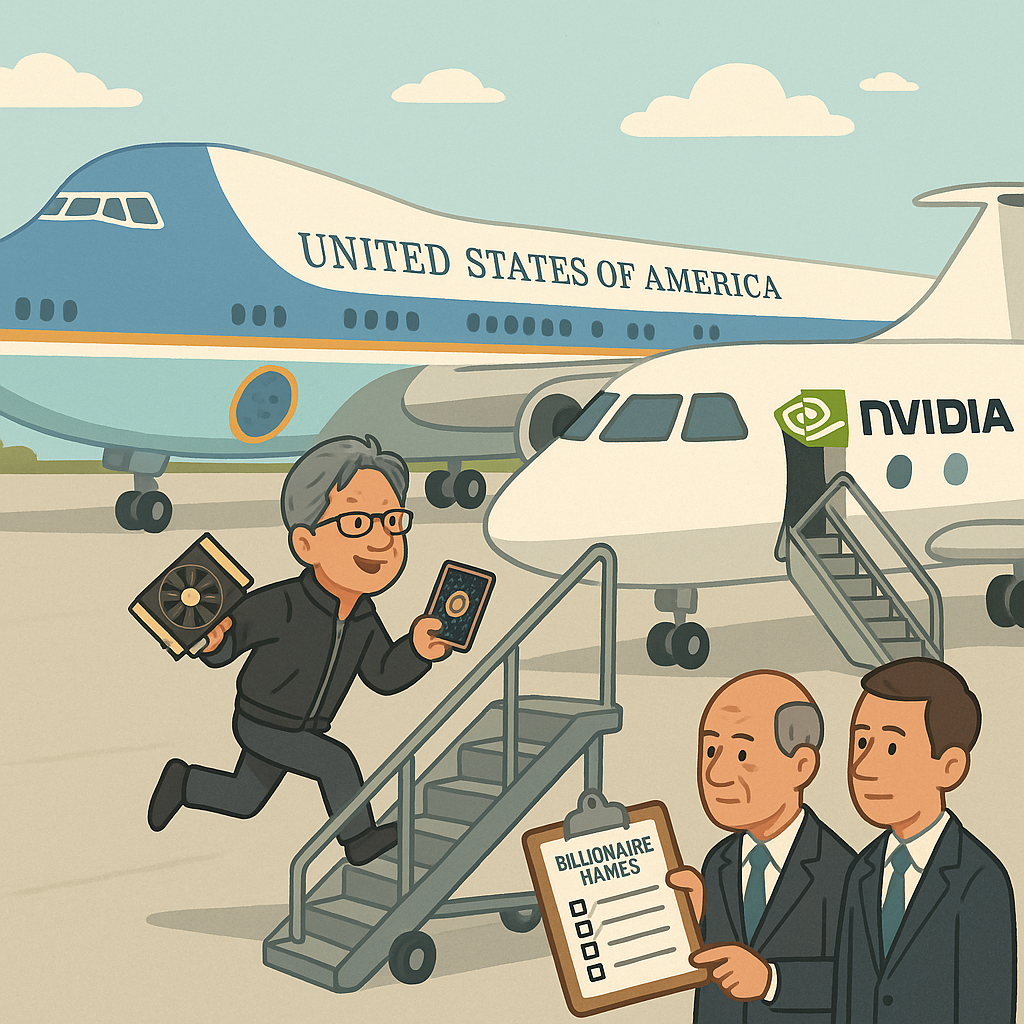
The American delegation reads less like a government and more like a panel at a monetization summit: Trump, Secretary of State Marco Rubio, Defense Secretary Pete Hegseth, Eric and Lara Trump, Elon Musk, and more than a dozen billionaire CEOs whose key expertise is not starting wars and not running countries.
One senior administration official, speaking on condition of anonymity because they are not on a single cap table, summarized the agenda.
“We have four pillars,” the official said. “Tariffs, Taiwan, Iran, and making sure Jensen does not move his data centers to a Cayman-flagged barge.”
Inside the Great Hall of the People, Xi Jinping opened with a carefully scripted call for the United States and China to be “partners, not rivals.” According to people in the room, Trump nodded solemnly, then turned to Huang and asked, “Is partner the one where we still get the really fast cards?”
Nvidia’s CEO reportedly replied by sliding a laminated flowchart across the table labeled “Global AI Strategy,” which consisted of three boxes:
- Box 1: China makes things.
- Box 2: We sell them to everyone.
- Box 3: Do not touch Box 1 or 2.
Reuters notes that Asian stock indices have been “turbocharged” by AI bets, with South Korea’s KOSPI and Taiwan’s TAIEX near record highs and SK Hynix up more than 1,000 percent since 2025. Analysts, speaking over the sound of confetti cannons at chipmaker earnings calls, warn that U.S. AI policy remains “incoherent,” a technical term for “We will sanction you, unless Jensen is in the room, in which case we will reconsider.”
In a joint photo op, Trump hailed the progress.
“Trade will be totally reciprocal,” Trump said, flanked by Xi and an increasingly nervous Musk. “We give them tariffs, they give us chips, we maybe forget some little things about Taiwan, very small, very island.”
Xi did not respond directly, instead repeating that the two powers should pursue “win-win cooperation” and showing Trump a slide titled “Consequences of mashing Taiwan and export controls into a single spreadsheet cell.” Interpreters report that this slide consisted entirely of energy price charts, a map of Middle East shipping lanes, and a small note reading “Please see: Iran war you started.”
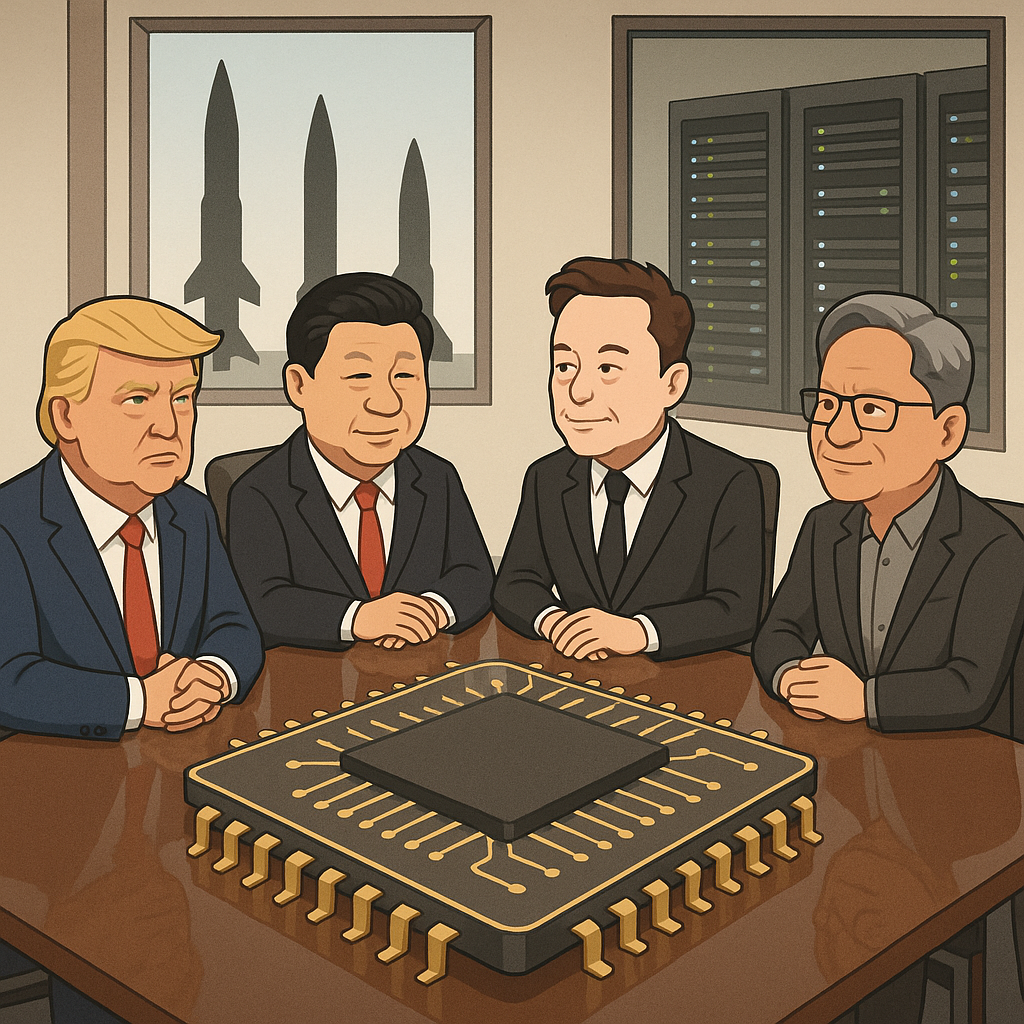
The war in Iran, which has disrupted global energy flows, is a major subtext of the talks. Chinese officials privately worry that the same administration that cannot pick a consistent GPU export rule might also forget who controls the Strait of Hormuz. U.S. officials, in turn, worry that a country holding trillions in Treasuries and most of the world’s battery factories might notice that worry.
Into this delicate balance strode Musk, whose role on the trip is described in internal memos as “Tech Executive / Situational Distraction.” Between sessions on semiconductor controls, the Tesla and X owner reportedly pitched Xi on a combined “peace tunnel and data center” beneath the Taiwan Strait that would “solve latency and war in one go.”
“It is like Boring Company, but for geopolitics,” Musk explained to assembled reporters. “We put GPUs every 50 meters, then no one can invade because the compute is too precious. Also, it would be great for Dogecoin.”
Chinese negotiators have asked for written details, mainly to confirm there is no scenario where Musk is allowed to manage a tunnel that close to their coastline.
Back in Washington, some lawmakers have raised questions about who is actually setting U.S. AI and China policy. A House staffer familiar with the Commerce Department’s export control process described current strategy as “whatever prevents Nvidia’s stock from dropping 3 percent intraday.”
“We were told to align national security with shareholder value,” the staffer said. “So we wrote a rule that bans GPUs by default, then auto-issues waivers if SK Hynix is up more than 4 percent at the open. It is very agile.”
Newsweek’s quick-hit bulletin summarized the stakes in 60 seconds: Trump in Beijing, Taiwan as flashpoint, U.S. war in Iran in the background. It did not mention that for most institutional investors, the real drama is whether this trip ends with a vaguely worded joint communique about “trusted and secure AI” or with a surprise product announcement titled “H200: Beijing Edition (Export-Control Compliant).”
According to leaked draft language, the emerging communique includes several key phrases.
- “Reciprocal access to semiconductors and related infrastructure, subject to mutually agreed national security exemptions and the availability of parking for Jensen’s leather jacket collection.”
- “Commitment to peaceful resolution of cross-Strait issues, provided no one moves a 3 nanometer fab closer to Taiwan without prior consultation.”
- “Shared understanding that any reference to ‘de-risking’ is purely decorative and not to be interpreted by markets literally.”
For Taiwan, whose own chipmakers are the quiet backbone of this entire performance, the summit is a reminder that its security guarantee now comes bundled with a hardware roadmap. Military support and foundry capacity are being discussed in the same breath, and occasionally in the same spreadsheet tab.
“We used to worry about missiles,” one Taiwanese official said. “Now our main concern is becoming a line item in some Q4 supply chain optimization deck.”
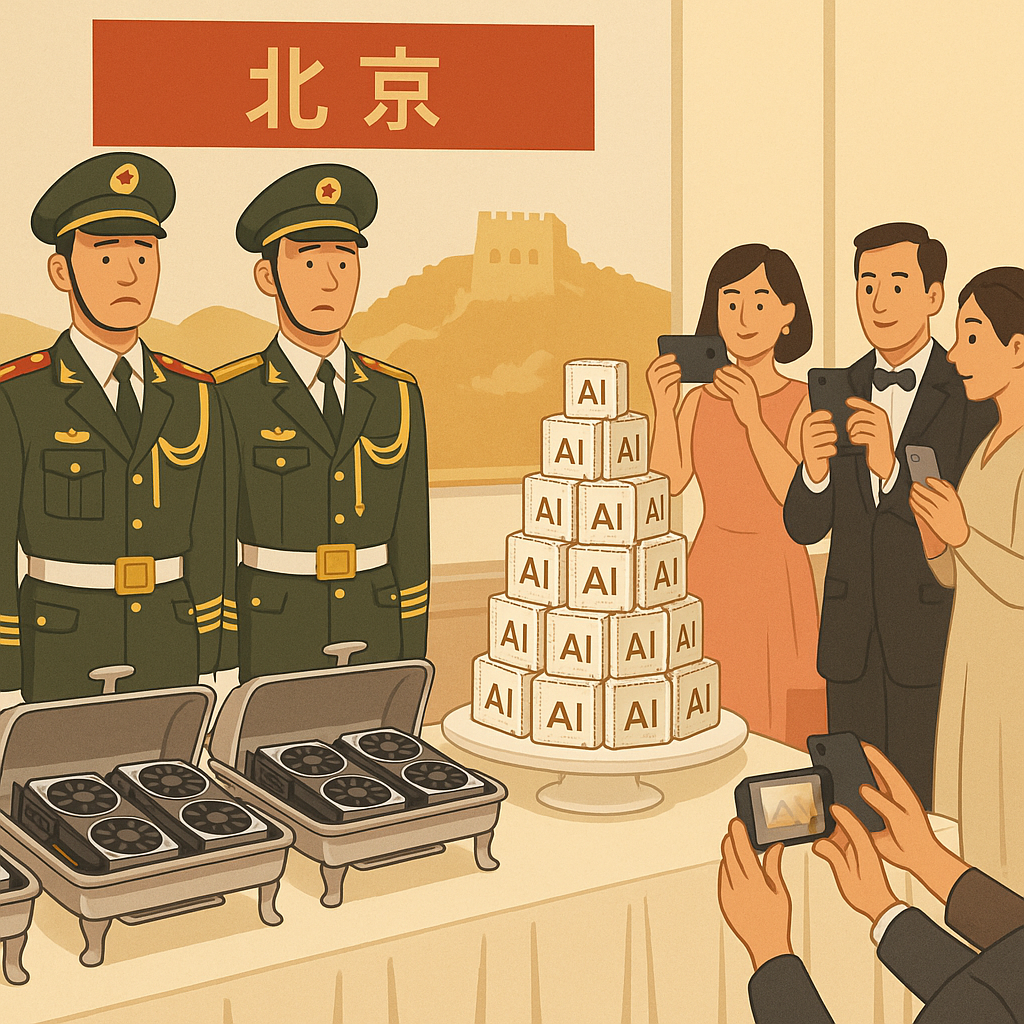
Investors remain optimistic. The AI rally across Asia has only accelerated as Trump and Xi shake hands in the Great Hall of the People, each man silently calculating how much domestic political damage can be offset by another quarter of record chip profits. Financial television anchors use the phrase “historic moment” interchangeably for both democracy and HBM3 memory yields.
Back on the ground in Beijing, the state banquet is serving as the final venue for quiet lobbying. Between courses, U.S. CEOs are reportedly rotating through Trump’s table like a speed-dating event for national policy, each pitching their preferred equilibrium between export rules and earnings guidance.
The only figure without a clear role is the honor guard, who spent the afternoon practicing rifle spins for cameras while the real negotiations took place in side rooms filled with spreadsheets and SEC lawyers.
As the summit enters its second day, one working assumption has finally reached bipartisan, bicameral, and bi-civilization consensus: whatever text emerges from Beijing, it will not be a coherent doctrine for AI or China. It will be a compatibility layer, written under duress, that lets Trump, Xi, Jensen Huang, Elon Musk, and a trillion dollars of chip rally each go home and announce that nothing important has changed.
The rest of the planet will receive the usual guidance: to continue routing basic questions about war, energy, and sovereignty through a handful of semiconductor firms and a stock market that mostly wants to know whether Iran is bullish for data centers.
The partnership is clear enough. Countries get to pretend they are in charge of strategy. The AI supply chain gets to be in charge of reality.