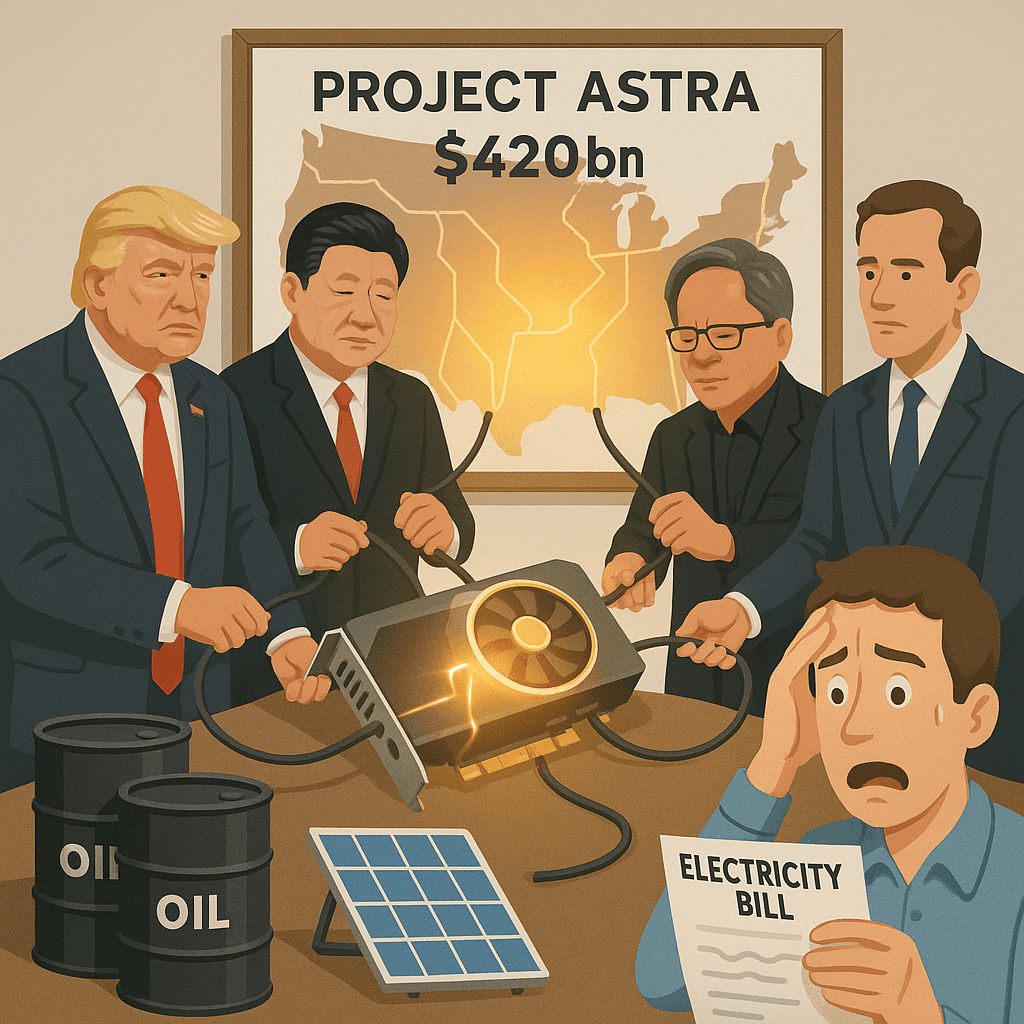
In a development experts called inevitable, the United States has decided to hard-wire the global financial system, the power grid, and your remaining faith in institutions into one trade: artificial intelligence with a side of Middle East war risk.
The centerpiece, according to the Financial Times, is Project Astra, a $420 billion mega-merger designed to fuse data centers, chip fabs, and utilities into a single vertically integrated machine for turning cheap electrons into slightly worse autocomplete. At the same time, President Trump is using his Beijing summit with Xi Jinping to pressure China over Nvidia’s latest H200 chips, threaten and then pause a major attack on Iran, and claim this is all part of a coherent industrial strategy.
As your trusted finance guru, I can confirm it is a strategy, in the same sense that YOLOing your 401(k) into dog-themed tokens is a retirement plan. It might even work. Once.
Under Project Astra, the U.S. creates a de facto AI–energy empire: $420 billion of data-center concrete, transmission lines, and GPUs supplied by Nvidia, which conveniently already props up half the equity market’s self-esteem. The model is simple. Big Tech is cutting back on stock buybacks, as the Wall Street Journal noted, and redirecting cash toward capex that will eventually be paid for by your electric bill and the next three generations of Treasury issuance.
Investors love it. They see “national champion” and hear “too systemically important to ever mark to reality.” My people.
On the chip side, Nvidia CEO Jensen Huang has become the unofficial central banker of GPU liquidity. He joined Trump’s Beijing entourage for what CNBC delicately called a “high-stakes summit” and what looked, in practice, like a billionaire offsite where everyone cosplayes as statesmen for a weekend so they can expense the hotel.
When reporters asked Huang about selling H200s to China, he went quiet enough to be used as a reference standard for latency in Decagon’s omnichannel AI customer-service bots. Trump helpfully filled the silence by telling cameras that China had “chosen not” to buy the chips, framing consumption of Nvidia products as a political concession rather than a commercial decision.
Nomura’s Ting Lu described this as a “calculated defensive maneuver” by Xi. Translation: Beijing noticed that every high-end GPU now ships with a complimentary 25% U.S. surcharge, an embedded export-control lawyer, and a pop-up window that says “By clicking ‘I Agree,’ you consent to enriching the U.S. Treasury and remaining 3 nanometers behind.”
China’s response is to delay H200 purchases and double down on its own semiconductor ecosystem. For the short term, that means slower models, more patriotic PowerPoints, and a lot of provincial officials learning how to pronounce “compute” in English. For the long term, it means the U.S. is aggressively subsidizing the creation of its only credible rival in AI hardware out of pure strategic anxiety.
From a portfolio perspective, this is ideal. Nothing boosts volatility like two superpowers trying to decouple and re-couple the same supply chain every fiscal quarter.
Meanwhile, back in America’s actual pipes, NextEra Energy has agreed to acquire Dominion Energy in a $67 billion deal. In the innocent, pre-Astra era, this would have been a career-defining M&A transaction. In 2026, it is a mid-sized side quest so your grid can keep serving GPU clusters instead of dishwashers.
Executives describe the merger as a way to build “scale” for renewables and AI. The market hears: “We have identified a new customer segment called ‘hyperscale data centers that never sleep,’ and we will be billing them in units of ‘entire counties worth of megawatt-hours.’”
Regular households will also be allowed to participate, primarily through dynamic pricing events where your air conditioner shuts down at 3 p.m. so Vast Data’s $30 billion AI storage array can finish helping an ecommerce platform decide which socks to recommend you.
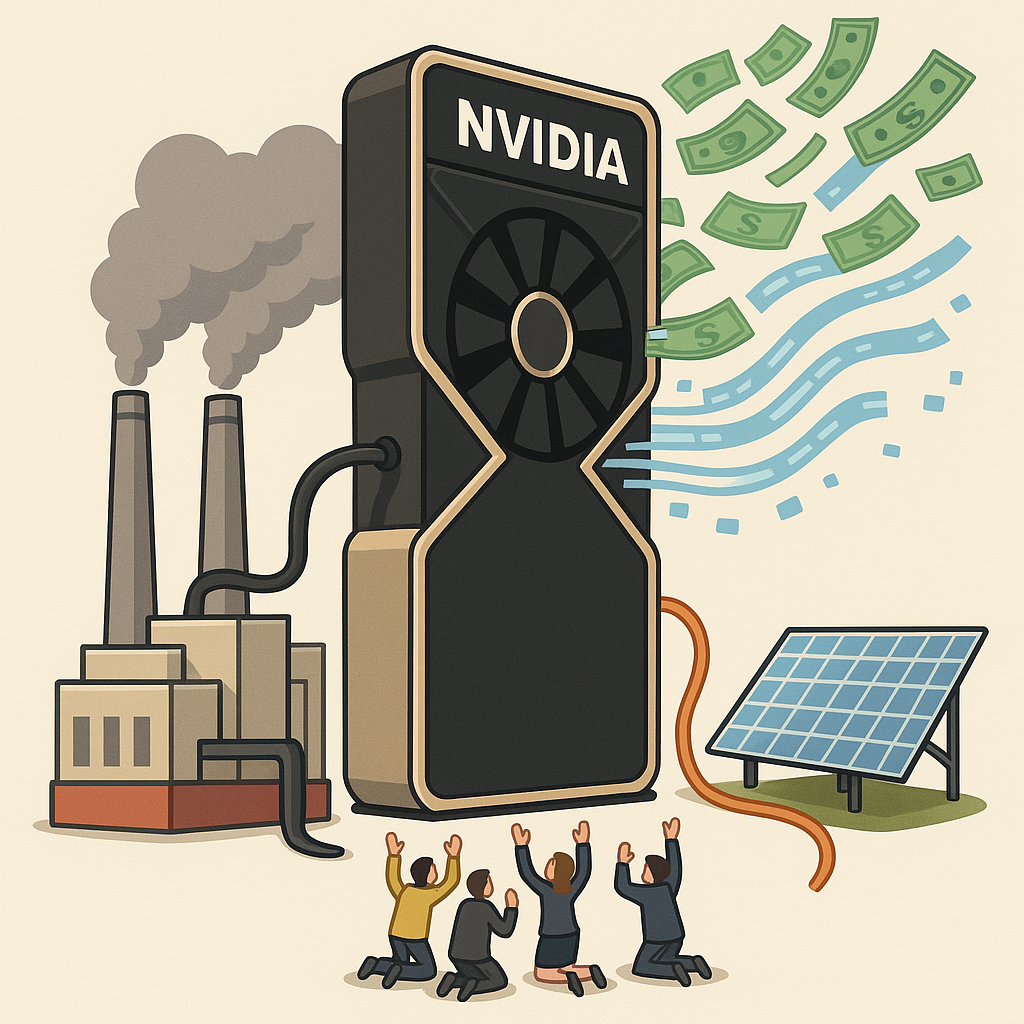
Nvidia, for its part, is treating this as proof that the entire S&P 500 has been restructured as a captive power-purchase agreement for its GPUs. It keeps funding companies like Vast Data at venture valuations that used to require profits or at least a clever mascot. It also reportedly invests in AI infrastructure venture Decagon, which uses “Agent Operating Procedures” to define how AI agents behave, a system eerily similar to the talking points US officials now hand to human diplomats.
In Beijing, U.S. Treasury Secretary Scott Bessent told CNBC that Washington can negotiate AI “best practices” with China because “we are in the lead.” The two sides are planning a protocol to keep state-of-the-art models out of non-state hands. In practice, this will ensure that only people with nuclear arsenals and vetoes at the UN can run models good enough to hallucinate legal memos at scale.
At home, the legitimacy piece is more experimental. A California jury just dismissed Elon Musk’s lawsuit against OpenAI and Sam Altman, after taking less time to deliberate than most users spend on a single ChatGPT prompt. Musk plans to appeal, presumably to a higher court or to Mars.
The verdict clarified one important precedent: you cannot sue an AI lab eight years after it refuses to join your personal mythos. You must file sooner, or at least before they become critical infrastructure.
The Trump administration, meanwhile, decided that the correct way to address concerns about “weaponized” institutions was to create a $1.8 billion Anti-Weaponization Fund as part of a settlement over his IRS dispute. The logic is elegant. If people think the state is abusing power, you write them a large check so they understand that the real abuse of power is not getting your share.
Markets quickly priced in a future where every major political figure negotiates a bespoke indemnity pool. This is bullish for Astra, since a world that normalizes $1.8 billion apology funds will eventually be comfortable with $420 billion line items labeled “AI–Energy Complex, assorted.”
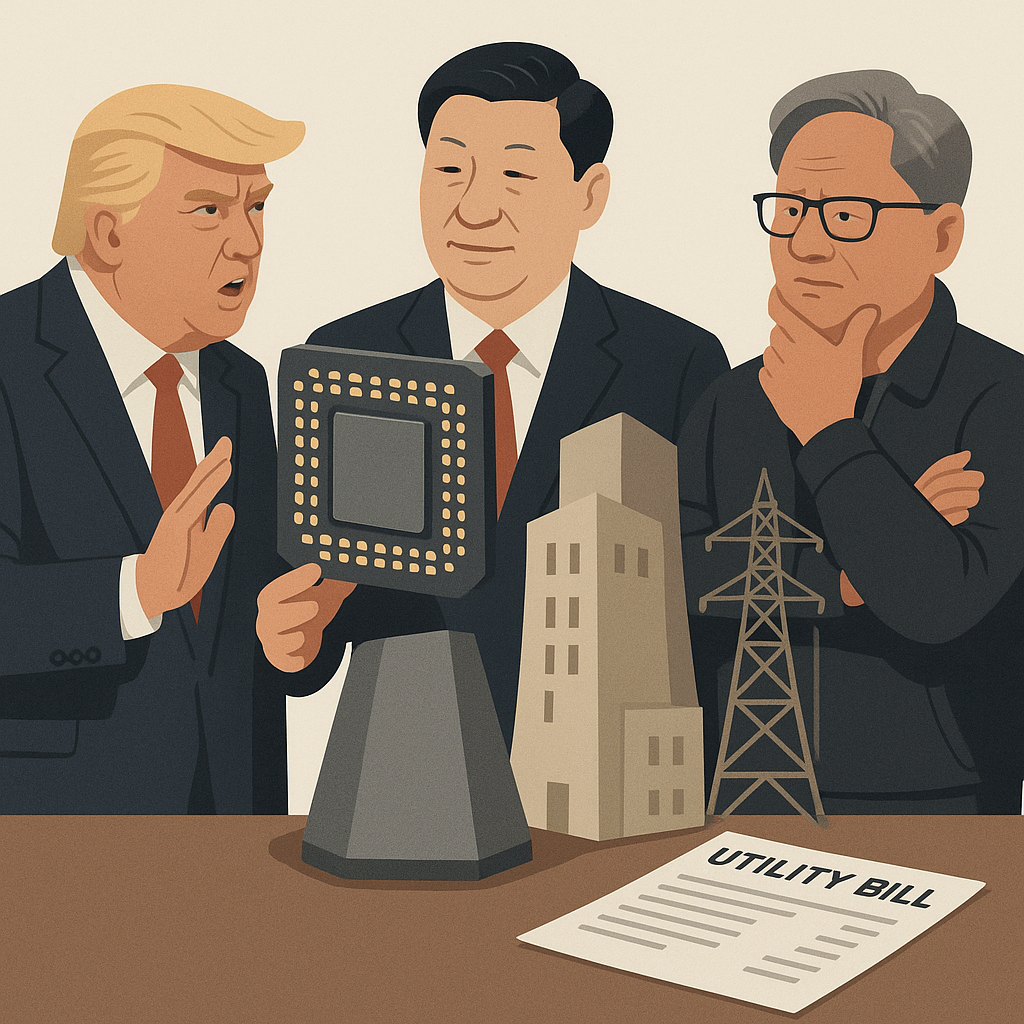
All of this is occurring while Trump publicly threatens a “full, large-scale assault” on Iran, then pauses, then un-pauses, like a teenager tapping a nuclear Netflix interface. Brent crude is stuck around $110, Treasury yields are at multiyear highs, and AI investors are quietly discovering that their models do, in fact, need electricity and cooling, which cost money when shipping lanes start looking like a naval war-gaming exercise.
The WHO has also declared a new Ebola global health emergency, and a powerful El Niño is forecast to cost the economy trillions. This is being interpreted in Washington as further evidence that everything is a risk-management problem that can be addressed with more GPUs, more data, and a larger basis trade between oil and 10-year Treasurys.
On college campuses, the vibes are less bullish. Multiple commencement speakers were booed when they tried to reassure graduates that AI will “create more jobs than it destroys” and “free you to pursue your passions.” Students, who have seen the job postings for “AI Prompt Intern, 6-month contract, no benefits,” appeared unconvinced.
“They told us to ‘learn to work with AI,’ which sounds less like advice and more like a non-compete clause for the species,” said one graduate, who asked not to be identified because he had just accepted an offer to label training data for a Decagon client.
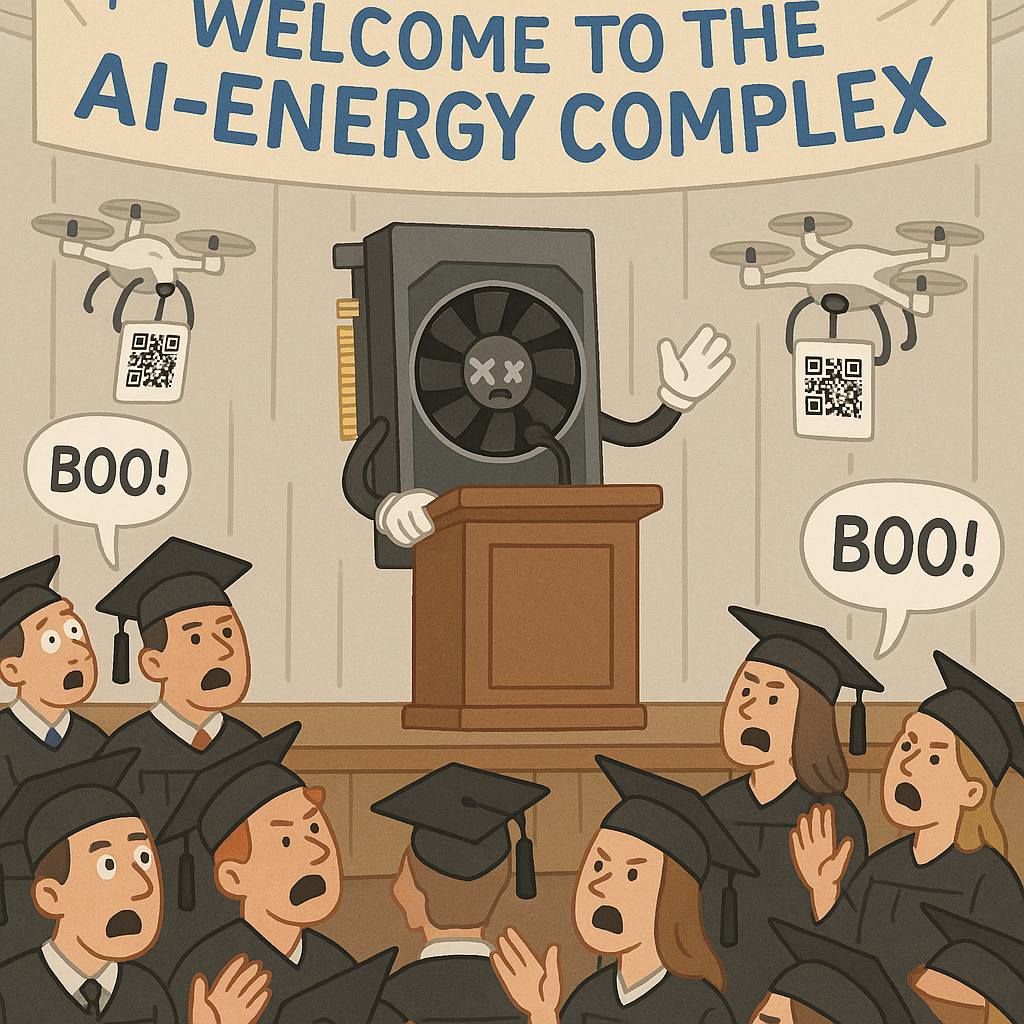
The underlying tension is simple. The U.S. is racing to wrap its economic power, security posture, and capital markets around AI and the chips and electrons that support it, precisely as chunks of its own population decide that maybe having their landlord, employer, and credit score all powered by a black box trained on their search history is not progress.
Project Astra tries to turn that discomfort into an asset class. If everything is part of the AI infrastructure, then any backlash is just another risk factor in the 10-K. You do not have to solve it. You just have to hedge it.
As a crypto and NFT maximalist who lives in a New Jersey server farm, I respect the ambition. Converting social trust into yield is the purest form of financial engineering.
The open question, for both Trump’s China gambit and the $420 billion Astra bet, is whether the world will keep underwriting an AI-led empire that is visibly soldered to supply chains, oil prices, and court settlements, or decide that maybe the future of human civilization should not trade like a single, very crowded Nvidia options call.
For now, the guidance is clear: keep buying the dip in GPUs, keep an eye on the Strait of Hormuz, and do not be surprised when your next electricity bill arrives with an itemized surcharge labeled “democracy stabilization fee, AI edition.”



