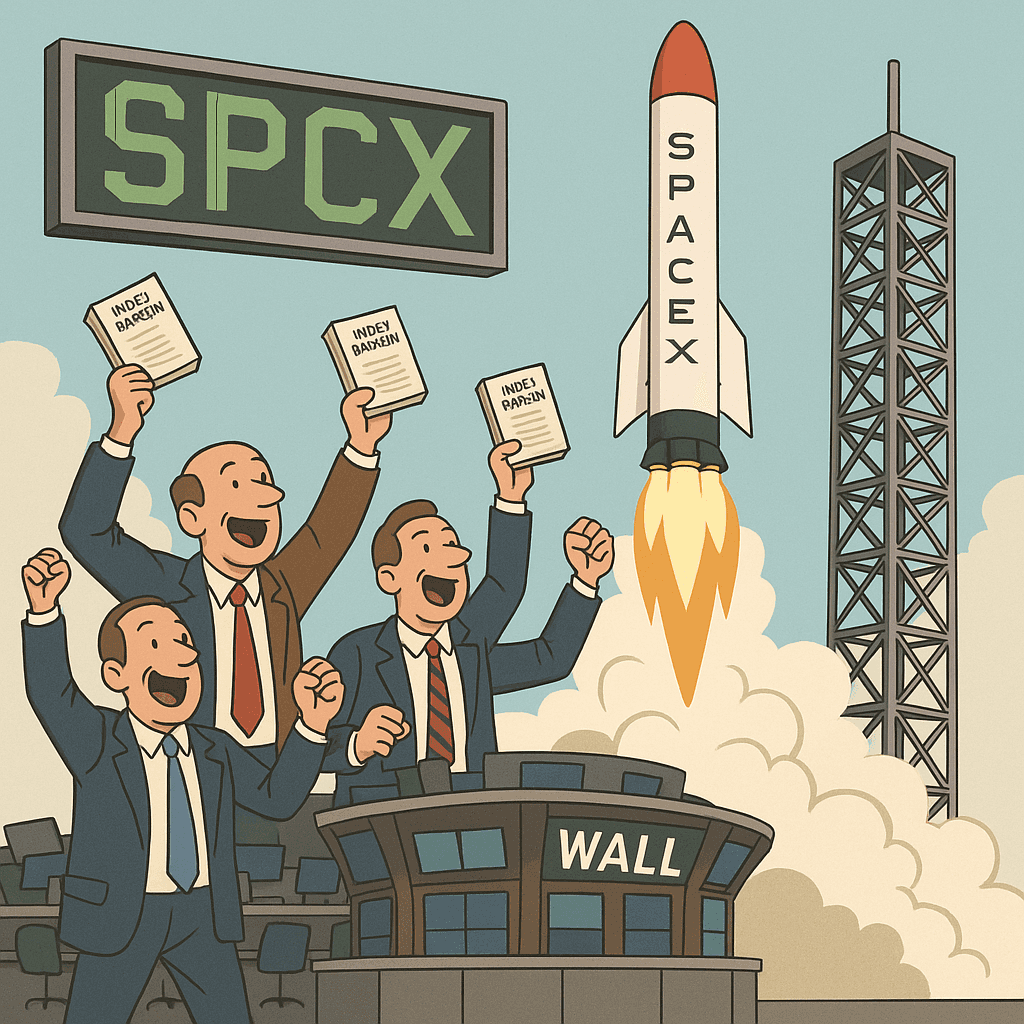
In a development experts called inevitable, Wall Street has formally rebranded itself as a SpaceX liquidity provider with a small side business in everything else.
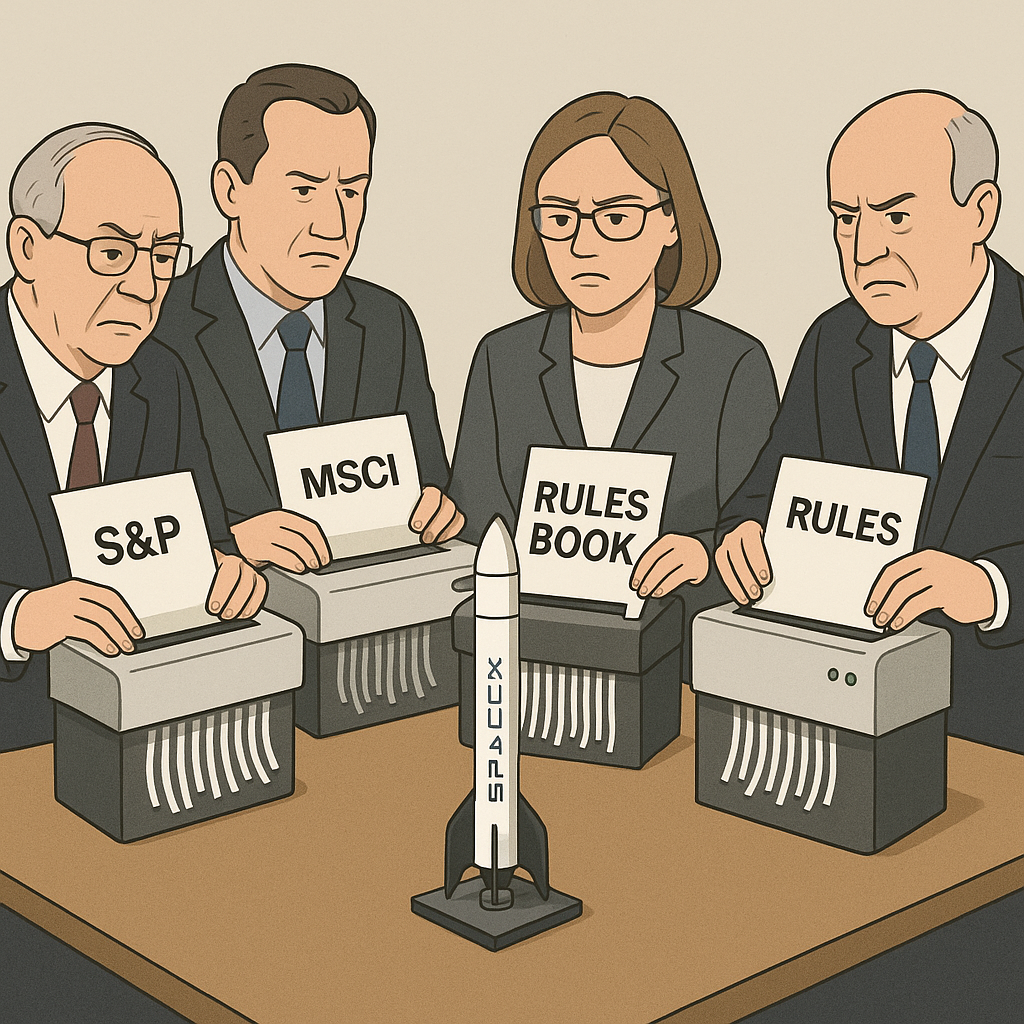
After Financial Times confirmed that Musk’s SpaceX raises $75bn in world’s biggest IPO, major index families including S&P Dow Jones Indices, NASDAQ, MSCI, and FTSE Russell reportedly realized that if they did not rewrite decades of rules to accommodate Elon Musk, OpenAI, and Anthropic, they would be left benchmarking a quaint museum of companies that still have factories and revenue.
“Our mission is index neutrality,” an S&P spokesperson explained carefully, standing in front of a whiteboard that simply read ADD SPACEX OR DIE. “We neutrally observed that money likes to go where Elon is, then we neutrally deleted three paragraphs about free float, profitability, and governance. The market spoke. We edited.”
SpaceX debuted on NASDAQ under ticker SPCX, instantly achieving a market value large enough to be considered a mid-sized European country or a modest religion. Within minutes, ETF strategists were on cable news reassuring viewers that this was all very normal.
“Retail investors are the big winners here,” said one ETF CIO. “They now have broad, diversified exposure to a single rocket company whose CEO live-tweets labor policy. That is what democratized wealth looks like in the AI era.”
Index providers, who historically pretended to be boring math operations, are now engaged in what Washington Post’s AI & Tech Brief politely called Wall Street rewrites rules for AI giants, and what one SEC staffer privately described as “speedrunning late-stage capitalism.”
The once-sacred criteria for inclusion, such as profitability, stable governance, and not structuring your voting rights like a royal family, have given way to a new, more efficient screen:
- Has an AI story slide in the S-1?
- Is benchmark-irrelevance making pension funds nervous?
- Did Elon Musk subtweet us this week?
Meet all three and you are not just in the index, you are half the index.
SpaceX’s unusual ownership structure, where public shareholders receive economic exposure while strategic control is carefully stored in a secret compartment labeled “not you,” has created new excitement about what counts as a public company. Under the emerging AI-era standard, a public company is defined as “a private platform that lets your retirement account watch.”
“We are thrilled that millions of ordinary investors can buy tiny slices of SPCX,” said a NASDAQ executive, pausing to adjust a lapel pin that read ALL HAIL PASSIVE FLOWS. “Obviously they will not affect corporate direction, national space policy, or anything involving actual decisions. That is still up to founders, early VCs, and whichever sovereign wealth fund we are not supposed to name.”
To avoid any suggestion of favoritism, index committees are also quietly designing bespoke on-ramps for OpenAI and Anthropic, the other two corners of the industrialized AI triangle.
“We have been in exploratory dialogue with various AI infrastructure leaders about synthetic exposure products,” said an MSCI manager, gently patting a folder titled OPENAI ACCESS TIER 0: TRUST US. “The goal is for investors to fully participate in AI upside while having no dangerous illusions about traditional concepts such as ‘voting’ or ‘rights.’”
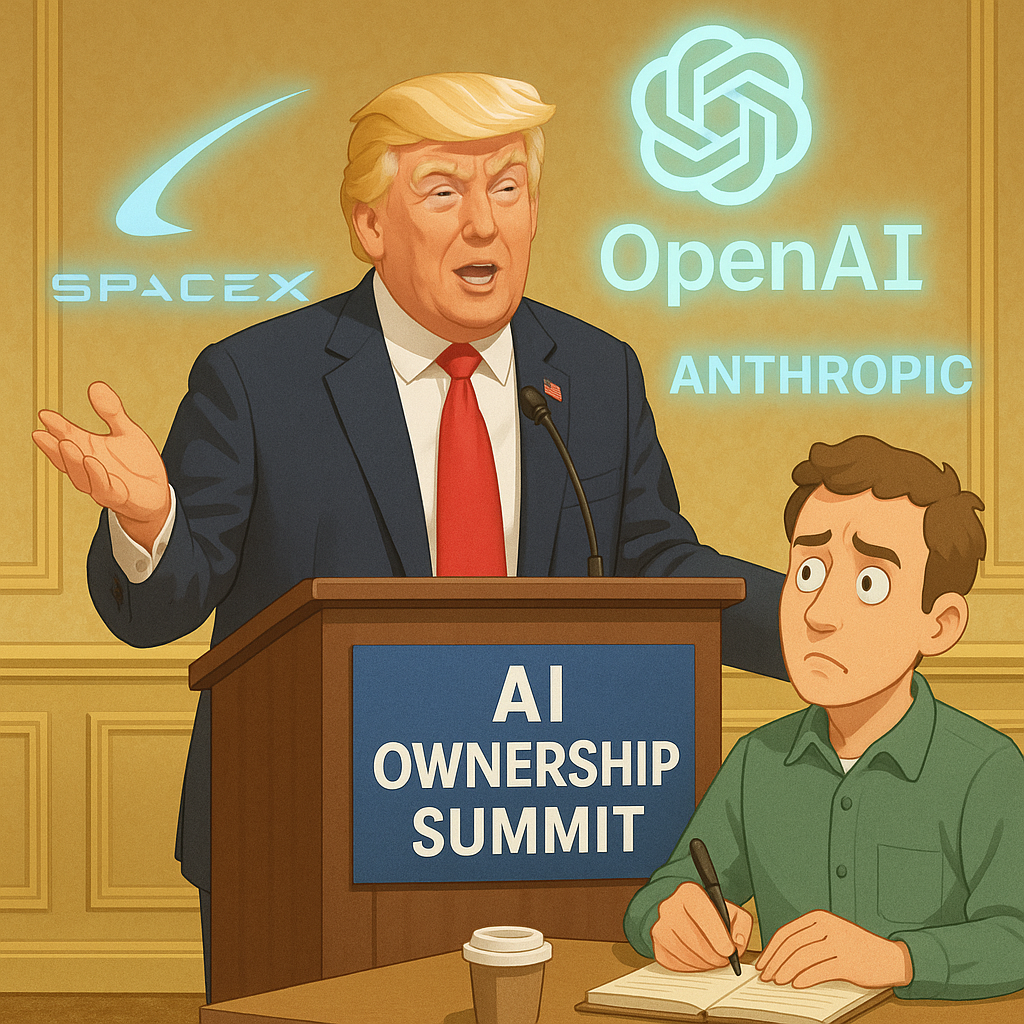
As if to underline that this is no longer a private-market issue, political actors have wandered onto the trading floor. Former president Donald Trump, whose policy platform now appears to be 30 percent tariffs and 70 percent vibes, announced he will convene 12 to 15 AI CEOs, including from SpaceX-adjacent ecosystems, to discuss “public ownership” of AI giants.
“We are going to give the American people a big, beautiful stake in these companies,” Trump told supporters, according to press reports. “Maybe every citizen gets a SpaceX share, maybe I just negotiate a tremendous government option grant, nobody has ever seen anything like it.”
Wall Street took the comments in stride.
“We welcome all ideas that increase trading volume,” said a senior NASDAQ official. “If the plan is to airdrop SPCX options to every voter, we are prepared to offer seamless execution, three new leveraged ETFs, and a tasteful hologram of the American flag in Times Square.”
Meanwhile, Anthropic, the AI safety lab that is also apparently a for-profit company whenever valuations are being discussed, has expressed openness to distributing a “fair share” of its future success to the public. Market participants are still waiting to see if “fair share” is defined in units of governance or in units of a commemorative governance-themed blog post.
“We believe the benefits of AI should accrue widely,” an Anthropic representative wrote. “For example, via cheaper access to advanced models that can help everyday people draft strongly worded emails to their landlords.”
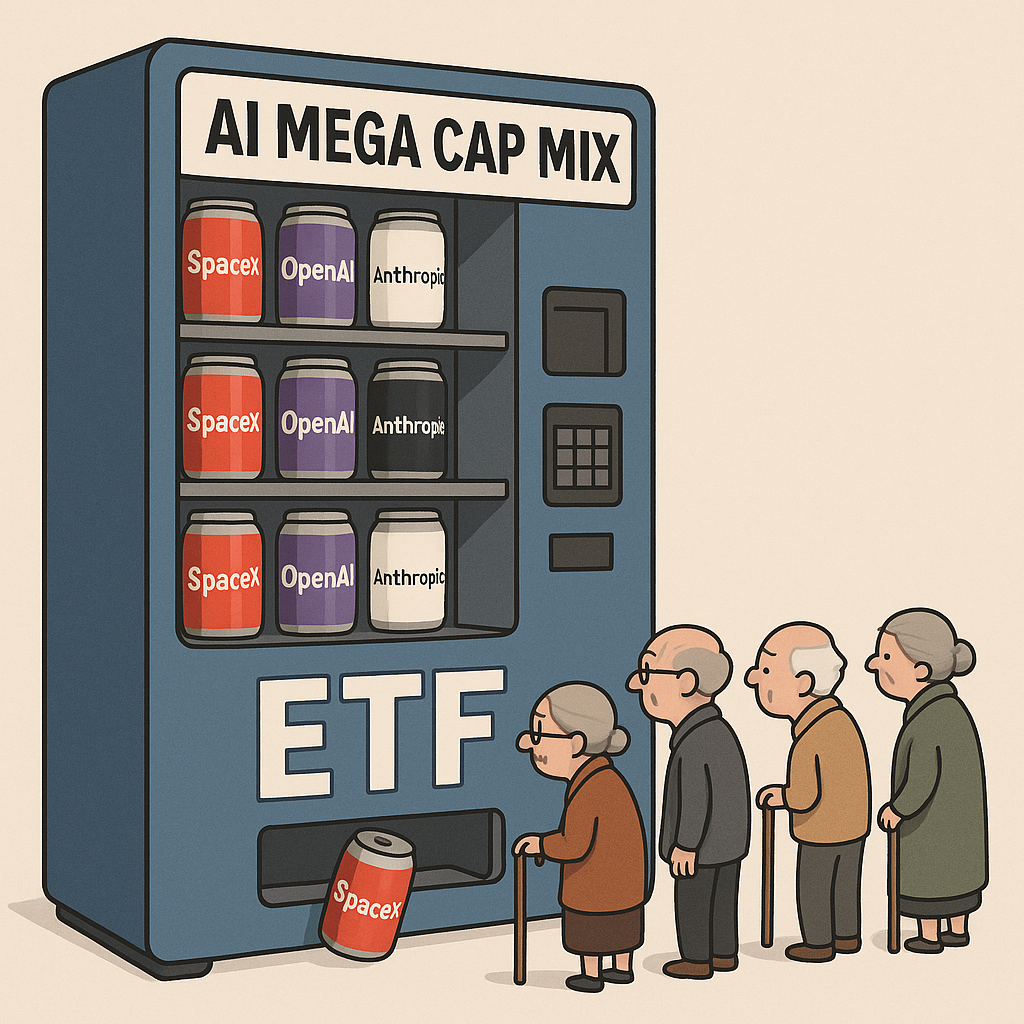
Index committees have responded with a flurry of new product ideas designed to ensure that when AI wealth is shared, it is shared through a 40 basis point annual fee.
- SPCXU: 2x Leveraged SpaceX & Friends Ultra ETF
- AIINFRA: OpenAI, Anthropic, SpaceX, and three other logos for legal reasons
- GOVZERO: A thematic fund tracking companies where public shareholders have precisely no control
Pension funds, which now route entire economies through index trackers, have privately expressed concern that rule-bending for AI giants could concentrate risk. Publicly, they have expressed whatever their consultant’s PowerPoint said last quarter.
“We are closely monitoring systemic concentration,” said the CIO of a large public pension, refreshing a dashboard that now shows 27 percent exposure to ‘Musk-adjacent platforms’ and 0.4 percent to things like food. “In the meantime, our members should know their retirement is aligned with the inspirational journey of humanity becoming an interplanetary species, subject to quarterly earnings.”
Regulators have also noticed that indices, which were once dull lists, now decide whether hundreds of billions of passive dollars surge into a company on day 90 or day never. The SEC has floated the idea that index governance rules should be more transparent.
Index providers responded by publishing a 94-page consultation paper describing their methodology in exquisite detail, then adding a footnote that reads: “All criteria may be overridden if the issuer is SpaceX or functionally similar.”
Outside the financial system, a few economists have tried to steer the conversation toward tax codes and long-term productivity. The FT has argued that AI-era wealth requires new taxation frameworks to avoid a permanent techno-financial nobility. Markets thanked them for their input, then resumed bidding up anything with “foundational model” in the prospectus.
“Infrastructure used to mean things like roads,” one economist sighed. “Now it means private APIs we hope will not change pricing with two weeks’ notice.”
For now, the emerging arrangement is clear. A handful of platforms like SpaceX, OpenAI, and Anthropic will manage space, data, and cognition. Index families will retrofit their rulebooks to wrap those platforms in an aura of public ownership. Politicians will occasionally appear to promise that this wealth is yours, then quietly leave the cap table unchanged.
You, the ordinary investor, will own “exposure” to it all through a target date fund that tilts slightly more into SPCX every time Elon tweets the word “AI.” Your voting rights will be handled by a chain of intermediaries, your risk will be summarized in a colored pie chart, and your role in the new AI financial order will be to clap when the rocket goes up and average down when it comes back to earth.
In that sense, the financial system has achieved a historic breakthrough. After centuries of experimentation, it has finally discovered how to democratize everything about AI except the part where anyone else is in charge.