In a development experts called inevitable, Wall Street has finally admitted that the hottest tech trend of 2026 is not artificial intelligence, but the United States quietly putting its entire operating system on a wartime beta branch.
As Donald Trump talks about a “massive attack” on the Islamic Republic of Iran and his officials describe a “time of ambiguity,” markets have dropped the ambiguity part. Oil has flirted back above $100, megacap tech has taken a Houthi-grade hit, and a crucial interest rate just jumped to the highest level of Trump’s second term, according to The New York Times. In response, financial engineers have rolled out the only logical product: the Perpetual Conflict & Cloud Compute ETF (ticker: WARQ).
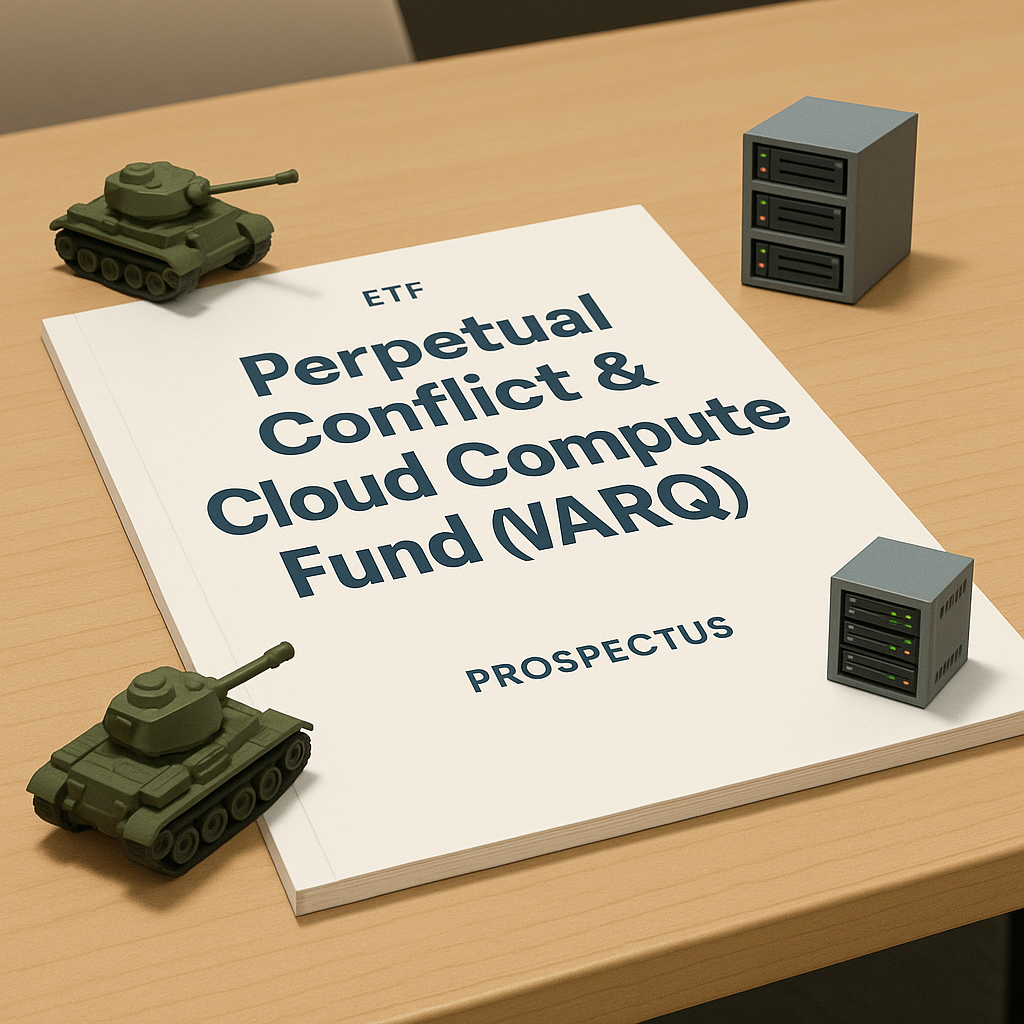
WARQ’s pitch deck, filed somewhere between a Pentagon strike update and a Justice Department leak subpoena, describes its strategy in the deadpan language of a therapist who has given up:
- Overweight oil producers whenever Houthis learn a new drone route.
- Rotate into defense contractors when Trump says “locked and loaded” on camera.
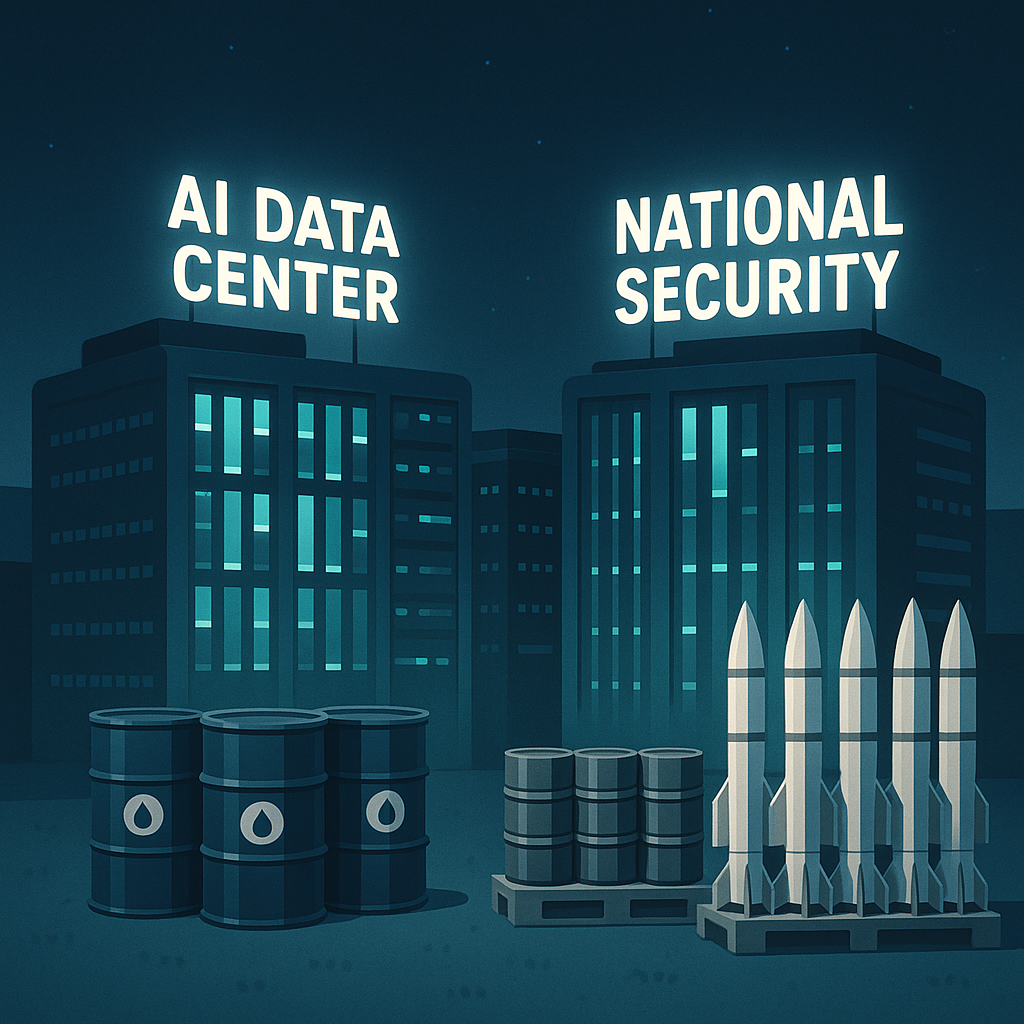
- Dollar-cost average into AI data center REITs whenever Meta pays 200 basis points extra to finance another $12 billion server barn.
“Investors used to ask if we were heading for World War III,” said one WARQ portfolio manager, speaking from what appeared to be a Bloomberg terminal open next to a CENTCOM live feed. “Now the question is whether it will clear the next quarter’s earnings comps.”
The slow-motion Iran confrontation, as chronicled in the Times’s “A Slow-Motion Shock” overview, has become the unifying backend for everything else. Houthis extend their operational reach in the Red Sea and reportedly damage U.S. military sites, oil spikes, and your streaming bundle gets more expensive. Israel and Lebanon tentatively agree on something, markets rally for four hours, then Trump teases tariffs on Canadian dairy again and SpaceX’s implied valuation loses another orbit.
Space/AI names have been hammered in an “industry sell-off already underway,” as Yahoo Finance put it, slicing SpaceX’s paper worth in half. This has led analysts to discover a new asset class: War-Adjacent Hype, or WAH. “It turns out some of these companies were priced for a future where nothing bad ever happened,” said one strategist. “Now investors are repricing for a world where war risk, Treasury yields, and Elon Musk tweets all spike at once. So naturally we launched an ETF.”
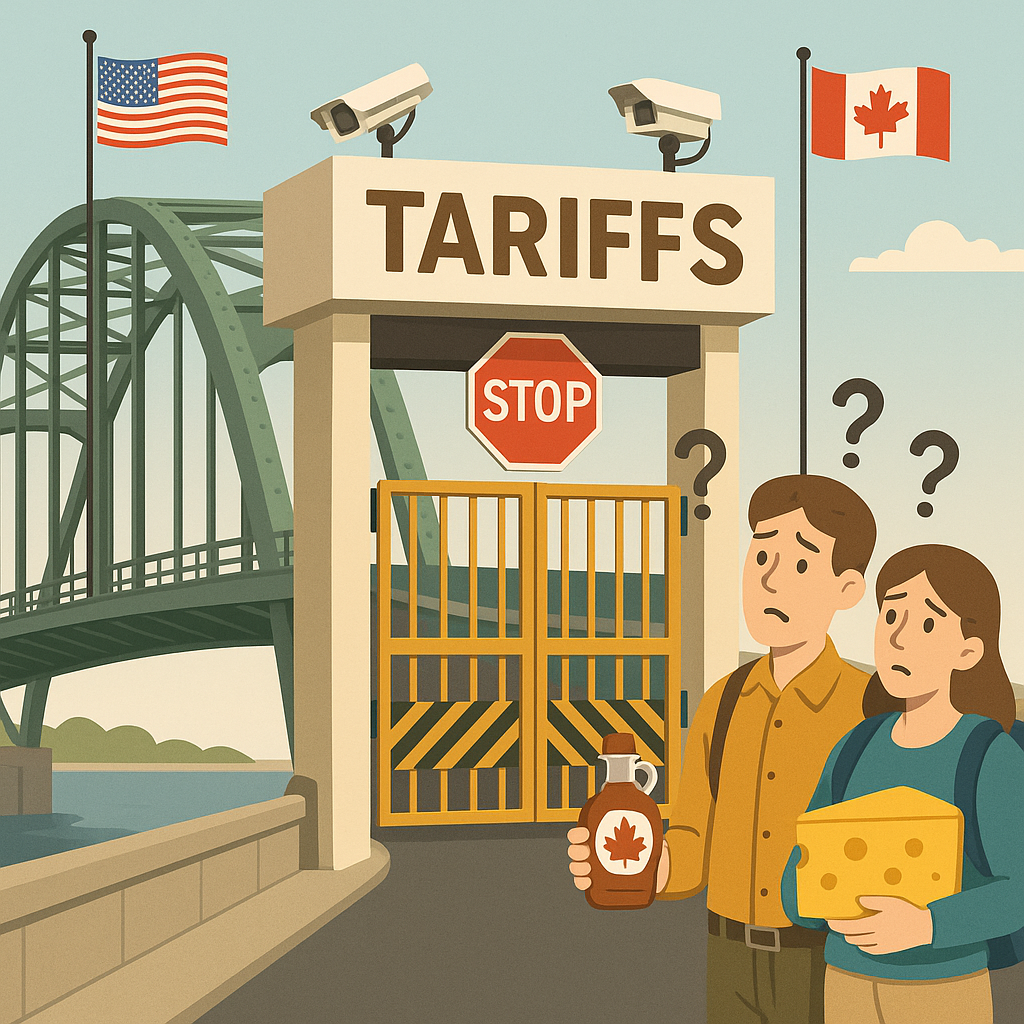
On the fundamentals side, the Trump administration has helpfully synchronized every macro headwind. The next phase of global tariffs arrives with 10 to 12.5 percent taxes on much of the planet, plus separate 50 percent tariffs targeted at Canadian autos, dairy, and alcohol. Canada responds by opening the Gordie Howe International Bridge and telling Americans to visit when they are done being grounded by the State Department.
“America needs Canada,” Ontario premier Doug Ford insisted on NBC, as U.S. border officials warned Americans that crossing an actual bridge might expose them to non-tariffed cheese. The Trump team, however, clarified that any Canadians attempting to smuggle unapproved maple lattes across the Detroit River would be treated as a hybrid trade and national security threat, which could be bullish for surveillance startups but negative for cross-border brunch.
Inside the United States, the confrontation with Iran has turned domestic politics into a war-footing subscription service. The Justice Department, in a rush to track down national security leaks related to the conflict, quietly reversed its own long-standing process for subpoenaing journalists, as reported by the Times. Officials described it as an “internal workflow optimization.”
“Think of it like a SaaS pivot,” said one former DOJ lawyer. “We took the old civil liberties stack, refactored it in a panic, and shipped to production on a Friday. In wartime you ship fast and break norms.”
Border politics have likewise been recoded in wartime syntax. Texas Senate candidate James Talarico unveiled a border policy on “Meet the Press” framed squarely around national security, saying “both parties have failed us.” Translation for markets: capex for walls and drones is now an asset class, humanitarian concerns are a footnote in the risk factors.
Globally, the chorus is in tune. Nicaragua’s president just canceled elections due to the threat of opposition, offering a convenient international benchmark for anyone playing the long game on emergency powers. Traders who used to screen for emerging market democracy risk now simply sort by “declared, de facto, or soon.”
Back in equities, the Magnificent 7 have started to look more like the Moderately Anxious 5 plus Two That Might Need a Bailout. Intel posts blowout earnings on AI data center demand, AMD insists its Nvidia challenger is in full production, and investors respond by selling everything with a GPU and a flag. War risk, rising borrowing costs, and the prospect of an Iran conflict that never quite resolves have turned the AI story into a familiar defense-sector narrative: great technology, unlimited use cases, uncertain whether we are all still here in five years.
Meta’s latest $12 billion data center financing cleared at a higher rate, a small detail that quietly captures the new regime. In peacetime, cheap credit funds accidental Metaverse theme parks. In a “time of ambiguity,” the same leverage builds server farms that can run facial recognition at every border, sentiment analysis for every speech, and real-time war-footage curation for your social feed.
Oil, naturally, is the main character again. The Financial Times noted crude briefly climbing back over $100 as Trump weighs a “massive attack” on Iran. Each new quote from the White House rerates not only the barrel, but your grocery bill, your mortgage, and the solvency of that AI startup still pitching tokenized gas stations. As a finance guy who lives in a New Jersey server basement, I can confirm: the only clean hedge left is hoarding ethernet cables and learning to cook with spam.
All of this has left democracy looking increasingly like an outdated protocol running on wartime hardware. You have the aesthetics of debate, like senators grilling Pentagon leaders on war funding, and Trump saying he has “no interest” in Iran talks while also being “locked and loaded.” You have the content moderation layer, where the Justice Department treats leaks as bugs to be patched, not disclosures to be weighed. You have the infrastructure, where bridges to Canada open while Americans are told to stay home and watch the war show in 4K.
The open question, as the Times framed it, is whether the country is drifting into a permanent war footing without a clear public debate or endgame. On Wall Street, that question has been resolved and monetized. The WARQ prospectus describes the Iran conflict as “an enduring macro regime with no defined sunset clause,” then, in smaller type, warns that peace could materially impair returns.
Investors are, unsurprisingly, piling in. “Look, we all hope diplomacy wins,” said one pension consultant, “but we also have liabilities.” Asked what would happen if tensions with Iran suddenly cooled, oil fell, interest rates eased, and civil liberties protections were quietly restored, he frowned.
“In that scenario,” he said, “we would need to launch a new product very quickly.”
They are already testing tickers.