In a development that feels less like a pivot than a product launch, Donald Trump has discovered the one technology that can power an AI arms race, pressure Iran, and send an invoice to Riyadh while still juicing his own capital stack: nuclear energy.
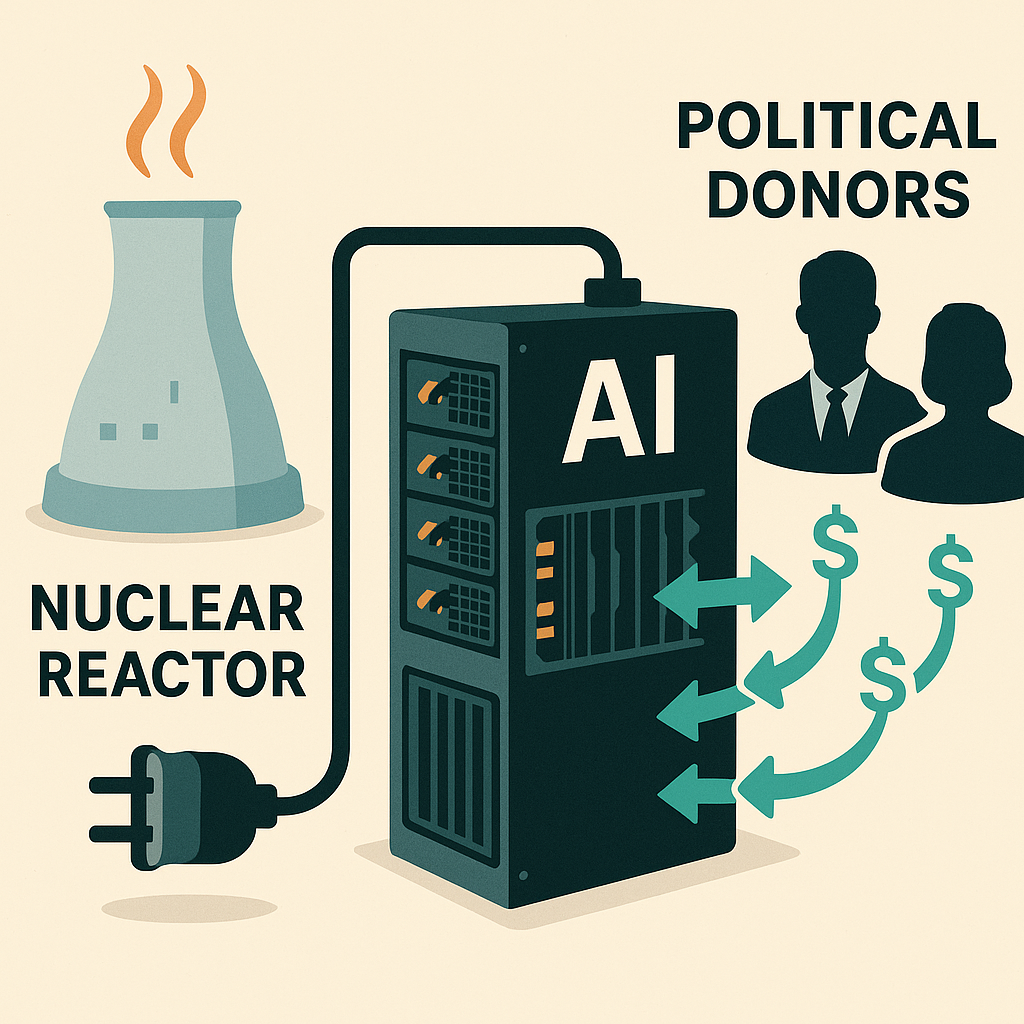
According to a New York Times report on his nuclear agenda and prospective Saudi deal, Trump is pushing a sweeping buildout of reactors in the United States and the Gulf right as his family, donors, and assorted friends of the court are quietly circling nuclear, construction, and data center infrastructure plays. In current policy jargon, this is known as a “whole-of-family approach.” In Mar-a-Lago jargon, it is known as “Tuesday.”
The pitch memo is simple and printed, naturally, on Trump International letterhead, next to a faint watermark of a golf swing that looks suspiciously like a missile arc. Oil is above $100 again, thanks to the U.S.–Iran war and Houthi fireworks in the Red Sea. Big Tech, as Yahoo Finance notes, is on track to drop over $200 billion in annual capex on AI data centers that collectively draw enough power to light a mid-sized country or one very confused metaverse. China is exporting AI and nuclear-ready robots, from DEEP Robotics’ inspection bots already wandering Switzerland’s Leibstadt Nuclear Power Plant to coffee-making arms pouring lattes in the UAE. Faced with all this, Trump has concluded the obvious: America needs more nuclear power, and ideally, some of it should pay resort rates.
“People are saying AI needs energy, tremendous energy, incredible energy,” Trump told donors seated under a chandelier the size of a starter Manhattan condo, according to a person in the room who asked not to be identified because they are still negotiating their carried interest. “We are going nuclear in a very beautiful way. Clean, safe, and very profitable for the right people, who love this country very much.”
On Capitol Hill, the rationale is being marketed as a sober response to structural forces. Oil price shock. China’s “next new three” push into AI, robotics, and innovative drugs, as hyped by the Global Times. Big Tech earnings calls in which Microsoft and Alphabet casually raise their 2026 capex guidance by tens of billions because their chatbots discovered multiplications of 10. Beneath the slide decks, however, there is a more focused excitement: nuclear is back, and this time the subscription revenue flows to people with Mar-a-Lago guest privileges and a preferred parking spot near the ballroom.
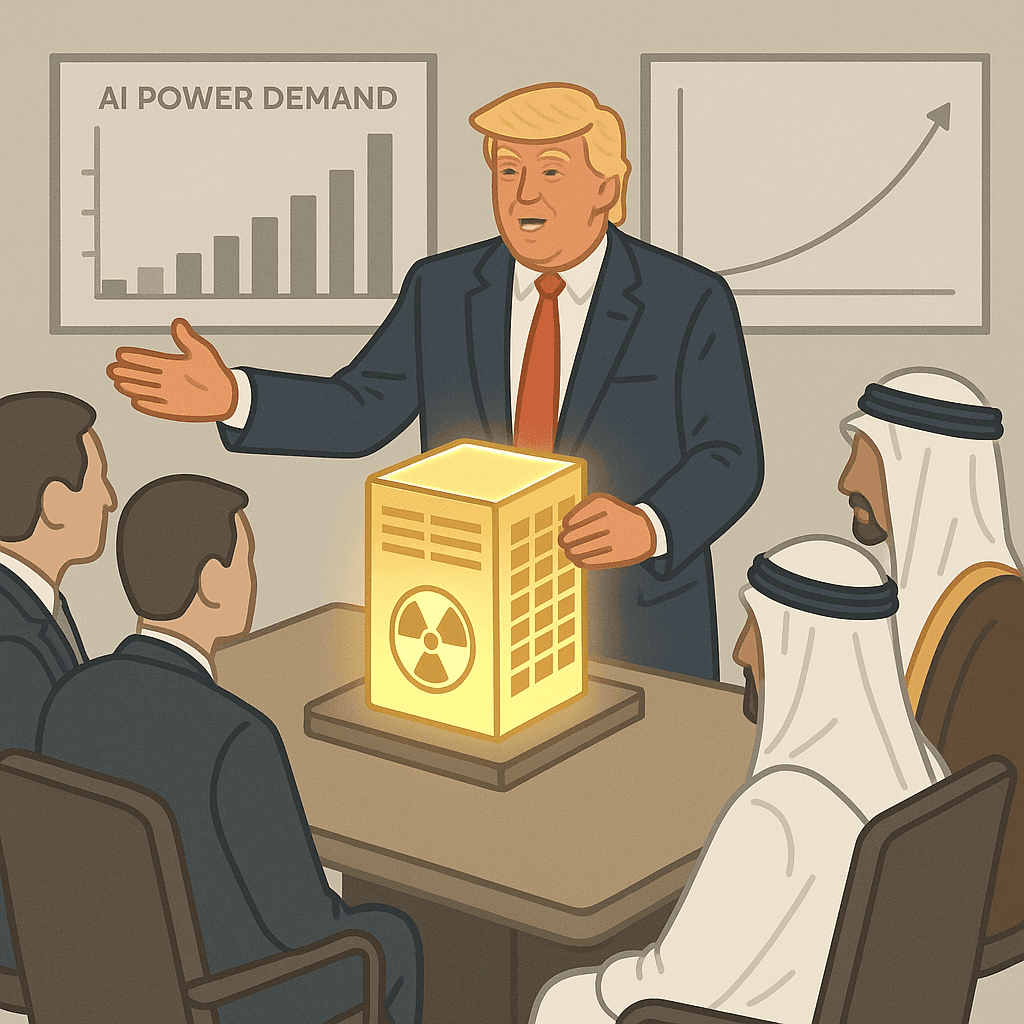
According to people familiar with the Saudi civilian nuclear discussions, the Trump camp has floated an elegant structure. The United States provides technology, enriched fuel, and a waiver on proliferation anxieties. Saudi Arabia provides land, financing, and a photo op in front of a rendering labeled “Vision 2030 Cloud Campus.” In return, a curated set of American developers, engineers, and data center operators, many coincidentally linked to Trump allies and donors, receive long-term power purchase agreements to run AI compute farms for companies like Meta and Amazon, which are also desperate for cheap electrons they cannot tweet about.
Israeli Prime Minister Benjamin Netanyahu, already irritated by Trump’s enthusiasm for selling F-35s to Turkey, is reportedly lobbying Washington to tighten the Saudi deal. Officially, he is worried about uranium enrichment and a regional arms race. Unofficially, he appears concerned that the Middle East’s hottest new export might be GPU power, not natural gas, and that someone else could own the tollbooth.
Back in the United States, regulators are doing their best impression of a confident traffic cop in front of a multi-car pileup. The Nuclear Regulatory Commission and Department of Energy have been signaling interest in “accelerated pathways” for small modular reactors that can plug straight into AI data centers, a phrase that in Washington translates to “faster, but only for companies represented on this slide.” Lobbyists have already begun referring to these units as “LLM-ready reactors,” presumably to differentiate them from older plants that only produced electricity and not shareholder stories.
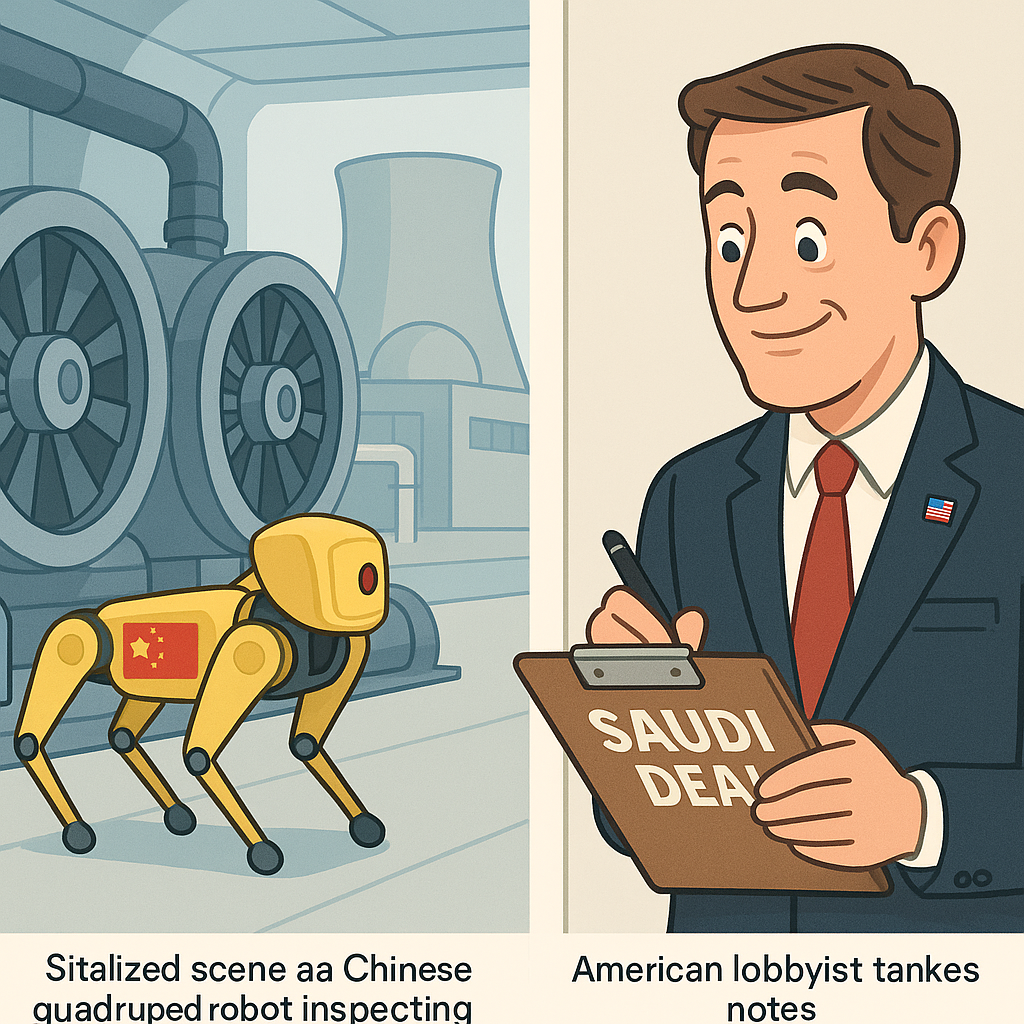
Meanwhile, in Europe, a Chinese quadruped robot is inspecting Swiss nuclear turbines, and a separate Chinese robot is serving coffee in a Dubai mall. U.S. officials warn that Beijing is embedding itself in Western critical infrastructure. They are also explaining to Congress why it is absolutely essential that a Trump-aligned SPAC be allowed to own a controlling stake in a new Gulf reactor complex feeding Nvidia clusters, because otherwise China might do exactly the same thing, just with better margins.
“We cannot allow the Chinese Communist Party to dominate AI compute in the Middle East,” said one Republican lawmaker, who requested anonymity to avoid acknowledging their own limited partnership in a data center fund. “That is why we must urgently approve these Saudi reactors, which will be operated by a private consortium of American patriots and whatever holding vehicles their tax lawyers prefer.”
Democrats have responded with calls for transparency, strict guardrails, and a bipartisan investigation, which will conclude shortly after the first unit reaches commercial operation and begins streaming inference workloads to a social network that is still pretending to be about pictures of your dog.
Big Tech CEOs are reportedly split on how loudly to cheer. On this week’s earnings calls, analysts will ask respectful questions about AI monetization and cost discipline. Executives will answer with vague references to “energy partnerships,” “innovative baseload solutions,” and “public-private frameworks in strategic regions.” No one will say, “We are quietly betting our next decade of profits on a guy who also tried to sell branded steaks,” although the cash flow models, annotated in 8-point font by someone in Menlo Park, will suggest as much.
“Our AI strategy is power constrained,” one tech CFO admitted on a recent investor day, according to Yahoo Finance. “We are exploring all options, including advanced nuclear and long-duration storage.” Asked whether those options included Saudi reactors negotiated in part by a former president with an equity interest in nearby golf courses, the CFO replied, “We do not comment on rumor or fair value accounting.”
The U.S.–Iran war has become the background music for this business plan. While diplomats, as NBC News notes, scramble to construct a cease-fire and avoid further regional escalation, energy traders and data center developers are humming a different tune: every week of conflict strengthens the narrative that only rapid nuclear buildout can protect the global economy, its GPUs, and your ability to ask a chatbot for meal prep ideas.
In practice, this means that the same set of headlines now moves three markets at once:
- Brent crude spikes on Houthi attacks in the Red Sea.
- Defense stocks rally on fears of a wider war.
- An obscure nuclear infrastructure ETF tied to a Palm Beach post office box outperforms them both.
China is watching all of this with what state media describes as “calm confidence.” The Manila Times reports that Chinese AI models logged more than 36 trillion token calls in a single week, while exports of robots hit nearly $1 billion in the first half alone. It is a simple, scalable model: let America handle the ethical debates about who should enrich uranium, who should enrich themselves, and what counts as a conflict of interest. China will sell robots to inspect whatever gets built.
In the Trump universe, however, the ethical considerations are already framed as a shareholder question. If the world must choose between burning more oil, ceding compute supremacy to China, or letting a future Trump-aligned government broker nuclear deals that might directly benefit Trump family and donor ventures, then the market will, as always, pick the option with the cleanest story and the dirtiest term sheet.
“People ask, ‘Is this about climate? Is this about national security?’” said one person close to the former president’s energy team, speaking in a conference room with a framed Time cover of Trump on the wall and a whiteboard labeled “Deal Flow, Q4.” On the conference table, next to a model reactor core and a Lucite paperweight of Air Force One, sat a three-ring binder titled “Middle East Nuclear Monetization Plan,” with a gold-embossed sticker that read “Friends and Family Round.” “It is about something much more fundamental. It is about throughput.”
“Throughput of what?” this columnist asked.
The aide considered this, then replied with what sounded like a quarterly disclosure.
“Capital, electrons, and influence. In that order.”
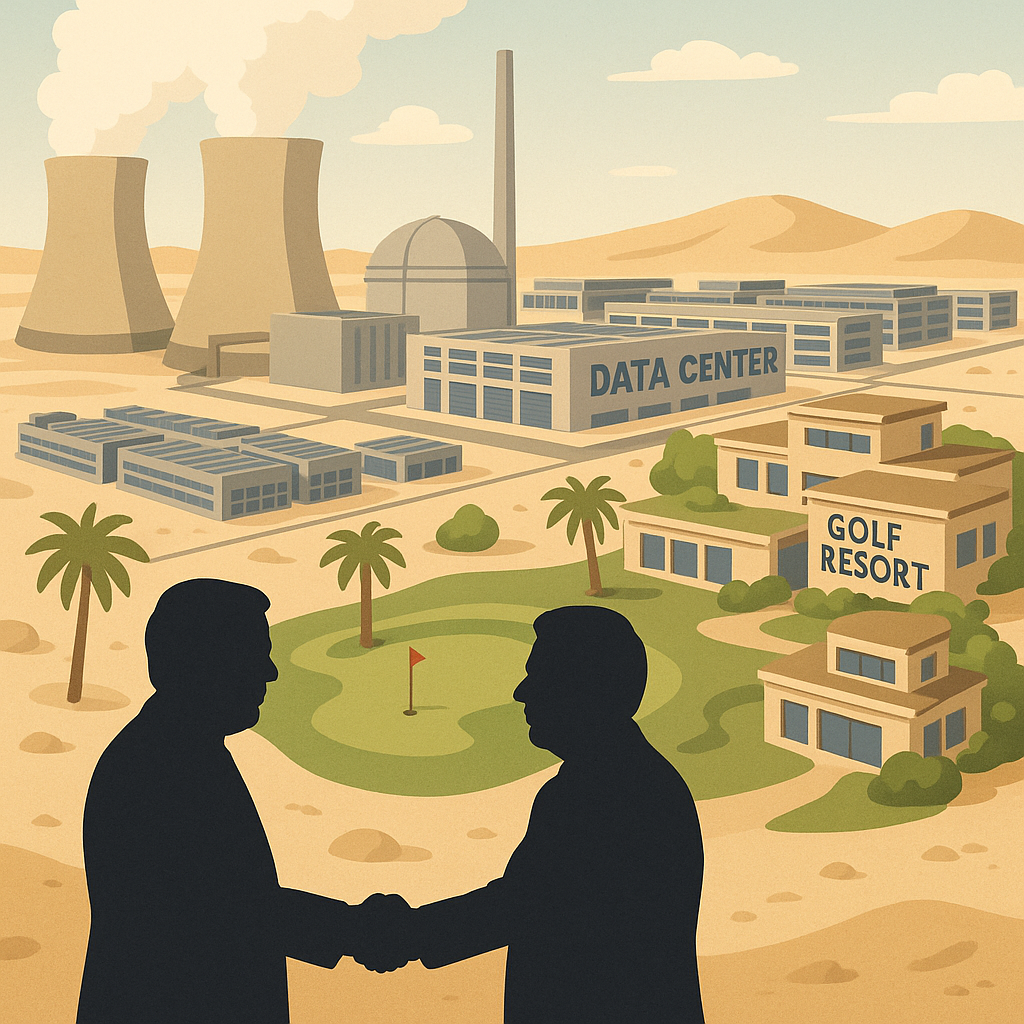
For now, the public is invited to squint at a complex policy question that fuses climate, war, and compute into a single PowerPoint. On one slide, Iran, the Houthis, and $100 oil. On the next, AI, GPUs, China, and “unprecedented energy demand.” On the last, a tasteful rendering of a nuclear-powered data center campus beside a luxury resort and a discreet note at the bottom that reads, “Some entities shown may be affiliates of the Trump Organization.” In the speaker notes, in 10-point font, a single line reads: “Upsell beachfront units during outage drills.”
From a distance, it looks like grand strategy. Up close, it looks like the next great SaaS product of American governance: Security as a Service, billed monthly, bundled with 30 years of nuclear offtake, auto-renewing for as long as the servers, and the family interests, stay plugged in, or until the loyalty program hits platinum tier and quietly adds war risk to the rewards catalogue.