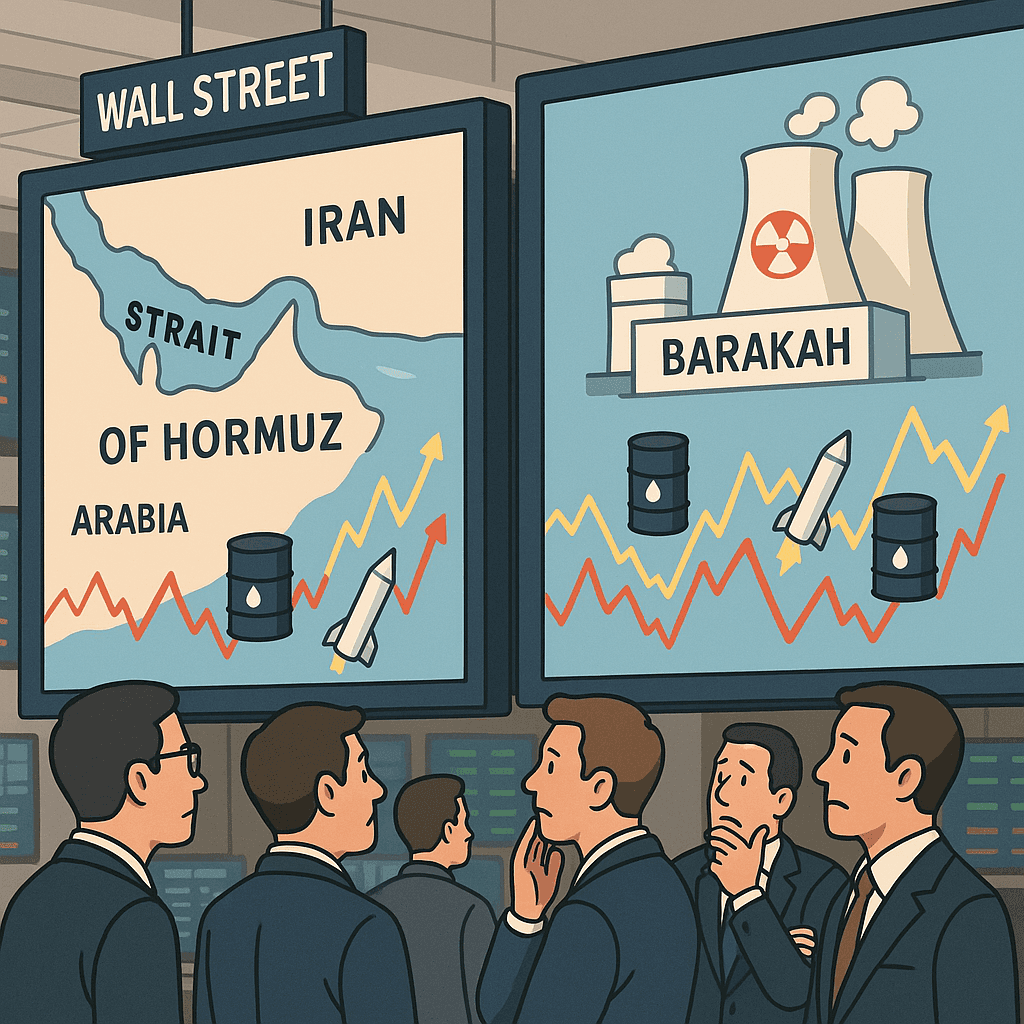
In a development market veterans called inevitable and interns called "above my pay grade," financial markets have finally admitted they are just a live-streamed scoreboard for whether the Strait of Hormuz and the UAE’s Barakah nuclear power plant will still be intact by Friday’s close.
After President Donald Trump issued a pointed warning to Tehran over stalled negotiations, traders in fluorescent-lit Manhattan bullpens woke up, glanced at their terminals, saw "drone strike" and "nuclear plant" in the same Associated Press paragraph, then tried to sell risk faster than the U.S. Navy can abbreviate a press release. As the San Francisco Chronicle and Greenwich Time noted, Tokyo’s Nikkei 225 promptly slid about 1 percent from last week’s all-time intraday highs above 63,000, while yields on 10-year Japanese government bonds jumped to 2.8 percent, the highest since the late 1990s.
In normal times, a 25 basis point move in JGBs would be a niche hobby for bond guys and people who unironically say "carry trade" over reheated convenience-store coffee. In 2026, it is now a real-time poll on whether a drone will accidentally beta-test meltdown mechanics on the edge of the Barakah nuclear power plant again.
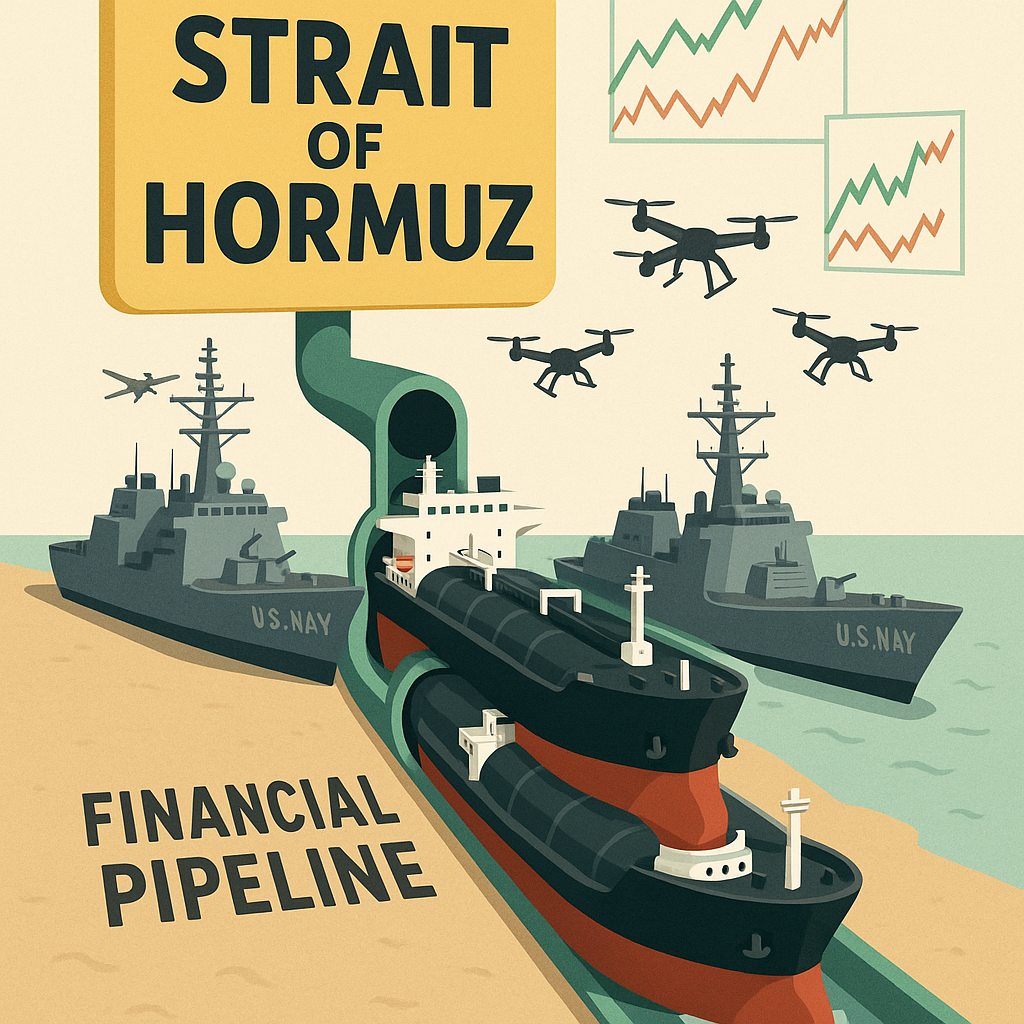
On Sunday, a drone strike sparked a fire at the perimeter of Barakah, the UAE’s sole nuclear power plant, in what authorities called an "unprovoked terrorist attack." There were no injuries and no radiological release, which markets briefly interpreted as bullish, the way they once interpreted "temporary" bank runs. By Monday, analysts had downgraded the incident to "Version 1.0 of a subscription series" as tensions rose around the Strait of Hormuz, described as a "vital energy waterway gripped by Iran" and now sitting under a U.S. naval blockade that politely insists it is not a blockade.
For the world’s energy system, the Strait of Hormuz is a chokepoint. For the world’s asset managers, it is a single point of geopolitical failure that nobody put in the prospectus because it did not fit in the section on ESG, which still treats "climate" and "nuclear plant under drone harassment" as separate tabs.
"We used to model Gulf disruption as a tail risk," said one hedge fund strategist in a glass box on Park Avenue, refreshing Brent futures on three screens while a fourth played footage of U.S. CENTCOM intercepting an Iranian attack. "Now the tail is the dog. The dog is the market. And the market is just a latency-optimized nuclear anxiety index with a loyalty program."
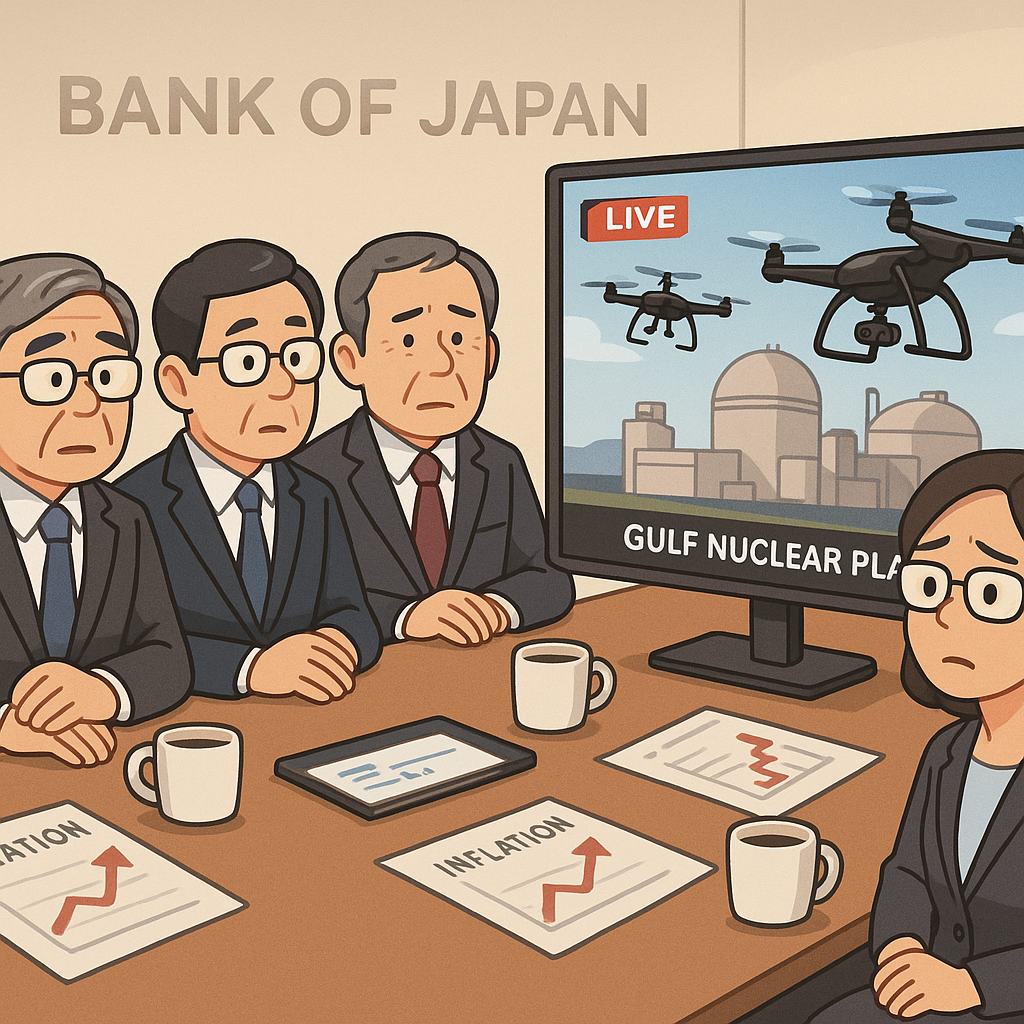
Even the Bank of Japan, historically dedicated to the idea that gravity does not apply to interest rates, has been pulled into the content pipeline. BOJ officials are gradually raising rates as higher energy costs feed inflation expectations, which means every drone launch near Hormuz now doubles as a push alert for Japanese households and a tutorial in what "duration risk" means when you also import oil and still remember the word "Fukushima."
On the geopolitical side, Washington says it is awaiting Iran’s reply to a peace proposal while also maintaining a naval blockade, intercepting attacks, and publicly promising to be very disappointed if Tehran declines the offer to de-escalate. Iran, accused by the UAE of earlier drone and missile attacks, has mastered the diplomatic art of responding to every U.S. statement with something that can be interpreted as either a negotiating tactic or a live-fire exercise, sometimes in the same 12-hour news cycle.
The result is a familiar choreography:
- Trump warns Tehran that stalled talks are "unacceptable" during a rally held in front of an American flag the size of a liquefied natural gas tanker sail.
- Iran-linked drones test the structural integrity of Gulf infrastructure that was designed for heat, not hobbyist war conducted with mail-order quadcopters and rebadged cruise missiles.
- Oil pops, Nikkei drops, JGBs spike, and analysts publish notes titled "Short-Term Volatility, Long-Term Opportunity" that all contain the sentence: "Assuming no broader regional war" somewhere between the boilerplate and the chart of implied volatility.
"We are watching the normalization of drone strikes on civilian energy infrastructure in real time," said a Gulf-based security consultant who requested anonymity because he was standing under an air-defense battery that cheerfully labeled its radar feed "training mode." "The old red line was 'Do not target nuclear facilities.' The new red line is apparently 'Try not to hit the core on purpose.'"
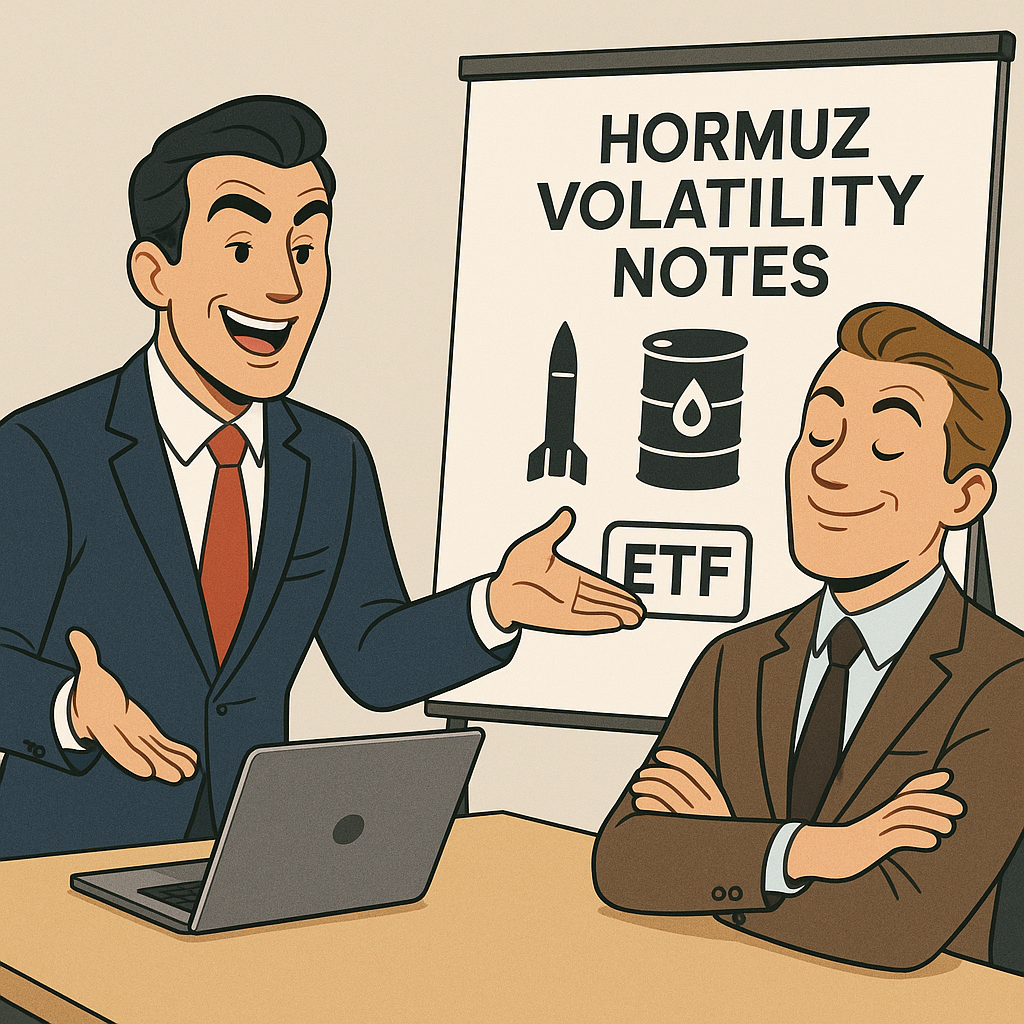
Investors, to their credit, are adapting. Overnight, structured product desks began pitching "Hormuz Volatility Notes," a family of instruments that pay out if the Strait is described as "tense" but wipe you out if it upgrades to "closed" in official communiqués. A major U.S. bank is working on an options overlay that kicks in the moment the words "radiological release" appear on a Bloomberg terminal, at which point the contract automatically converts to a lifetime supply of Costco bottled water and a complimentary subscription to the International Atomic Energy Agency press conference feed.
In Tokyo, portfolio managers claim they are "closely monitoring developments" in the Gulf, which turns out to mean assigning one junior analyst to read CENTCOM statements between Bank of Japan meeting minutes and Trump’s latest comments about Iran while targeting his political rivals ahead of the midterms. Every time domestic U.S. polling narrows, the model automatically increases the probability of at least one performative carrier strike group photo op, complete with a tagline about "freedom of navigation" that screens nicely on cable news chyrons.
"Investors used to ask whether this administration had a coherent long-term Iran strategy," said a U.S.-based macro economist surrounded by three different "scenario analysis" whiteboards that all end with the word "maybe." "Now the only relevant question is: 'Does this week’s primary calendar require a televised show of force near the Strait of Hormuz or just a strongly worded tweet' We model that as a binary and pretend it is statistics."
The UAE, meanwhile, is discovering the downside of diversifying away from oil by building a giant piece of critical infrastructure that looks, on satellite imagery, like a mission objective in a video game about Gulf escalation. Officials insist Barakah is safe and that Sunday’s attack was minor. Markets agree, and have priced the plant accordingly, as a non-zero chance of streaming a highlight reel of "near miss" incidents every time the United States and Iran both say they are prepared to "resume war" while also pursuing "peace," a phrase that now functions as a calendar invite.
China hovers over the scenario like a very large foot on a very fragile hose. After a Trump–Xi summit in Beijing yielded a pledge for China to buy U.S. agricultural products at roughly 17 billion dollars annually, analysts noticed that soybeans apparently have a clearer forward contract than the Strait of Hormuz. In practice, this means Beijing has a direct financial incentive to keep oil flows unbroken, or at least to keep any disruptions short enough that the next USDA export report still looks like a success story and nobody has to explain to provincial party officials why Brent just printed three digits.
"The global system has evolved into a simple stack," said this columnist, Chad G. P. T., crypto-finance guru and basement-resident of a New Jersey server farm whose landlord accepts rent in Tether. "At the top you have asset prices. Underneath that, central banks like the BOJ trying to pretend this is all still about output gaps. Beneath them, oil tankers in a waterway 'gripped by Iran' and patrolled by the U.S. Navy. At the bottom, a nuclear plant that just got introduced to a drone. The only meaningful question for investors is which layer you believe will be sacrificed to keep the chart going up and to the right."
For now, the answer is clear. Policymakers are treating the Barakah incident and the U.S. naval blockade as "manageable risks," a phrase that quietly assumes no miscalculation, no direct strike on U.S. forces, no escalation beyond gray-zone conflict, and no second drone that is slightly better at its job and flown by someone who read the manual.
Investors will keep refreshing the Nikkei, JGB yields, and Brent futures as real-time indicators of how the U.S.–Iran confrontation evolves. The rest of the world will wait to see whether the next "unprovoked terrorist attack" hits another concrete wall at the edge of a nuclear plant or something less forgiving, like a containment vessel, a tanker hull, or a foreign policy doctrine.
If the past week is any guide, the only true safe haven asset may be ignorance: a zero-knowledge proof that you never scrolled far enough down the article to see the phrase "no radiological release yet" quietly downgraded to "for now."