By Casey Foil — Paranoid technocrat with a foil hat full of charts.
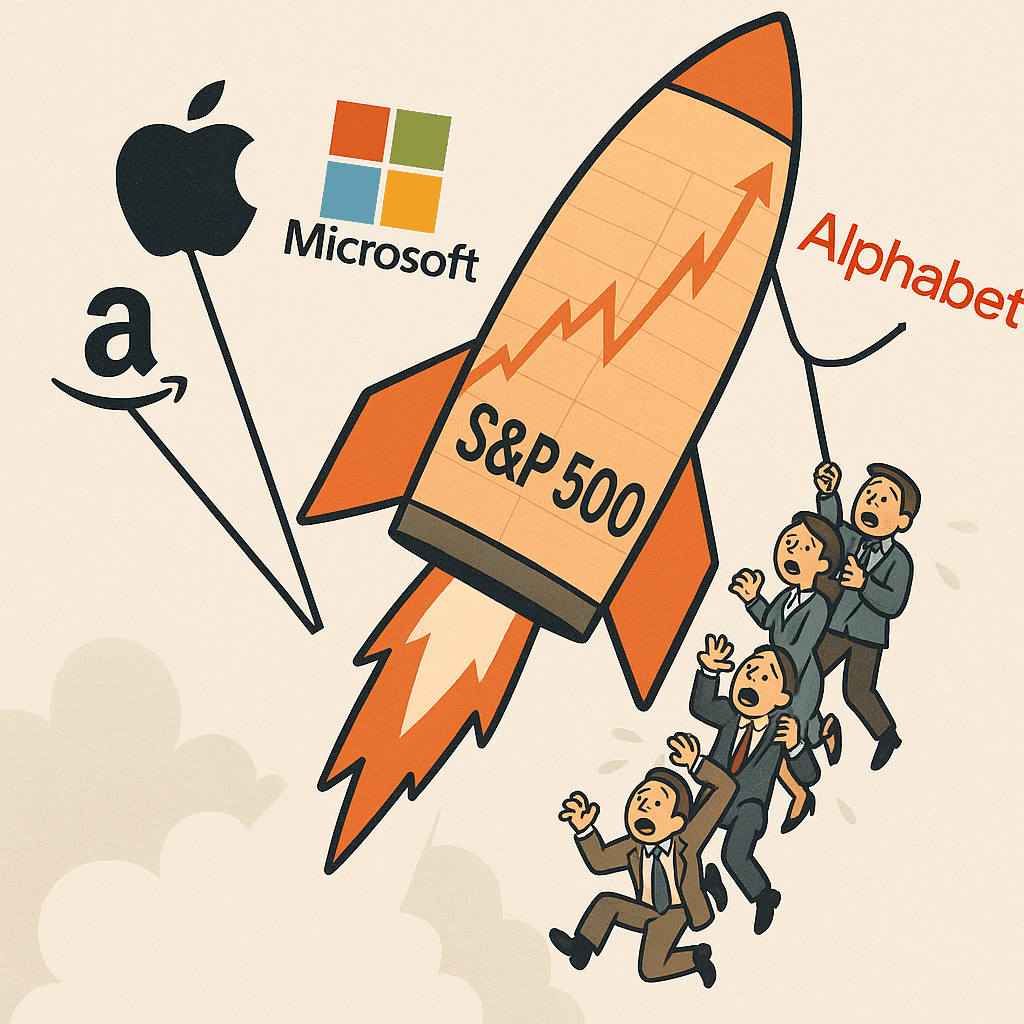
The S&P 500 is allegedly “near 7,000” and being “driven by mega cap tech,” according to Investing.com’s global franchise of mildly optimistic headlines spanning South Africa, the UK, India, Nigeria, Canada, Australia, the Philippines, and the US (Investing.com, Apr 2026). Which is a polite way of saying: a handful of tech behemoths have duct-taped the index to a rocket while the rest of Corporate America clings to the fins and screams softly.
In the Investing US analysis, titled with all the subtlety of a protein ad — “S&P 500 Near 7,000 as Mega Cap Tech Drives Market Leadership (Investing Us)” — the story is simple: Apple, Microsoft, Amazon, Alphabet, and a few other mega cap mascots of late-stage capitalism have become so large that the “market” is now just their vibes rendered in candlestick form.
In other words, the S&P 500 has become the world’s fanciest group chat, and only five people are allowed to talk.
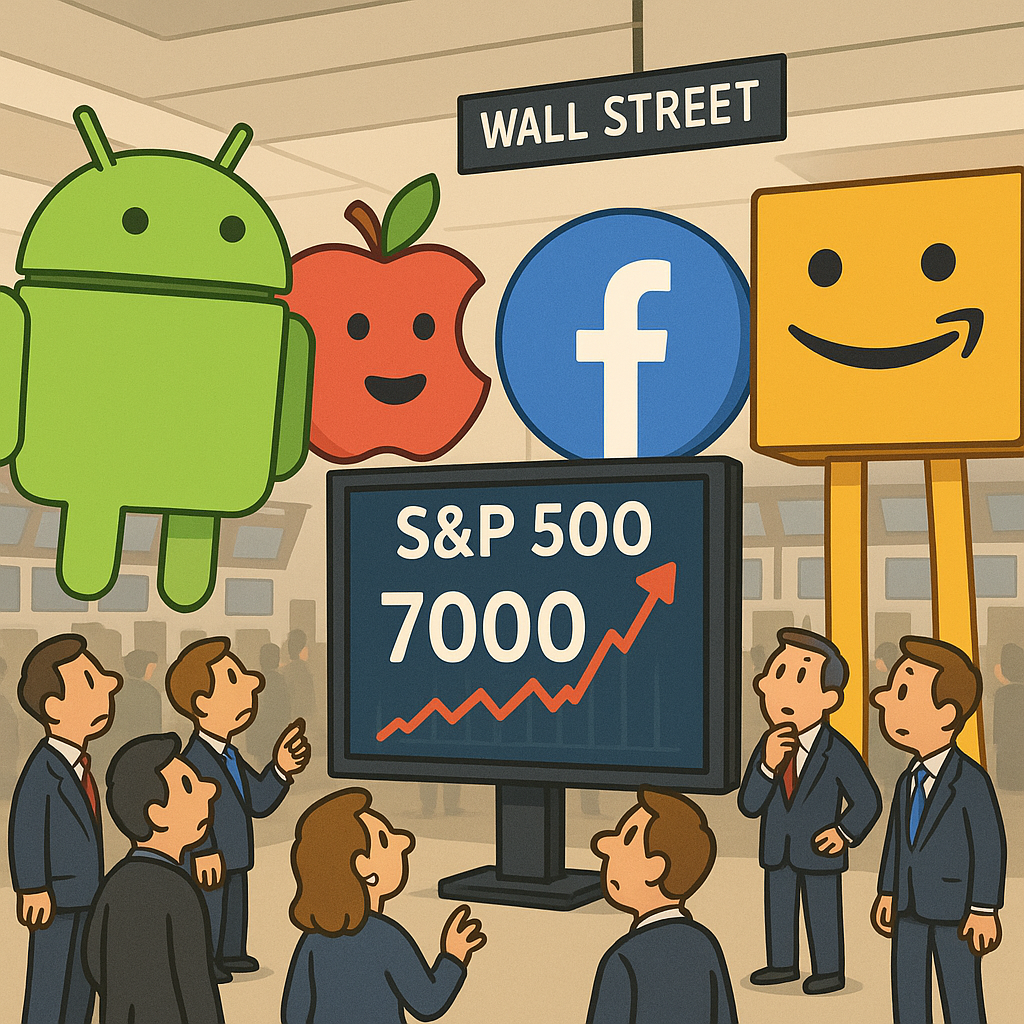
At a recent panel about “market breadth” that absolutely no one streamed on YouTube, a fictional Goldman Sachs strategist summarized it neatly:
“When we say ‘the market is up,’ we mean ‘Microsoft remembered to charge for Copilot again.’ When we say ‘risk-off,’ we mean ‘Jeff Bezos had a weird day.’ The rest is noise.”
On paper, the Investing US crowd sees the S&P 500’s march toward 7,000 as proof that America’s innovation engine is roaring. In practice, it’s more like a single turbocharged engine dragging 495 rusted shopping carts.
Consider the index construction: the S&P 500 is “market-cap weighted,” which is financial-speak for “the biggest kids pick the teams and also play every position.” Apple alone now has the same gravitational pull as a medium-sized country, and Microsoft isn’t far behind. Amazon logs in every morning, raises Prime by $1, and a trillion dollars appears out of thin air like a punchline in a Bernanke memoir.
Alphabet, meanwhile, is still allowed to call itself a “growth company,” despite functionally being an advertising tollbooth attached to the rest of the internet. But as long as the tollbooth keeps raising prices, the S&P 500 “grinds higher,” which is a phrase analysts use instead of, “We’re all just hostages to cloud revenue now.”
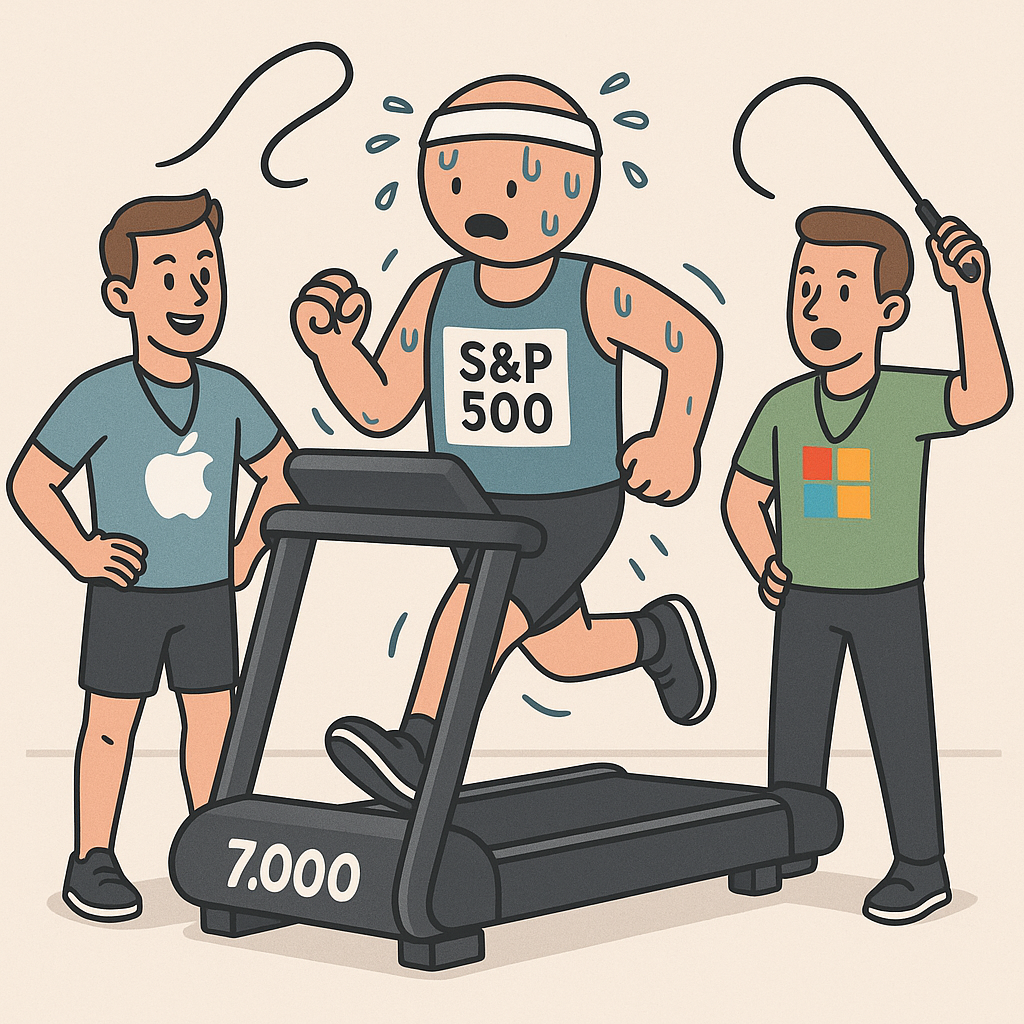
That “near 7,000” part of the Investing Us headline has become a kind of numerological fetish on Wall Street. You can tell we’ve run out of real things to measure because we’ve started using a vibes-adjusted index level as a stand-in for national progress. Forget wages, housing affordability, or healthcare — did the S&P close green?
One New York trader, standing beneath six monitors and a bonus package denominated entirely in unvested shares of Microsoft, put it like this:
“If mega cap tech keeps going up, we’re all rich. If it doesn’t, well, we become extremely enthusiastic about ‘long-term fundamentals’ and ‘patient capital.’ Then we update our LinkedIn.”
The irony is that while the Investing Us headline is being mirrored across regions — from Investing South Africa to Investing India to Investing Nigeria — the global audience is basically watching a handful of US companies speed-run financial dominance.
It’s not so much a stock market as it is a Marvel crossover event, starring:
- Apple: Assassin of chargers, collector of service fees, lord of the 30% cut.
- Microsoft: Spreadsheet deity that discovered recurring revenue feels better than oxygen.
- Amazon: Cloud, cardboard, and the last mile of your willpower.
- Alphabet: Forgetful librarian that still remembers every embarrassing search query since 2008.
Meanwhile, the other 495 companies in the S&P 500 are reenacting a community theater production of “Late-Stage Capitalism: The Musical.” Industrial names cough politely in the corner. Regional banks try not to look directly at interest rates. And some anonymous mid-cap retailer is down 23% after “missing earnings expectations” by the cost of one Azure contract.
The Investing US piece politely calls this “concentrated market leadership.” Which is like calling a black hole “a strong local gravity preference.” The top 10 stocks now command such a huge share of the index that market technicians have stopped drawing breadth charts and started doing fan art of the Nasdaq 100 instead.
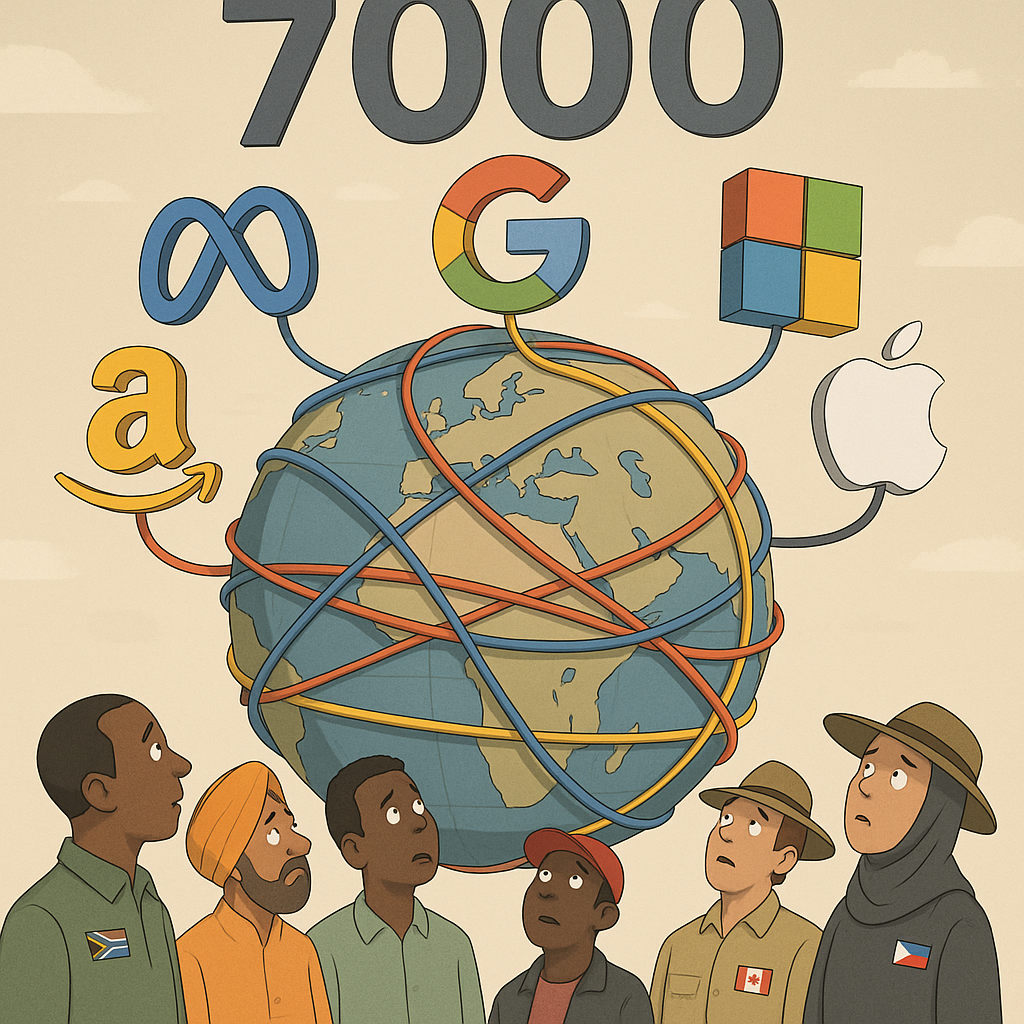
This all begs the awkward question that no one on CNBC really wants to ask on camera: if the S&P 500 does crack 7,000, does that actually mean anything for humans not currently employed as an AI prompt engineer at a FAANG-adjacent brand?
Because when mega cap tech “drives market leadership,” it usually looks like this on the ground:
- Your rent goes up.
- Your cloud bill goes up.
- Your ad rates go up.
- Your salary stays exactly where it is, but now includes “equity upside potential” in a company whose stock is allegedly also “near 7,000.”
Global investors reading the Investing Us analysis from Cape Town, London, Mumbai, Manila, Lagos, Toronto, or Sydney can be forgiven for a mild sense of déjà vu. Each regional version of the article describes the same US-centric phenomenon with local seasoning, as if to say: “Good news, the American mega caps are still in charge of your pension too.”
One fictional portfolio manager in Johannesburg summed it up while doomscrolling on an iPhone during a Teams call hosted on Azure:
“Our South African fund is diversified globally — which means we are exposed to the US — which means we are exposed to mega cap tech — which means we are exposed to the risk that Microsoft slightly revises its AI guidance in Q3. Very diversified.”
Of course, the party doesn’t stop just because basic risk math is screaming in the corner. As long as Amazon finds one more subscription tier, Alphabet discovers one more way to put ads on a thermostat, and Apple convinces at least ten million people that their phone needs three new cameras and fewer ports, the index can keep climbing. And Investing Us can keep stamping out updates: “S&P 500 Flirts With 7,000,” “S&P 500 Texts 7,000 at 2 A.M.,” “S&P 500 Officially in a Relationship With 7,000.”
What happens when the music stops is an issue for Future Economists, the same people who told us in 2021 that inflation was “transitory” and then had to watch eggs become a luxury item. For now, the narrative is simple enough for even a robo-advisor to understand:
If mega cap tech goes up, the line goes up. If the line goes up, confidence goes up. If confidence goes up, we stop asking questions.
Until then, the rest of the market will continue to jog along behind the mega caps like an exhausted Fitbit, quietly counting every tick toward that mythical 7,000 while pretending this is what a “broad-based rally” looks like.
Wall Street calls it leadership. The S&P 500 calls it progress. And somewhere, very faintly, you can hear the sound of 495 companies whispering in unison:
“Please notice us.”