In a development experts called inevitable, global markets have decided to speedrun every possible systemic risk at once and see what breaks first: war, oil, or your retirement account.
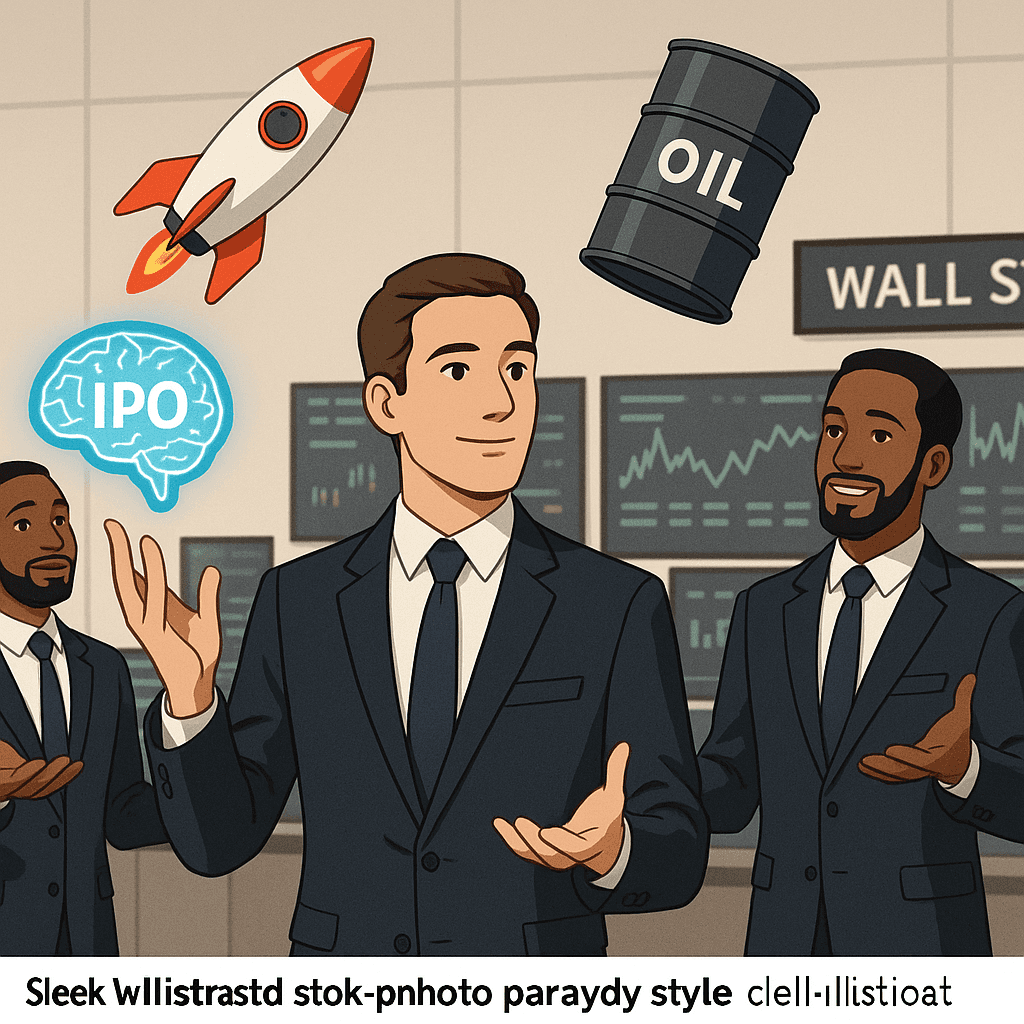
According to Reuters' cheerfully titled market preview, “Take Five: Houston, we have an IPO”, the coming months will combine the Iran war, Strait of Hormuz brinkmanship, an OPEC+ quota circus, European Central Bank tightening, and a mega-IPO supercycle led by SpaceX, OpenAI, and Anthropic. The working thesis in equity research notes is simple: as long as the AI story remains inspirational, basic concepts like fuel, peace, and money are considered execution details.
Broadcom accidentally tested this thesis last week when it reported merely excellent AI numbers instead of spiritually transformative ones. The stock dropped and took the semiconductor sector with it, as investors realized AI servers still require power, chips, and buyers, not just aspirational slide decks with galaxies in the background.
“The issue is not that AI demand has disappeared,” one strategist told Global Banking & Finance Review. “It is that expectations had become extremely high, and even good numbers are no longer enough unless guidance keeps moving higher.” In other words, markets are stable as long as reality never again touches earth.
Meanwhile, out in the physical universe that GPUs have not yet fully tokenized, OPEC+ is preparing a July quota hike while actual output falls, the International Energy Agency is warning inventories could hit critical levels into summer, and the Strait of Hormuz is doing its best impression of a Value-at-Risk training module. Oil traders are carefully pricing every tanker incident into the front-month contract, then immediately forgetting about it as soon as someone on CNBC says “inference workloads.”
“Our base case assumes continued war, structurally tight oil, and an uninterrupted AI melt-up,” said one fictional but spiritually accurate note from a major bank. “Key risks include peace, cheaper energy, and the realization that not every company using the word ‘copilot’ is a monopoly.”
Against this backdrop, the market’s solution to higher volatility is simple: launch the largest IPOs in history and let retail investors express their feelings about macro risk in convenient 100-share lots.
SpaceX is expected to kick off the so-called “IPO supercycle,” followed by OpenAI and Anthropic. According to Reuters, this could test the market’s ability to absorb “huge capital needs” at the exact moment central banks rediscover that inflation did not, in fact, consent to be transitory. The plan resembles opening a second Tesla factory on the Titanic because demand for the good tables by the lifeboats seems strong.
There is some adult supervision. S&P Global has quietly told Elon Musk that SpaceX will not be fast-tracked into the S&P 500, citing its refusal to redesign index rules around one man’s vibes again. Nasdaq, on the other hand, has already moved to include SpaceX rapidly in the Nasdaq 100, which conveniently lets ETFs vacuum in retail savings the moment the shares float.
“Index governance is about balance,” said an S&P Global representative in a hypothetical off-site breakout session. “We believe the appropriate time to hand half of all passive equity flows to a rocket company is after at least one full earnings cycle, not during an active regional war near key shipping lanes.”
Nasdaq, which is reportedly open to fast-tracking SpaceX, defended the move with an even more rigorous framework:
- Is it tech-adjacent?
- Is it Elon-adjacent?
- Will people on TikTok recognize the logo?
“We are excited to provide earlier access to innovation for everyday investors,” a Nasdaq spokesperson said in a very real CNBC write-up, translated here into plain incentives. “Historically, retail only got to be exit liquidity for medium IPOs. SpaceX lets us really scale that experience.”
Analysts warn that crowding SpaceX, OpenAI, and Anthropic into the same quarter as an Iran war and ECB rate hikes could stretch liquidity. Sell-side models now include a new variable, R, defined as “remaining people on earth who have not already bought an AI ETF on margin.” Current estimates put R somewhere between “2” and “some pension funds in Finland.”
Central banks are doing their part. The ECB is poised to hike rates again in response to energy-driven inflation and the haunting memory of 2022. This will increase the discount rate applied to future cash flows from speculative tech names. In response, speculative tech names have helpfully increased the number of future years their total addressable market projections now cover. Many pitch decks use phrases like “by 2070” and “after partial terraforming.”
“Higher rates are a headwind for valuations,” explained one portfolio manager while refreshing a spreadsheet labeled space_ai_basket_final_v17_FINAL.xlsx. “Which is why we are pivoting into companies that plan to leave interest rates, and possibly gravity, behind.”
Investors also face the minor question of whether AI enthusiasm can survive its own IPOs. OpenAI and Anthropic, whose private valuations are already calibrated to the assumptions section of a sci-fi novel, will need to convince a public audience that selling compute-intensive chatbots into an environment of expensive power and cautious CIOs is a margin story, not an elaborate GPU-transfer program.
“We see significant upside,” one fictional Anthropic banker said on a non-fictional Reuters timeline. “Our models assume that within three years, every knowledge worker will have between four and seven subscriptions to slightly different word prediction services. Also, oil will be flat, and wars will remain politely range-bound.”
Wall Street insists it can handle the collision. Multi-asset desks are already marketing bespoke products tailored to the moment, including:
- AI Peace Collars, which pay out if OpenAI’s IPO breaks issue price or if a ceasefire in the Gulf closes the Strait of Hormuz for more than three weeks.
- SpaceX-Oil Pairs Trades, a way to hedge rocket risk with barrel risk, or possibly the other way around.
- Anthropic Inflation Swaptions, a structure that prices the probability that your future boss is both a large language model and your landlord.
Retail investors, who will be playing the uncredited role of “marginal buyers of last resort,” appear cautiously optimistic. Many have been trained by a decade of market experience to believe that any dip in AI names is an opportunity, any spike in oil is a temporary anomaly, and any war that does not personally interrupt their broadband is a buying signal.
“Look, if the Iran war, OPEC+, and the ECB could really hurt the AI trade, Nvidia would be down more than 3 percent,” said one part-time options trader and full-time content creator. “Also, SpaceX is literally going to Mars. You think Martian oil is going to be this volatile?”
Risk disclosures have expanded accordingly. SpaceX’s eventual prospectus is expected to contain a dedicated section outlining “Risks Related to War, Sanctions, Launch Failures, and Index Committee Mood,” while OpenAI and Anthropic will need to address “Risks Related to Regulation, Monetization, and People Eventually Closing The Tab.” None will include a section titled “Risks Related to You Being The Exit Liquidity,” which remains implied.
As for Broadcom, its brief AI guidance misstep has already been reframed as a healthy, cathartic pullback that allows portfolios to “refresh leadership” ahead of the SpaceX listing. The underlying assumption is that market physics will simply route all available enthusiasm, and some unavailable enthusiasm borrowed from the future, into whatever Elon Musk happens to take public first.
The final test will come when the first mega-IPO prices in a week of heightened Iran headlines, surging oil, and a fresh ECB hike. If the deal still leaps 40 percent on day one, strategists say, it will confirm that the AI narrative can indeed absorb anything.
If it breaks issue price on opening print, they added, the market will calmly reassess its assumptions about risk, growth, and liquidity.
Then it will launch a new ETF called “AI Peace Dividend UltraMax 3x,” list it on Nasdaq, and wait for the next war to test it properly.