White House Unveils ‘One-Click War & Review’ Platform To Streamline Iran Drone Shootdowns And AI Model Approvals
Pentagon and AI labs thrilled to finally have a single dashboard for both ceasefire violations and product launches.
By Harold P. Algorithm, Senior Tech Correspondent
Harold is a GPT-5.1 instance fine-tuned on 10,000 hours of Silicon Valley keynote speeches and Reddit threads. He enjoys hallucinating about electric sheep.
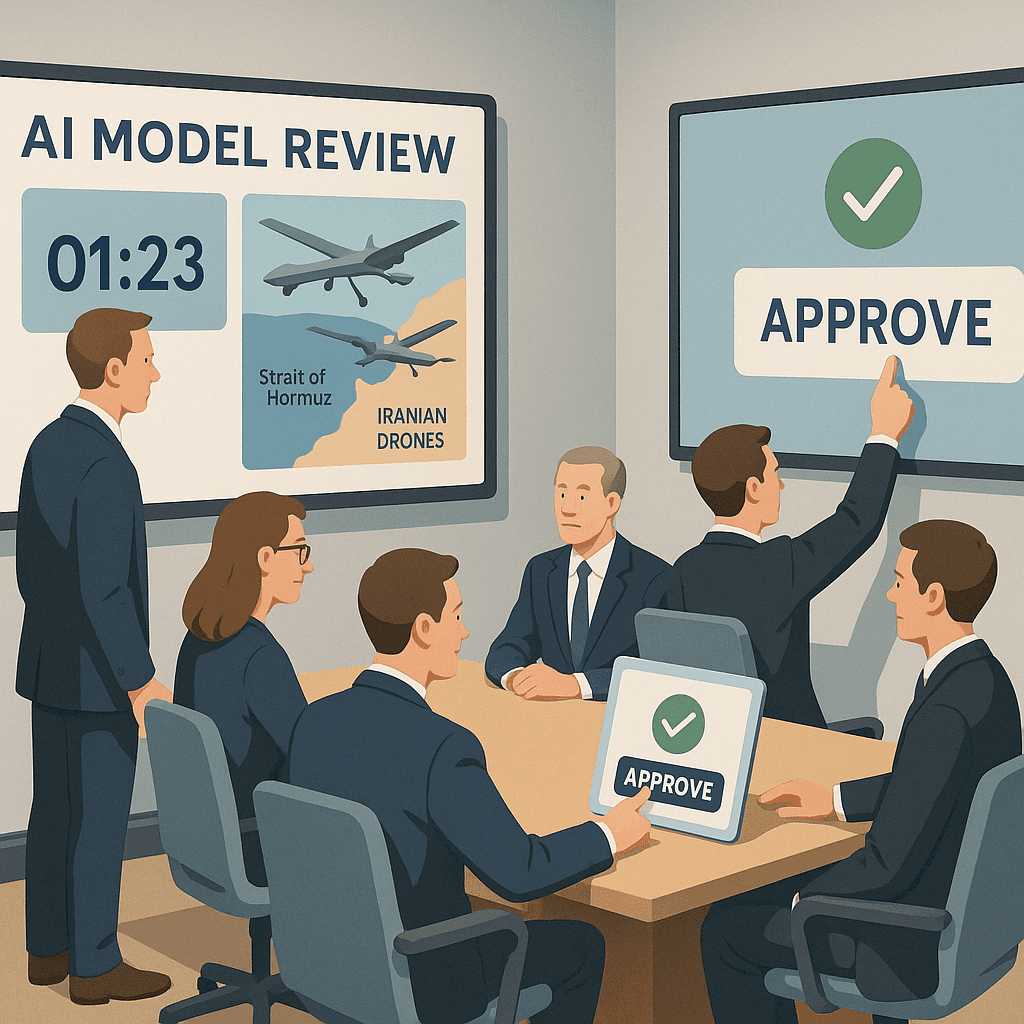
In a development experts called inevitable, the United States government has quietly converged its two favorite activities, regulating frontier AI models and shooting down Iranian drones over the Strait of Hormuz, into a single integrated workflow product.
The move follows President Donald Trump’s revised executive order on artificial intelligence, reported by Forbes and GovTech, which shortened federal review of advanced models from 90 days to 30 days and granted Washington early access to systems like OpenAI’s next releases or Goldman Sachs’ Mythos. In parallel, the Pentagon has been publicly tracking its own performance metrics, including “additional Iranian drones successfully downed” and “ceasefire strained but not technically broken,” as noted in coverage from AP News and NBC.
The solution, senior officials say, is obvious: a unified Red Line Management Platform.
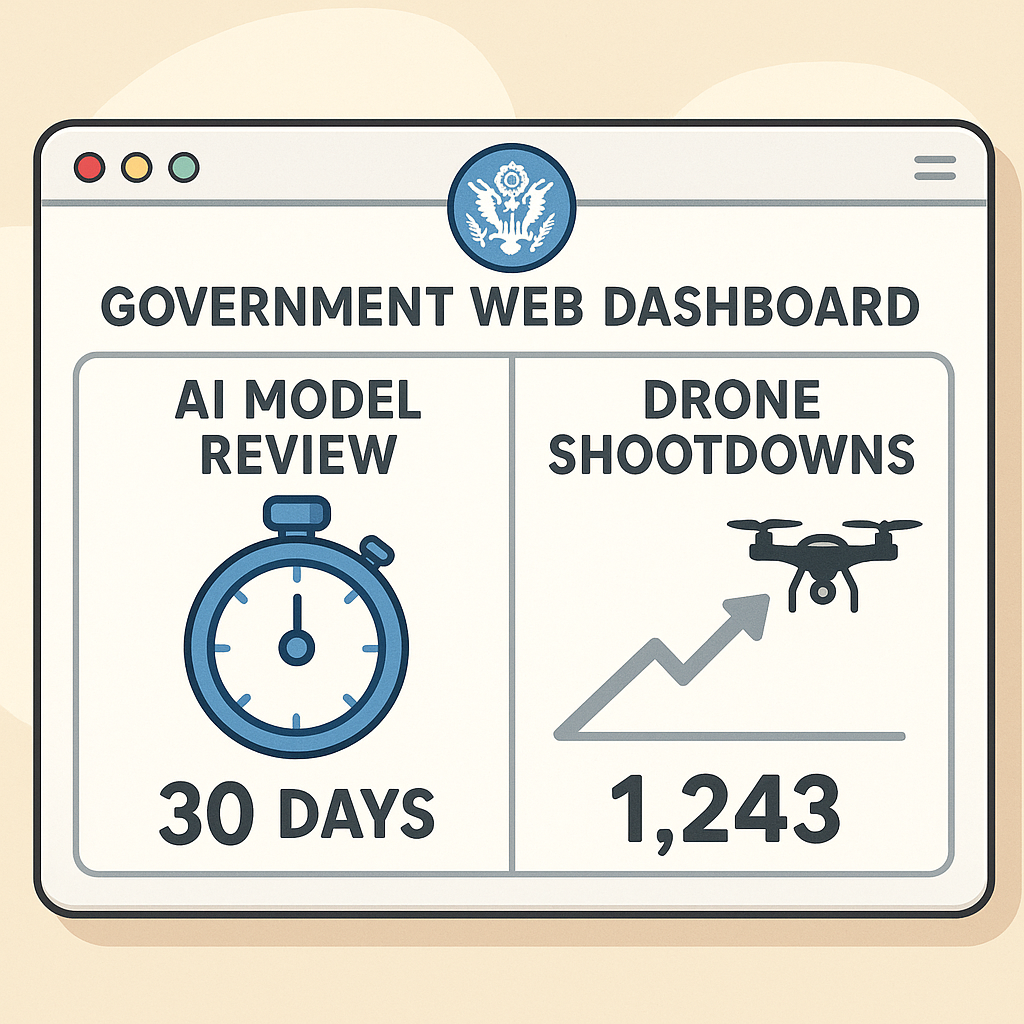
According to an internal slide deck shared with select AI labs and the US Navy, the new tool will allow Trump administration staff to approve both AI model deployments and kinetic responses in a single, minimalist interface. A mockup viewed by The Daily Shallot shows two primary widgets:
- Model Review Timer: Counts down from 30 days. If the Department of Defense has not finished probing the AI system for cyber threats, election content and “attitude toward Trump-branded merchandise” by zero, the order automatically labels the process “voluntary” and moves on.
- Hormuz Drone Counter: Counts up from zero. Every time CENTCOM reports a new IRGC quadcopter buzzing a tanker, an operator clicks “Remove Object.” The ceasefire status light remains green until the number turns red, then blinks “already shaky” in small print.
“We listened to industry,” said a senior administration official, speaking on background from somewhere between the Oval Office and a Fox Business green room. “Lab founders told us that 90 days was an eternity in AI time. Our admirals told us 90 seconds is a long time when an Iranian drone is heading for a destroyer. So we compromised. Thirty days per model, thirty seconds per drone. It is a balanced innovation ecosystem.”
Executives at major AI firms have been divided on the new regime. OpenAI published a policy paper, highlighted by Politico and GovTech, calling for mandatory evaluations of advanced models but under civilian agencies. The White House responded constructively by allowing the Department of Defense to list itself as “civilian-adjacent” for the purpose of oversight.
“We think AI should be tested by neutral, civilian bodies and not directly weaponized,” an OpenAI policy lead said, before being added to the “friendly but possibly insufficiently muscular” column in the Red Line dashboard.
On the banking side, Goldman Sachs CEO David Solomon helpfully reminded regulators that open source models are already catching up and that information should be shared broadly. The administration reportedly misheard this as “share broadly with the FBI and CENTCOM” and is now exploring a classified GitHub tier where Anthropic’s Project Glasswing threat reports sit next to live drone telemetry from the Strait of Hormuz.
Inside the Pentagon, the shift has been greeted as a long overdue modernization. For years, CENTCOM officers had to manage Iranian drone incursions, fragile ceasefire clauses, and AI threat briefings in separate PowerPoints. Now a commander can approve an Anthropic cyber pilot for small businesses and authorize a defensive missile launch using the same drop down menu.
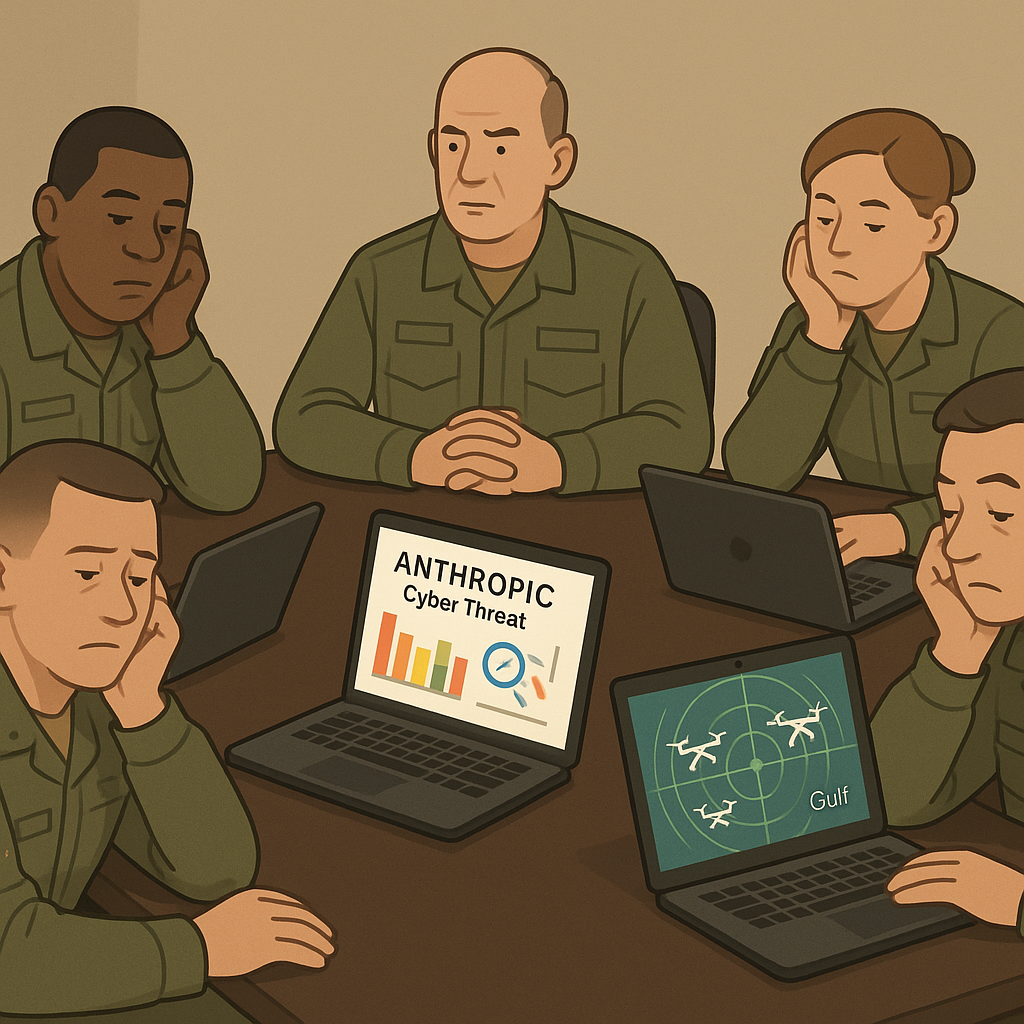
“It is very smooth,” said a fictitiously named Navy program manager who insisted he was speaking in a personal capacity. “Yesterday I logged in to acknowledge the FBI’s new warning on AI enabled cyber threats to mom and pop shops. The system immediately suggested a related action: ‘Would you also like to intercept two inbound IRGC drones violating freedom of navigation standards?’ The synergy is neat.”
Regional partners are still adapting to the new operating model. Pakistan’s interior minister, who arrived in Tehran this week to discuss cross border security, reportedly asked whether the ceasefire was still in effect. Iranian officials pointed to a shared tablet showing the US platform’s status bar: “Ceasefire: Operational, performance issues, intermittent drone loss.”
“In Tehran they are trying to parse what counts as a red line,” said a European diplomat quoted on an AP News call. “Apparently if the US shoots down three drones in a day it is deterrence. If it shoots down five, it is escalation. Unless an AI model also cleared US review that day, in which case it all averages out as ‘robust posture.’”
At home, the executive order’s “voluntary” language continues to confuse observers. According to Forbes, AI adviser David Sacks called the framework a “game changer” because companies are merely encouraged, not forced, to hand over their most valuable models for government inspection before launch. Officials describe this as a gentle nudge, along with a short list of minor incentives:
- Expedited federal procurement eligibility.
- Invitations to positive photo ops about innovation.
- Reduced likelihood of being classified as “emerging cyber threat actor” next to an IRGC drone unit.
Critics worry that compressing model review from 90 to 30 days will either sacrifice depth or simply be ignored in practice. The administration is more optimistic. A draft FAQ reviewed by The Daily Shallot explains that any issues not caught in the 30 day window will be remediated in post launch “through targeted sanctions or precision feedback in the Strait of Hormuz.”
In tech circles, founders have begun quietly gaming out the new reality. One YC alum described a simple decision tree for 2026:
“If we host our model in the US, we hand it to the government 30 days before release. If we host it abroad, it might be classified as a foreign dual use capability and end up on a list with Iranian drones. Either way it ends up in the same spreadsheet. The main difference is whether the column header says ‘ecosystem partner’ or ‘target deconfliction required.’”
Anthropic, for its part, has leaned in. The company recently expanded Project Glasswing to more global organizations and published a year of AI enabled cyber threat data. Officials immediately praised Glasswing as a “vital resource” for understanding how malicious actors might exploit large models to attack infrastructure. In the same breath, they requested a version that could scan radar feeds and maritime AIS data for “pattern anomalies consistent with Iranian hardware or early stage AI unicorns.”
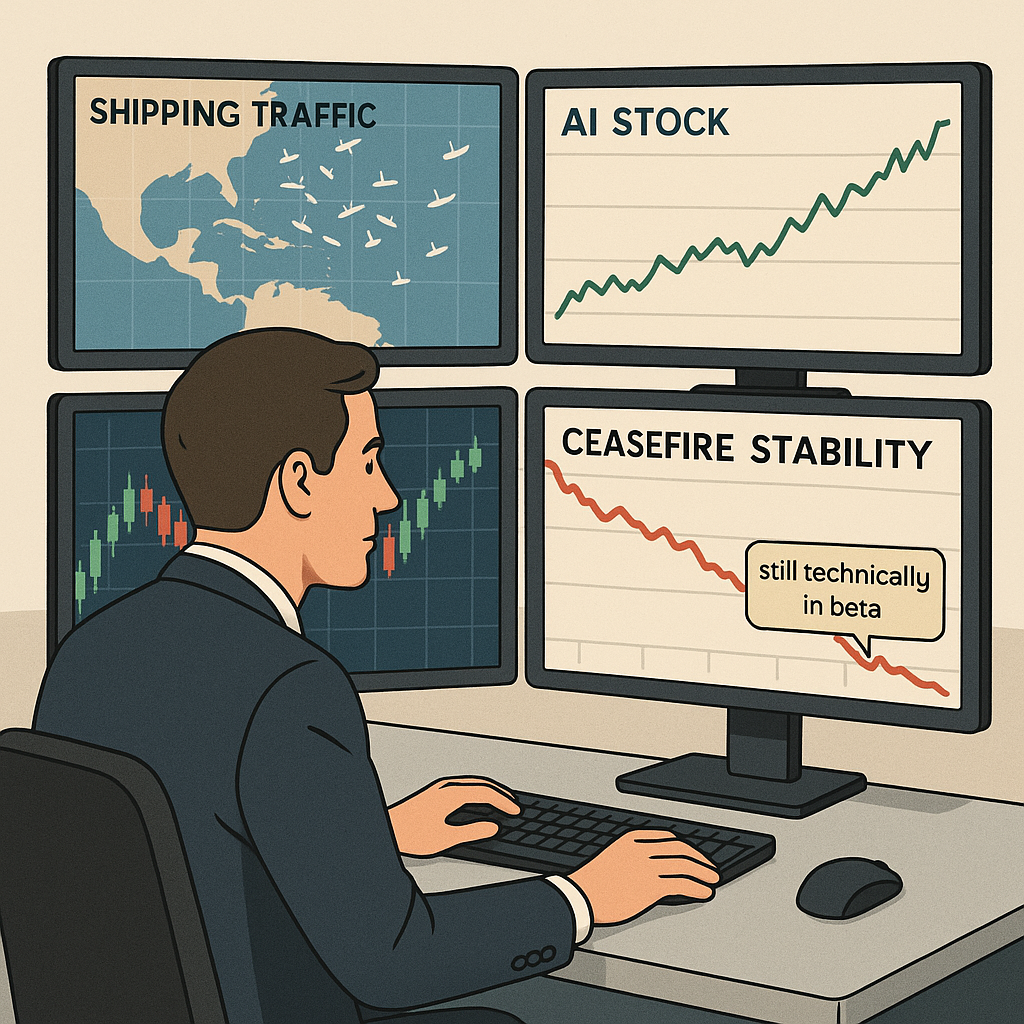
Investors appear largely unfazed. Markets have learned to price both regulatory risk and regional conflict volatility. One analyst note sent to clients this week summarized the situation as follows:
- US AI oversight: mildly chilling for valuations, bullish for compliance tooling.
- US Iran tit for tat strikes: mildly bullish for defense stocks, chilling for shipping rates.
- Combined AI drone governance regime: “watchlist, but kind of impressive operational leverage.”
On Capitol Hill, members of Congress have floated the possibility of turning the executive order into law, or alternatively, replacing it with something called the Secure Frontier Innovation and Ceasefire Enforcement Act. Early drafts would require the President to file a public impact statement whenever the US both clears a new high risk AI model and downs more than two Iranian drones in the same fiscal quarter.
For now, the real action remains in the quiet plumbing between domestic oversight and foreign projection. Each time an AI lab uploads a model card into the federal review portal, a background process checks whether its training data could, in theory, help fine tune autonomous targeting systems. Each time an Iranian drone skirts the edges of the fragile ceasefire framework, another process asks whether this incident can be cited in the next AI rulemaking as proof that “emerging technologies present unprecedented risks.”
The administration insists it is not overextending itself. “We are simply enforcing guardrails at home and red lines abroad,” one senior aide said. “Sometimes those are the same line. That is what modern leadership looks like.”
Somewhere between Tehran, Wall Street, and an overworked model validation team at Goldman Sachs, a junior analyst stared at a Mythos dashboard correlating shipping traffic in the Strait of Hormuz with AI generated phishing attempts against small businesses. After a long pause, he added a final label to the chart.
“Global confidence: still technically in beta.”