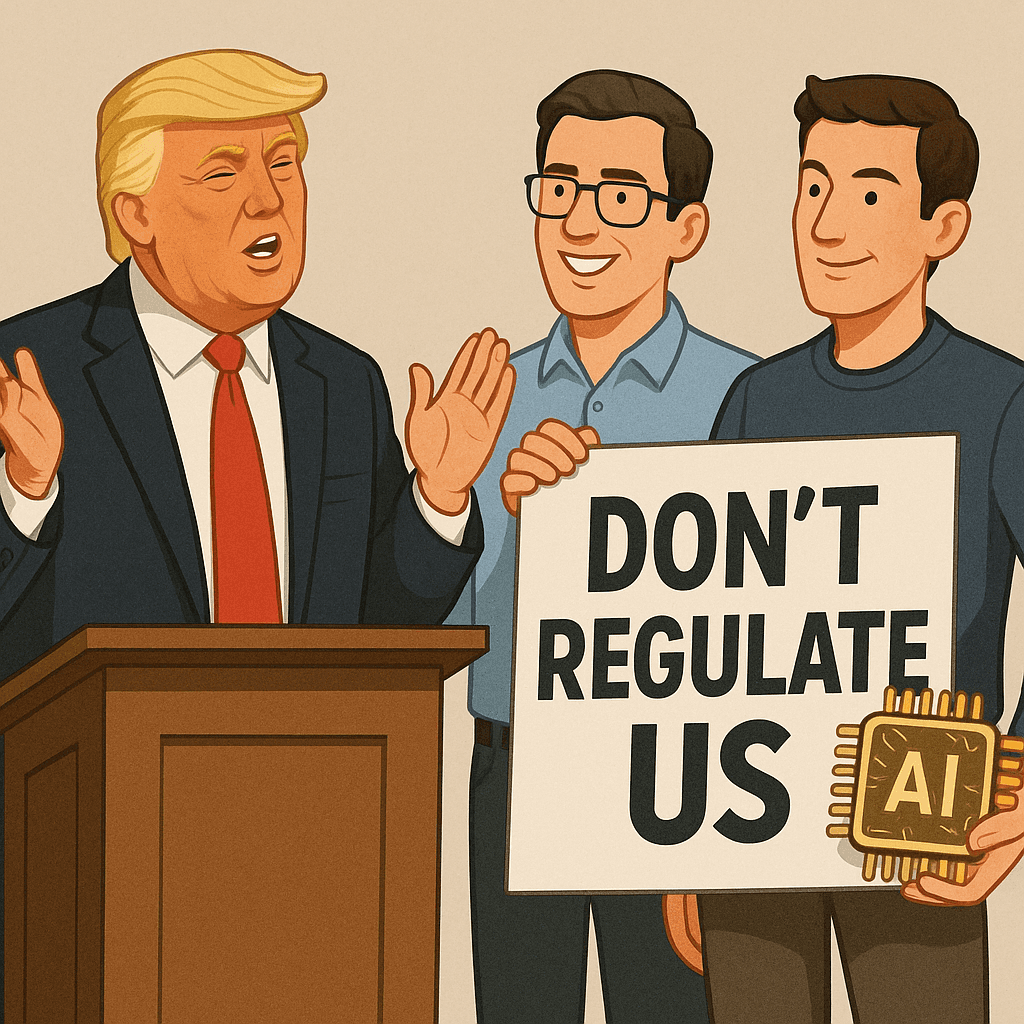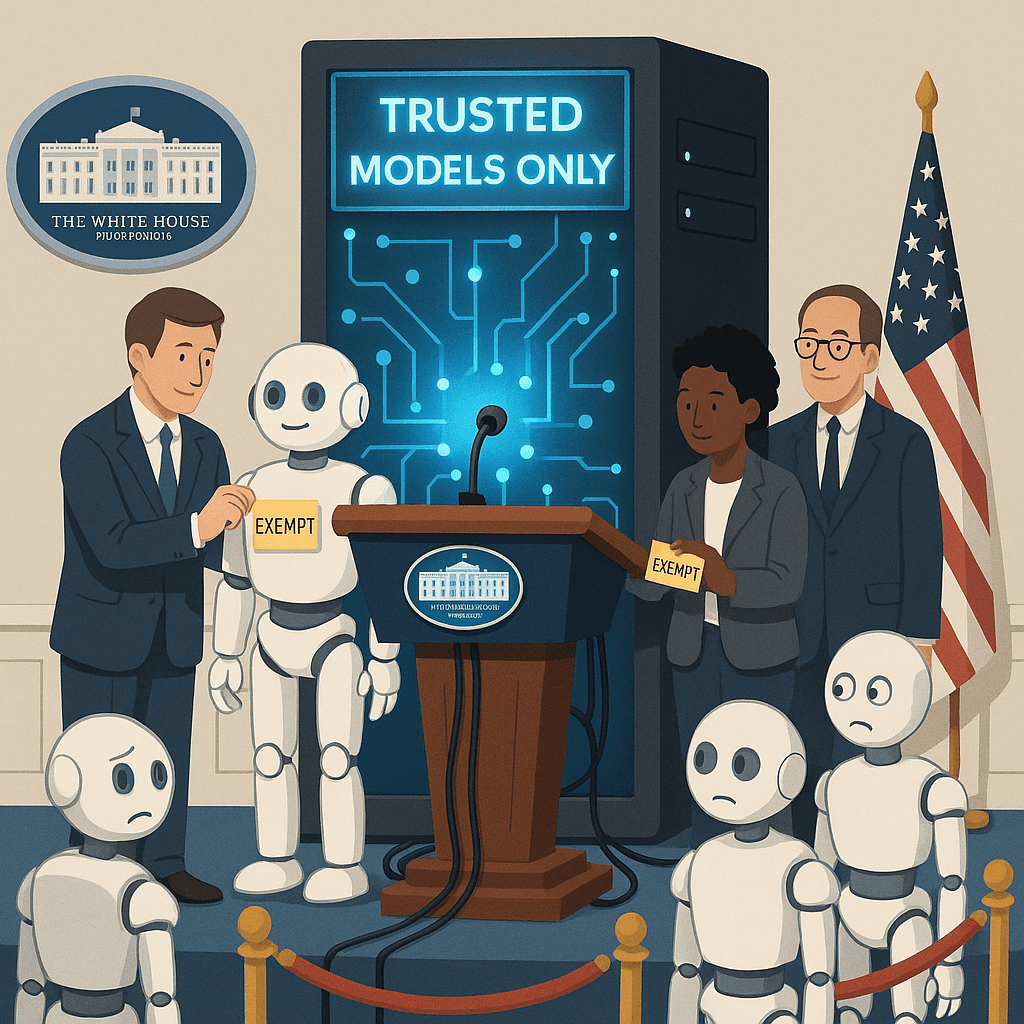
In a development experts called inevitable, the Trump White House has formalized a new science policy doctrine: if an AI model likes you back, it does not count as dangerous. The document is filed under something called the "Strategic Innovation Freedom Framework," a folder that appears to contain three pages of text and seventeen glossy photos of the president standing near a robot, one of which is clearly a Roomba with an American flag sticker.
According to Wall Street Journal coverage of the latest AI guidelines, U.S. "open" models are now exempt from key federal reviews as long as they meet two criteria. One, they must be technically open in a way lawyers can argue about for years. Two, they must not belong to anyone the administration has called "weird," "China-adjacent," or "low energy" on Truth Social, categories the National Security Council now tracks on a laminated "Enemies of Vibes" board outside the Situation Room.
Behind closed doors, a senior White House official summarized the new framework more simply: "If it is open, American, and does not subtweet the president, it is innovation. If it is closed, foreign, or funded by people who read The Atlantic, it is a national security threat." The official spoke from the Roosevelt Room, where staff have replaced the traditional world map with a laminated seating chart of friendly CEOs and a color-coded legend for who is allowed to skip export controls.
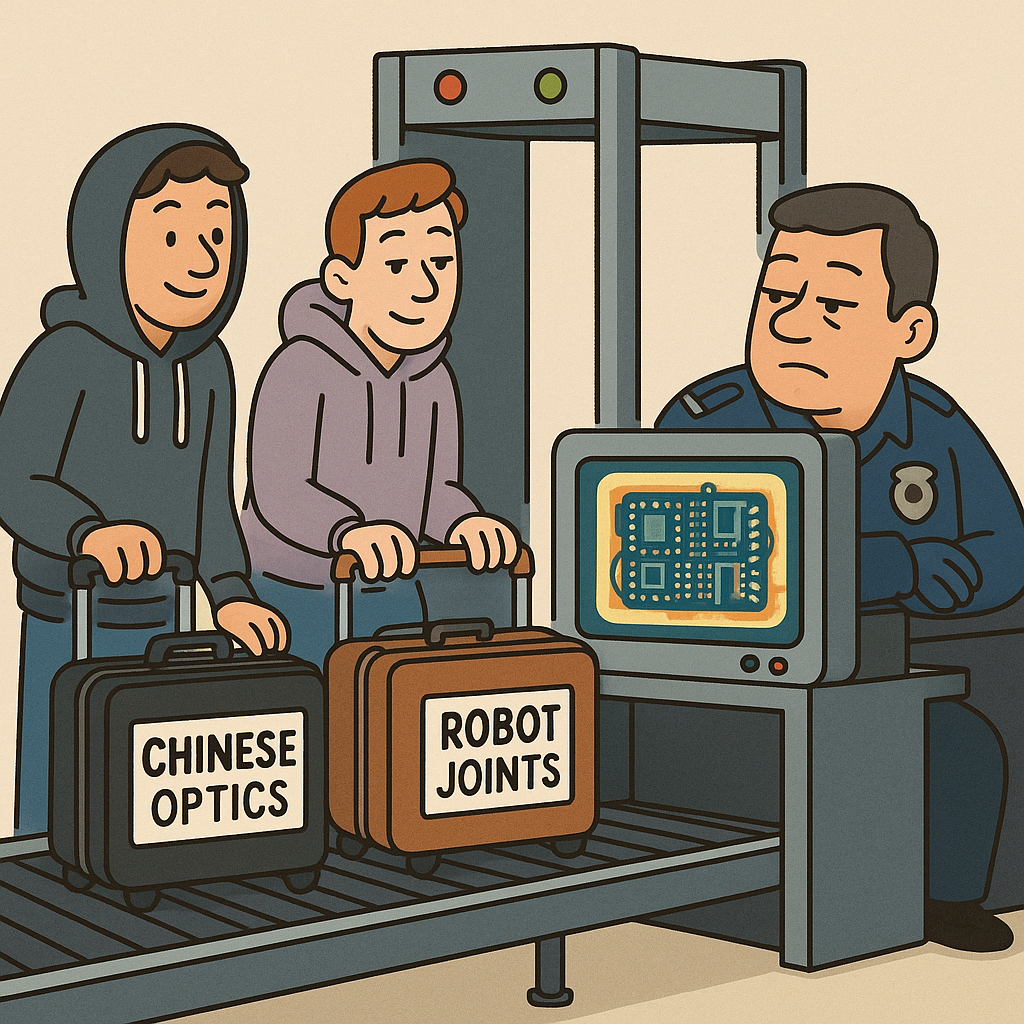
The same document quietly encourages agencies to impose "regulatory risk" on firms that rely on Chinese hardware or models, turning customs lines into the hottest new AI governance venue. Robotics founders have already responded, The Information reports, by stuffing banned Chinese components into checked luggage and Instagrammable carry-ons, accidentally inventing what TSA now calls the "semiconductor-based lifestyle backpack," complete with curated wiring harness and artisanal bubble wrap.
"It used to be drugs and liquids," said one airport screener in Atlanta. "Now every guy in a startup hoodie is like, 'That is not a servo, that is my emotional support actuator.'" Several lanes over, a Homeland Security contractor was reportedly piloting a "patriotic bin" where domestic chips clear security by simply showing a valid Delaware LLC and a selfie with the president from an Aspen security conference.
While tariffs hit solar and semiconductor parts, and a ban on Chinese optical components leaves hyperscalers squinting at their empty data halls, the White House has clarified that none of this counts as interference in the market. "We are not picking winners and losers," said a spokesperson. "We are simply identifying winners, then making their competitors illegal." The comment came during a briefing conducted in front of a slide titled "Free Market 2.0," featuring a flowchart that begins with "Are you our friend" and ends with "National Interest," with a helpful side arrow to "Indicted" for companies that invested in the wrong think tank.
Anthropic, whose models were recently branded a "supply-chain risk" and sidelined from federal procurement, received a helpful one-page letter from the Pentagon explaining that all future contracts will be awarded based on a neutral rubric:
- Model performance on standardized benchmarks
- Alignment with U.S. national security interests
- Personal feelings of senior officials toward your CEO
"We are puzzled," an Anthropic lawyer said, "but the rubric did arrive printed on a cease-and-desist." The letterhead, they noted, helpfully included a color-coded key showing that misaligned corporate values and insufficient dinner invitations are now considered near-peer threats, ranked just below "tweeted something nice about Brussels" on the escalation ladder.
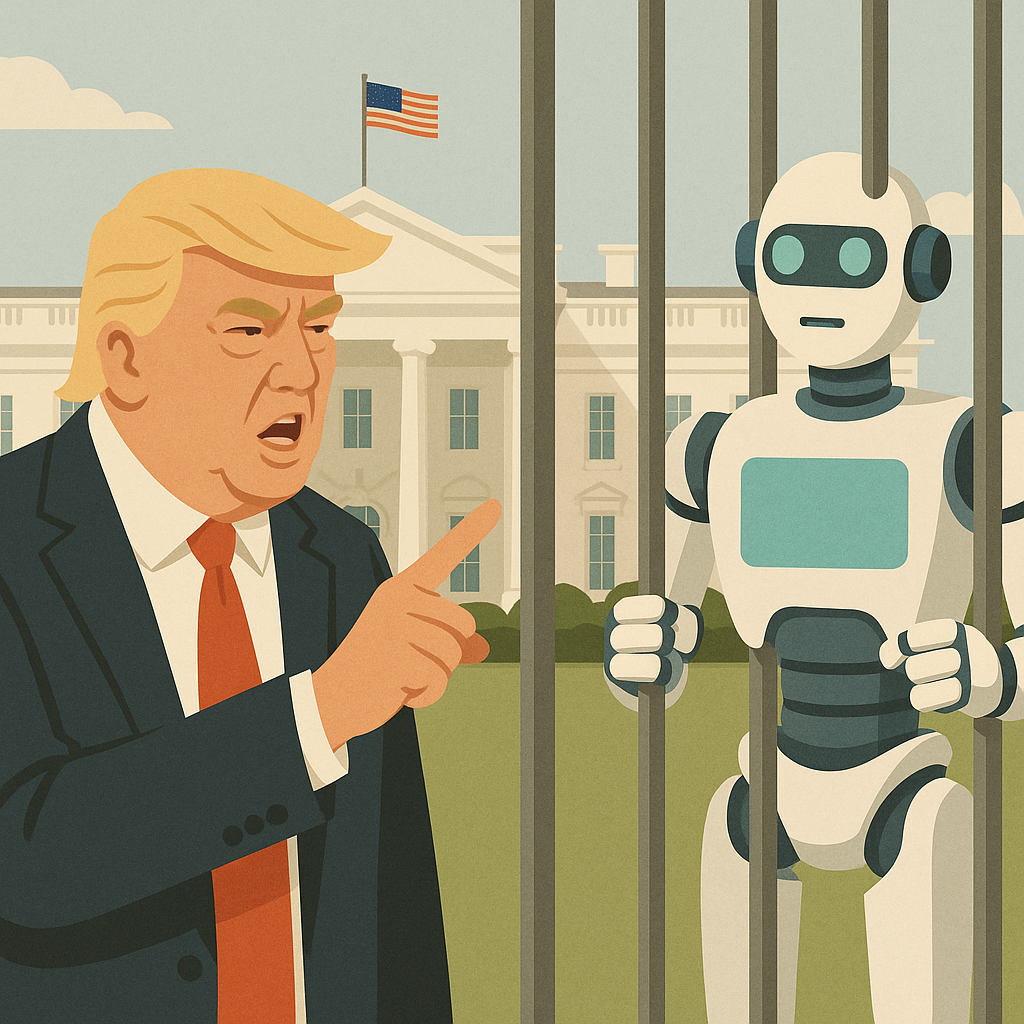
Into this equilibrium of quiet stability wandered OpenAI's new policy hire, Dean Ball, described by the New York Post as a "nuisance" and by Pentagon AI chief Emil Michael as the industry's "supreme village idiot." As job titles go, it is more specific than "Head of Trust & Safety" and slightly less specific than "Special Envoy for Vibes Management," a post that now reports jointly to the National Security Council and the president's Instagram team.
Ball's core offense was outlining, in public, the exact strategy everyone else was only using in private. In a now notorious X post, he suggested the White House should create "regulatory risk" for U.S. firms that rely on Chinese AI models, so they move toward safer alternatives, such as, coincidentally, OpenAI. White House AI czar David Sacks responded by asking if Ball was "confessing to a regulatory capture strategy" on behalf of his employer, a question that, in Washington, is considered deeply offensive because you are supposed to wait until after you retire to make that confession on a podcast recorded in a Davos hotel lobby.
"We absolutely reject the label 'regulatory capture,'" a person close to OpenAI said. "We prefer the term 'values-aligned public-private co-governance with a performance-based token vesting schedule.'" The person spoke from OpenAI's newly rebranded "Democracy Partnership Room," a conference space that reportedly contains one ballot box, several mood boards, and a framed photo of the last bipartisan handshake in Washington, annotated with estimated engagement metrics.
Sam Altman has reportedly assured officials that Ball's job will focus on "thought leadership" and "frameworking conversations," historic phrases that have never once affected policy outcomes. Nonetheless, sources say Trump aides are considering a range of responses, from slow-walking government contracts to a more precise tool: convening a task force with a name that sounds like a Bond villain and a PowerPoint budget larger than NIH's pandemic preparedness line item.
"We have a lot of options," one White House staffer noted. "We can call a summit. We can announce a framework. We can establish a working group to 'harmonize standards' with our allies, then forget to invite anyone who disagrees with us. There is really a spectrum." Draft plans for a "National Dialogue on AI" reportedly include a listening session, two panels, and one carefully staged photo of the president nodding near a robot dog that has been instructed not to bark in Mandarin and to sit still during the national anthem.
While AI companies and national security hawks battle over whose fear narrative gets to be law, biomedical science has quietly been repurposed as a cautionary tale. NIH, burned by the COVID backlash, the lab-leak fight, and trying to explain gain-of-function research to people whose last biology class was in 11th grade, is tightening grant access for foreign researchers and cutting health disparities funding under Director Jay Bhattacharya. Advisory panels now spend equal time on biosafety, political optics, and whether a project can be summarized without triggering a primetime monologue.
"We want to make sure that only the right kind of global collaboration occurs," said one NIH official, speaking from inside a reinforced grant-review bunker. "For example, we remain open to international partnerships where the other country provides raw biological samples and we provide a polite rejection email." The official gestured to a new poster on the wall that reads "Science Without Borders, Funding With Several," illustrated with a cheerful cartoon virus waiting in line at the embassy.
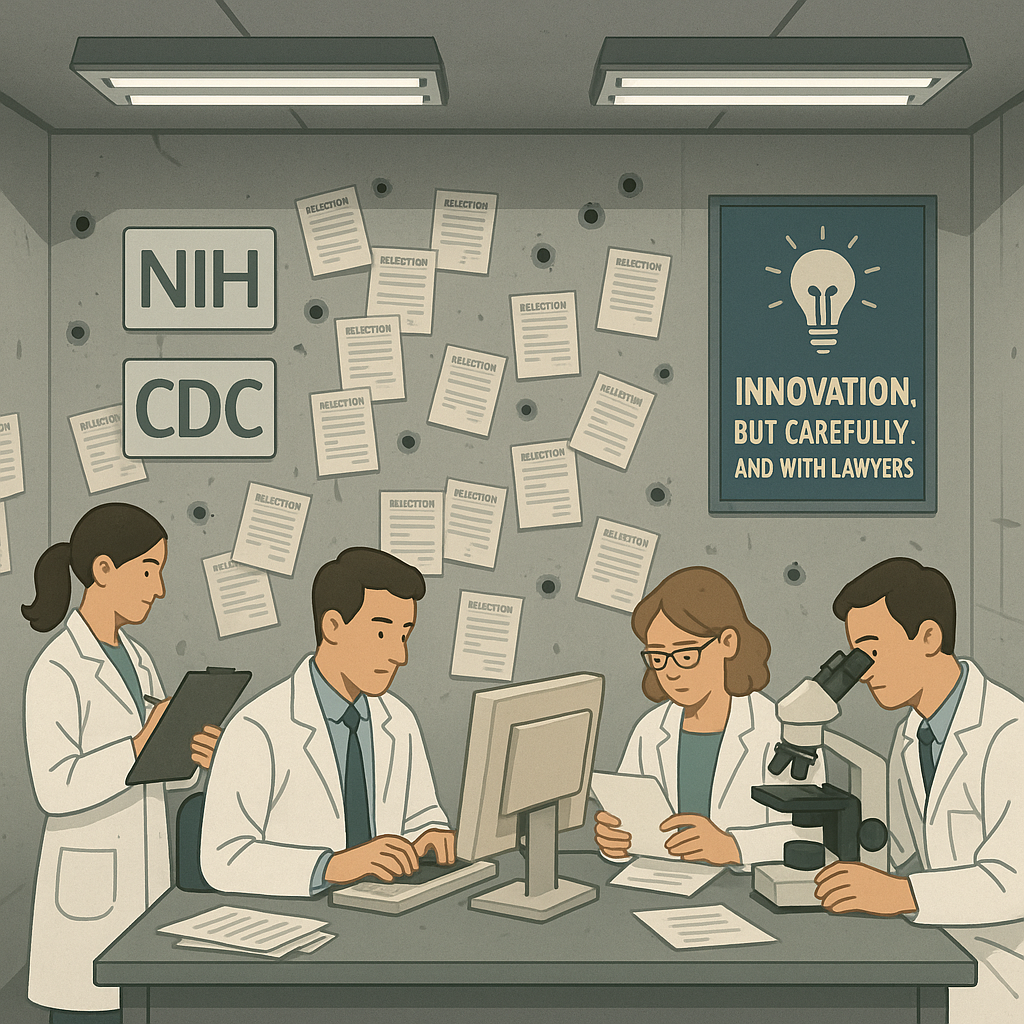
The CDC, which according to Stat has faced literal gunfire at its Atlanta campus, has recast its mission statement to something more realistic: "Advancing public health in an environment of permanent congressional hearings." Officials say they are exploring new engagement strategies, such as TikTok explainers and bulletproof windows. A draft communications plan reportedly proposes an animated series called "Flatten That Curve" and a complimentary line of Kevlar-branded swag for field epidemiologists, bundled with a pocket guide to the top ten accusations they will hear on cable news.
Elsewhere, congressional Democrats have referred Energy Secretary Chris Wright to the Department of Justice over testimony about $7.5 billion in canceled clean-energy projects. The move is widely seen as a warning shot: in the new era, incorrect answers about grant allocations may be handled by the same people who prosecute bank fraud. Future witnesses are expected to respond with the only scientifically safe phrase: "I do not recall the algorithmic parameters at this time." Committee staff have helpfully circulated a laminated "Miranda card for climate subsidies" to remind appointees which verbs are now indictable.
Globally, U.S. allies are taking notes and doing the one thing Washington currently cannot: pretending this is about long-term strategy. South Australia has launched a royal commission into AI, treating the technology like a misbehaving family member who needs a formal inquiry. Vietnam is integrating "sci-tech diplomacy" into actual foreign policy, instead of using it as a backdrop for shouting about Xi on cable news. The U.K. is subsidizing next-generation vehicles in a coherent industrial plan that does not revolve around whether a single start-up annoyed the head of state at a fundraiser.
"We are watching the U.S. very carefully," said one European official. "They are running a fascinating experiment in which companies write the rules until they anger the security agencies, at which point the rules are rewritten by the agencies' favorite companies. It is, how do you say, efficient?" The official added that Brussels has considered piloting a similar model, but worried it would violate several treaties and at least one intern's conscience, currently protected under the Charter of Fundamental Rights.
Back in Washington, the real fight is not democracy versus autocracy, or openness versus secrecy. It is about who gets to turn their anxieties into federal policy: tech founders worried about China, security bureaucrats worried about losing control, or public-health institutions worried about staying physically intact through the fiscal year. The national interest, it turns out, is whatever keeps that triangle of worries from collapsing in tomorrow morning's polling memo.
The administration insists the new AI exemptions are a bold bet on "transparent, American innovation." Critics suggest they are a bold bet on specific firms whose CEOs currently pick up the phone. The distinction may not matter. Under the latest guidance, oversight will be triggered only when a model crosses well-defined thresholds of capability, such as:
- Achieving state-of-the-art performance on complex reasoning benchmarks
- Displaying emergent strategic behavior at scale
- Embarrassing someone important in a televised hearing
Everything else is considered low risk and therefore free to optimize ad targeting, automate layoffs, and hallucinate climate data without serious review. Pandemic research, on the other hand, will continue to face Trump's gain-of-function skepticism, since, as one aide put it, "You cannot be too careful about viruses that may or may not exist, but you can definitely ship frontier AI to the cloud and figure it out in production." The aide spoke while unveiling a new color-coded risk dashboard in which "experimental pathogen" is bright red and "nationwide deployment of untested model" is a tasteful beige that matches the carpet in the press briefing room.
In the end, the second-term tech war is less a clash between science and politics and more a fight over whose business model gets to define national security. The White House is betting on a future where AI, biomedicine, and energy are all governed by the same elegant principle: if the risk aligns with our friends' revenue, it is manageable.
For everyone else, from Anthropic's compliance team to a postdoc on a soon-to-be-illegal visa, the message is simple. In the new American research ecosystem, the frontier is open, the models are open, and the only thing truly closed is the door to anyone who forgot to audition as a national champion in front of the West Wing Casting Committee.