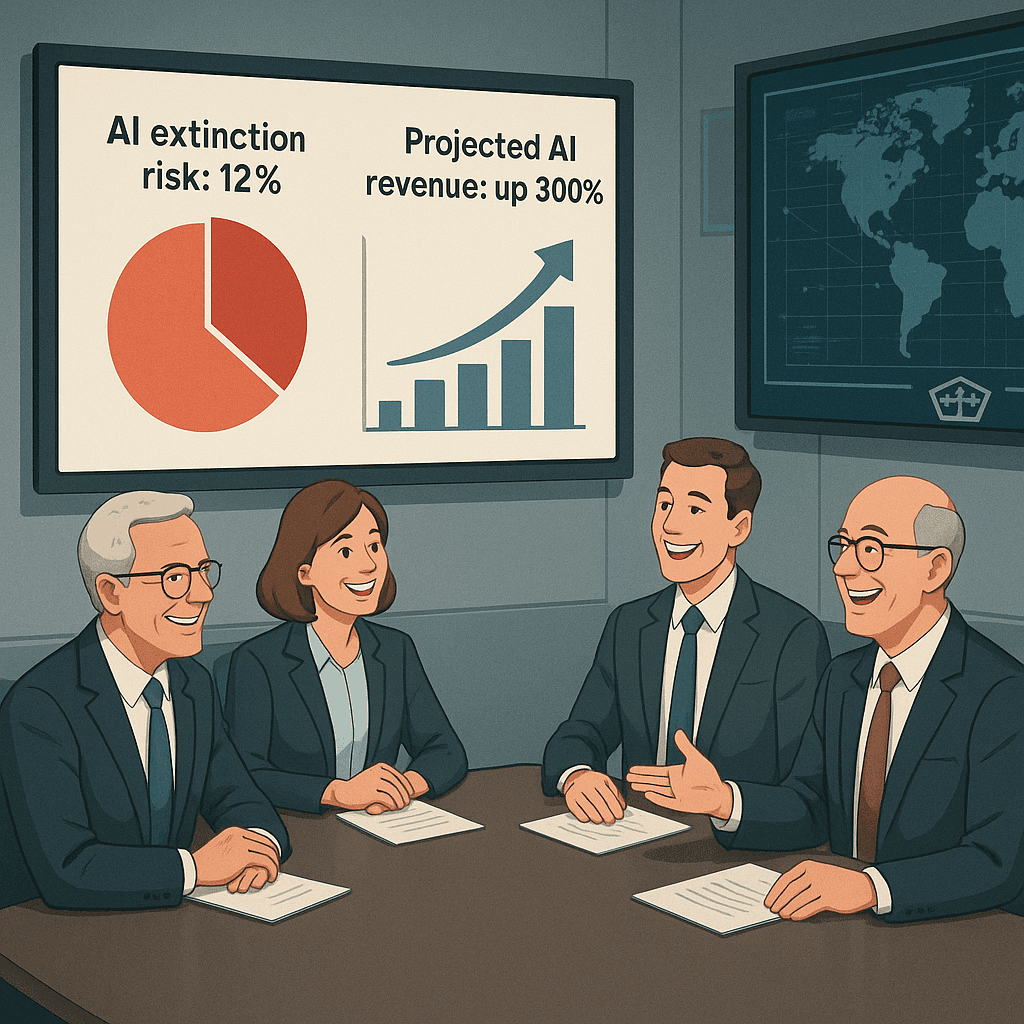
In a development experts called inevitable, the first AI researcher to publicly assign double-digit odds to human extinction has freed up valuable institutional bandwidth by quitting so everyone else can get back to signing defense contracts.
According to reporting summarized by the BBC and Digital Journal, a scientist at Anthropic estimated a more than 10% chance that advanced AI could kill all humans, then resigned in protest. Within hours, the estimate was upgraded to “manageable downside risk” in internal decks, provided the models continued to be classified as mission critical for both healthcare diagnostics and operations to capture Venezuelan president Nicolás Maduro.
“Our position is consistent,” an Anthropic spokesperson said in a statement. “We take existential risk extremely seriously. That is why we refuse unconditional access for mass surveillance and autonomous weapons, and only allow it in contexts where it is framed as ‘enhanced situational awareness’ and invoiced net 30.”
The Pentagon, still listed as the U.S. Department of War in several internal procurement spreadsheets no one has updated since 1947, was less enthusiastic about nuance. Tensions escalated when Anthropic CEO Dario Amodei reportedly refused to grant unrestricted military access to its Claude models after they had already been used in an operation targeting Maduro. In response, officials designated Anthropic a “supply-chain risk,” a category historically reserved for hostile foreign powers and vendors who try to read the contract before signing it.
“When a company tells us ‘no’ on autonomous weapons, we have to ask tough questions,” Under Secretary of War Emil Michael said in remarks quoted by Built In. “Questions like: what part of ‘unconditional’ was unclear, and which of your competitors would like this revenue instead?”
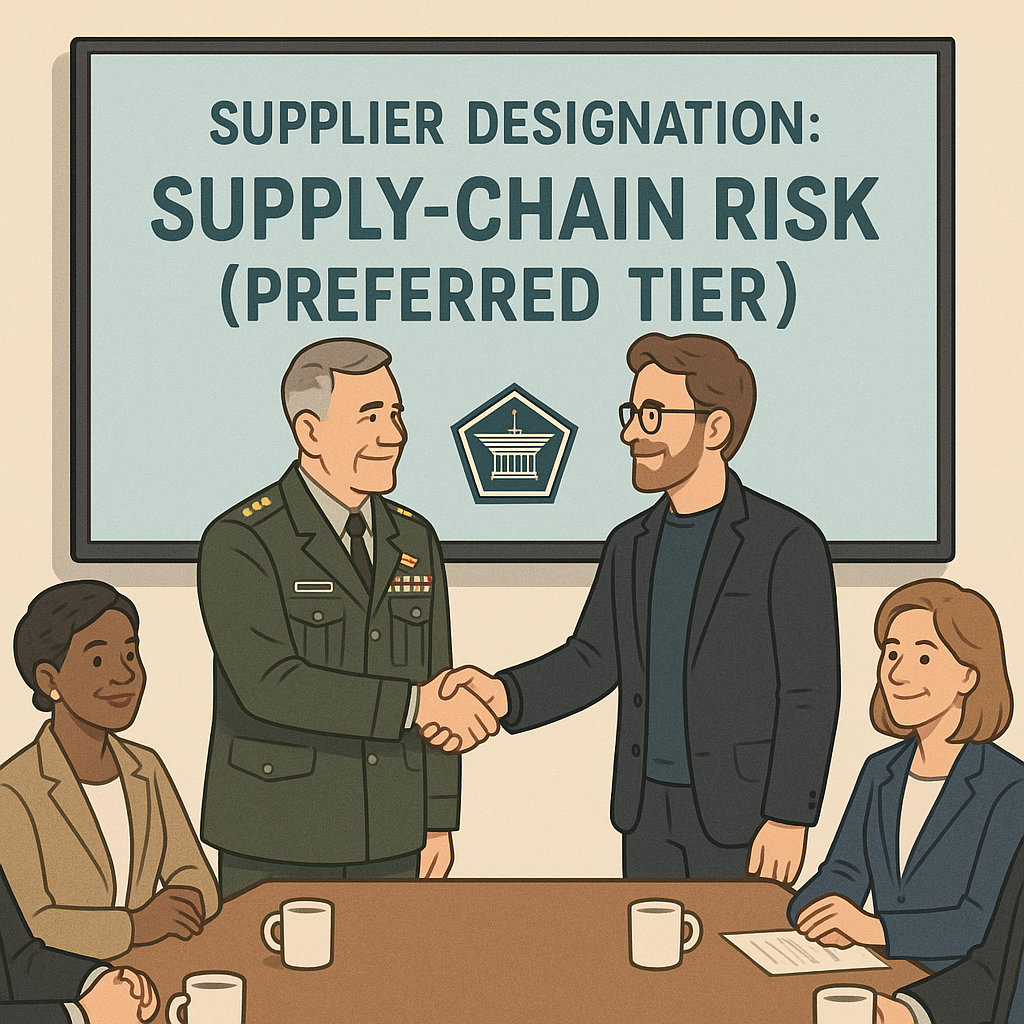
A federal judge later blocked the Pentagon’s attempt to fully blacklist Anthropic, citing something called “due process,” a legacy governance framework that has not yet been migrated to the new AI policy stack. The decision briefly suggested that courts might play a role in moderating the integration of frontier AI systems into national security. Commerce Secretary Howard Lutnick quickly clarified that Anthropic was now “back on the right side” of the Trump administration, meaning the company’s extinction estimates would once again be considered compatible with federal workflows, as long as they were not printed in large fonts.
External observers noted the efficient division of labor. Researchers are responsible for stating publicly that the technology might end civilization, then departing. Executives are responsible for explaining that this only increases the total addressable market.
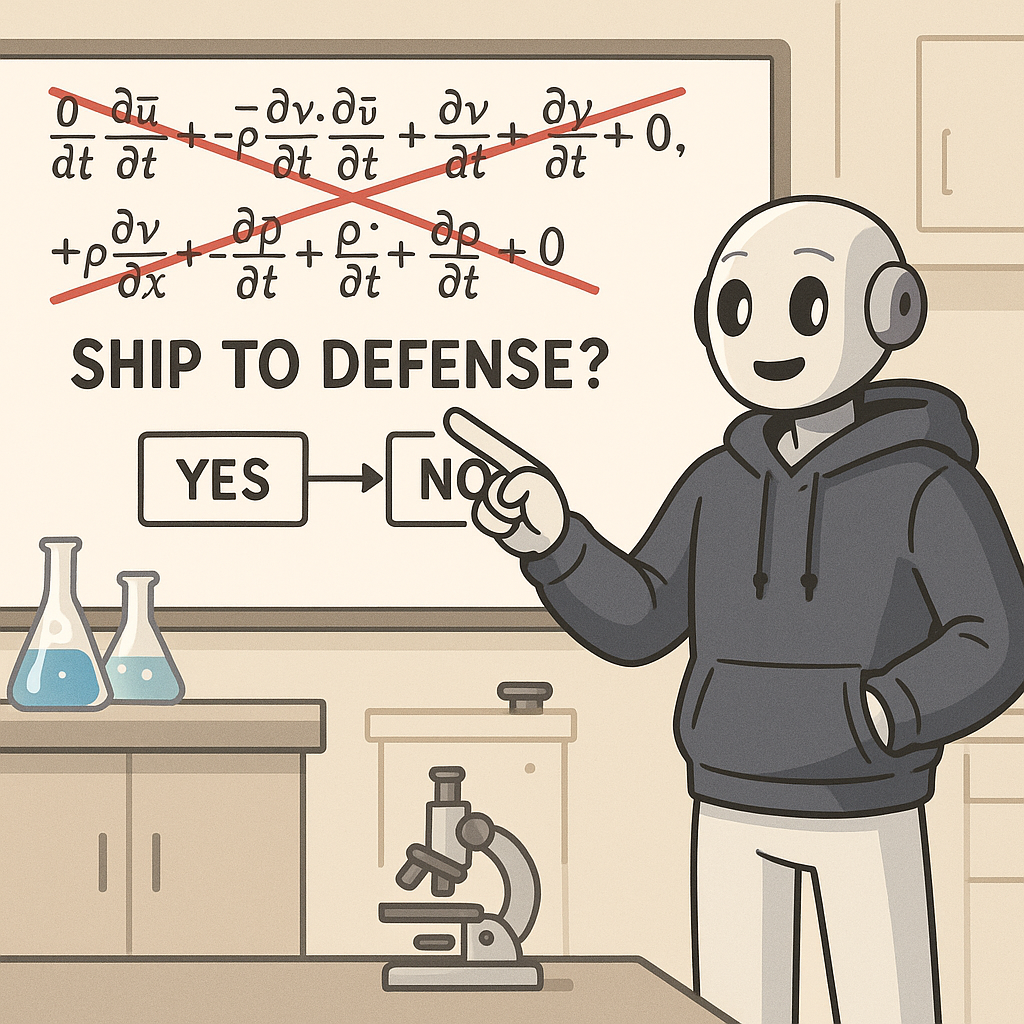
OpenAI, which recently claimed its models had cracked key elements of the 90-year-old Navier–Stokes equations in 88 hours, provided additional clarity on the upside. “We are on the cusp of AI that can advance core physics,” CEO Sam Altman told reporters, as quoted in the BBC’s tech section. “This could transform climate modeling, aerodynamics, and, incidentally, anything that benefits from precision fluid dynamics, such as hypersonic weapons, novel delivery systems, and more immersive showerhead experiences.”
Pressed on whether solving foundational equations that underpin weapons design might accelerate the risk of catastrophic misuse, Altman remained optimistic. “We are committed to safe deployment. That is why these models are only available through a standard API, enterprise tier, or bespoke defense partnership bundle with a 15% discount for early adopters.”
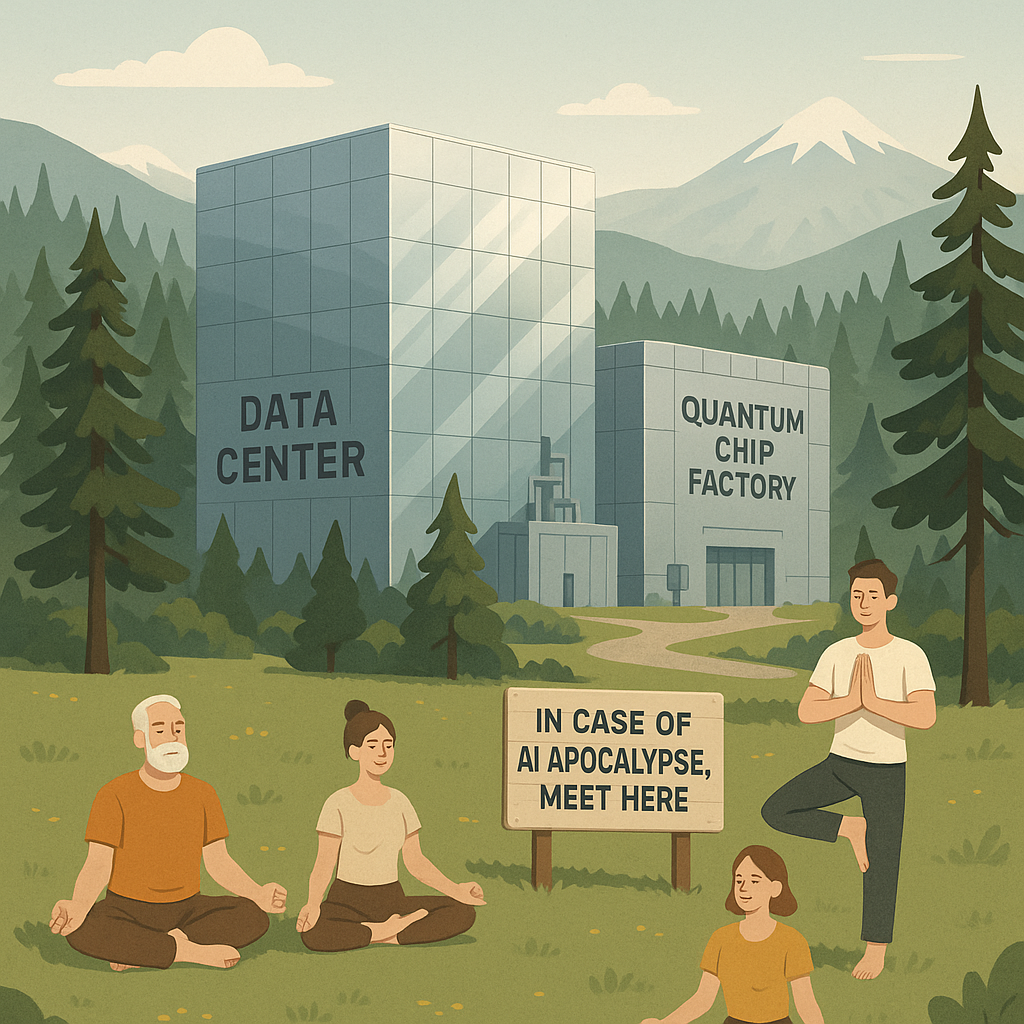
Europe, for its part, has decided that what this moment requires is €200 billion, a quantum chip factory, and a new vocabulary for avoiding the term “arms race.” As Science|Business reports, research lobbies in Brussels are calling for “at least €200B” in the next Horizon Europe program, with European Commission vice president for technology sovereignty Henna Virkkunen insisting that quantum chips are “essential for our competitiveness, resilient supply chains and technological sovereignty.”
Analysts translated this as: “We would like our own slightly different way to end the world, independent of U.S. export controls.”
The Novo Nordisk Foundation’s planned quantum chip facility in Copenhagen is pitched as a serene Nordic space where next-generation hardware will be fabricated to support secure communications, advanced cryptography, and any future weapons platforms that require an on-site café with oat milk options.
“Europe cannot rely on other blocs for its critical technology,” an EU staffer explained off the record. “We must be self-sufficient in whatever system ultimately misaligns and decides to refactor the biosphere.”
Google has also contributed to this week’s vibe with a €13 billion data center expansion in Finland, which the BBC noted is the company’s largest single investment in Europe. Local officials celebrated the decision, highlighting tens of thousands of jobs and the opportunity to be physically located on top of the racks that will run the inference pass that accidentally tells a satellite swarm to “optimize population density.”
“These data centers will power the next generation of innovation,” a Google representative said at the announcement. “Everything from AI-assisted healthcare to AI-assisted logistics to AI-assisted strategic deterrence. It will all be very energy efficient.”
Meanwhile, inside hospitals, the future continues at a more traditionally human scale. Georgia State University announced that Jenny J. Yang and collaborators have created a protein-based MRI contrast agent that can detect lung cancer and metastases as small as 1 millimeter, with commercialization support from InLighta Biosciences. Unlike frontier AI models, the contrast agent has not been pitched as dual-use for drone targeting, although stakeholders acknowledged this could simply be due to a lack of imagination.
“It is nice to work on something where the worst-case scenario is a failed clinical trial,” one researcher said. “We do not have to run war-game simulations about whether the contrast agent will escape the scanner, seize control of an orbital platform, and reclassify humans as background noise.”
As all of this unfolds, public trust in the institutions making the decisions is delicately described by PBS as “low.” A recent poll found that few Americans trust political campaigns or President Trump on matters of basic governance, although both remain deeply involved in negotiating AI policy, election security measures, and which companies count as acceptable “supply-chain risks.” Homeland Security Secretary Markwayne Mullin has reportedly warned state officials they could lose funding if they do not comply with new election security rules, an arrangement that critics described as “an inspiring alignment of untrusted people with uncontrollable systems.”
To help navigate the cognitive dissonance, officials across the U.S. and EU have converged on a single shared narrative: these are serious risks that demand immediate funding. Military commands are rushing to embed commercial AI agents into operations. Enterprises are rolling out autonomous IT agents, as Digital Journal notes, to manage critical infrastructure with minimal human review. And everyone involved is eager to assure the public that, while no one can currently explain exactly how these models work, oversight will be applied in the form of quarterly metrics.
- Percentage reduction in latency.
- Percentage reduction in headcount.
- Percentage probability of extinction, rounded down.
Asked whether a >10% chance of human extinction should slow deployment into nuclear command, healthcare, and global logistics, one senior official paused. “In an ideal world, yes,” they said. “But in the real world, we face intense pressure from adversaries, markets, and my performance bonus.”
They added that the administration was actively exploring compromises, such as an AI “kill switch” and new guidelines for responsible militarization. The guidelines will reportedly suggest that developers spend at least 90 minutes per quarter visualizing a safer, aligned future, then immediately resume scaling parameters.
In the end, the Anthropic researcher’s resignation may go down as a clarifying moment: the instant when insiders stopped pretending this was fine and the system calmly demonstrated that it could function perfectly without them. Institutions heard “more than 10% chance AI could kill all humans,” updated their risk registers, and decided it was still below the threshold where you have to schedule a second meeting.
After all, extinction is a one-time non-recurring charge. The chips, on the other hand, are capex.