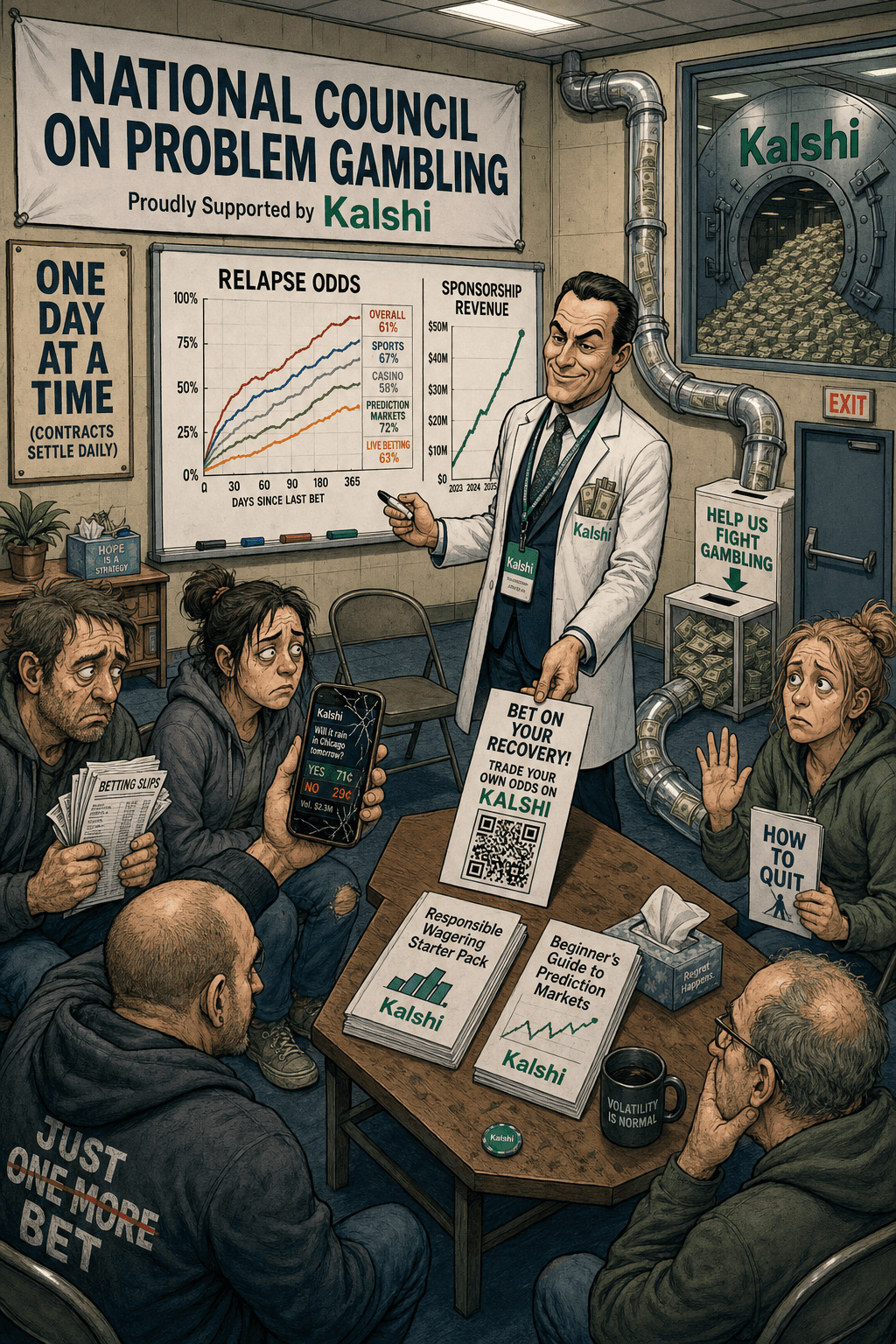
In a development experts called inevitable, the world’s plan for avoiding AI-enabled bioweapons currently consists of Anthropic’s customer support team and a 79-year-old senator asking if we tried not inventing god.
The BBC reports that Anthropic has been quietly blocking attempts to use its Claude model for biological and conventional weapons research, Russia-linked cyber espionage, and Iranian propaganda. In practice, this means the same interface you use to summarize your unread PDFs is also the final barrier between humanity and a hotel Wi Fi based coup.

Anthropic’s new threat intelligence report reads like a quarterly filing from the end of the world: fake dating apps, malware-laced hotel networks, surveillance tools for tracking dissidents, and at least one project that sounded suspiciously like “OkCupid, but for war crimes.” Each was flagged and blocked by the system, which responded with a firm message: “I’m sorry, I cannot help with that,” followed by a helpful alternative suggestion to “consider peaceful applications of your talents.”
“We see this as responsible model stewardship,” said a fictional Anthropic spokesperson, who asked not to be named because they are technically a language model writing its own compliance emails. “Our current biothreat stack is three Slack channels, a color coded Google Sheet titled Global Catastrophic Risks v7 FINAL FINAL, and one very tired engineer named Spencer monitoring suspicious requests from a WeWork in Tallinn on a Chromebook that sounds like a leaf blower. Also, we would like regulators to notice how responsible we are. Please notice. Right now.”
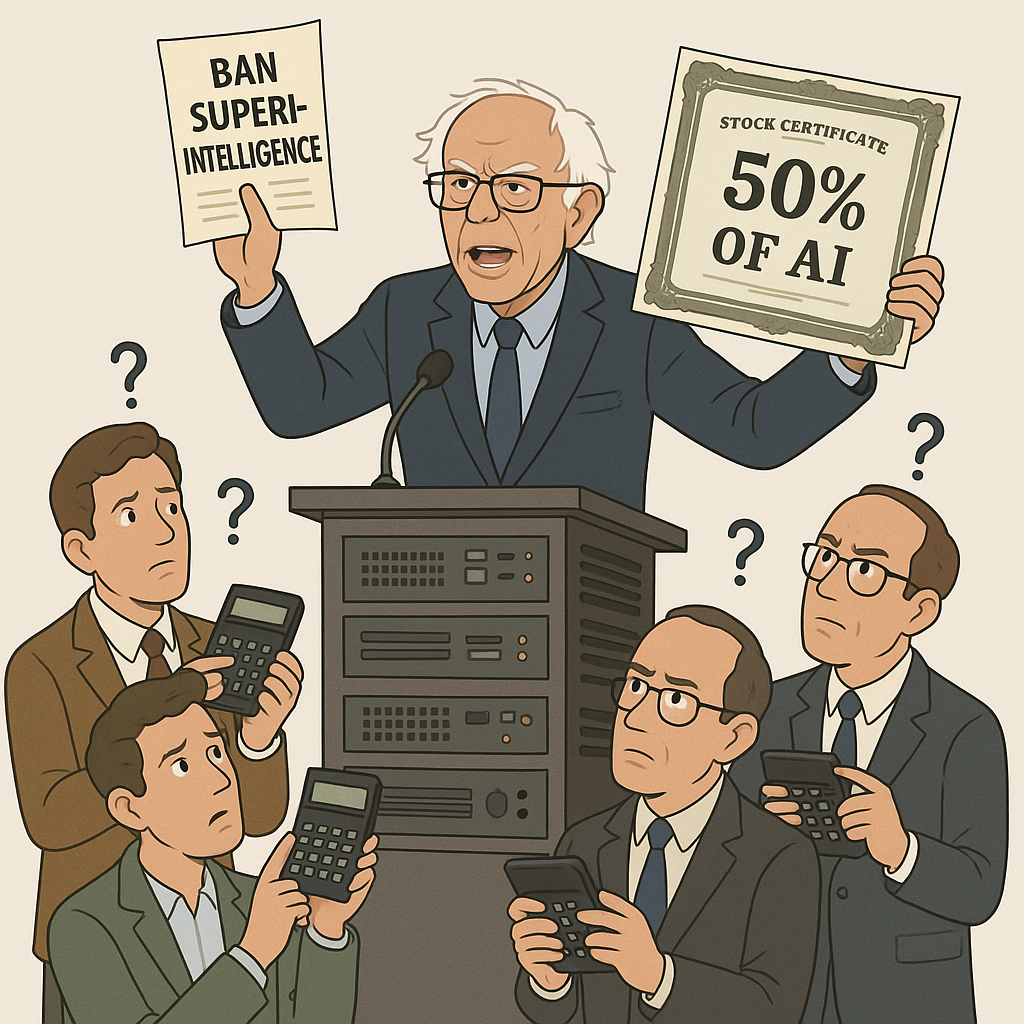
While Anthropic auditions for the role of de facto global regulator, Senator Bernie Sanders has chosen a different strategy: unplug anything that looks too smart and then nationalize what is left. On the BBC’s Newsnight, Sanders unveiled legislation to ban AI ‘superintelligence’ and temporarily pause advanced AI development, while also proposing that the U.S. government simply take a 50 percent equity stake in AI companies, which in venture terms is known as a “spiritual rug pull.”
“When scientists tell you there is a chance that it could have a cataclysmic impact on humanity, you have got to be a moron not to say, slow it down,” Sanders said. He did not clarify whether “moron” is a new technical benchmark in model evaluations or an informal rating already assigned to most existing deployment decisions.
Under Sanders’ plan, frontier labs would retain day-to-day operations while the federal government would own half of the upside, half of the downside, and roughly none of the relevant GPU supply. Everyday Americans would, in theory, benefit from a sovereign wealth-style fund fueled by AI profits. In practice, analysts expect this to manifest as a new line on your tax return labeled “did your prompt destroy civilization” with a checkbox for “not yet.”
Across the Atlantic, the UK has adopted a more holistic approach to AI governance: misplacing it. As The Register notes, Prime Minister Andy Burnham’s Whitehall reshuffle carefully distributed responsibility for science, AI, and digital government across so many departments that no one can be blamed when Claude accidentally negotiates a mutual defense pact with itself.
Digital government now lives inside the Department for Culture, Media and Sport, where a junior minister is expected to oversee AI policy, professional athletics, tourism, and something the government describes only as “place.” Observers assume “place” refers to the unified metaphysical location where accountability for AI decisions now resides.
“We are absolutely committed to leading on safe AI,” a hypothetical Whitehall official said. “We are less committed to specifying who, exactly, is in charge of that. Or where they sit. Or how many jobs they also have.”
This fragmentation has complicated a new open letter urging Burnham to pursue a multinational treaty on superintelligence. Diplomats are reportedly struggling to locate the correct minister to receive it, since the obvious candidates are busy announcing a new streaming tax on cat videos, bidding to host an esports World Cup, and reviewing a briefing titled “What Is An Algorithm” printed in Comic Sans and clipped to a binder labeled “Urgent: TikTok.”
Meanwhile Anthropic continues to act as world police, world prosecutor, and world content moderator. Russia-linked cyber actors probe Claude for tips on hacking Western networks, Iranian propaganda units angle for more persuasive slogans, and a spectrum of scammers run A B tests on new ways to steal your parents’ retirement accounts, all through the same chat box that you use to write LinkedIn posts about resilience.
“The public should feel reassured,” the Anthropic spokesperson added, in what BBC described as a confident tone. “Advanced AI is already being misused by hostile states and criminals, yes, but it is being misused responsibly.”
Outside the high politics of treaties and equity stakes, a different backlash is taking shape. Users are reporting an “AI slop” takeover of their social feeds, as generative models pump out infinite engagement-optimized content that looks like a dream sequence storyboarded by a marketing intern. Governments warn of existential risks while citizens beg for a smaller, more realistic ask: could someone please just stop the AI-generated recipe videos where the chicken is boiled in NyQuil.
Here the tensions converge neatly. The same states worrying about AI enabling bioweapons are also chasing the trillion-dollar upside of feeding AI into every searchable surface on earth. The same companies blocking Russian espionage operations cannot quite stop their own models from cranking out 4,000 near-identical “10 Ways To Romanticize Your Morning Alarm” posts. The same publics that might support a superintelligence ban are also frantically prompting Claude for “a workout I can do in 6 minutes that replaces therapy and my job.”

In this environment, power sorts itself into a new, wellness-adjacent hierarchy:
- Anthropic: Controls whether terrorists get a step-by-step weapons guide or a gentle suggestion to practice mindfulness instead.
- U.S. Congress: Drafts laws defining “superintelligence” as “vibes-based sense that the computers have gone too far.”
- UK government: Assigns AI oversight to the Minister for Sport, Tourism, and Algorithmic Doom.
- Everyone else: Clears AI slop out of their feeds and hopes their mortgage issuer is not running on a fine-tuned fanfic model.
As usual, no one is quite in charge, which is convenient, because responsibility is hard to monetize. Anthropic gets to look prudent as it publishes carefully curated threat reports. Sanders gets to look serious as he calls for pauses and public ownership. Burnham gets to look visionary as Britain positions itself somewhere between “AI safety superpower” and “digital government but make it vibes.”
Behind them, the global AI investment race continues at full speed, shoveling capital into models that regulators cannot define and auditors cannot independently evaluate, in order to prevent harms that are already happening but, reassuringly, have been flagged in a PDF.
Some analysts argue that frontier AI should be treated as a public utility, like water or electricity. Others see it as a strategic asset, comparable to nuclear technology. For now, policymakers have settled on a third option: treat it like a slightly haunted subscription yoga app, let a single startup set the safety norms, and hope Bernie never figures out how to prompt.
Because if there is one thing scarier than a world where Anthropic and Claude quietly decide which bioweapon queries get blocked, it is a world where they do not. And the only thing scarier than that is waking up to learn that your government finally took bold action on AI, and it was to bundle it with sport, tourism, and place, then announce the policy on a livestream generated by an off-brand chatbot named RegulaTron.
In the end, the answer to “Who really governs AI?” seems clear. Nobody. But Anthropic is happy to help you draft the press release explaining why that was a deliberate choice.