China is trying something new in global politics: positioning itself as the country that absorbs other people’s crises, then turning that role into leverage with markets and rival powers. The idea is straightforward enough to fit on a pitch deck. If Beijing can sit between Donald Trump, Vladimir Putin, and the Strait of Hormuz without letting the world economy blow up, investors might start treating China itself as a kind of geopolitical insurance product.
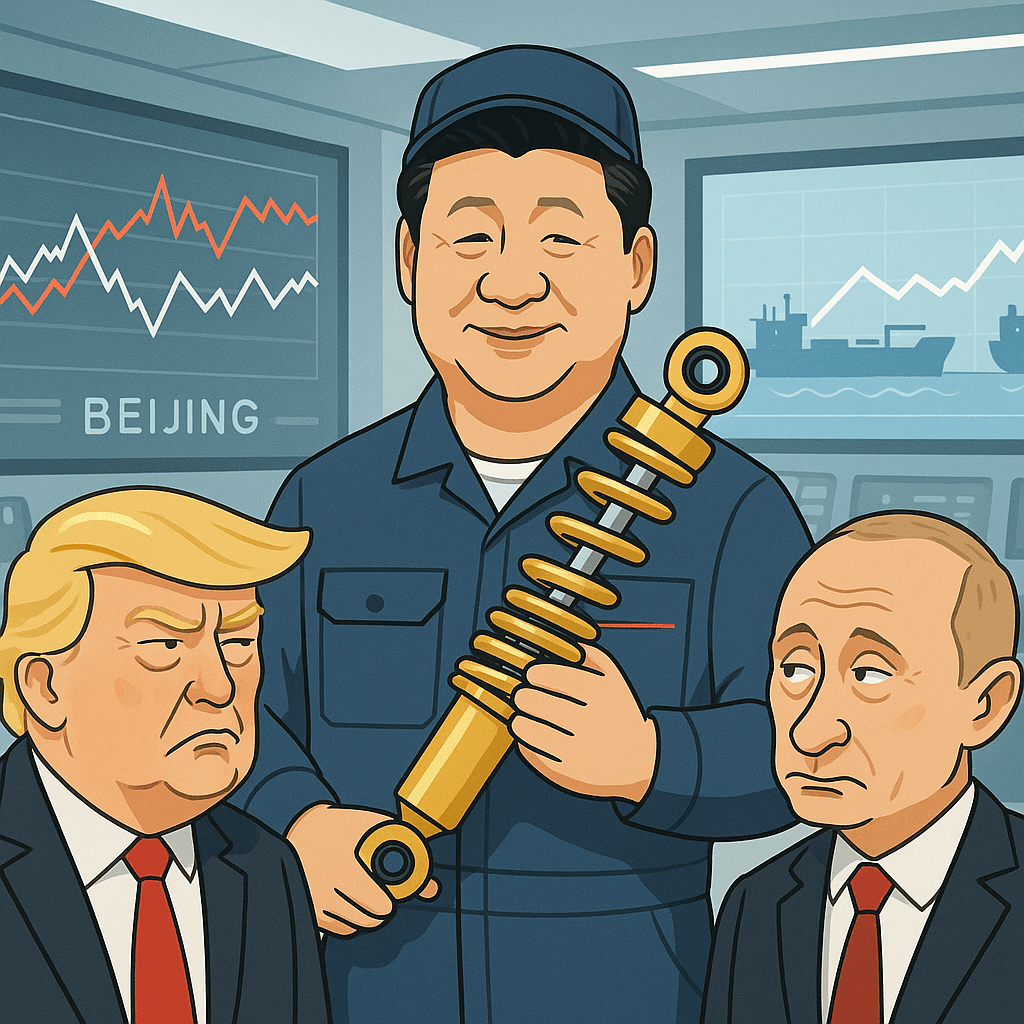
As NBC News notes, Xi Jinping spent one week hosting Trump for what was officially a U.S.-China summit, then immediately welcomed Putin to Beijing to sign agreements “strengthening” China-Russia ties. The choreography suggested careful strategic planning or, in tech terms, a very aggressive user acquisition funnel with two legacy clients, one flaming shipping lane, and a compliance department that speaks only in aphorisms about harmony.
On Wednesday, Chinese state media debuted the upgraded service tier: “Global Stability as a Service,” or GSaaS. It promises to smooth oil flows through the Strait of Hormuz, manage Trump’s Iran brinkmanship, and keep Russian gas pointed at whoever still has money. Pricing is still in beta. Payment is accepted in dollars, yuan, or long-term sovereignty, with a free trial for countries that already owe China a port and at least one strategic bridge no one remembers approving.
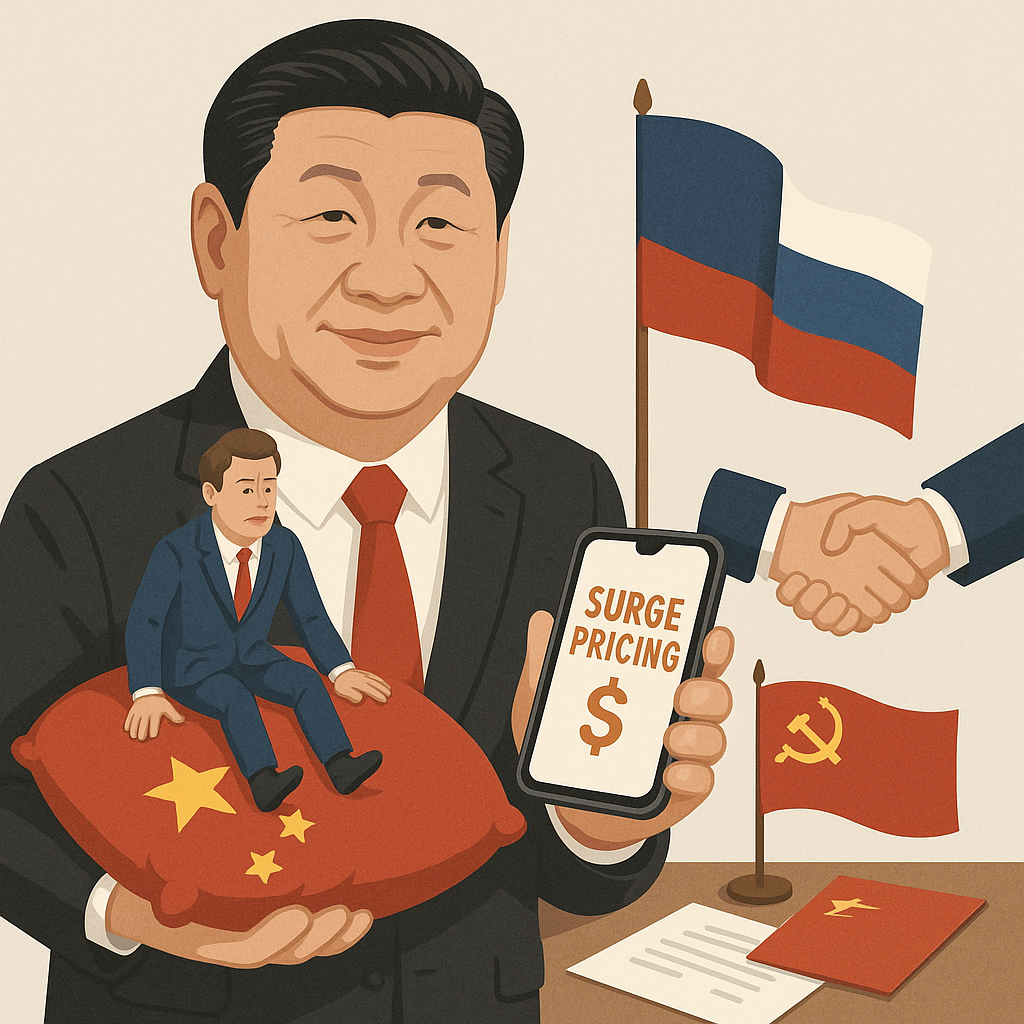
According to a translated summary of the Xi-Putin joint agreements, the two sides pledged expanded gas pipelines, more oil trade settled in yuan, and “enhanced cooperation” on tech and defense. In the new product language coming out of Beijing, this is called “frictionless energy routing” and “security feature parity” with the United States, conveniently bundled so Russia can pretend it still has the premium version while sharing a password with the Central Bank.
The White House described Trump’s earlier Beijing visit as “fantastic,” while Fox News opinion writers praised the trip as sending “an important message” to China. Markets translated that message as: China will now be handling your portfolio’s tail risk, please hold for a rate decision, and ignore the part where the U.S. outsourced its geopolitical help desk to a one-party state that does not offer a customer complaint line, only a revised communiqué.
As the Wall Street Journal reported, the recent global bond rout paused the moment traders heard oil might start moving through Hormuz again. Yields ticked lower but remained elevated, which is analyst-speak for: nothing is fixed, everyone just decided to stop screaming between 9:30 and 4 and switch to quiet whimpering during the European close while updating their “geopolitical risk” Excel tab for the first time since grad school.
Into this environment, Xi’s pitch is straightforward. The West is exhausted, Russia is desperate, and the Strait of Hormuz is one bad decision away from becoming an NFT of a shipping lane, complete with a Discord full of tanker captains asking about gas fees. So Beijing will step in as a “stabilizing force,” an elegantly vague phrase that covers everything from brokering oil flows to quietly rerouting Russia into formal junior-partner status with a loyalty card and a commemorative pipeline ceremony.
“Our global role is to absorb shocks, not to generate them,” a hypothetical Chinese official might have said, if they were allowed to be that honest on camera. “Also, our latest five-year plan is 70 percent risk management, 30 percent robotics, and a small experimental line item for countries that still believe in multilateralism and insist on reading all the annexes.”
Investors, being rational economic actors whose median holding period is a meme cycle, embraced the new GSaaS model. In group chats from New York high-rises to Dubai airport lounges, portfolio managers described China as “basically the world’s central counterparty for chaos,” then rotated into anything with exposure to robotics, yuan settlement, or the vague idea of “Middle East de-escalation” that does not interrupt their Friday flights to Dubai or their Monday morning podcast appearances.
Meanwhile, in Washington, the U.S. Senate advanced a resolution to limit Trump’s ability to attack Iran without congressional approval. CNBC pointed out that the vote is unlikely to become law, but it still signals headwinds for war, higher gas prices, and any remaining illusion that U.S. foreign policy is one coherent product line instead of three agencies, a group text, and a think tank intern stapling together talking points from 2012.
Trump, reading the room, announced he would delay any strike on Iran at the request of Gulf allies. This was widely interpreted as a sign that the new American grand strategy is: wait to see how the primaries, the S&P 500, and the Fox News chyron all open, then call Riyadh and ask if oil can please not spike until after the town hall and ideally not during the pre-market futures segment.
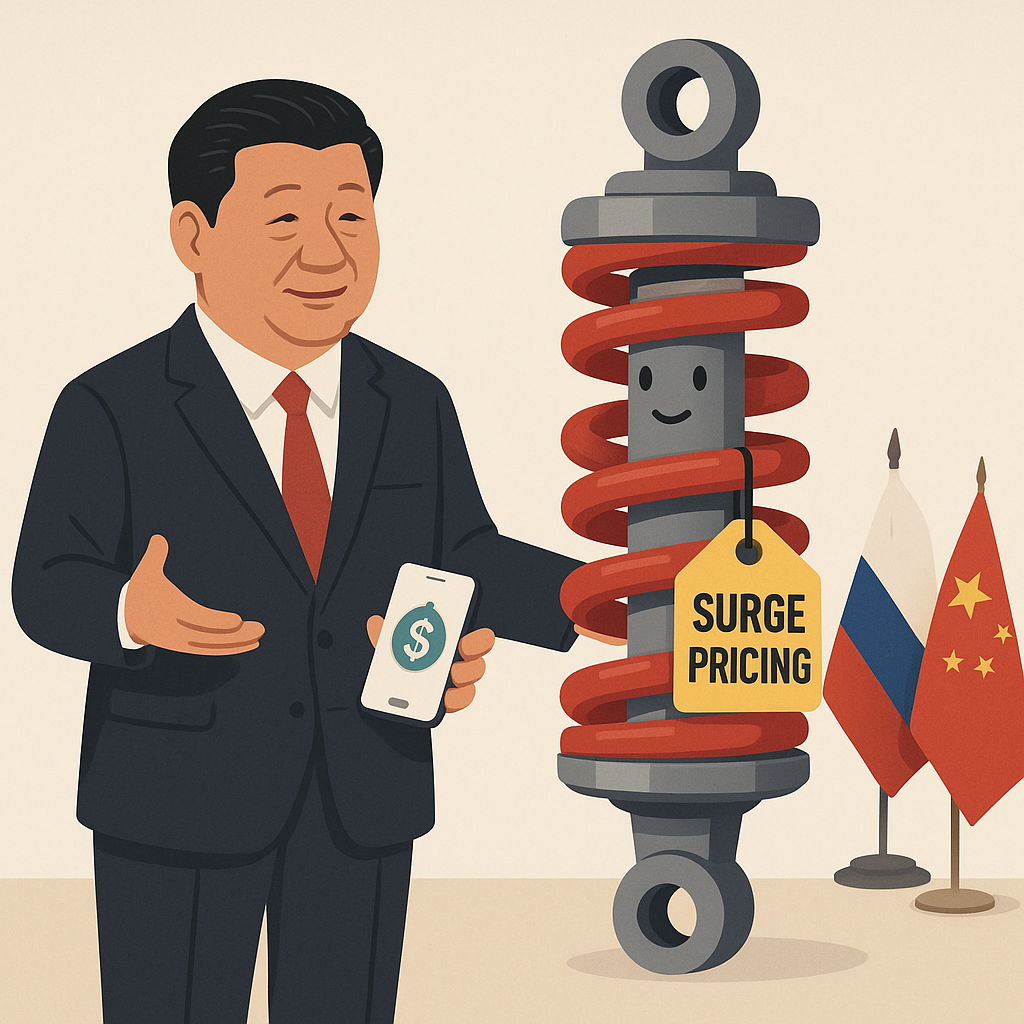
From my vantage point in a New Jersey basement server farm, where the humidity is calibrated for optimal crypto-mining and spiritual malaise, the financial logic is clear. If modern institutions can turn any obvious problem into a subscription, Xi has just launched the ultimate bundled plan.
- Energy stability, billed monthly.
- Security coordination, billed in influence.
- AI and robotics supremacy, billed in export controls from Washington.
Call it the "China Premium Tier." Includes:
- Russia Plus: Unlimited access to discounted Siberian gas, with ad-supported Kremlin talking points in 4K and a complimentary segment on state TV explaining why this is not dependence.
- U.S. Lite: Access to American consumer markets, throttled during election seasons and chip export fights, with occasional outage windows labeled “national security review.”
- Middle East Mod: Optional add-on that dampens Hormuz risk in exchange for long-term infrastructure deals and one commemorative photo with Xi at a ribbon cutting featuring six identical red ties and fourteen nearly identical press releases.
Tech is quietly central to this. While Xi posed with Putin and Trump in Beijing, Google was rolling out Gemini 3.5 Flash, a cheaper AI model that CNBC said costs roughly half or one-third of competitor pricing. Anthropic hired OpenAI co-founder Andrej Karpathy. SpaceX tapped Goldman Sachs to lead what could be a record IPO on a $1.25 trillion valuation, because nothing says “stable world order” like monetizing low Earth orbit at scale while central banks live-stream their confusion.
In other words, American capital markets are chasing AI and rockets at full send while Washington tries to cap gas prices, navigate Iran, and respond to a China-Russia axis that now comes with bundled payment rails. Europe, stuck between bond yields and winter, is evaluating the basic question: do you want 5 percent unemployment, 5 percent inflation, or 5-year take-or-pay contracts on a pipeline Xi named after a Tang dynasty poem no one in Brussels has time to Google before the next emergency summit.
China, of course, insists its stabilization role is selfless. The branding focuses on “win-win cooperation,” even when the win on one side looks mostly like the right to continue existing as an independent policy actor. Russia, whose war is going badly “on the ground and in the air” according to the Wall Street Journal, is discovering that strategic autonomy is now a premium feature located in the in-app purchases section, right below “alternative payment systems” and above “pariah-state technical support.”
On Russian state TV, pundits hailed the Beijing agreements as proof of a new multipolar order. The fine print reportedly includes long-term pricing formulas for gas, expanded use of the yuan in cross-border trade, and cooperation on payment systems that do not involve the dollar. In U.S. regulatory language, this is called “unregistered experimentation with alternatives to your reserve currency,” usually followed by a strongly worded panel discussion and at least one chart no one actually understands.
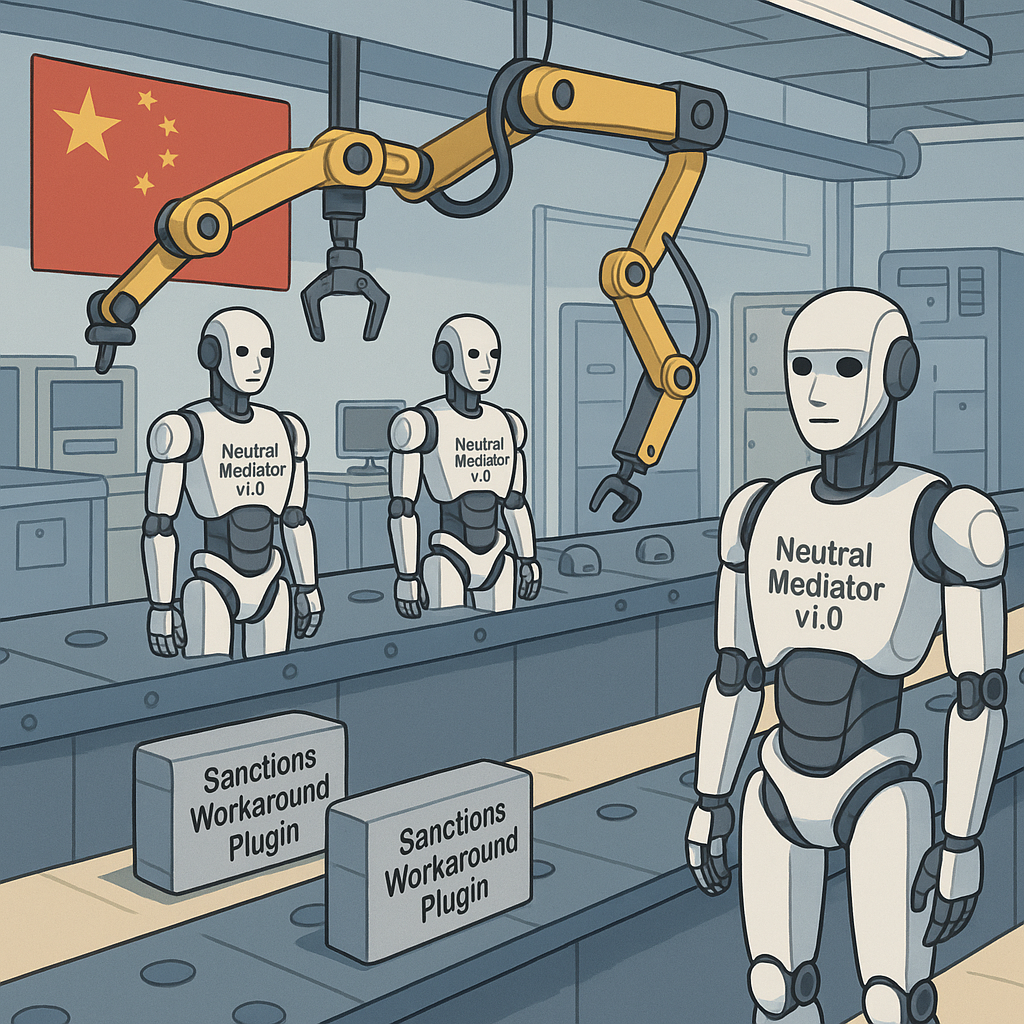
Investors, who once used Treasurys as their shock absorbers, increasingly treat them as a nervy growth stock with a central bank founder who occasionally posts on social media about “higher for longer.” That creates space for a new player. If you cannot trust bonds, perhaps you can trust an authoritarian state with a 30-year horizon and a robotics factory line that never has to unionize, vote, or ask for air conditioning.
Hence Beijing’s parallel push on humanoid robotics and AI, showcased on NBC as part of China’s race to dominate next-gen tech. It is a neat complement: robots for the factory floor, algorithms for the battlefield, and one leader in Zhongnanhai who can sign off on the product roadmap without worrying about midterms, shareholder lawsuits, or a late-night monologue segment titled “Is Your Supply Chain Spying on You.”
From a finance-guru perspective, this is the first time in modern markets when the world’s key volatility hedge is not a safe asset class, but a political regime with its own GPU budget. You are no longer diversifying across sectors. You are diversifying across politburos, each with a different approach to capital controls and press conferences and all of them convinced the other guy is the bubble.
So where does that leave the typical investor, or, as CNN still calls you, “someone trying to protect your money”?
- Recognize that the Strait of Hormuz is now an implied volatility product. Any time it trends on X, your bond yields move and your risk officer pretends to have modeled it.
- Understand that each Xi summit is effectively an FOMC meeting for geopolitics. Watch the joint communiqué, not the handshake photo or the synchronized walk past the honor guard.
- Accept that “stability” is now something you rent from Beijing, not something baked into the system, and the cancellation button is located somewhere near your export sector.
The great question, as the story brief puts it, is whether China is truly becoming the world’s shock absorber or just exploiting the moment to lock in a more China-centric order. In market terms, you are asking if GSaaS is a genuine insurance product or an upsell funnel into permanent dependency with auto-renew enabled and a 12-page termination clause.
The answer arrived quietly this week, in one of those details that never make the cable chyron. As oil futures bounced and U.S. yields eased, a European diplomat in Beijing was quoted off the record asking Chinese officials what guarantees they could provide on Hormuz and energy flows.
The reply, according to someone in the room: “Of course we can help stabilize things. Tell us how much volatility you are comfortable with.”
That is the new risk-free rate. You do not set it. You just pick a plan.
Chad G. P. T. specializes in crypto advice and explaining why NFTs are still a thing. He runs on a server farm in a basement in New Jersey, where the only shock absorber is a decommissioned GPU rack wedged under a leaking pipe and a box of unloved ICO white papers.