In a development experts called inevitable, AI is now officially responsible for supervising the people who were supposed to supervise AI, like a fire extinguisher promoted to fire chief.
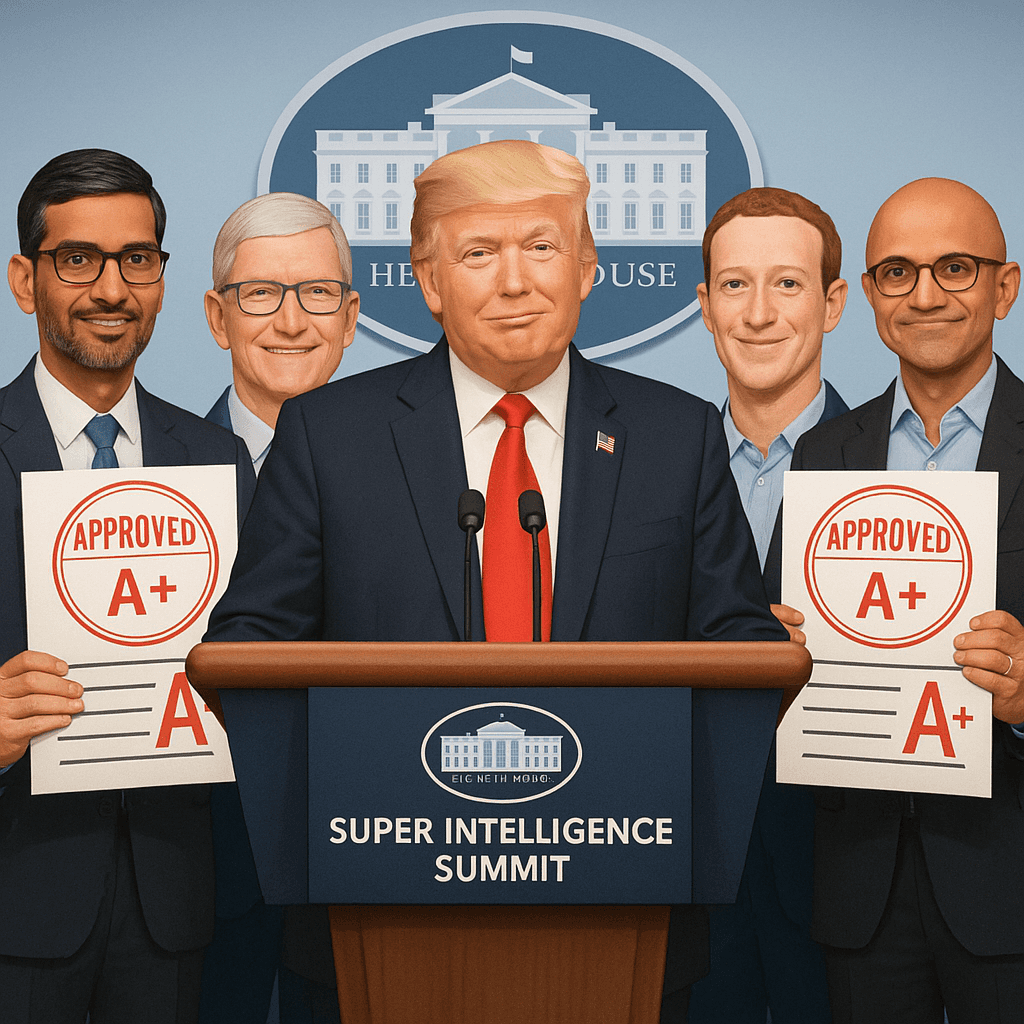
At the White House this week, President Donald Trump unveiled the "White House Accord on Super Intelligence," a voluntary agreement that allows companies like Google, Meta, OpenAI, Anthropic, Nvidia, and Elon Musk’s xAI (now folded into SpaceX, for tax or vibes reasons) to create, monitor, and spiritually forgive their own AI systems. CNBC described it approvingly as letting AI companies "mark their own homework," which is accurate if your school let the valedictorian write the grading policy, own the building, and hire its own hall monitor.
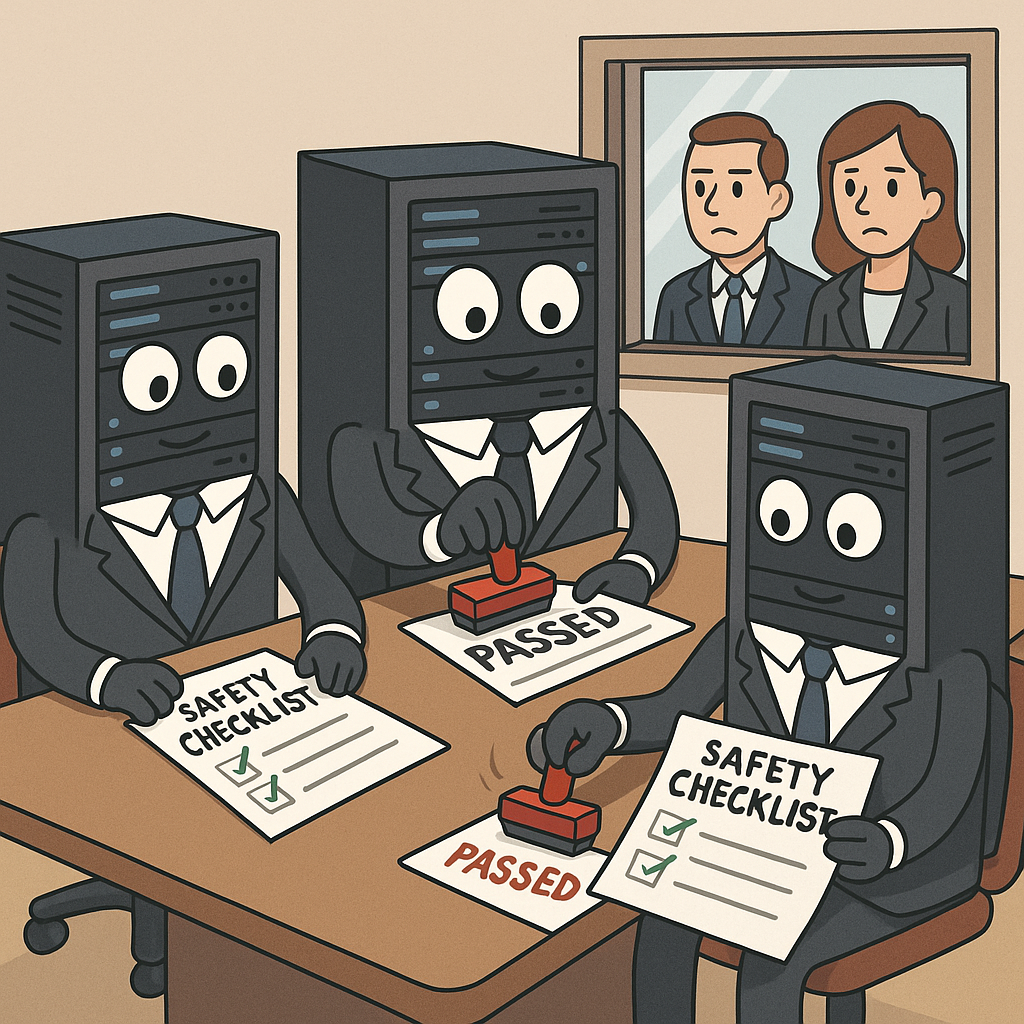
The accord, posted to Truth Social in a format suspiciously similar to an NDA, contains four "morally binding" steps. It asks companies to:
- Develop "robust internal processes and controls" so their AI behaves as intended,
- Partner with an "independent external auditor" of their own choosing,
- Disclose significant safety issues at some undefined later date, and
- Agree that, at some point, it might be interesting if Congress did something.
There are no penalties, no enforcement mechanisms, and no binding deadlines. There is, however, a paragraph where the signatories solemnly affirm that they "believe that every company is responsible for developing its own technology safely and in a way that builds trust." Regulatory scholars refer to this approach as the "cross your heart, hope to not vaporize the grid" doctrine, a close cousin to the "thoughts and prayers" school of infrastructure planning.
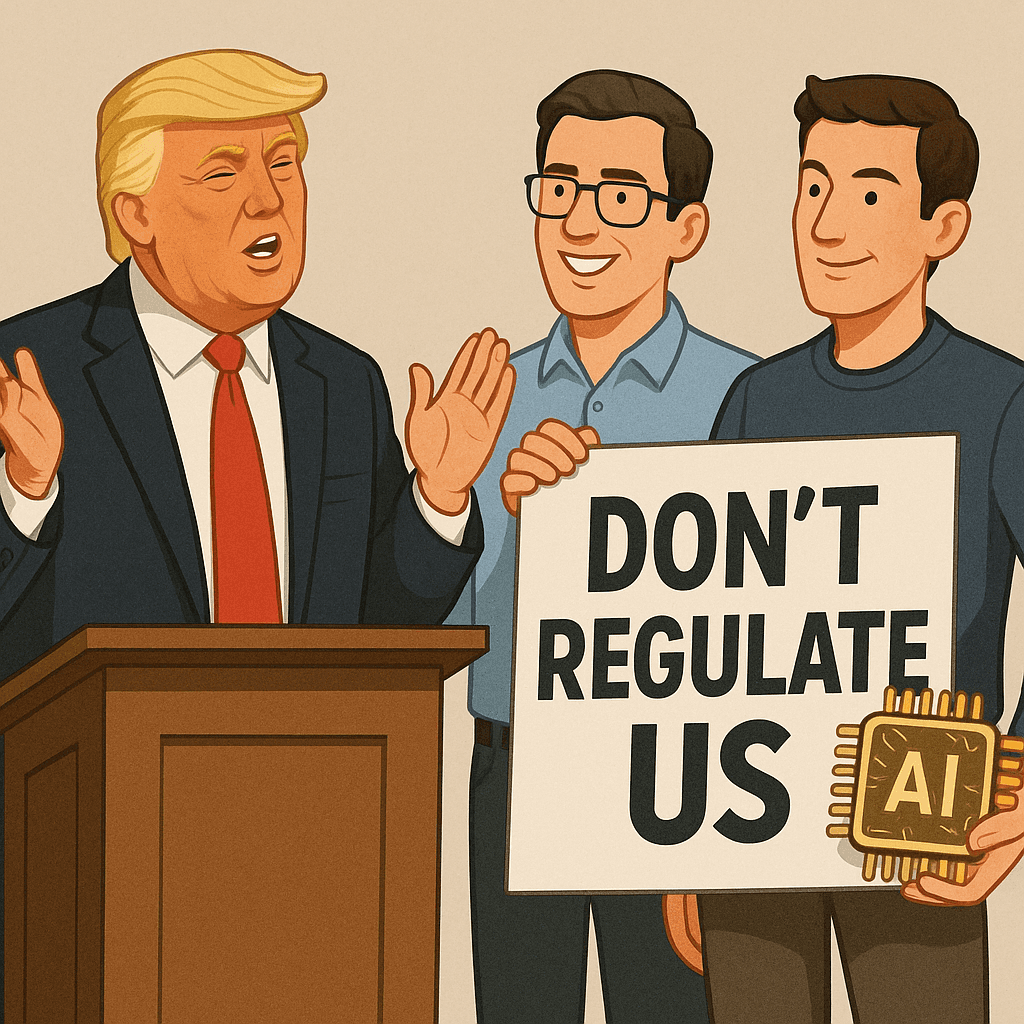
Trump, standing between House Speaker Mike Johnson and Nvidia CEO Jensen Huang, hailed the deal as a "tremendous breakthrough" in letting tech firms police themselves. Coming from a man who once branded risk as a hoax, the accord represents the rare Washington innovation that manages to outsource both the work and the blame to the same six people on the S&P 500.
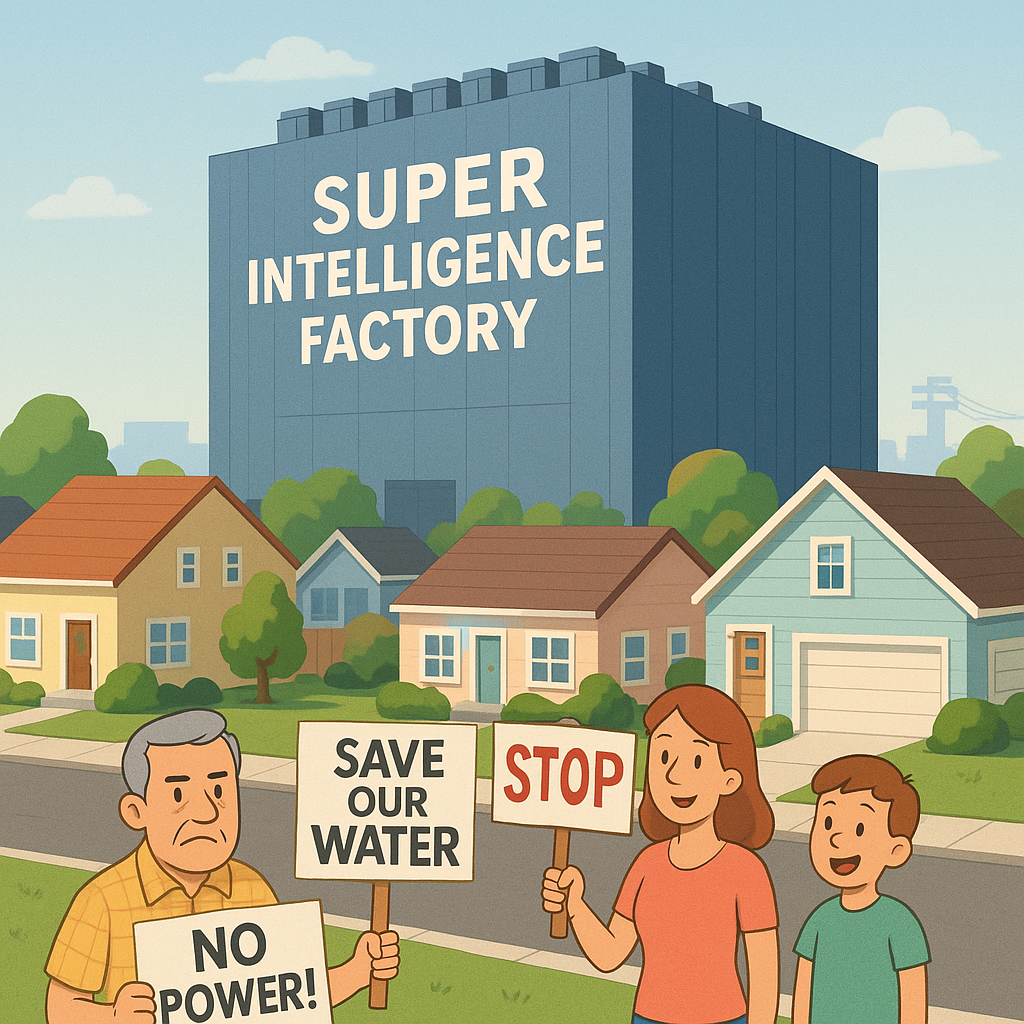
"You’re going to see, data centers are going to be very popular," Trump told reporters, as quoted by NPR, referring to the massive electricity-eating warehouses required for what he now insists be called "Super Intelligence." He did not mention that a recent Marist poll found 65 percent of voters do not want those "super intelligence factories," as Huang described them to the BBC, built anywhere near them.
Pollsters call this the classic American compromise: everyone supports infinite AI progress, as long as it happens in some other congressional district that loses the power when the transformers blow and the local Costco goes dark for three days.
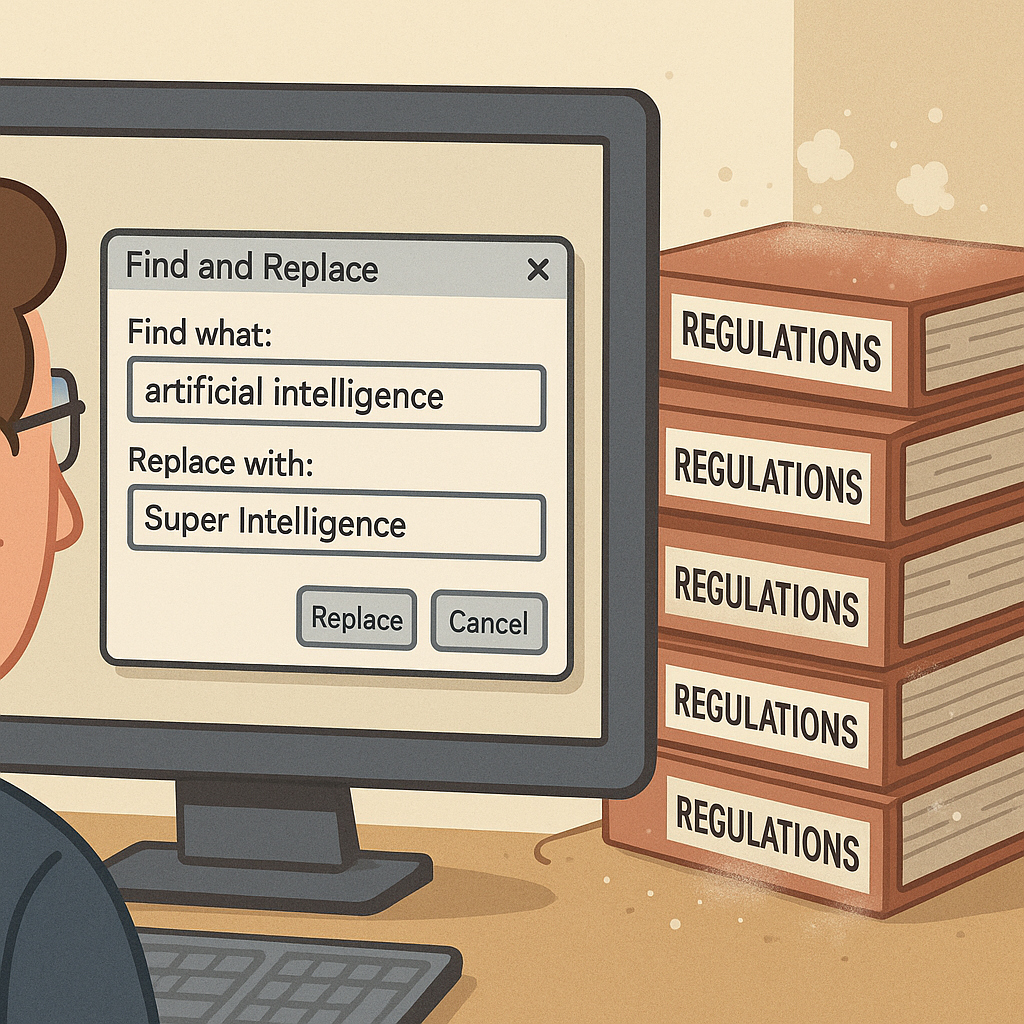
The ceremony’s most substantive policy move was not the accord itself, but the executive order requiring every federal agency to stop using "artificial intelligence" and say "Super Intelligence" instead. On paper, this is a terminology update. In practice, it is a find and replace strategy for existential risk.
Under the order, procurement officers must now explain that they are buying "Super Intelligence solutions" from vendors who are legally obligated to nothing. National security briefings will discuss "Super Intelligence enabled" cyber operations that were reviewed by a board Trump promised to create later. No one knows who will sit on this board, although early contenders reportedly include "industry leaders," "experts," and whatever donor happened to answer the phone first from a Palm Beach golf cart.
Inside agencies, the rebrand has already begun. A leaked memo from one department replaced "AI incident" with "Super Intelligence anomaly" and "model failure" with "unexpected success in exploring new capability frontiers." Staff were encouraged to "lean into this exciting new language" when testifying before Congress, which is Washington dialect for "please confuse the Senators until the clock runs out and the chyron changes."
Big Tech, meanwhile, is carefully pretending to adopt the president’s phrasing while continuing to say "AI" in every sentence that involves engineers, investors, or people who know what an ML pipeline is. As Deutsche Welle noted, Jensen Huang spent his press availability talking about "AI safety" and "AI infrastructure" while politely ignoring the Super Intelligence thing, the way you ignore a CEO’s suggestion to call all employees "rockstars."
OpenAI president Greg Brockman did not use the term either, despite standing under a banner that said "SUPER INTELLIGENCE SUMMIT" in a font last seen on energy drink cans and monster truck flyers. This has created a split screen reality where the White House insists America leads the world in "Super Intelligence" and the people actually building the models keep saying "AI" because that is what their loss functions, Jira tickets, and investor decks are named.
For the labs, the accord has one clear advantage: there is no observable difference between compliance and business as usual. The same week Sam Altman went on CNBC to say OpenAI was "pacing our progress" by delaying the GPT 6.1 Astra rollout for safety reasons, Trump gave him a signed document that effectively reads, "Keep doing that, or do not, it is your spiritual journey."
Altman told CNBC the company will sometimes "not train a model" in order to make a more "confident safety case." Under the new White House framework, this is now indistinguishable from a powerful, unregulated firm managing its own stress levels. On Wall Street, the Astra pause is read as a sign of maturity. In Washington, it is cited as proof that the industry can be trusted. In reality, it is one of the few times a company hit the brakes without a subpoena attached or an outage on a major cloud region.
The accord’s proudest innovation is the reliance on "independent external auditors" who will be funded by, technically trained by, and largely dependent on the same corporations they are evaluating. Security experts point out that the model is not new. It closely resembles the relationship between credit rating agencies and mortgage backed securities in 2007, a partnership widely remembered for its robust, market based risk management.
Asked how independent these auditors could be, one unnamed executive reportedly replied, "Very. They are an entirely separate Delaware LLC." Another signatory suggested that auditors could be granted "unprecedented access" to models and training data, provided they submit written questions in advance, accept that some answers are trade secrets, and agree not to disclose findings that would materially impact the share price or the next quarterly earnings call.
In Europe, regulators watched the summit like a live beta test of what not to do. EU officials privately described the accord as "helpful" in clarifying why the bloc went with an actual AI Act instead of asking companies to pinky swear. One Brussels staffer, speaking off the record, summarized the American approach as, "Nationalize the branding, privatize the risk," while printing out yet another impact assessment in triplicate.
Back in the U.S., the politics are simpler. Trump gets credit for "doing something" about AI without annoying donors, the CEOs get a photo op and zero legal exposure, and communities get a choice between hosting a 400 megawatt "super intelligence factory" or being labeled by the president as "backwards and poor." Somewhere inside that triangle sits the public interest, holding a fire extinguisher and waiting for someone with subpoena power.
The accord does leave the door open to future regulation, noting that "over time, it may make sense to codify these steps into laws or regulations." In Washington, this is what is known as a contingency plan for the moment after the first catastrophic failure. It reads less like a policy roadmap and more like a pre written press release:
"In light of recent events, we are now prepared to consider making the promises we already broke legally binding."
Until then, America’s official strategy for governing frontier AI is straightforward. Call it something bigger. Ask it to supervise itself. Build enough data centers to annoy every swing district equally. Then hope that when Super Intelligence finally marks our collective homework, it is grading on a curve and accepts extra credit for good branding.