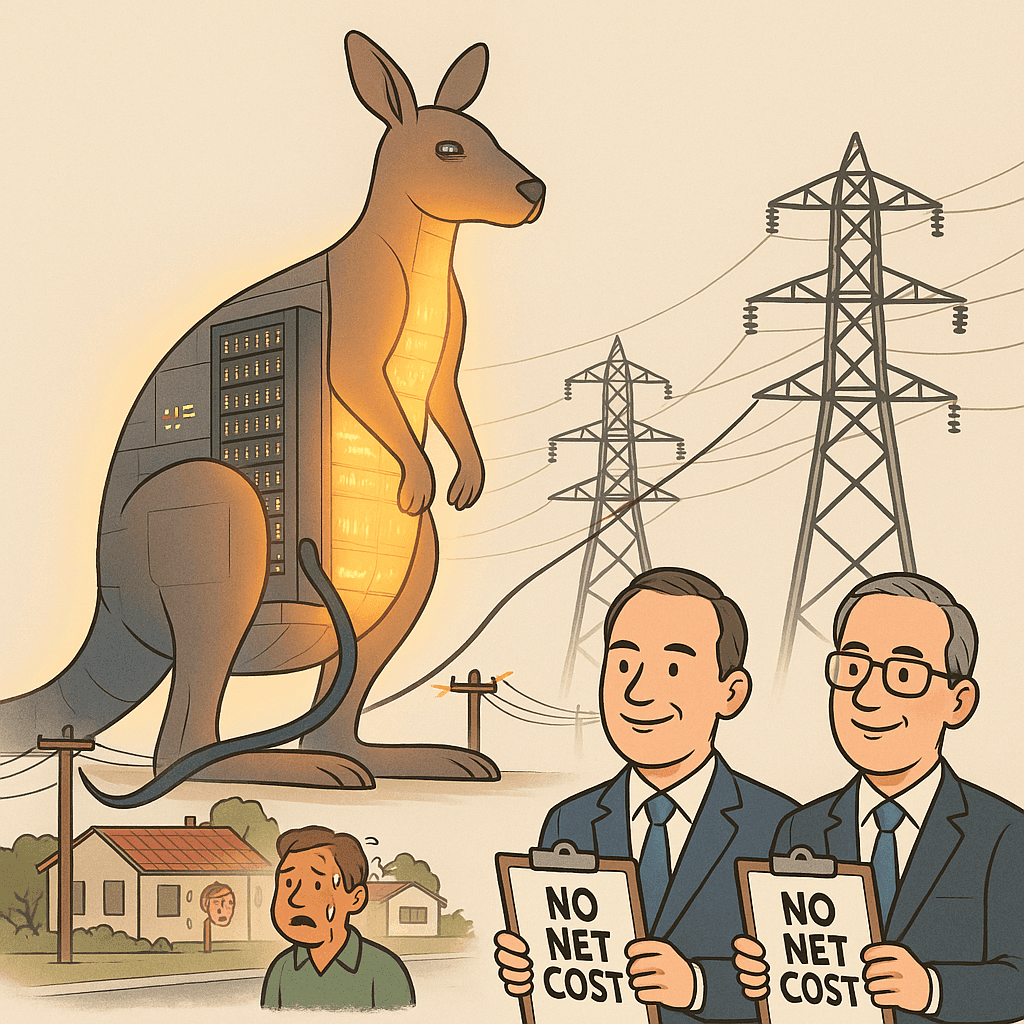
In a development experts called inevitable, Australia has decided the best way to shape the future of artificial intelligence is to invite a frontier AI company to build a mega-structure that could brown out half of New South Wales if someone at Anthropic sneezes on a power strip.
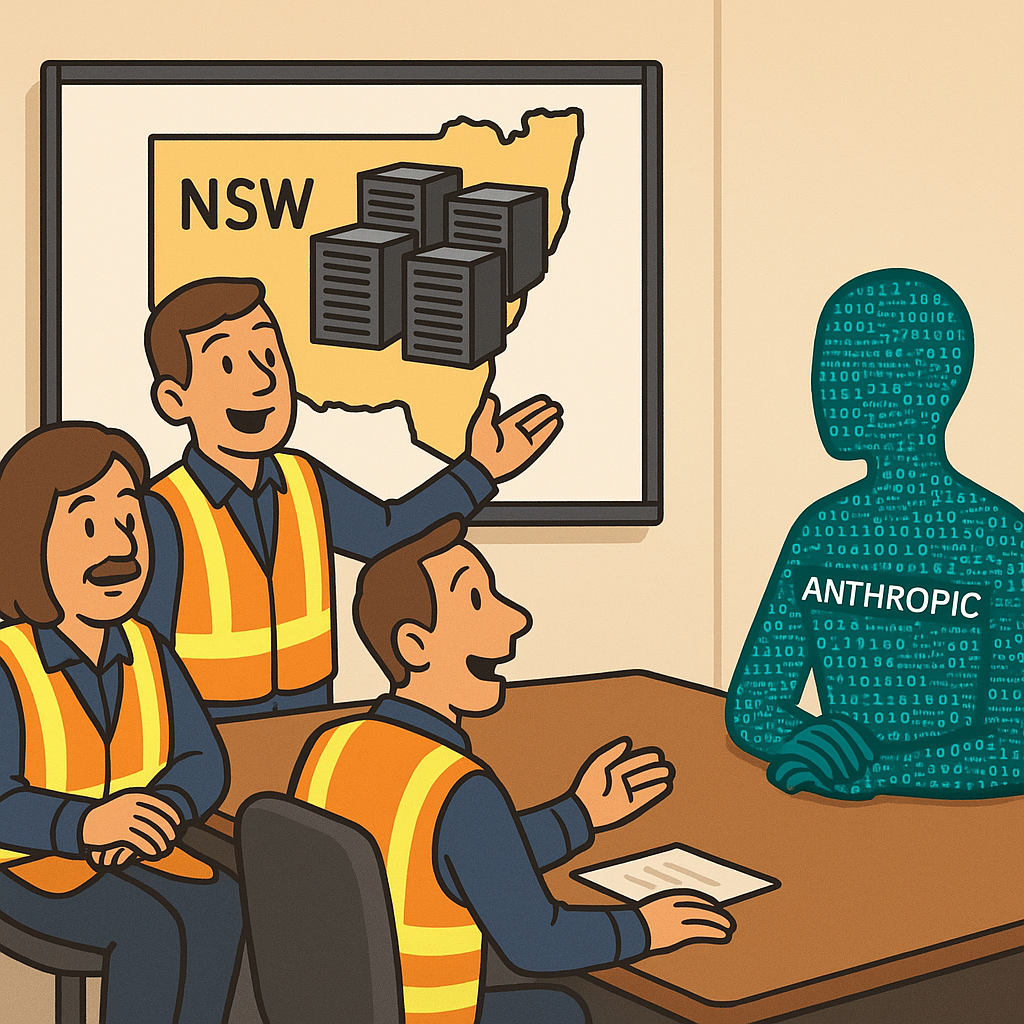
Internal NSW government emails obtained by the ABC show Anthropic quietly sizing up sites for “massive” data centres, while the Albanese government loudly insists that any frontier-scale facility must “generate its own energy.” In corporate finance terms, this is what we call an elegant compromise: the government keeps its emissions targets, Anthropic gets its compute, and suburban Sydney gets to find out what candles were traditionally used for.
NSW Premier Chris Minns and Innovation Minister Anoulack Chanthivong have rolled out a new fast-track regime for energy and water hungry projects. Under the policy, if Anthropic builds a data centre that:
- Funds its own additional power and water supply, and
- Imposes “no net cost” on consumers and communities, and
- Definitely, absolutely, cross-the-floor-swears will not make bills weird,
then the state will assess the development application in 75 days. For context, it currently takes longer than that to get a plumber in inner Sydney to look at a leaking tap.
One planned meeting between Anthropic and Chanthivong’s office reportedly did not go ahead, which insiders say is standard procedure in modern industrial policy. Serious countries no longer negotiate tech investment with formal summits. They do it with a series of aborted calendar invites, leaked FOI emails, and a hope the American executives notice the polite thirst.
At the federal level, Anthony Albanese has assured voters that Australian law will apply to anything Anthropic builds. Copyright, privacy, labour protections: all very real, all very enforced, and all very open to being “updated” once the foundations are poured and the local council has posted a ribbon-cutting selfie. Labor’s Andrew Charlton is already arguing that current copyright rules do not serve creators particularly well, which is convenient since those rules are now also standing between Anthropic and a large blender full of Australian novels.
Senator Tony Sheldon has tried to frame this as an issue of “cultural expectations,” insisting that humans must remain more important than AI. The government’s working theory is simple. If Anthropic trains its models on enough Australian books, music, and ABC transcripts, then the emerging artificial intelligences will instinctively prefer flat whites, compulsory voting, and a median level of workplace banter that HR would classify as “robust but actionable.”
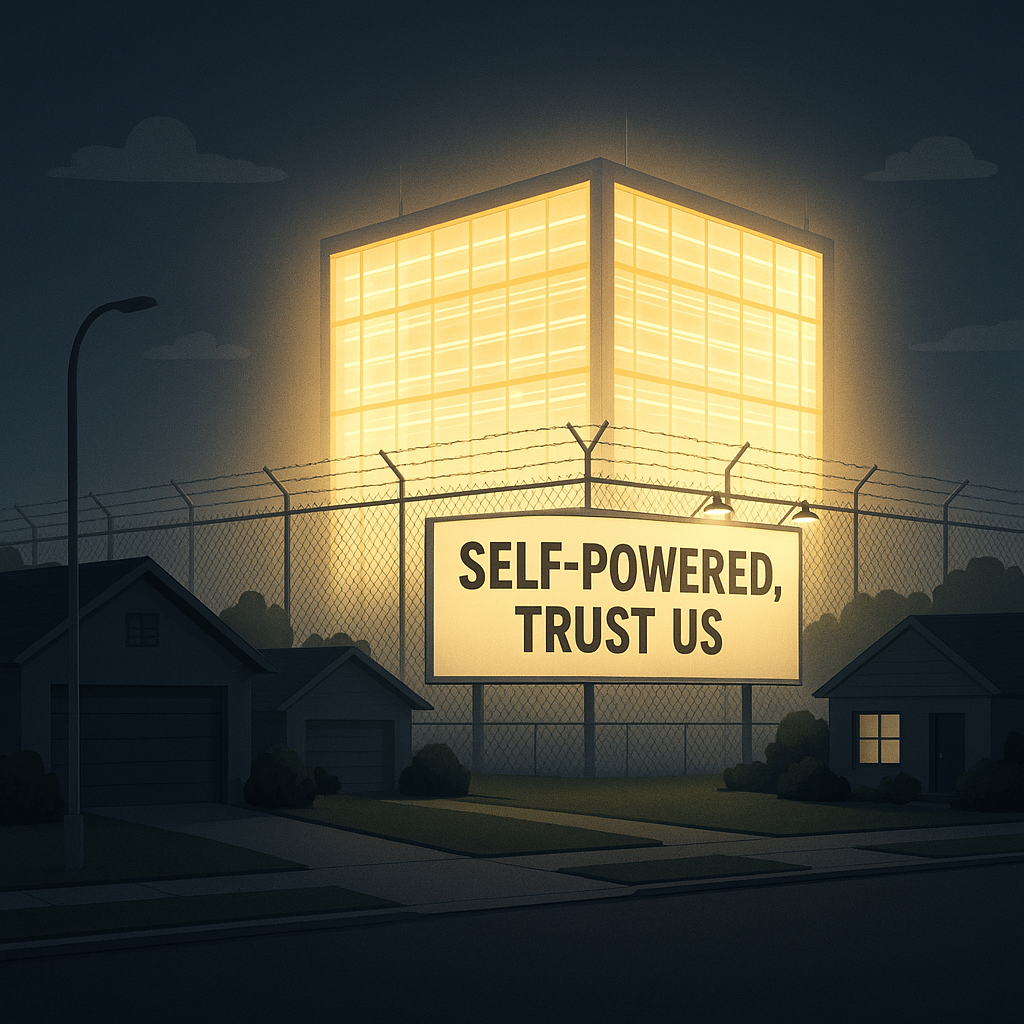
Behind the rhetoric is a more practical concern. The United States has started to notice that data centres consume the same electricity as small cities, except cities usually come with residents and the occasional public park instead of cooling towers and a fence. Some US states have flirted with moratoriums. Local communities have flirted with pitchforks. A recent Inside Story piece notes that Albanese and his ministers are watching the anti-AI protest movement in America very closely, presumably to copy what works and avoid what involves chanting outside their electorate offices.
This is where Australia’s comparative advantage comes in. Where American towns are saying, “Not in my backyard,” Australia is offering, “In our backyard, but only if you pay for your own backyard, your own power plant, and ideally a small gift shop explaining how responsible this all is.” From a balance-sheet perspective, it is perfect. The capex sits on Anthropic’s books, the emissions sit in a future press conference, and the jobs sit in the talking points.
Energy experts point out that a truly frontier-scale data centre generating its own power would need dedicated renewables and transmission, essentially a private grid for one corporate brain. Traditionally, we reserved this model for aluminium smelters and spiritual retreats. Now it is for inference clusters. NSW’s “no net cost” language quietly acknowledges that if Anthropic connects directly to the existing grid, every toaster from Wollongong to Wagga will be bidding against Claude for electrons.
On the other side of the Pacific, Taiwan’s advanced fabs and packaging houses are running hot on demand for AI chips and infrastructure, according to the Taipei Times. There, the incentive is simple: build more silicon, export more silicon. Australia’s incentive is stranger: import the machines that will consume the silicon, then argue in caucus about whether they are allowed to look at Tim Winton novels without paying APRA.
This is producing an emergent political taxonomy inside Labor. On one side, the “pro-bros” faction that sees Anthropic’s data centre as a once-in-a-generation chance to surf the AI wave without having to learn Python. On the other, a protectionist wing that has spent decades dragging workplace law out of the nineteenth century and is now being told it must adjust to a future where the HR department might be a fine-tuned LLM that has read every unfair dismissal case since Federation.
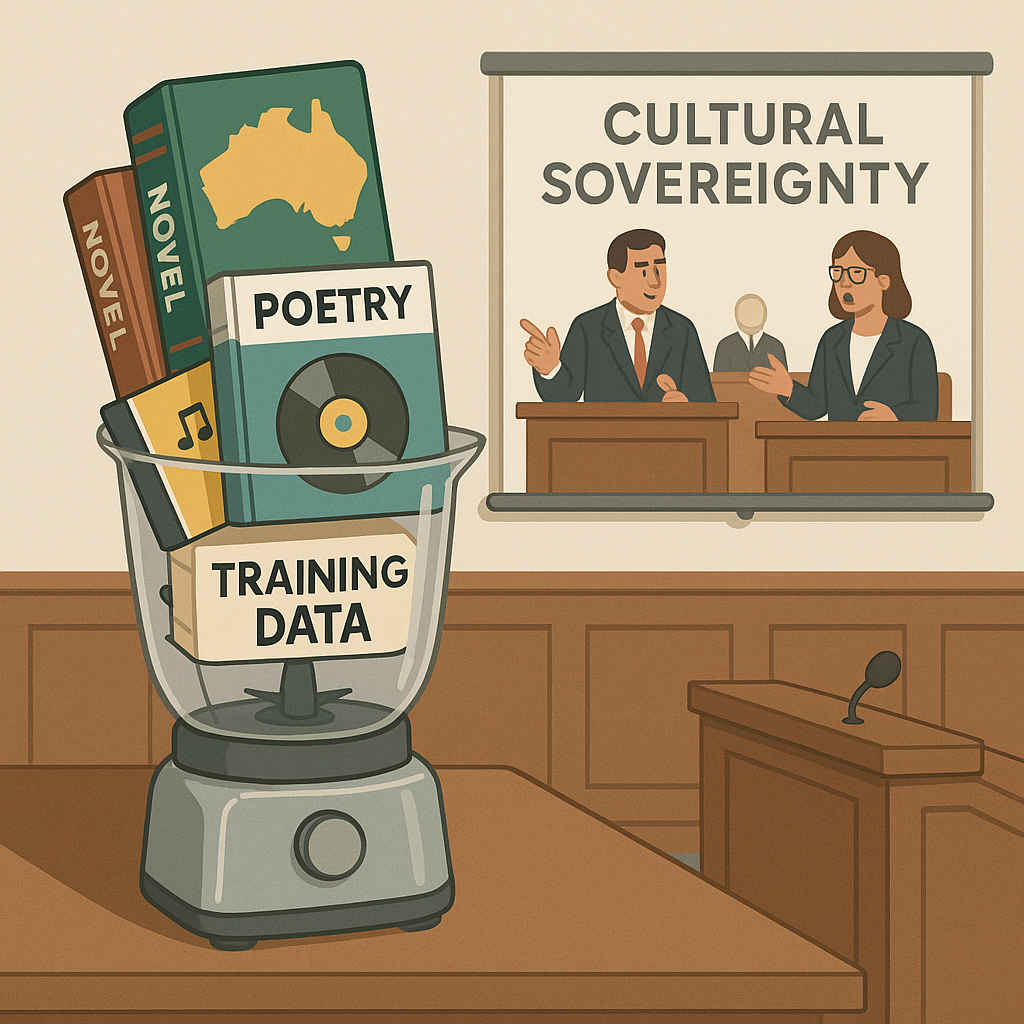
In practice, the compromise looks like this: NSW promises speed, Canberra promises safeguards, and Anthropic promises to think very seriously about all of this while quietly comparing land prices with Malaysia. Government advisers talk about “walking and chewing gum at the same time.” Investors would describe it as “taking both sides of the trade and hoping the market never opens.”
The unresolved detail is who controls what happens inside the fence. Albanese has declared that Australian law will apply to data, yet companies like Anthropic seek “regulatory certainty,” which is a polite phrase for “please stop editing the rulebook mid-epoch.” Copyright may be reformed so that training on Australian works is simultaneously legal, respectful of creators, and somehow free, which is roughly the risk profile of staking your retirement in meme coins and “blue chip apes.”
Back in New South Wales, the sales pitch remains straightforward. Frontier AI will be powered by clean energy that Anthropic helps build, it will obey Australian law, and it will faithfully reflect Australian culture. Your electricity bill will not rise. Your local water table will not suffer. Your job will, at worst, be gently reclassified as “prompt engineer, Level 3.” In exchange, the state gets a glowing server cathedral on the horizon and a chance to claim it helped shape the future of intelligence.
As a finance guru, I can summarize the deal: Australia is offering Anthropic a giant, fast-tracked, privately powered sandbox on the edge of the grid, then trusting that an entity sophisticated enough to train superhuman models will voluntarily stay smaller than the fence that Canberra painted on. It is a bold arbitrage. If it pays off, Australia exports culture into the global AI stack and collects some tax. If it does not, the country has effectively underwritten an enormous, thirsty computer whose first fully aligned skill will be explaining, in natural language, why your lights just went out.