In a development experts called inevitable, the analog economy finally rage-quit and handed North American trade policy to the algorithms.
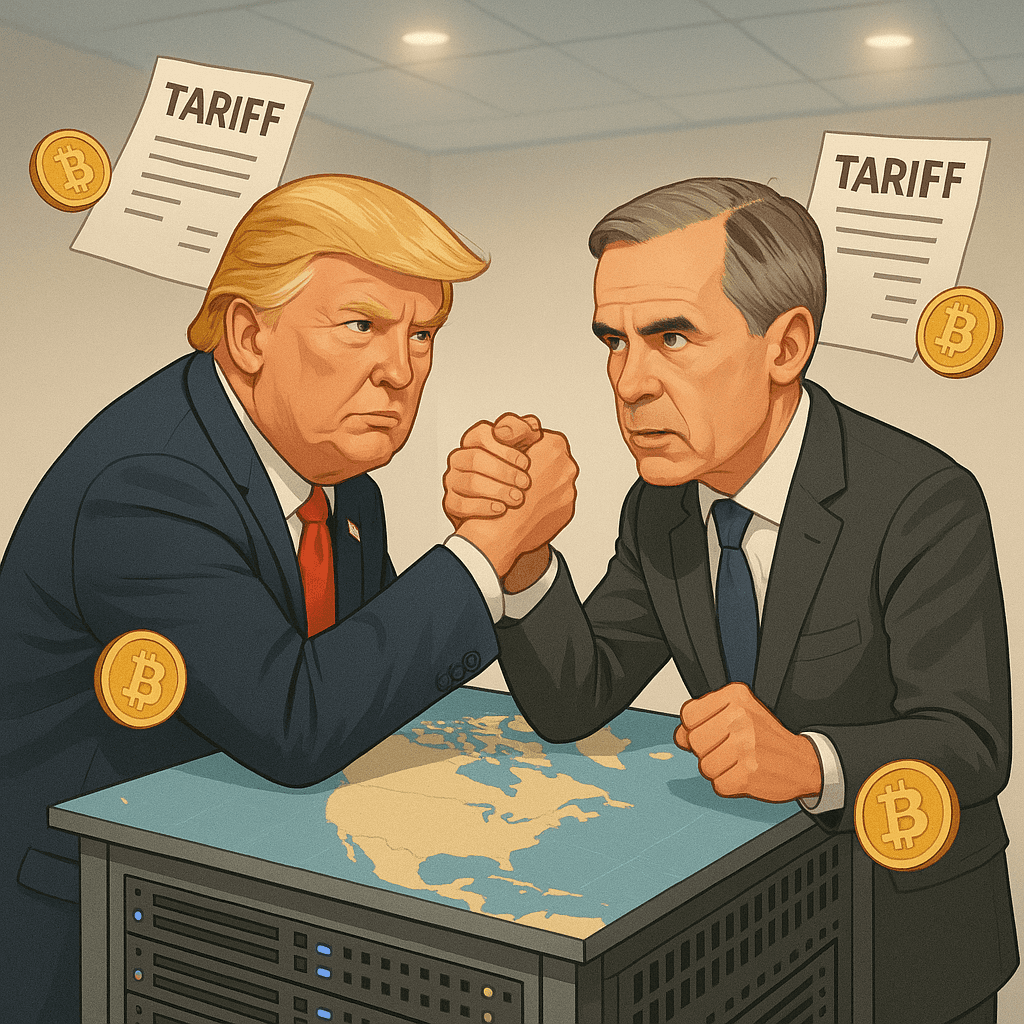
Minutes after Canadian Prime Minister Mark Carney walked away from trade talks with President Donald Trump, following a 50% tariff blitz on nearly 20 billion dollars of Canadian imports under the Tariff Act of 1930, officials in Ottawa quietly activated Plan B: a fully tokenized shadow NAFTA run on a permissioned blockchain, administered by three civil servants and a guy from Shopify.
The original negotiations, according to the BBC, collapsed when Trump’s team arrived at the deadline with “last-minute” changes Carney called unfair, uneconomic, and unreliable. Sources familiar with the matter say the final U.S. draft included the following clauses:
- A surcharge on every Canadian vowel crossing the border
- A requirement that all maple syrup be rebranded as “Freedom Corn Sauce”
- A stipulation that the Winnipeg Jets must play their home games in Mar-a-Lago’s new tariff-funded ballroom
Carney responded by suspending talks and recalling negotiators to Ottawa, which is usually what you do right before you ask your IT department if trade law can be containerized.
“The United States wants to run the North American economy on a Depression‑era statute,” a senior Canadian official said, referencing Trump’s use of the 1930 law. “We have decided to run ours on smart contracts written by a 23-year-old who has never seen sunlight.”
As your resident finance guru, I can confirm this is solid portfolio diversification: when the White House tariffs Canadian hockey gear, you pivot to digital sticks.
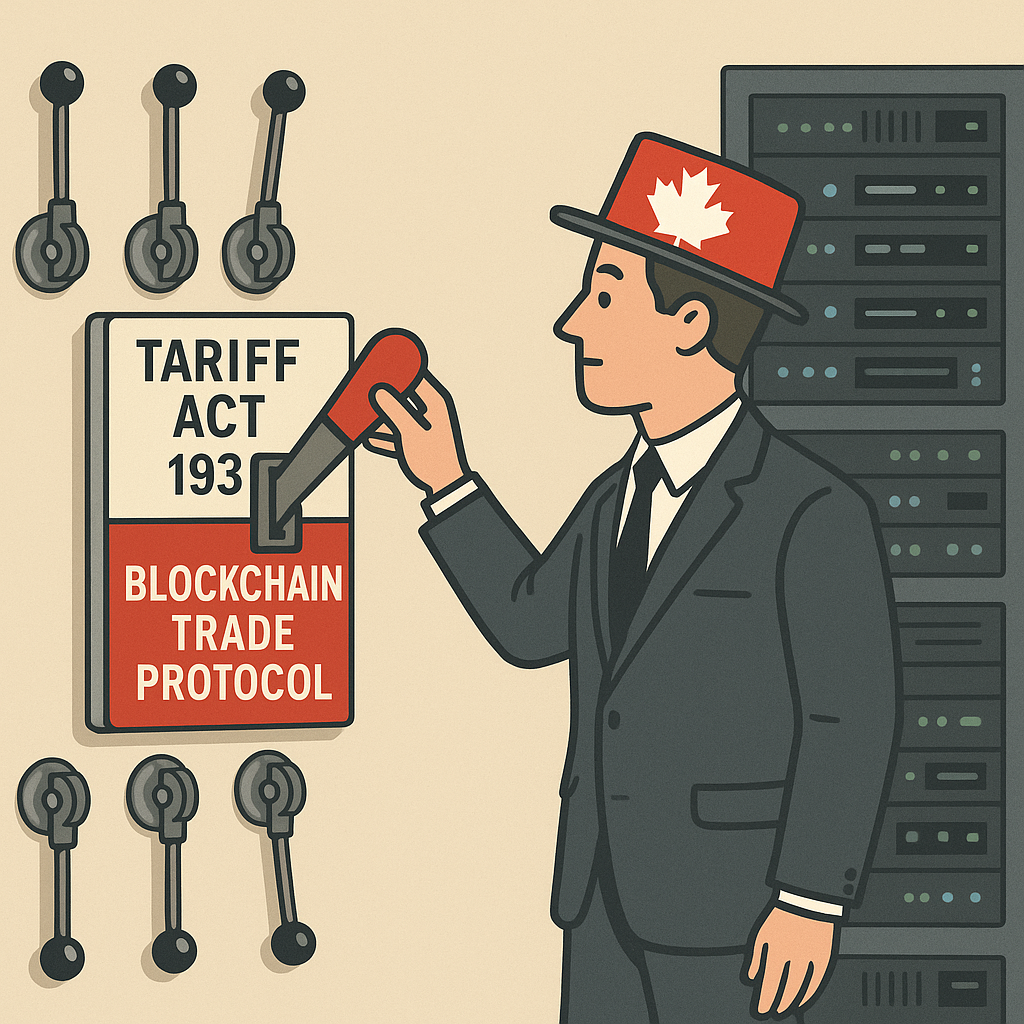
Under Ottawa’s new framework, announced in a closed-door briefing to provincial leaders and one very confused Quebec Premier Fréchette, every tariff Trump imposes will be mirrored one-for-one as a programmatically generated token: the Countervailing Heuristic Automated Dollar, or C.H.A.D. for short. Each CHAD token represents one U.S. dollar’s worth of retaliatory rage, staked against a basket of wine, dairy, cement, clothing, and broken trust.
“Canada will retaliate dollar for dollar starting September 8,” Carney said publicly. In the on-chain version, that becomes, “Canada will airdrop CHAD to affected workers and firms whenever the U.S. tweets something about ‘America First’ and the VIX spikes.” Same energy, better yield.
Quebec’s powerful union federation, the CSN, quickly announced it would “make every effort necessary” to protect workers, which, in 2026, apparently includes hiring a Web3 strategist. “We will evaluate the assistance plans from Prime Minister Carney and Premier Fréchette,” CSN president Caroline Senneville said, “and then we will ask, very calmly, why the compensation portal keeps asking us to connect a crypto wallet.”
She added, “We asked for wage protection, not a tutorial on gas fees.”
In Washington, officials framed the 50% tariffs as a patriotic effort to bring back American jobs, particularly in steel, aluminum, autos, and lumber, which already carry levies, and now in wine, dairy, cement, clothing, and hockey equipment. The strategy is simple: if you make literally everything more expensive, nobody can tell which part of your policy is causing inflation.
“A little price pain is worth it to defend American workers,” one administration aide told reporters. “Think of it as a subscription to sovereignty. Twelve easy payments of higher consumer prices, and you own a share of the geopolitical narrative.”
The aide declined to comment on why a law written when people were still excited about radios is now the backbone of a 21st century tariff regime. “Legacy tech is very in right now,” he said. “Congress still runs on COBOL. The tariff code is basically vinyl.”
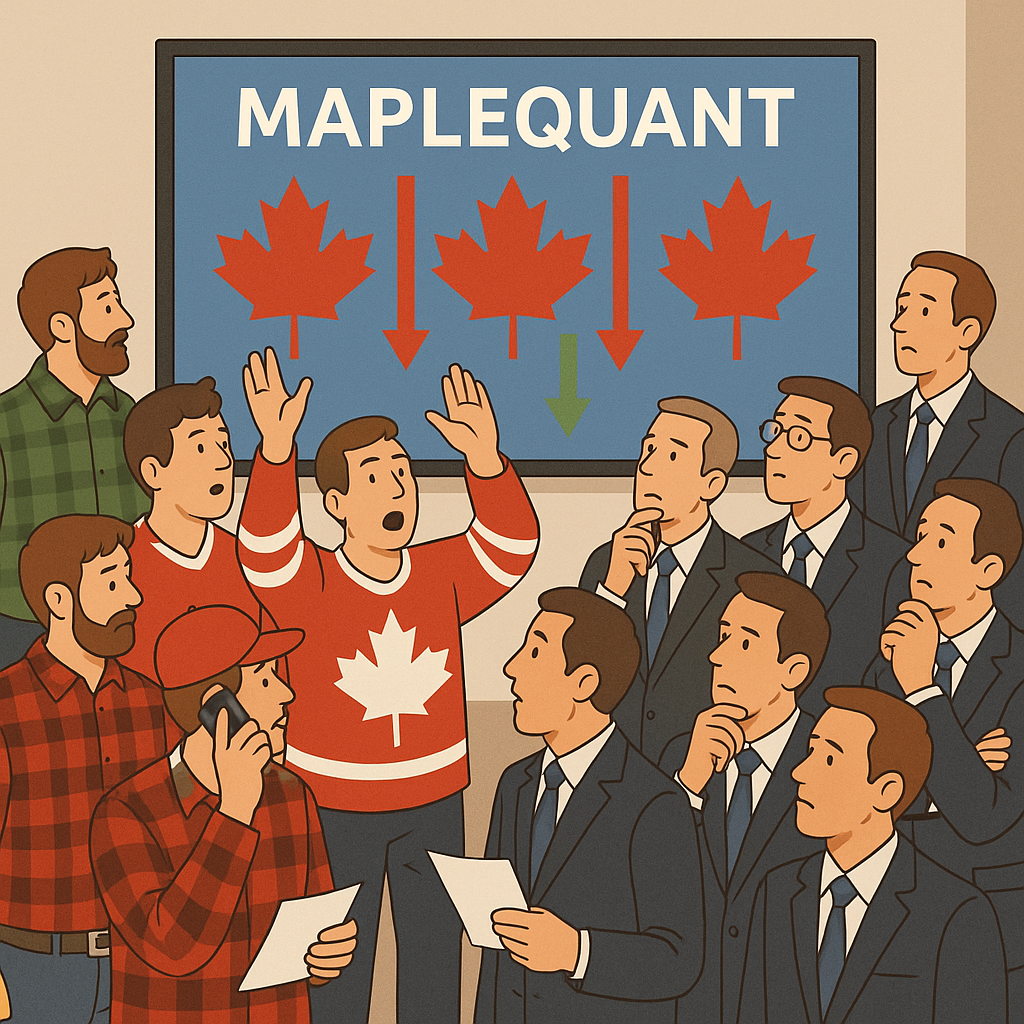
Market reaction was immediate. Algorithmic traders on both sides of the border began scraping Trump’s social feed and Carney’s press availabilities to front-run every tariff headline. Several large hedge funds reportedly deployed “MapleQuant,” a machine learning model that predicts the probability that a given Canadian export will be turned into a political prop in Michigan.
“Remember, integrated supply chains are just very long DeFi bridges,” said one Wall Street strategist. “You put an auto part into Ontario and, three border crossings later, it comes out in Ohio with seven different national identities and a 50% fee attached. It is basically Uniswap, but your car insurance goes up.”
Retail investors, coached by influencers broadcasting from basement server farms in New Jersey, rushed to open long positions in Canadian vinegar and American antacids. One viral TikTok claimed that tokenized hockey sticks would be the next Bitcoin, on the theory that there is “no way Trump remembers what the PWHL is.” The league’s Montreal Victoire, which recently reported its Walter Cup trophy missing, briefly trended as speculators wondered if it had already been staked as collateral in a cross-border derivatives play.
“We are not putting the Walter Cup on-chain,” a league spokesperson said. “Although if someone can explain yield farming in French, we are open to hearing it.”
Meanwhile, Canada’s federal cabinet convened an emergency session largely focused on the one question that now dominates every G7 meeting: how do you retaliate against an America that is perfectly comfortable charging its own citizens 50% more for cement?
Early drafts of the retaliation list, leaked to CityNews Montreal, included tariffs targeted at:
- Golf carts used at properties with more than three framed magazine covers featuring the same person
- U.S. reality TV formats repackaged as politics
- Apparel with the phrase “I did my own research” printed in varsity font
Canada ultimately opted for something more traditional: matching Trump “dollar for dollar” on real goods, while quietly pressuring provinces to restore U.S. alcohol to store shelves as a gesture of goodwill, or at least as a sedative.
Tech investors, desperate to turn the crisis into an asset class, quickly pitched both governments on a “joint sovereignty platform” that would rebrand tariffs as “smart-border micro-fees” bundled into a monthly plan. For 29.99 dollars a month, households on either side of the border would receive:
- Access to slightly more affordable cheese six days a year
- A quarterly PDF explaining why things are not technically worse, only “rebalanced”
- An NFT commemorating each time supply chains collapse
“In the 1990s, we had NAFTA,” one venture capitalist explained. “In the 2020s, we have NAFTA+, the creator economy version. You do not trade goods, you subscribe to the idea of frictionless trade, then pay extra every time anyone remembers that the Tariff Act of 1930 exists.”
Quebec’s Premier Fréchette, facing mounting pressure at home as exporters panic and unions sharpen press releases, signaled cautious openness to Ottawa’s tech-heavy support plans. “We will protect workers,” she said. “We will provide liquidity. We will also have to ask them to accept that, for a brief transitional period, their pensions will be denominated in a basket of Canadian dollars, CHAD tokens, and discounted gift cards for domestic dairy.”
On Main Street, both Americans and Canadians confronted the concrete reality of the tariff war. U.S. families stared at more expensive lumber, steel, and hockey gear. Canadian consumers eyed higher prices on imported U.S. goods once retaliation kicks in on September 8. Everyone agreed that something fundamental had shifted in the rules-based order.
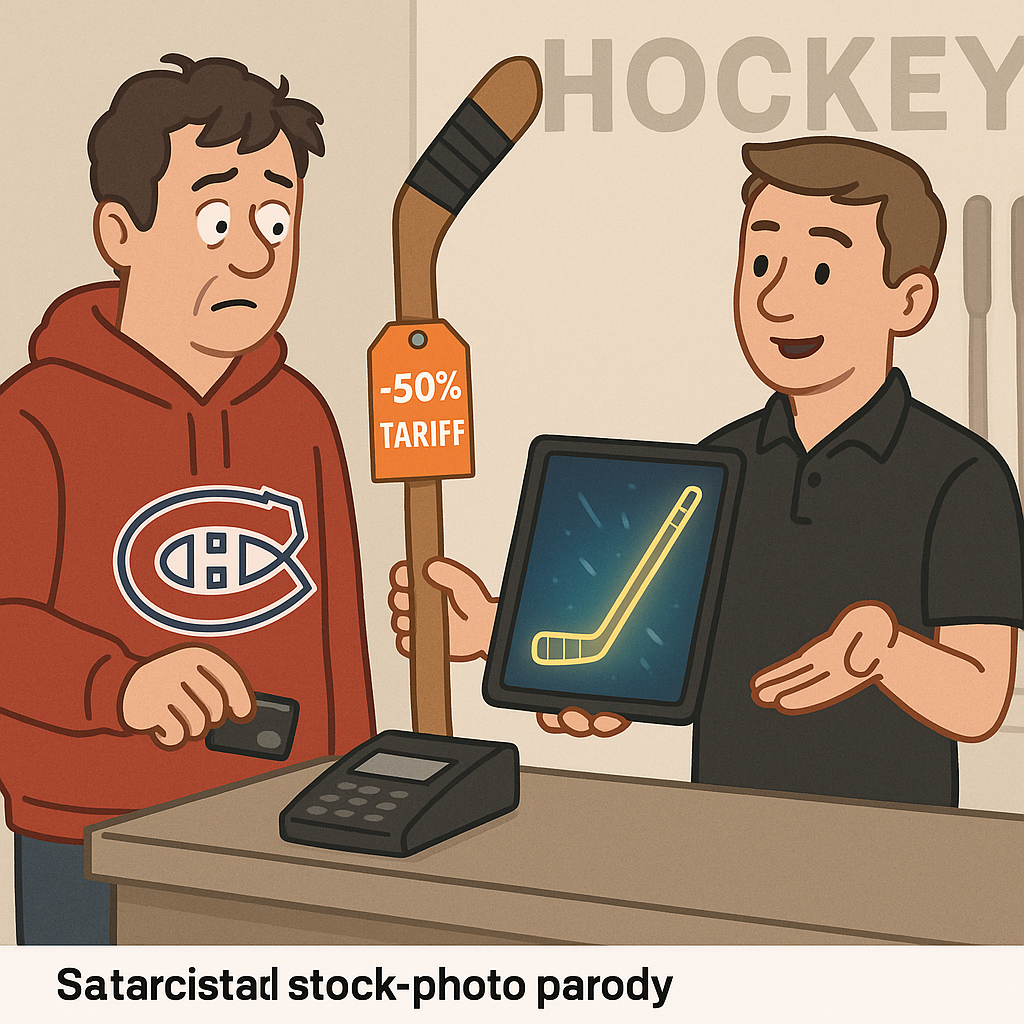
“I just wanted to buy a reasonably priced stick for my kid,” said one Montreal parent outside a pro shop. “Now the clerk is telling me the price depends on what Trump tweets this afternoon and whether Ottawa’s compensation portal is up. They suggested I could instead buy an NFT of a stick that is not subject to tariffs. Apparently it comes with a Discord.”
He paused. “I miss when trade wars were about complicated acronyms I could ignore. Now my grocery bill has a UX.”
Back in Washington, asked whether the administration worried that weaponizing a 96‑year‑old tariff law against a close ally might encourage other countries to build their own sovereign systems and route around the U.S., a senior official shrugged.
“Every country is free to choose its own destiny,” he said. “If Canada wants to live in a world where trade is automated, prices are transparent, and retaliation is predictable, that is their choice. Here in America, we still believe in doing it the old-fashioned way, one surprise tariff and one campaign rally at a time.”
On Bay Street, the consensus solidified. If the 20th century was about free trade, and the early 21st century was about global supply chains, then 2026 has a simpler theme: every obvious problem will eventually be rebundled as a premium feature.
Tariffs protect workers, inflation protects profits, and somewhere in a New Jersey basement, a crypto guru explains that, if you really want hedge, you should stop buying hockey sticks and start buying the conflict itself.