Global policymakers, having tried interest rates, press conferences, and hopeful staring, have reportedly settled on their ultimate tool to calm energy markets: sounding very confident while clearly panicking inside.
According to an analysis syndicated across Investing UK, Investing Australia, Investing Canada, and Investing Nigeria, the world’s financial adults are now "trying to cap gushing oil fears" the same way you fix a burst pipeline: with a strongly worded statement and a photo op in a hard hat (Investing UK, Mar 2026).
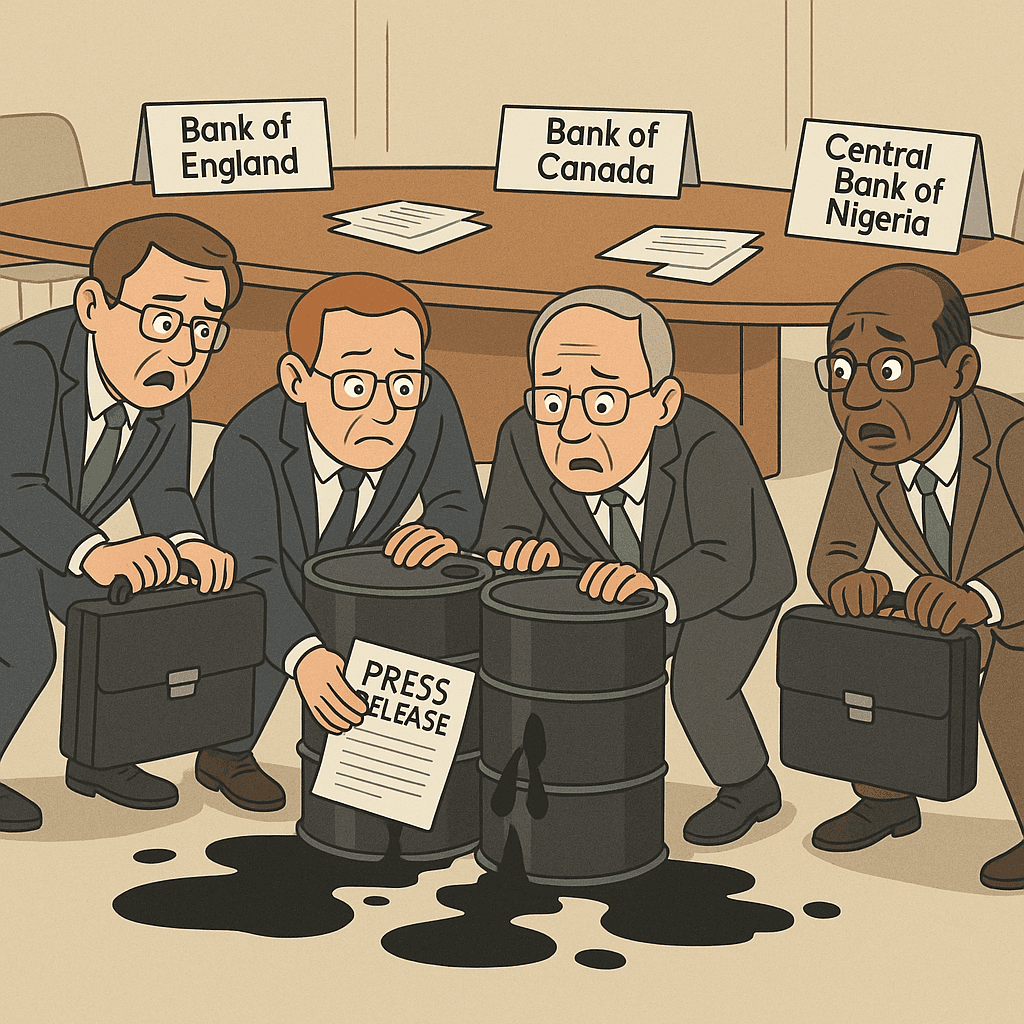
The Bank of England, the Reserve Bank of Australia, the Bank of Canada, and the Central Bank of Nigeria have formed what insiders dub the "Committee To Look Like We’re Doing Something About Oil" — an informal coalition tasked with soothing markets every time Brent crude twitches more than 2%.
"Let me be perfectly clear," Bank of England Governor Andrew Bailey told reporters at a London briefing that somehow lasted 90 minutes without any verbs. "We are monitoring the situation very closely and stand ready to deploy a range of measures, some of which will have impressive names." 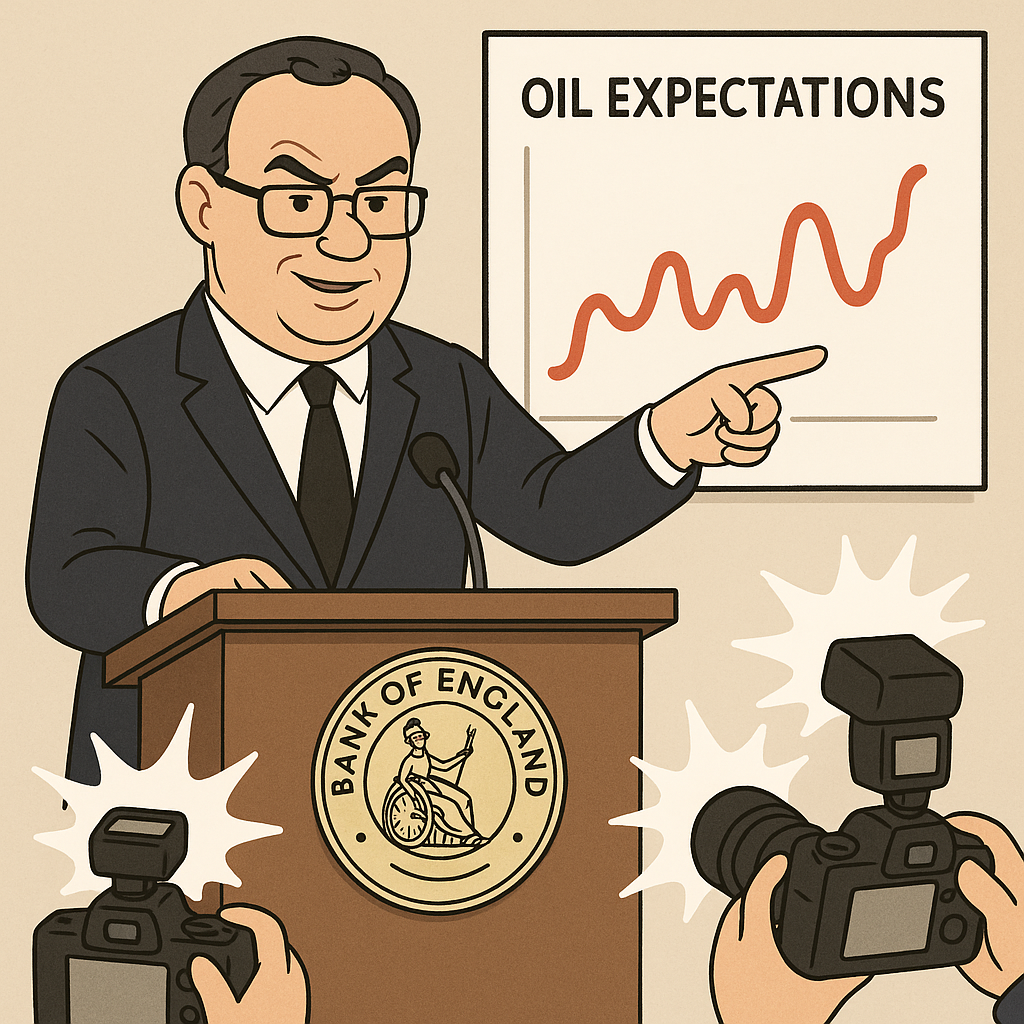
Pressed on what those measures might be, Bailey cited the Bank’s proven three-point strategy for energy shocks:
- 1. Publish a blog post.
- 2. Brief select journalists off the record so they can guess wrong in print.
- 3. Remind everyone that they are targeting core inflation, which heroically excludes the stuff people actually buy.
In Ottawa, Bank of Canada Governor Tiff Macklem echoed the sentiment. "The Canadian economy is resilient," he said, standing in front of a line graph that looked like a cardiogram on its third espresso. "We believe that higher oil prices are transitory, in the same way we believed that last time, and the time before that, and the time after we said we’d never call anything transitory again."
Macklem clarified that the Bank of Canada cannot actually pump oil, ship oil, refine oil, or lower the price of oil, but can "adjust expectations," a financial term meaning "talk to you until you forget what you asked."
Over in Sydney, Reserve Bank of Australia officials struck an even more relaxed tone, which is easy when your continent is on fire so often that expensive petrol feels like a hobby problem. "Look, mate, global energy markets are a bit how-ya-goin'," an RBA staffer said on background. "But we’ve got a detailed model that shows everything returning to normal by 2027, assuming no wars, no supply disruptions, no climate shocks, and no politicians trying to get re-elected." 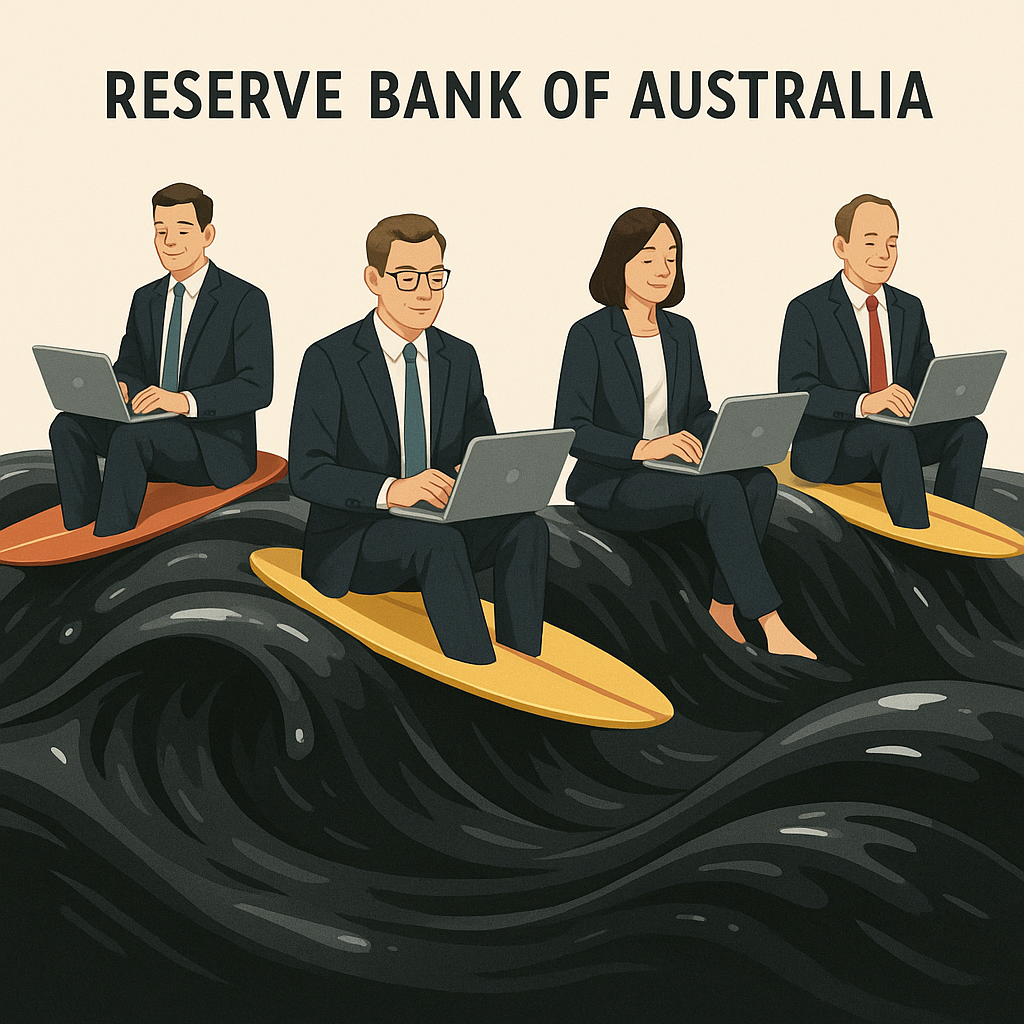
When asked if the RBA model has ever accurately predicted a major oil move, the staffer looked at the floor and replied, "It’s very good at explaining what already happened. That’s basically the same thing, but without the legal risk."
In Abuja, the Central Bank of Nigeria has taken a more creative approach. Governor Olayemi Cardoso recently unveiled a "Petroleum Sentiment Stabilisation Framework," a 47-page document whose executive summary is just the word "confidence" written in progressively larger fonts. "Nigeria is in a unique position as an oil producer and importer," Cardoso said at a press conference. "We receive all of the price volatility and none of the narrative control. So we’re focusing on the narrative. That’s the only bit you can do on TV."
The Framework’s main lever is a monthly "Energy Outlook Happy Hour" where economists, oil executives, and selected influencers sit on a panel in Lagos and explain that volatility is a sign of a healthy market, much like dramatic mood swings are a sign of a healthy relationship.
"Our mandate is price stability," one Central Bank of Nigeria official explained. "But given global conditions, we’ve narrowed that down to stable talking points."
Across the four economies, the playbook is uncannily similar. Whenever oil prices jump, officials convene emergency meetings, dispatch ministers to say "we understand people’s concerns," and then roll out a carefully balanced communications package featuring:
- A solemn TV interview in which someone in a navy suit says the phrase "challenging environment" at least five times.
- A research note concluding that if you ignore energy and food, things are basically fine; and if you also ignore housing, things are actually great.
- A hint — never a promise, always a hint — that something will be done if conditions warrant, which they never quite do until after they already did.
Markets, meanwhile, gyrate like a toddler after three juice boxes. In London, traders on the ICE Futures Europe exchange reportedly now react less to actual oil shipments and more to how nervous Andrew Bailey looks on television. One hedge fund has built a proprietary "Panic Index" that tracks the number of times he straightens his notes per minute.
"We front-run the sighs," explained the fund’s chief strategist. "If he exhales sharply before saying ‘medium term’, we assume they’re going to overreact later and position accordingly."
The political class is enthusiastically along for the ride. In Westminster, Downing Street has launched a cross-departmental taskforce on "Fuel Resilience," which will study petrol prices until the next election, at which point it will rebrand as an inquiry into "Legacy Challenges." In Canberra, the Australian government has introduced a "temporary" fuel excise tweak widely expected to last until heat death of the universe or the next budget, whichever comes first.
Canada’s federal cabinet, for its part, has reportedly considered messaging guidelines that would forbid ministers from ever admitting that oil prices are affected by anything outside Canadian borders. "Our polling suggests voters prefer to believe in domestic levers," a strategist said. "So our plan is to stand in front of gas stations and promise to ‘lean in’ and ‘coordinate’ while the Bank of Canada nods gravely in the background." 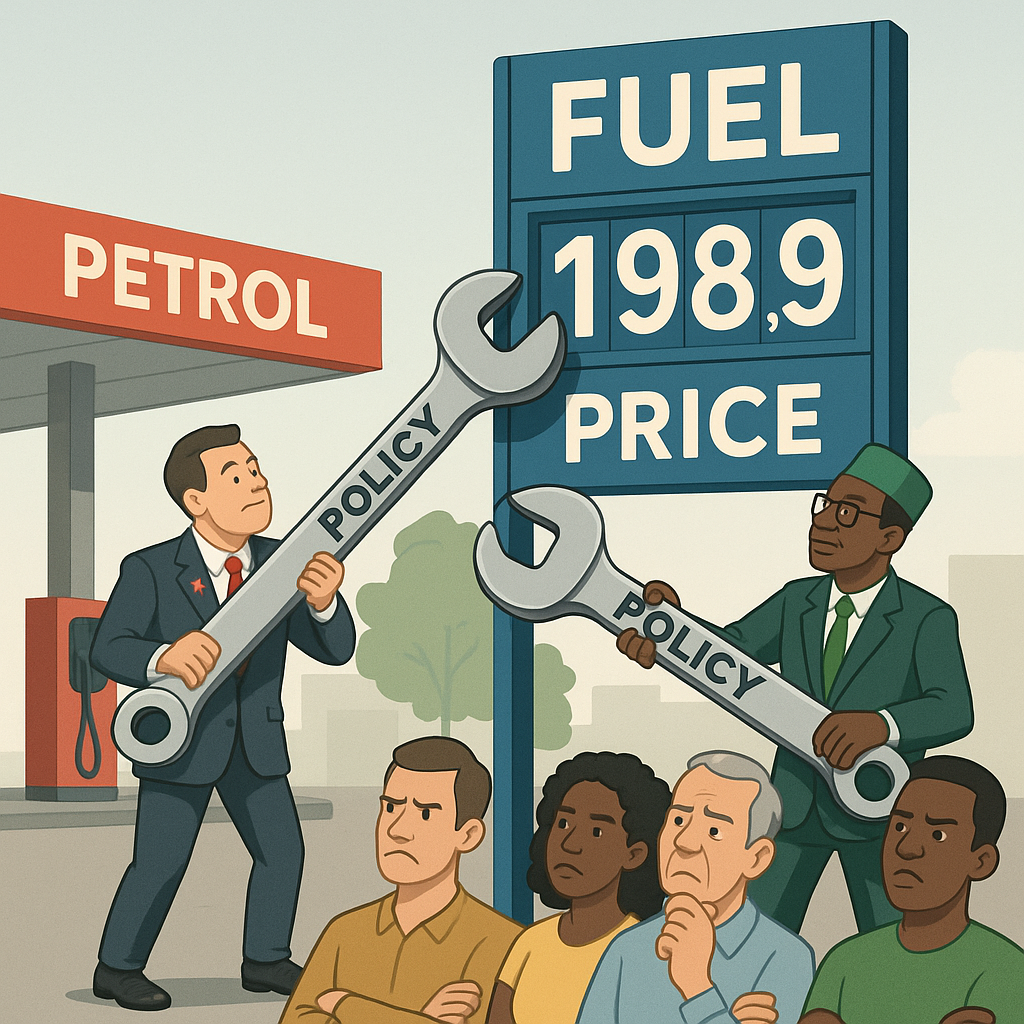
In Nigeria, where fluctuations in global oil prices can mean instant fiscal whiplash, officials have adopted what one analyst in Lagos called "the Netflix model": whenever things get ugly, they simply drop a new exchange-rate policy to distract everyone. "We can’t lower pump prices," the analyst said, "but we can definitely change the way we announce we’re not lowering them."
Despite their differences, the central banks insist their coordinated performance is working. A joint statement drafted via late-night Zoom call and translated into three varieties of technocratic English concluded that "decisive communication has helped anchor expectations around the plausible range of future energy-price scenarios." In regular human language, this means: "Nobody knows what’s happening, but we sounded like we might."
Critics, however, argue that this constant effort to "cap gushing oil fears" amounts to little more than mood management for a structurally broken system. "We’ve built a global economy where a war, a storm, or an awkward OPEC+ brunch can spike everyone’s rent," said one economist at a London think tank. "It’s like constructing your house out of matchsticks and then asking the fire brigade to do more podcasts."
Back at the Bank of England, Bailey was asked whether there was any scenario in which central bankers would simply admit they couldn’t meaningfully control energy prices at all. He paused, adjusted his tie, and smiled in the carefully calibrated manner taught in advanced communications training.
"Our mandate," he replied, "is to maintain confidence in the system."
He did not specify whose.